Value Added Tax (VAT) By Vijay Poojari - KH08JUNMBA110 Manoj Singh - KH08JUNMBA078 Neelesh Nanda – KH08JUNMBA081 Sridhar Dornala - KH08JUNMBA112 Project On ITM – Kharghar / Economics – Dr. Gulnar Sharma
Topics to be discussed Introduction to VAT Characteristics of VAT History of VAT VAT Terminology How does VAT work Problems of implementation of VAT in  IN D IA VAT Returns Sales Tax v/s. VAT
Introduction to Vat Meaning   Value Added Tax is a multi point sales tax with set off for tax paid on purchases. It is basically a tax on the value addition on the product. The burden of tax is ultimately borne by the consumer of goods. In many aspects it is equivalent to last point sales tax. It can also be called as a multi point sales tax levied as a proportion of Valued Added. It is a general tax that applies, in principle, to all commercial activities involving the production and distribution of goods and the provision of services.  It is not a charge on companies. It is charged as a percentage of price.
Characteristics of VAT The difference between retail sales tax and VAT is that while retail sales tax is collected at one stage, VAT is collected in installments at successive stages of production and distribution. It is a multi - state  tax rather than a single stage one like the retail sales tax, and in its deal form, is to be levied on all the states of production & distribution.  It is principle, comprehensive unlike selective excises. It is collected in bits at each stage of production and distribution which, when added, equal a tax on the retail sale of the final product at the same rate as the VAT. It falls on each input entering into the final products once and only once.
History of VAT The very system of Value Added Taxes or VAT was introduced for the first time in the market by the  modern French economist in 1954. Maurice Lauré  who was the joint director of the French tax authority and the director general of the department of import, was the first person to introduce VAT or the value Added Tax with effect from 10th of April in the year 1954 in the cases of large businesses, and which are extended over time to all business sectors. In France, VAT became so important that it has became one of the most important sources of the state finance and it is accounting for almost  45% of state revenues. Like all the other direct taxes in the market, the VAT is quite different. This is actually an indirect tax because in this sort of tax it is collected from someone other than the individual who actually bears the cost of the tax who is known as the seller rather than the consumer. The implementers of this tax also have taken certain initiatives which help them in avoiding double taxation on final consumption.
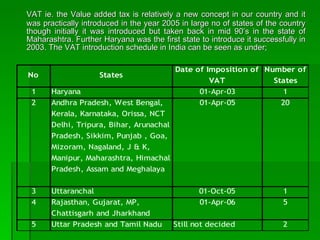
VAT ie. the Value added tax is relatively a new concept in our country and it was practically introduced in the year 2005 in large no of states of the country though initially it was introduced but taken back in mid 90’s in the state of Maharashtra. Further Haryana was the first state to introduce it successfully in 2003. The VAT introduction schedule in India can be seen as under;
VAT Terminology Output VAT : Amount received by a seller as a percentage  of the gross sale price of goods or services Input VAT  : Amount paid by a buyer as a percentage of the  gross purchase price for goods or services  used in production. Zero Rated  : Transactions in which the seller collects no  output tax and the corresponding input tax is  fully refundable. Exports are zero rated Exempt  : Transactions in which the seller collects no  output tax but the corresponding input tax is  non-refundable and absorbed by the seller.  Financial services are commonly exempt.
How VAT (Value Added Tax) Works   A trader registered for VAT effectively pays VAT only at one stage when he sells his goods. This tax is the only amount, which has an effect on his selling price which includes VAT.  The VAT that he has paid as a part of his purchase price is charged on him by his suppliers. This is not a cost to him because he gets it back by deducting it from tax on his sales (Output Tax). Therefore, VAT should have a minimum impact on his selling prices. 
Let’s take an example Manufacturer The Manufacturing company Perfect Shoemaker Pvt. Ltd has purchased raw material worth Rs. 50,000/- after paying state tax of Rs. 2,000/- @ 4%. The Labour contents are Rs. 40,000/- and the margin towards administrative and selling expenses and profit are Rs.10000 hence the total sale price 100000/- .Suppose the tax is rate 12.5% he will charge Rs 12500 as tax from the Wholesaler. Since he has already paid Rs 2000/- on the raw materials hence his net tax liability Rs 10500/- after getting a credit of Rs 2000/- tax paid by him on raw Material. This is VAT for manufacturer
Wholesaler The wholesaler ‘tough shoe seller’ has purchased goods worth Rs 1,00,000/-  after paying tax of Rs. 12,500/- as mentioned above. Let us assume his margin for profit and expenses is Rs. 7,000/- then he will the goods for Rs. 1,07,000/- to the retailer and also charge tax of Rs. 13,375/- from the retailer.  Since he has already paid the tax of Rs. 12,500/- on his purchases hence his net tax liability will be Rs. 13,375/- (-) 12,500/- = Rs. 875/- We can Verify it as 12.5% of 7000 Since the value added by the Wholesaler is 7000.
Retailer The retailer “M/s. Bright shoe point” has purchased  goods for Rs. 1,07,000/- after paying tax of Rs. 13,375/-. Suppose his margin for profit and expenses is Rs. 10,000/- thus he will sell the goods to the customer at Rs. 1,17,000/- and will charge tax of Rs. 14,625/-. His net tax liability will be Rs. 14,625/- (-) Rs. 13,375 = Rs. 1,250/- we can verify it as 12.5% of 10,000/- since the value added by the retailer is Rs. 10,000/-
In this study it is found that there are number of problems to introduce value added tax on commodities in different states in India, but in this paper only major problems have been taken which are facing by different states for imposing of VAT, as follows  Problems in Implementation of Value Added Tax in India
Billing Lack of uniformity   Concession for New Industry   Number of Taxes impose by the Government   Lack of infrastructure facilities   Dealing in Variety of Goods
VAT Returns   VAT Returns are filed every month or every quarter depending on the amount of VAT you pay. The normal rule is that if you pay less than Rs 15,000 for VAT every month, a VAT Return is to be filed every quarter. It is all at the discretion of the VAT officer. At monthly or quarterly intervals on your VAT Return, you should subtract your Input Tax (attributable to taxable supplies only) from your Output Tax and pay the difference to the VAT Commissioner.  If your Input Tax is greater than your Output Tax you can carry over the difference as a credit to your next VAT Return. In certain circumstances, the Commissioner may pay you any excess if he is satisfied that such an excess is a regular feature of your business
According to VAT law, you cannot sell any goods without a sales document. This document can be a small cash memo or a cash sale or a bill for cash transactions issued at, or before, the time when the cash is received. The prices mentioned on these sale documents should include VAT and the words 'Price includes VAT' must be printed on them. These documents are suitable for retailers such as grocers and chemists. You must give the original to the customer and keep a duplicate. At the end of each business day, you can total the cash sales and enter it in your Sales Ledger.  For selling on credit, you are required to provide the purchaser with a tax invoice at the time of supply in respect of that supply. When you receive a deposit as advance payment for a booking, a tax invoice should be issued at the time such deposit is received. All tax invoices should be serially numbered and issued in serial number order. They must include the following information:  Issuing Tax Bills and Invoices
MERITS OF VAT It ensures that input is taxed only once. It combines the advantage of being of general tax, without  the disadvantages of extended input taxation. It is free of other economic demerits of cascade type  turnover or sales tax. It does not change the relative prices of inputs and give  wrong signals to producers regarding factor combinations. It does not raise costs through input taxation. In developing countries, a mild bias could be built into the  system against capital intensive methods. Economy in the use of scarce inputs could be promoted  through an additional non – refundable duty.
DEMERITS OF VAT VAT  was to be applied in all states but it failed to do so. Inflation rate has been increased due to VAT. VAT has complicated both tariff in customs and excise and  Overburdend with more exemptions VAT is regressive :-   It’s burden falls disproportionately on    Poor people since the poor are likely to    spend more of their incomes  VAT is too difficult to operate from the position of both the Administration and business Monthly Return : The   manufacturer is required to pay    CenVAT on a fortnightly basis and submit a monthly return    (ER1) to the Superintendent of Central Excise by the 10th of    the month
VAT  RATES AND CLASSIFICATION OF COMMODITIES For different commodities VAT rates are calculated as 1%,  4%, 12.5% and a  specific category is exempted from VAT GOODS   EXEMPTED  FROM  VAT Agricultural implements manually operated or animal driven as  notified by the state government. Aquatic feed, Cattle feed, Poultry feed, Animal feed supplements. Books including almanacs, panchangs, timetables for passenger  transport services.  Cereals & Pulses (during period from 01/04/05 to 31/03/06) in whole grain  Chalk stick, Charcoal & Badami Charcoal, Charkha implements used in production of handspun yarn. Firewood, Fishnet fabrics, Contraceptives of all types.
Sales Tax V/s VAT
Thank You

Value Added Tax (India) Final

  • 1.
    Value Added Tax(VAT) By Vijay Poojari - KH08JUNMBA110 Manoj Singh - KH08JUNMBA078 Neelesh Nanda – KH08JUNMBA081 Sridhar Dornala - KH08JUNMBA112 Project On ITM – Kharghar / Economics – Dr. Gulnar Sharma
  • 2.
    Topics to bediscussed Introduction to VAT Characteristics of VAT History of VAT VAT Terminology How does VAT work Problems of implementation of VAT in IN D IA VAT Returns Sales Tax v/s. VAT
  • 3.
    Introduction to VatMeaning Value Added Tax is a multi point sales tax with set off for tax paid on purchases. It is basically a tax on the value addition on the product. The burden of tax is ultimately borne by the consumer of goods. In many aspects it is equivalent to last point sales tax. It can also be called as a multi point sales tax levied as a proportion of Valued Added. It is a general tax that applies, in principle, to all commercial activities involving the production and distribution of goods and the provision of services. It is not a charge on companies. It is charged as a percentage of price.
  • 4.
    Characteristics of VATThe difference between retail sales tax and VAT is that while retail sales tax is collected at one stage, VAT is collected in installments at successive stages of production and distribution. It is a multi - state tax rather than a single stage one like the retail sales tax, and in its deal form, is to be levied on all the states of production & distribution. It is principle, comprehensive unlike selective excises. It is collected in bits at each stage of production and distribution which, when added, equal a tax on the retail sale of the final product at the same rate as the VAT. It falls on each input entering into the final products once and only once.
  • 5.
    History of VATThe very system of Value Added Taxes or VAT was introduced for the first time in the market by the modern French economist in 1954. Maurice Lauré who was the joint director of the French tax authority and the director general of the department of import, was the first person to introduce VAT or the value Added Tax with effect from 10th of April in the year 1954 in the cases of large businesses, and which are extended over time to all business sectors. In France, VAT became so important that it has became one of the most important sources of the state finance and it is accounting for almost 45% of state revenues. Like all the other direct taxes in the market, the VAT is quite different. This is actually an indirect tax because in this sort of tax it is collected from someone other than the individual who actually bears the cost of the tax who is known as the seller rather than the consumer. The implementers of this tax also have taken certain initiatives which help them in avoiding double taxation on final consumption.
  • 6.
    VAT ie. theValue added tax is relatively a new concept in our country and it was practically introduced in the year 2005 in large no of states of the country though initially it was introduced but taken back in mid 90’s in the state of Maharashtra. Further Haryana was the first state to introduce it successfully in 2003. The VAT introduction schedule in India can be seen as under;
  • 7.
    VAT Terminology OutputVAT : Amount received by a seller as a percentage of the gross sale price of goods or services Input VAT : Amount paid by a buyer as a percentage of the gross purchase price for goods or services used in production. Zero Rated : Transactions in which the seller collects no output tax and the corresponding input tax is fully refundable. Exports are zero rated Exempt : Transactions in which the seller collects no output tax but the corresponding input tax is non-refundable and absorbed by the seller. Financial services are commonly exempt.
  • 8.
    How VAT (ValueAdded Tax) Works A trader registered for VAT effectively pays VAT only at one stage when he sells his goods. This tax is the only amount, which has an effect on his selling price which includes VAT. The VAT that he has paid as a part of his purchase price is charged on him by his suppliers. This is not a cost to him because he gets it back by deducting it from tax on his sales (Output Tax). Therefore, VAT should have a minimum impact on his selling prices. 
  • 9.
    Let’s take anexample Manufacturer The Manufacturing company Perfect Shoemaker Pvt. Ltd has purchased raw material worth Rs. 50,000/- after paying state tax of Rs. 2,000/- @ 4%. The Labour contents are Rs. 40,000/- and the margin towards administrative and selling expenses and profit are Rs.10000 hence the total sale price 100000/- .Suppose the tax is rate 12.5% he will charge Rs 12500 as tax from the Wholesaler. Since he has already paid Rs 2000/- on the raw materials hence his net tax liability Rs 10500/- after getting a credit of Rs 2000/- tax paid by him on raw Material. This is VAT for manufacturer
  • 10.
    Wholesaler The wholesaler‘tough shoe seller’ has purchased goods worth Rs 1,00,000/- after paying tax of Rs. 12,500/- as mentioned above. Let us assume his margin for profit and expenses is Rs. 7,000/- then he will the goods for Rs. 1,07,000/- to the retailer and also charge tax of Rs. 13,375/- from the retailer. Since he has already paid the tax of Rs. 12,500/- on his purchases hence his net tax liability will be Rs. 13,375/- (-) 12,500/- = Rs. 875/- We can Verify it as 12.5% of 7000 Since the value added by the Wholesaler is 7000.
  • 11.
    Retailer The retailer“M/s. Bright shoe point” has purchased goods for Rs. 1,07,000/- after paying tax of Rs. 13,375/-. Suppose his margin for profit and expenses is Rs. 10,000/- thus he will sell the goods to the customer at Rs. 1,17,000/- and will charge tax of Rs. 14,625/-. His net tax liability will be Rs. 14,625/- (-) Rs. 13,375 = Rs. 1,250/- we can verify it as 12.5% of 10,000/- since the value added by the retailer is Rs. 10,000/-
  • 12.
    In this studyit is found that there are number of problems to introduce value added tax on commodities in different states in India, but in this paper only major problems have been taken which are facing by different states for imposing of VAT, as follows Problems in Implementation of Value Added Tax in India
  • 13.
    Billing Lack ofuniformity Concession for New Industry Number of Taxes impose by the Government Lack of infrastructure facilities Dealing in Variety of Goods
  • 14.
    VAT Returns  VAT Returns are filed every month or every quarter depending on the amount of VAT you pay. The normal rule is that if you pay less than Rs 15,000 for VAT every month, a VAT Return is to be filed every quarter. It is all at the discretion of the VAT officer. At monthly or quarterly intervals on your VAT Return, you should subtract your Input Tax (attributable to taxable supplies only) from your Output Tax and pay the difference to the VAT Commissioner.  If your Input Tax is greater than your Output Tax you can carry over the difference as a credit to your next VAT Return. In certain circumstances, the Commissioner may pay you any excess if he is satisfied that such an excess is a regular feature of your business
  • 15.
    According to VATlaw, you cannot sell any goods without a sales document. This document can be a small cash memo or a cash sale or a bill for cash transactions issued at, or before, the time when the cash is received. The prices mentioned on these sale documents should include VAT and the words 'Price includes VAT' must be printed on them. These documents are suitable for retailers such as grocers and chemists. You must give the original to the customer and keep a duplicate. At the end of each business day, you can total the cash sales and enter it in your Sales Ledger.  For selling on credit, you are required to provide the purchaser with a tax invoice at the time of supply in respect of that supply. When you receive a deposit as advance payment for a booking, a tax invoice should be issued at the time such deposit is received. All tax invoices should be serially numbered and issued in serial number order. They must include the following information: Issuing Tax Bills and Invoices
  • 16.
    MERITS OF VATIt ensures that input is taxed only once. It combines the advantage of being of general tax, without the disadvantages of extended input taxation. It is free of other economic demerits of cascade type turnover or sales tax. It does not change the relative prices of inputs and give wrong signals to producers regarding factor combinations. It does not raise costs through input taxation. In developing countries, a mild bias could be built into the system against capital intensive methods. Economy in the use of scarce inputs could be promoted through an additional non – refundable duty.
  • 17.
    DEMERITS OF VATVAT was to be applied in all states but it failed to do so. Inflation rate has been increased due to VAT. VAT has complicated both tariff in customs and excise and Overburdend with more exemptions VAT is regressive :- It’s burden falls disproportionately on Poor people since the poor are likely to spend more of their incomes VAT is too difficult to operate from the position of both the Administration and business Monthly Return : The manufacturer is required to pay CenVAT on a fortnightly basis and submit a monthly return (ER1) to the Superintendent of Central Excise by the 10th of the month
  • 18.
    VAT RATESAND CLASSIFICATION OF COMMODITIES For different commodities VAT rates are calculated as 1%, 4%, 12.5% and a specific category is exempted from VAT GOODS EXEMPTED FROM VAT Agricultural implements manually operated or animal driven as notified by the state government. Aquatic feed, Cattle feed, Poultry feed, Animal feed supplements. Books including almanacs, panchangs, timetables for passenger transport services. Cereals & Pulses (during period from 01/04/05 to 31/03/06) in whole grain Chalk stick, Charcoal & Badami Charcoal, Charkha implements used in production of handspun yarn. Firewood, Fishnet fabrics, Contraceptives of all types.
  • 19.
  • 20.