MOTIVALUATE
PRESENTS
VAT WORKSHOP
DUBAI, U.A.E
MARCH 2017
Agenda
8.30 a.m. to 10.00 a.m. Session1: Introduction & Basic Concepts of VAT and how it works
10 a.m. to 10.15 a.m. Coffee/Tea Break
10.15 a.m. to 11.45 p.m. Session 2: How VAT is applied on Goods and Services – Case Studies / Examples
11.45 a.m. to 12.45 p.m. Prayer and Lunch Break
12.45 p.m. to 2.15 p.m. Session 3: Commercial Implications of VAT and how to get prepared
2.15 p.m. to 2.30 p.m. Coffee/Tea Break
2.30 p.m. to 4.00 p.m. Session 4: VAT related challenges - Lessons to be learnt from other countries
4.00 p.m. to 4.15 p.m. Feedback and Summary session
2
Session 1:
Introduction
3
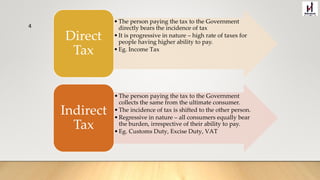
•The person paying the tax to the Government
directly bears the incidence of tax
•It is progressive in nature – high rate of taxes for
people having higher ability to pay.
•Eg. Income Tax
Direct
Tax
•The person paying the tax to the Government
collects the same from the ultimate consumer.
•The incidence of tax is shifted to the other person.
•Regressive in nature – all consumers equally bear
the burden, irrespective of their ability to pay.
•Eg. Customs Duty, Excise Duty, VAT
Indirect
Tax
4
Basic Concepts of
VAT
&
How it works!?
5
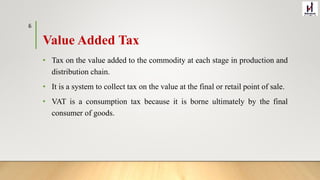
Value Added Tax
• Tax on the value added to the commodity at each stage in production and
distribution chain.
• It is a system to collect tax on the value at the final or retail point of sale.
• VAT is a consumption tax because it is borne ultimately by the final
consumer of goods.
6
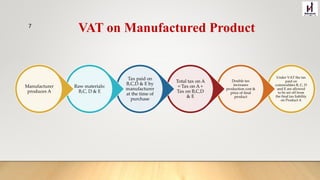
Under VAT the tax
paid on
commodities B, C, D
and E are allowed
to be set off from
the final tax liability
on Product A
Double tax
increases
production cost &
price of final
product
Total tax on A
= Tax on A +
Tax on B,C,D
& E
Tax paid on
B,C,D & E by
manufacturer
at the time of
purchase
Raw materials:
B,C, D & E
Manufacturer
produces A
VAT on Manufactured Product7
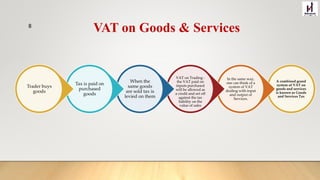
VAT on Goods & Services
A combined grand
system of VAT on
goods and services
is known as Goods
and Services Tax
In the same way,
one can think of a
system of VAT
dealing with input
and output of
Services.
VAT on Trading -
the VAT paid on
inputs purchased
will be allowed as
a credit and set off
against the tax
liability on the
value of sales
When the
same goods
are sold tax is
levied on them
Tax is paid on
purchased
goods
Trader buys
goods
8
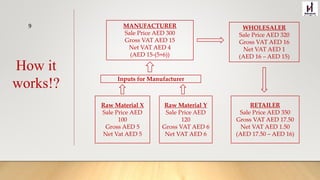
MANUFACTURER
Sale Price AED 300
Gross VAT AED 15
Net VAT AED 4
(AED 15-(5+6))
WHOLESALER
Sale Price AED 320
Gross VAT AED 16
Net VAT AED 1
(AED 16 – AED 15)
Raw Material X
Sale Price AED
100
Gross AED 5
Net Vat AED 5
Raw Material Y
Sale Price AED
120
Gross VAT AED 6
Net VAT AED 6
RETAILER
Sale Price AED 350
Gross VAT AED 17.50
Net VAT AED 1.50
(AED 17.50 – AED 16)
Inputs for Manufacturer
How it
works!?
9
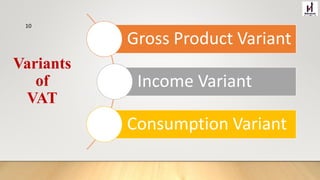
Variants
of
VAT
Gross Product Variant
Income Variant
Consumption Variant
10
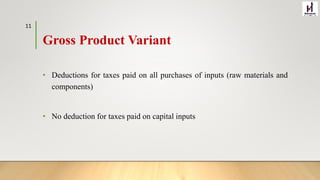
Gross Product Variant
• Deductions for taxes paid on all purchases of inputs (raw materials and
components)
• No deduction for taxes paid on capital inputs
11
Income Variant
• Deductions on purchases of inputs (raw materials and components)
• Depreciation on capital goods (as specified)
• This method provides incentives to classify purchases as revenue expenditure to claim
set-off
12
Consumption Variant
• Deduction for all business purchases including capital assets.
• Gross investment is deductible in calculating the value added.
• Neither distinguishes between capital and revenue expenditures, nor
specifies the life of assets or depreciation allowance for different assets.
13
Variant of VAT - Summary
• Gross Product Variant: allows deductions for taxes paid on all purchases of raw materials and components, but no
deduction is allowed for taxes paid on capital inputs
• Income Variant: allows for deductions on purchases of raw materials and components as well as depreciation on
capital goods. This method provides incentives to classify purchases as revenue expenditure to claim set-off
• Consumption Variant: allows deduction for all business purchases including capital assets. Thus gross investment is
deductible in calculating the value added. It neither distinguishes between capital and revenue expenditures nor
specifies the life of assets or depreciation allowance for different assets.
• Note: The Consumption Variant is the most widely used variant of the VAT. Most of the European countries and other
continents have adopted this variant. It does not affect decisions regarding investment because the tax on capital goods
is also available for set-off against the VAT liability. The system is tax neutral and obliviates the need to distinguish
between purchase of inputs and capital goods
14
Methods of
Computing Tax
Addition method
Invoice method
Cost subtraction method
15
Addition method of computing VAT
• This method aggregates all the factor payments (excluding value of
material) including profits to arrive at the total value addition on which
the tax rate is applied to calculate the tax.
• This calculation is used with income variant.
• The drawback in this method is it does not facilitate matching of invoices
for detecting evasion as tax liability is calculated period-wise and not
invoice-wise.
16
Invoice method of computing VAT
• Most common and popular method.
• Tax is imposed at every stage of sales on the entire sales value and tax
paid at the earlier stage is allowed as set-off.
• At every stage the differential tax is paid.
• At every stage, the tax is to be charged separately in the Invoice.
• This method is also called the Tax Credit Method or Voucher Method.
• This method is widely used in Europe and in India this method is
followed under the State Level VAT and the Central Excise Law.
17
Cost Subtraction method of computing VAT
• Tax is charged only on the value added at each stage of sale of goods.
• Since the total value of goods sold is not taken into account, the question
of grant of claim for set-off or tax credit does not arise.
• This method is applied where the tax is not charged separately.
• Direct Subtraction method - deducting the aggregate value of purchase
exclusive of tax from the aggregate value of sales exclusive of tax.
• Intermediate Subtraction method – deducting the tax inclusive value of
purchases from the sales and taxing difference between them.
18
Input
Tax
• It is a tax paid or payable in the course of business on the
purchases of any goods or services from a registered dealer
Output
Tax
• It is a tax charged or chargeable under the VAT Act by a
registered dealer for the sale of goods or services in the course
of business.
Input Tax & Output Tax
19
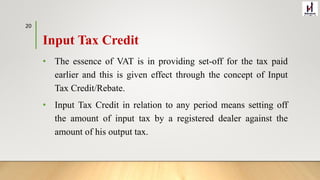
Input Tax Credit
• The essence of VAT is in providing set-off for the tax paid
earlier and this is given effect through the concept of Input
Tax Credit/Rebate.
• Input Tax Credit in relation to any period means setting off
the amount of input tax by a registered dealer against the
amount of his output tax.
20
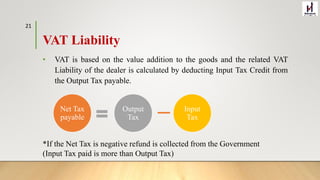
VAT Liability
• VAT is based on the value addition to the goods and the related VAT
Liability of the dealer is calculated by deducting Input Tax Credit from
the Output Tax payable.
Net Tax
payable
Output
Tax
Input
Tax
*If the Net Tax is negative refund is collected from the Government
(Input Tax paid is more than Output Tax)
21
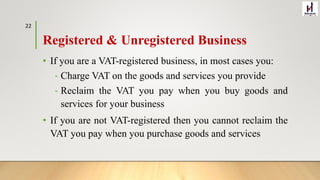
Registered & Unregistered Business
• If you are a VAT-registered business, in most cases you:
‐ Charge VAT on the goods and services you provide
‐ Reclaim the VAT you pay when you buy goods and
services for your business
• If you are not VAT-registered then you cannot reclaim the
VAT you pay when you purchase goods and services
22
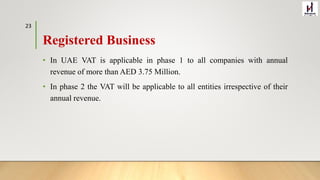
Registered Business
• In UAE VAT is applicable in phase 1 to all companies with annual
revenue of more than AED 3.75 Million.
• In phase 2 the VAT will be applicable to all entities irrespective of their
annual revenue.
23
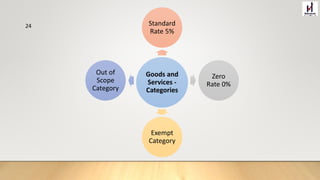
Goods and
Services -
Categories
Standard
Rate 5%
Zero
Rate 0%
Exempt
Category
Out of
Scope
Category
24
Supplies under
different
categories
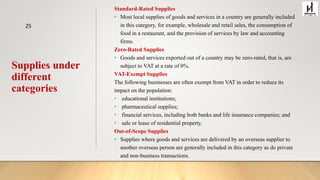
Standard-Rated Supplies
• Most local supplies of goods and services in a country are generally included
in this category, for example, wholesale and retail sales, the consumption of
food in a restaurant, and the provision of services by law and accounting
firms.
Zero-Rated Supplies
• Goods and services exported out of a country may be zero-rated, that is, are
subject to VAT at a rate of 0%.
VAT-Exempt Supplies
The following businesses are often exempt from VAT in order to reduce its
impact on the population:
• educational institutions;
• pharmaceutical supplies;
• financial services, including both banks and life insurance companies; and
• sale or lease of residential property.
Out-of-Scope Supplies
• Supplies where goods and services are delivered by an overseas supplier to
another overseas person are generally included in this category as do private
and non-business transactions.
25
Exempted Category
The UAE government has already announced that
• 100 food items
• Health
• Education
• Bicycles and
• Social services
would be exempted from VAT.
26
Exempted Category
• Exempt supply means that you will not charge VAT to your customer.
• Any VAT incurred on those purchases will not be claimable.
• Wholly exempt businesses will not be entitled to register for VAT nor claim any VAT incurred on
their purchases.
• Partially exempt businesses (i.e. mixed business) will be able to register for VAT and claim those
expenses to the extent that it is incurred for the making of taxable supplies. This will mean that
VAT incurred on common costs and general overheads (such as marketing and promotional
expenses, utilities, professional fees, purchases of office furniture) will not be fully claimable and
must be apportioned.
27
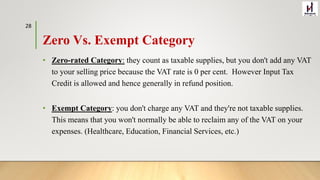
Zero Vs. Exempt Category
• Zero-rated Category: they count as taxable supplies, but you don't add any VAT
to your selling price because the VAT rate is 0 per cent. However Input Tax
Credit is allowed and hence generally in refund position.
• Exempt Category: you don't charge any VAT and they're not taxable supplies.
This means that you won't normally be able to reclaim any of the VAT on your
expenses. (Healthcare, Education, Financial Services, etc.)
28
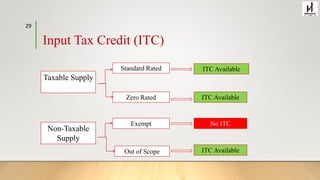
Input Tax Credit (ITC)
Taxable Supply
Non-Taxable
Supply
Standard Rated
ITC Available
No ITC
ITC Available
ITC Available
Exempt
Out of Scope
Zero Rated
29
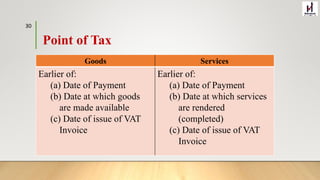
Point of Tax
Goods Services
Earlier of:
(a) Date of Payment
(b) Date at which goods
are made available
(c) Date of issue of VAT
Invoice
Earlier of:
(a) Date of Payment
(b) Date at which services
are rendered
(completed)
(c) Date of issue of VAT
Invoice
30
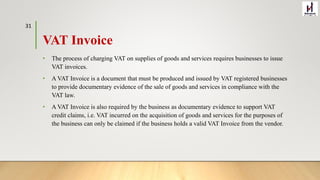
VAT Invoice
• The process of charging VAT on supplies of goods and services requires businesses to issue
VAT invoices.
• A VAT Invoice is a document that must be produced and issued by VAT registered businesses
to provide documentary evidence of the sale of goods and services in compliance with the
VAT law.
• A VAT Invoice is also required by the business as documentary evidence to support VAT
credit claims, i.e. VAT incurred on the acquisition of goods and services for the purposes of
the business can only be claimed if the business holds a valid VAT Invoice from the vendor.
31
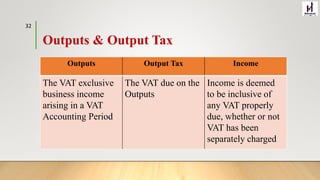
Outputs & Output Tax
Outputs Output Tax Income
The VAT exclusive
business income
arising in a VAT
Accounting Period
The VAT due on the
Outputs
Income is deemed
to be inclusive of
any VAT properly
due, whether or not
VAT has been
separately charged
32
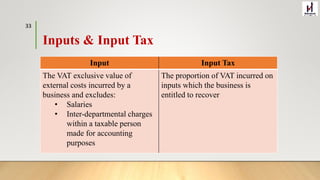
Inputs & Input Tax
Input Input Tax
The VAT exclusive value of
external costs incurred by a
business and excludes:
• Salaries
• Inter-departmental charges
within a taxable person
made for accounting
purposes
The proportion of VAT incurred on
inputs which the business is
entitled to recover
33
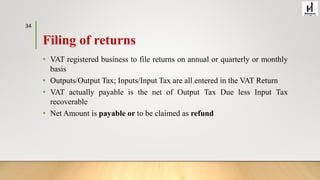
Filing of returns
• VAT registered business to file returns on annual or quarterly or monthly
basis
• Outputs/Output Tax; Inputs/Input Tax are all entered in the VAT Return
• VAT actually payable is the net of Output Tax Due less Input Tax
recoverable
• Net Amount is payable or to be claimed as refund
34
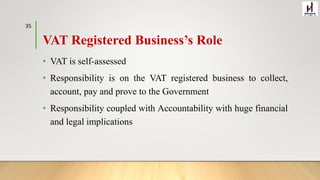
VAT Registered Business’s Role
• VAT is self-assessed
• Responsibility is on the VAT registered business to collect,
account, pay and prove to the Government
• Responsibility coupled with Accountability with huge financial
and legal implications
35
Agenda
8.30 a.m. to 10.00 a.m. Session1: Introduction & Basic Concepts of VAT and how it works
10 a.m. to 10.15 a.m. Coffee/Tea Break
10.15 a.m. to 11.45 a.m. Session 2: How VAT is applied on Goods and Services – Case Studies / Examples
11.45 a.m. to 12.45 p.m. Prayer and Lunch Break
12.45 p.m. to 2.15 p.m. Session 3: Commercial Implications of VAT and how to get prepared
2.15 p.m. to 2.30 p.m. Coffee/Tea Break
2.30 p.m. to 4.00 p.m. Session 4: VAT related challenges - Lessons to be learnt from other countries
4.00 p.m. to 4.15 p.m. Feedback and Summary session
36
Session2:
How VAT is applied on
Goods & Services –
Case Studies / Examples
37
Case Study No.1
• ABC LLC, a manufacturer of Aluminium Frames, sells its products to
distributor for AED1,000. The Distributor sells the goods to a wholesale
dealer for AED1,200 and the wholesale dealer sells the goods to a Retailer
for AED1,500. The Retailer sells the goods to consumers at AED2,000.
The rate of tax on the goods manufacturer is 5%.
Requirement:
• Compute the VAT Liability at every stage of the sale
38
Case Study No.2
• Red Chilli restaurant has collected VAT on various invoices during the month
amounting to AED 500,000.
• During the month there were purchases made on which VAT paid amounted to
AED 125,000.
• Rent paid for various outlets during the month included VAT amounting to
AED 100,000.
• One of the suppliers issued a credit note in respect of supplies made in the earlier month
and the VAT component of the credit note worked out to AED 12,000
• Expenses incurred during the month on which VAT paid in total amounted to
AED 18,000
Requirement:
Prepare the VAT Account for the month for Red Chilli Restaurant.
39
Case Study No.3
• Batman Building Materials Trading has purchased goods worth AED 12,000,000 during the
month. The goods are normally bought on 60 days credit.
• During the month the Sales of building materials was worth
AED 20,000,000 and the average terms with customers is 90 days.
• VAT paid on the various operating expenses of the company amounted to AED 35,000
• During the same month Professional Fee paid to consultants and lawyers amounted to AED
150,000.
• Corporate Expenses allocable to Batimat Building Material Trading amounted to AED 200,000
of which expenses which suffered VAT amounted to AED 80,000
Requirement:
Prepare the VAT Account of Batman Building Materials Trading.
40
Real Estate Business
• Sale and lease of commercial property is likely to be treated as taxable as opposed to the sale and lease of
residential property which is likely to be exempt under VAT. As a result, businesses such as property
developers who sell residential property are likely to be in the position of being a ‘final consumer’, that is,
unable to claim input credits for the VAT incurred on costs.
• In particular, consideration should be given to the following:
• The complexities in determining the VAT treatment in joint venture arrangements with local government
authority and other developers and investors.
• Whether sale and purchase agreements enable the property developer to either recover or pass on the
increased VAT costs to the purchaser, to ensure margins are not impacted.
• Whether property developers who have entered into long term build-and-sell contracts with purchasers
have taken VAT into consideration when pricing their properties.
• VAT provisions in construction contracts, since they typically span a number of years, to prevent any
adverse VAT impacts.
41
Retail Business
• VAT compliant invoicing and pricing as well as correct VAT classification of sales will be critical.
• Business promotion schemes, such as loyalty programs and voucher arrangements, can offer technically
complex VAT scenarios and implications.
• Additional consideration should be given to the following:
• The timing of any significant capital expenditure near to the VAT start date to avoid cash flow
implications due to VAT refunds stuck with the tax authorities.
• Reviewing payment terms with your customers and vendors to manage cash flow and allow the
claiming of input tax at the earliest opportunity.
• Cancellation fees/retained deposits – deposits or advance payments from a customer could be
considered as taxable or compensation and outside the scope of VAT where no supply has taken
place.
• Timing of the issue of invoices – for example consideration to invoices being issued at the start of
the month (instead of the end) to enable ample time to collect from your customers.
• Serious consideration to pricing to ensure that the business is not found or perceived to be
profiteering
42
Industrial Products Business
• The Industrial Products sector players face similar challenges and therefore ensuring
efficiency of VAT implementation and addressing cash flow implications will be
priorities for this sector.
• In particular consideration should be given to the following:
• Pricing impact on end consumers.
• Cash flow efficiencies.
• Cross border transactions within the GCC and the associated reporting and
documentation requirements (including imports and exports).
• Invoicing requirements.
43
Agenda
8.30 a.m. to 10.00 a.m. Session1: Introduction & Basic Concepts of VAT and how it works
10 a.m. to 10.15 a.m. Coffee/Tea Break
10.15 a.m. to 11.45 a.m. Session 2: How VAT is applied on Goods and Services – Case Studies / Examples
11.45 a.m. to 12.45 p.m. Prayer and Lunch Break
12.45 p.m. to 2.15 p.m. Session 3: Commercial Implications of VAT and how to get prepared
2.15 p.m. to 2.30 p.m. Coffee/Tea Break
2.30 p.m. to 4.00 p.m. Session 4: VAT related challenges - Lessons to be learnt from other countries
4.00 p.m. to 4.15 p.m. Feedback and Summary session
44
Session 3:
Commercial Implications
of VAT and How to get
prepared
45
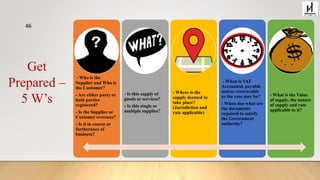
- Who is the
Supplier and Who is
the Customer?
- Are either party or
both parties
registered?
- Is the Supplier or
Customer overseas?
- Is it in course or
furtherance of
business?
- Is this supply of
goods or services?
- Is this single or
multiple supplies?
- Where is the
supply deemed to
take place?
(Jurisdiction and
rate applicable)
- When is VAT
Accounted, payable
and/or recoverable
as the case may be?
- When due what are
the documents
required to satisfy
the Government
authority?
- What is the Value
of supply, the nature
of supply and rate
applicable to it?
Get
Prepared –
5 W’s
46
Place of Supply
• Goods – place of supply is determined by location of goods when the supply takes place
• Services -
• B2B – place of supply is where the recipient belongs
• B2C – place of supply is where the supplier belongs
Note: There could be exceptions to the above basic rule
47
Commercial Implications
• Services provided over a lengthy period of time
- Construction
- Facilities Management Services
• Continuous Supplies
- Periodic invoicing
- Part payments made during the duration of service
48
Commercial Implications
• Pricing Policy
• Invoicing – inclusive of VAT or excluding
VAT
• Price Increase
• Assess capability of existing systems
• System requirements and corrections
• Manpower requirements and corrections
• Awareness within the organization
• Educating the Customer
• Dealing with the existing contracts
• Cut-off Procedures
• Inventory as at 31st December 2017
• Identify the intercompany transactions
• Training and awareness
49
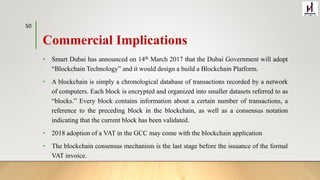
Commercial Implications
• Smart Dubai has announced on 14th March 2017 that the Dubai Government will adopt
“Blockchain Technology” and it would design a build a Blockchain Platform.
• A blockchain is simply a chronological database of transactions recorded by a network
of computers. Each block is encrypted and organized into smaller datasets referred to as
“blocks.” Every block contains information about a certain number of transactions, a
reference to the preceding block in the blockchain, as well as a consensus notation
indicating that the current block has been validated.
• 2018 adoption of a VAT in the GCC may come with the blockchain application
• The blockchain consensus mechanism is the last stage before the issuance of the formal
VAT invoice.
50
BitCoin & VATCoin
• Bitcoin is the world’s first peer-to-peer cryptocurrency.
• VATCoin is similar, but it is used in tax compliance
• Both Bitcoin and VATCoin are distributive ledger applications built upon blockchain
technology.
• Bitcoin’s ledger is public; VATCoin’s is private.
• If adopted, VATCoin could well become the world’s first government-mandated
cryptotaxcurrency.
• Unlike Bitcoin, VATCoin will not be a speculative currency. It is always fixed to the home
currency
51
VAT Impact on Business
VAT implementation is likely to have a significant impact on business operations,
as follows:
• business processes;
• IT and other related systems;
• supply chain:
• cash flows;
• human resources;
• legal;
• marketing and pricing; and
• fiscal and accounting
52
VAT Impact on Business
• Contracts - “inclusive” or “exclusive” of any applicable sales or value added
tax - a provision should allow for a valid tax invoice to be issued against
payments - indemnification against loss or penalties.
• Supplier - responsible for VAT - if the contract is silent - account to relevant
authority - may be unable to recover the VAT from customer - leaving the
supplier short changed.
53
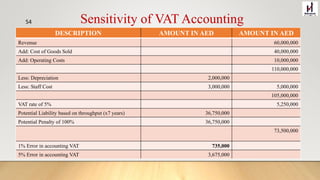
DESCRIPTION AMOUNT IN AED AMOUNT IN AED
Revenue 60,000,000
Add: Cost of Goods Sold 40,000,000
Add: Operating Costs 10,000,000
110,000,000
Less: Depreciation 2,000,000
Less: Staff Cost 3,000,000 5,000,000
105,000,000
VAT rate of 5% 5,250,000
Potential Liability based on throughput (x7 years) 36,750,000
Potential Penalty of 100% 36,750,000
73,500,000
1% Error in accounting VAT 735,000
5% Error in accounting VAT 3,675,000
Sensitivity of VAT Accounting54
Agenda
8.30 a.m. to 10.00 a.m. Session1: Introduction & Basic Concepts of VAT and how it works
10 a.m. to 10.15 a.m. Coffee/Tea Break
10.15 a.m. to 11.45 a.m. Session 2: How VAT is applied on Goods and Services – Case Studies / Examples
11.45 a.m. to 12.45 p.m. Prayer and Lunch Break
12.45 p.m. to 2.15 p.m. Session 3: Commercial Implications of VAT and how to get prepared
2.15 p.m. to 2.30 p.m. Coffee/Tea Break
2.30 p.m. to 4.00 p.m. Session 4: VAT related challenges - Lessons to be learnt from other countries
4.00 p.m. to 4.15 p.m. Feedback and Summary session
55
Session 4:
VAT Related Challenges
– Lessons from other
countries
56
Carousel
Fraud in
Europe
57
Lessons from Malaysia
• Malaysia is the most recent economy to introduce a Value Added Tax. A Goods and
Services Tax was implemented in Malaysia on 1 April 2015.
• The key ‘lesson learnt’ from that experience is that businesses who began planning for
the implementation project early had successful implementations and were ready on go-
live date.
58
Lessons from Other Countries
An early start enabled them to:
• Facilitate early management responses to issues where guidance from senior management was
required which enabled early resolution of issues.
• Identify IT systems impacted by VAT implementation and assess the level of upgrades,
modifications (or new acquisitions) required.
• This in turn enabled them to accurately budget for the project and secure scarce external IT
resources for the project’s IT work stream.
• Decide whether to use in-house resources to handle the project or to outsource to third party
consultants.
• Identify the necessary head count and skills set to deliver a successful and timely project.
59
Lessons from Other Countries
• Identify any adverse impact from VAT laws on the business. This in turn enabled them to
approach and raise the issue with the tax authorities early. Businesses in such situations had a far
higher chance of receiving responses from the authorities (as opposed to those who made
submissions 3 months out from VAT go-live date).
• Plan their capital expenditure and cash flow management.
• Manage the risk of a late announcement by the Government providing a shorter time span to
implement the tax.
• Address (and renegotiate with counterparties) long term contracts adversely impacted by VAT.
• These are some of the critical success factors to consider to ensure a successful implementation of
the tax.
60
Merits of VAT
• No Tax evasion – only with proper records credit can be claimed for purchases/inputs –
perfect system of VAT will be a perfect chain where tax evasion is difficult
• Neutrality – it has anti-cascading effect – how much value is added and at what stage is
of no consequence
• Certainty – system is simply based on transactions
• Transparency – buyer knows out of total consideration what is tax component
• Better revenue collection and stability – minimum possibility of revenue leakage for
the government – if invoices is not demanded credit cannot be claimed
• Better Accounting system – better accounting to ensure credit for input tax
61
Demerits of VAT
• Increase in consumer price
• Cascading Effect can be distorted if there are differential rates
• Cost of Accounting will increase
• Increase in working capital requirements
• VAT tends to be regressive as the proportion of income spent on consumption is larger for
the poor than the rich – moderation is possible by exempting essentials
• Cost of administration is high for the Government
62
Thank You
For follow-up queries please write to:
tpanand@motivaluate.com

Value Added Tax (VAT) in UAE

  • 1.
  • 2.
    Agenda 8.30 a.m. to10.00 a.m. Session1: Introduction & Basic Concepts of VAT and how it works 10 a.m. to 10.15 a.m. Coffee/Tea Break 10.15 a.m. to 11.45 p.m. Session 2: How VAT is applied on Goods and Services – Case Studies / Examples 11.45 a.m. to 12.45 p.m. Prayer and Lunch Break 12.45 p.m. to 2.15 p.m. Session 3: Commercial Implications of VAT and how to get prepared 2.15 p.m. to 2.30 p.m. Coffee/Tea Break 2.30 p.m. to 4.00 p.m. Session 4: VAT related challenges - Lessons to be learnt from other countries 4.00 p.m. to 4.15 p.m. Feedback and Summary session 2
  • 3.
  • 4.
    •The person payingthe tax to the Government directly bears the incidence of tax •It is progressive in nature – high rate of taxes for people having higher ability to pay. •Eg. Income Tax Direct Tax •The person paying the tax to the Government collects the same from the ultimate consumer. •The incidence of tax is shifted to the other person. •Regressive in nature – all consumers equally bear the burden, irrespective of their ability to pay. •Eg. Customs Duty, Excise Duty, VAT Indirect Tax 4
  • 5.
  • 6.
    Value Added Tax •Tax on the value added to the commodity at each stage in production and distribution chain. • It is a system to collect tax on the value at the final or retail point of sale. • VAT is a consumption tax because it is borne ultimately by the final consumer of goods. 6
  • 7.
    Under VAT thetax paid on commodities B, C, D and E are allowed to be set off from the final tax liability on Product A Double tax increases production cost & price of final product Total tax on A = Tax on A + Tax on B,C,D & E Tax paid on B,C,D & E by manufacturer at the time of purchase Raw materials: B,C, D & E Manufacturer produces A VAT on Manufactured Product7
  • 8.
    VAT on Goods& Services A combined grand system of VAT on goods and services is known as Goods and Services Tax In the same way, one can think of a system of VAT dealing with input and output of Services. VAT on Trading - the VAT paid on inputs purchased will be allowed as a credit and set off against the tax liability on the value of sales When the same goods are sold tax is levied on them Tax is paid on purchased goods Trader buys goods 8
  • 9.
    MANUFACTURER Sale Price AED300 Gross VAT AED 15 Net VAT AED 4 (AED 15-(5+6)) WHOLESALER Sale Price AED 320 Gross VAT AED 16 Net VAT AED 1 (AED 16 – AED 15) Raw Material X Sale Price AED 100 Gross AED 5 Net Vat AED 5 Raw Material Y Sale Price AED 120 Gross VAT AED 6 Net VAT AED 6 RETAILER Sale Price AED 350 Gross VAT AED 17.50 Net VAT AED 1.50 (AED 17.50 – AED 16) Inputs for Manufacturer How it works!? 9
  • 10.
    Variants of VAT Gross Product Variant IncomeVariant Consumption Variant 10
  • 11.
    Gross Product Variant •Deductions for taxes paid on all purchases of inputs (raw materials and components) • No deduction for taxes paid on capital inputs 11
  • 12.
    Income Variant • Deductionson purchases of inputs (raw materials and components) • Depreciation on capital goods (as specified) • This method provides incentives to classify purchases as revenue expenditure to claim set-off 12
  • 13.
    Consumption Variant • Deductionfor all business purchases including capital assets. • Gross investment is deductible in calculating the value added. • Neither distinguishes between capital and revenue expenditures, nor specifies the life of assets or depreciation allowance for different assets. 13
  • 14.
    Variant of VAT- Summary • Gross Product Variant: allows deductions for taxes paid on all purchases of raw materials and components, but no deduction is allowed for taxes paid on capital inputs • Income Variant: allows for deductions on purchases of raw materials and components as well as depreciation on capital goods. This method provides incentives to classify purchases as revenue expenditure to claim set-off • Consumption Variant: allows deduction for all business purchases including capital assets. Thus gross investment is deductible in calculating the value added. It neither distinguishes between capital and revenue expenditures nor specifies the life of assets or depreciation allowance for different assets. • Note: The Consumption Variant is the most widely used variant of the VAT. Most of the European countries and other continents have adopted this variant. It does not affect decisions regarding investment because the tax on capital goods is also available for set-off against the VAT liability. The system is tax neutral and obliviates the need to distinguish between purchase of inputs and capital goods 14
  • 15.
    Methods of Computing Tax Additionmethod Invoice method Cost subtraction method 15
  • 16.
    Addition method ofcomputing VAT • This method aggregates all the factor payments (excluding value of material) including profits to arrive at the total value addition on which the tax rate is applied to calculate the tax. • This calculation is used with income variant. • The drawback in this method is it does not facilitate matching of invoices for detecting evasion as tax liability is calculated period-wise and not invoice-wise. 16
  • 17.
    Invoice method ofcomputing VAT • Most common and popular method. • Tax is imposed at every stage of sales on the entire sales value and tax paid at the earlier stage is allowed as set-off. • At every stage the differential tax is paid. • At every stage, the tax is to be charged separately in the Invoice. • This method is also called the Tax Credit Method or Voucher Method. • This method is widely used in Europe and in India this method is followed under the State Level VAT and the Central Excise Law. 17
  • 18.
    Cost Subtraction methodof computing VAT • Tax is charged only on the value added at each stage of sale of goods. • Since the total value of goods sold is not taken into account, the question of grant of claim for set-off or tax credit does not arise. • This method is applied where the tax is not charged separately. • Direct Subtraction method - deducting the aggregate value of purchase exclusive of tax from the aggregate value of sales exclusive of tax. • Intermediate Subtraction method – deducting the tax inclusive value of purchases from the sales and taxing difference between them. 18
  • 19.
    Input Tax • It isa tax paid or payable in the course of business on the purchases of any goods or services from a registered dealer Output Tax • It is a tax charged or chargeable under the VAT Act by a registered dealer for the sale of goods or services in the course of business. Input Tax & Output Tax 19
  • 20.
    Input Tax Credit •The essence of VAT is in providing set-off for the tax paid earlier and this is given effect through the concept of Input Tax Credit/Rebate. • Input Tax Credit in relation to any period means setting off the amount of input tax by a registered dealer against the amount of his output tax. 20
  • 21.
    VAT Liability • VATis based on the value addition to the goods and the related VAT Liability of the dealer is calculated by deducting Input Tax Credit from the Output Tax payable. Net Tax payable Output Tax Input Tax *If the Net Tax is negative refund is collected from the Government (Input Tax paid is more than Output Tax) 21
  • 22.
    Registered & UnregisteredBusiness • If you are a VAT-registered business, in most cases you: ‐ Charge VAT on the goods and services you provide ‐ Reclaim the VAT you pay when you buy goods and services for your business • If you are not VAT-registered then you cannot reclaim the VAT you pay when you purchase goods and services 22
  • 23.
    Registered Business • InUAE VAT is applicable in phase 1 to all companies with annual revenue of more than AED 3.75 Million. • In phase 2 the VAT will be applicable to all entities irrespective of their annual revenue. 23
  • 24.
    Goods and Services - Categories Standard Rate5% Zero Rate 0% Exempt Category Out of Scope Category 24
  • 25.
    Supplies under different categories Standard-Rated Supplies •Most local supplies of goods and services in a country are generally included in this category, for example, wholesale and retail sales, the consumption of food in a restaurant, and the provision of services by law and accounting firms. Zero-Rated Supplies • Goods and services exported out of a country may be zero-rated, that is, are subject to VAT at a rate of 0%. VAT-Exempt Supplies The following businesses are often exempt from VAT in order to reduce its impact on the population: • educational institutions; • pharmaceutical supplies; • financial services, including both banks and life insurance companies; and • sale or lease of residential property. Out-of-Scope Supplies • Supplies where goods and services are delivered by an overseas supplier to another overseas person are generally included in this category as do private and non-business transactions. 25
  • 26.
    Exempted Category The UAEgovernment has already announced that • 100 food items • Health • Education • Bicycles and • Social services would be exempted from VAT. 26
  • 27.
    Exempted Category • Exemptsupply means that you will not charge VAT to your customer. • Any VAT incurred on those purchases will not be claimable. • Wholly exempt businesses will not be entitled to register for VAT nor claim any VAT incurred on their purchases. • Partially exempt businesses (i.e. mixed business) will be able to register for VAT and claim those expenses to the extent that it is incurred for the making of taxable supplies. This will mean that VAT incurred on common costs and general overheads (such as marketing and promotional expenses, utilities, professional fees, purchases of office furniture) will not be fully claimable and must be apportioned. 27
  • 28.
    Zero Vs. ExemptCategory • Zero-rated Category: they count as taxable supplies, but you don't add any VAT to your selling price because the VAT rate is 0 per cent. However Input Tax Credit is allowed and hence generally in refund position. • Exempt Category: you don't charge any VAT and they're not taxable supplies. This means that you won't normally be able to reclaim any of the VAT on your expenses. (Healthcare, Education, Financial Services, etc.) 28
  • 29.
    Input Tax Credit(ITC) Taxable Supply Non-Taxable Supply Standard Rated ITC Available No ITC ITC Available ITC Available Exempt Out of Scope Zero Rated 29
  • 30.
    Point of Tax GoodsServices Earlier of: (a) Date of Payment (b) Date at which goods are made available (c) Date of issue of VAT Invoice Earlier of: (a) Date of Payment (b) Date at which services are rendered (completed) (c) Date of issue of VAT Invoice 30
  • 31.
    VAT Invoice • Theprocess of charging VAT on supplies of goods and services requires businesses to issue VAT invoices. • A VAT Invoice is a document that must be produced and issued by VAT registered businesses to provide documentary evidence of the sale of goods and services in compliance with the VAT law. • A VAT Invoice is also required by the business as documentary evidence to support VAT credit claims, i.e. VAT incurred on the acquisition of goods and services for the purposes of the business can only be claimed if the business holds a valid VAT Invoice from the vendor. 31
  • 32.
    Outputs & OutputTax Outputs Output Tax Income The VAT exclusive business income arising in a VAT Accounting Period The VAT due on the Outputs Income is deemed to be inclusive of any VAT properly due, whether or not VAT has been separately charged 32
  • 33.
    Inputs & InputTax Input Input Tax The VAT exclusive value of external costs incurred by a business and excludes: • Salaries • Inter-departmental charges within a taxable person made for accounting purposes The proportion of VAT incurred on inputs which the business is entitled to recover 33
  • 34.
    Filing of returns •VAT registered business to file returns on annual or quarterly or monthly basis • Outputs/Output Tax; Inputs/Input Tax are all entered in the VAT Return • VAT actually payable is the net of Output Tax Due less Input Tax recoverable • Net Amount is payable or to be claimed as refund 34
  • 35.
    VAT Registered Business’sRole • VAT is self-assessed • Responsibility is on the VAT registered business to collect, account, pay and prove to the Government • Responsibility coupled with Accountability with huge financial and legal implications 35
  • 36.
    Agenda 8.30 a.m. to10.00 a.m. Session1: Introduction & Basic Concepts of VAT and how it works 10 a.m. to 10.15 a.m. Coffee/Tea Break 10.15 a.m. to 11.45 a.m. Session 2: How VAT is applied on Goods and Services – Case Studies / Examples 11.45 a.m. to 12.45 p.m. Prayer and Lunch Break 12.45 p.m. to 2.15 p.m. Session 3: Commercial Implications of VAT and how to get prepared 2.15 p.m. to 2.30 p.m. Coffee/Tea Break 2.30 p.m. to 4.00 p.m. Session 4: VAT related challenges - Lessons to be learnt from other countries 4.00 p.m. to 4.15 p.m. Feedback and Summary session 36
  • 37.
    Session2: How VAT isapplied on Goods & Services – Case Studies / Examples 37
  • 38.
    Case Study No.1 •ABC LLC, a manufacturer of Aluminium Frames, sells its products to distributor for AED1,000. The Distributor sells the goods to a wholesale dealer for AED1,200 and the wholesale dealer sells the goods to a Retailer for AED1,500. The Retailer sells the goods to consumers at AED2,000. The rate of tax on the goods manufacturer is 5%. Requirement: • Compute the VAT Liability at every stage of the sale 38
  • 39.
    Case Study No.2 •Red Chilli restaurant has collected VAT on various invoices during the month amounting to AED 500,000. • During the month there were purchases made on which VAT paid amounted to AED 125,000. • Rent paid for various outlets during the month included VAT amounting to AED 100,000. • One of the suppliers issued a credit note in respect of supplies made in the earlier month and the VAT component of the credit note worked out to AED 12,000 • Expenses incurred during the month on which VAT paid in total amounted to AED 18,000 Requirement: Prepare the VAT Account for the month for Red Chilli Restaurant. 39
  • 40.
    Case Study No.3 •Batman Building Materials Trading has purchased goods worth AED 12,000,000 during the month. The goods are normally bought on 60 days credit. • During the month the Sales of building materials was worth AED 20,000,000 and the average terms with customers is 90 days. • VAT paid on the various operating expenses of the company amounted to AED 35,000 • During the same month Professional Fee paid to consultants and lawyers amounted to AED 150,000. • Corporate Expenses allocable to Batimat Building Material Trading amounted to AED 200,000 of which expenses which suffered VAT amounted to AED 80,000 Requirement: Prepare the VAT Account of Batman Building Materials Trading. 40
  • 41.
    Real Estate Business •Sale and lease of commercial property is likely to be treated as taxable as opposed to the sale and lease of residential property which is likely to be exempt under VAT. As a result, businesses such as property developers who sell residential property are likely to be in the position of being a ‘final consumer’, that is, unable to claim input credits for the VAT incurred on costs. • In particular, consideration should be given to the following: • The complexities in determining the VAT treatment in joint venture arrangements with local government authority and other developers and investors. • Whether sale and purchase agreements enable the property developer to either recover or pass on the increased VAT costs to the purchaser, to ensure margins are not impacted. • Whether property developers who have entered into long term build-and-sell contracts with purchasers have taken VAT into consideration when pricing their properties. • VAT provisions in construction contracts, since they typically span a number of years, to prevent any adverse VAT impacts. 41
  • 42.
    Retail Business • VATcompliant invoicing and pricing as well as correct VAT classification of sales will be critical. • Business promotion schemes, such as loyalty programs and voucher arrangements, can offer technically complex VAT scenarios and implications. • Additional consideration should be given to the following: • The timing of any significant capital expenditure near to the VAT start date to avoid cash flow implications due to VAT refunds stuck with the tax authorities. • Reviewing payment terms with your customers and vendors to manage cash flow and allow the claiming of input tax at the earliest opportunity. • Cancellation fees/retained deposits – deposits or advance payments from a customer could be considered as taxable or compensation and outside the scope of VAT where no supply has taken place. • Timing of the issue of invoices – for example consideration to invoices being issued at the start of the month (instead of the end) to enable ample time to collect from your customers. • Serious consideration to pricing to ensure that the business is not found or perceived to be profiteering 42
  • 43.
    Industrial Products Business •The Industrial Products sector players face similar challenges and therefore ensuring efficiency of VAT implementation and addressing cash flow implications will be priorities for this sector. • In particular consideration should be given to the following: • Pricing impact on end consumers. • Cash flow efficiencies. • Cross border transactions within the GCC and the associated reporting and documentation requirements (including imports and exports). • Invoicing requirements. 43
  • 44.
    Agenda 8.30 a.m. to10.00 a.m. Session1: Introduction & Basic Concepts of VAT and how it works 10 a.m. to 10.15 a.m. Coffee/Tea Break 10.15 a.m. to 11.45 a.m. Session 2: How VAT is applied on Goods and Services – Case Studies / Examples 11.45 a.m. to 12.45 p.m. Prayer and Lunch Break 12.45 p.m. to 2.15 p.m. Session 3: Commercial Implications of VAT and how to get prepared 2.15 p.m. to 2.30 p.m. Coffee/Tea Break 2.30 p.m. to 4.00 p.m. Session 4: VAT related challenges - Lessons to be learnt from other countries 4.00 p.m. to 4.15 p.m. Feedback and Summary session 44
  • 45.
    Session 3: Commercial Implications ofVAT and How to get prepared 45
  • 46.
    - Who isthe Supplier and Who is the Customer? - Are either party or both parties registered? - Is the Supplier or Customer overseas? - Is it in course or furtherance of business? - Is this supply of goods or services? - Is this single or multiple supplies? - Where is the supply deemed to take place? (Jurisdiction and rate applicable) - When is VAT Accounted, payable and/or recoverable as the case may be? - When due what are the documents required to satisfy the Government authority? - What is the Value of supply, the nature of supply and rate applicable to it? Get Prepared – 5 W’s 46
  • 47.
    Place of Supply •Goods – place of supply is determined by location of goods when the supply takes place • Services - • B2B – place of supply is where the recipient belongs • B2C – place of supply is where the supplier belongs Note: There could be exceptions to the above basic rule 47
  • 48.
    Commercial Implications • Servicesprovided over a lengthy period of time - Construction - Facilities Management Services • Continuous Supplies - Periodic invoicing - Part payments made during the duration of service 48
  • 49.
    Commercial Implications • PricingPolicy • Invoicing – inclusive of VAT or excluding VAT • Price Increase • Assess capability of existing systems • System requirements and corrections • Manpower requirements and corrections • Awareness within the organization • Educating the Customer • Dealing with the existing contracts • Cut-off Procedures • Inventory as at 31st December 2017 • Identify the intercompany transactions • Training and awareness 49
  • 50.
    Commercial Implications • SmartDubai has announced on 14th March 2017 that the Dubai Government will adopt “Blockchain Technology” and it would design a build a Blockchain Platform. • A blockchain is simply a chronological database of transactions recorded by a network of computers. Each block is encrypted and organized into smaller datasets referred to as “blocks.” Every block contains information about a certain number of transactions, a reference to the preceding block in the blockchain, as well as a consensus notation indicating that the current block has been validated. • 2018 adoption of a VAT in the GCC may come with the blockchain application • The blockchain consensus mechanism is the last stage before the issuance of the formal VAT invoice. 50
  • 51.
    BitCoin & VATCoin •Bitcoin is the world’s first peer-to-peer cryptocurrency. • VATCoin is similar, but it is used in tax compliance • Both Bitcoin and VATCoin are distributive ledger applications built upon blockchain technology. • Bitcoin’s ledger is public; VATCoin’s is private. • If adopted, VATCoin could well become the world’s first government-mandated cryptotaxcurrency. • Unlike Bitcoin, VATCoin will not be a speculative currency. It is always fixed to the home currency 51
  • 52.
    VAT Impact onBusiness VAT implementation is likely to have a significant impact on business operations, as follows: • business processes; • IT and other related systems; • supply chain: • cash flows; • human resources; • legal; • marketing and pricing; and • fiscal and accounting 52
  • 53.
    VAT Impact onBusiness • Contracts - “inclusive” or “exclusive” of any applicable sales or value added tax - a provision should allow for a valid tax invoice to be issued against payments - indemnification against loss or penalties. • Supplier - responsible for VAT - if the contract is silent - account to relevant authority - may be unable to recover the VAT from customer - leaving the supplier short changed. 53
  • 54.
    DESCRIPTION AMOUNT INAED AMOUNT IN AED Revenue 60,000,000 Add: Cost of Goods Sold 40,000,000 Add: Operating Costs 10,000,000 110,000,000 Less: Depreciation 2,000,000 Less: Staff Cost 3,000,000 5,000,000 105,000,000 VAT rate of 5% 5,250,000 Potential Liability based on throughput (x7 years) 36,750,000 Potential Penalty of 100% 36,750,000 73,500,000 1% Error in accounting VAT 735,000 5% Error in accounting VAT 3,675,000 Sensitivity of VAT Accounting54
  • 55.
    Agenda 8.30 a.m. to10.00 a.m. Session1: Introduction & Basic Concepts of VAT and how it works 10 a.m. to 10.15 a.m. Coffee/Tea Break 10.15 a.m. to 11.45 a.m. Session 2: How VAT is applied on Goods and Services – Case Studies / Examples 11.45 a.m. to 12.45 p.m. Prayer and Lunch Break 12.45 p.m. to 2.15 p.m. Session 3: Commercial Implications of VAT and how to get prepared 2.15 p.m. to 2.30 p.m. Coffee/Tea Break 2.30 p.m. to 4.00 p.m. Session 4: VAT related challenges - Lessons to be learnt from other countries 4.00 p.m. to 4.15 p.m. Feedback and Summary session 55
  • 56.
    Session 4: VAT RelatedChallenges – Lessons from other countries 56
  • 57.
  • 58.
    Lessons from Malaysia •Malaysia is the most recent economy to introduce a Value Added Tax. A Goods and Services Tax was implemented in Malaysia on 1 April 2015. • The key ‘lesson learnt’ from that experience is that businesses who began planning for the implementation project early had successful implementations and were ready on go- live date. 58
  • 59.
    Lessons from OtherCountries An early start enabled them to: • Facilitate early management responses to issues where guidance from senior management was required which enabled early resolution of issues. • Identify IT systems impacted by VAT implementation and assess the level of upgrades, modifications (or new acquisitions) required. • This in turn enabled them to accurately budget for the project and secure scarce external IT resources for the project’s IT work stream. • Decide whether to use in-house resources to handle the project or to outsource to third party consultants. • Identify the necessary head count and skills set to deliver a successful and timely project. 59
  • 60.
    Lessons from OtherCountries • Identify any adverse impact from VAT laws on the business. This in turn enabled them to approach and raise the issue with the tax authorities early. Businesses in such situations had a far higher chance of receiving responses from the authorities (as opposed to those who made submissions 3 months out from VAT go-live date). • Plan their capital expenditure and cash flow management. • Manage the risk of a late announcement by the Government providing a shorter time span to implement the tax. • Address (and renegotiate with counterparties) long term contracts adversely impacted by VAT. • These are some of the critical success factors to consider to ensure a successful implementation of the tax. 60
  • 61.
    Merits of VAT •No Tax evasion – only with proper records credit can be claimed for purchases/inputs – perfect system of VAT will be a perfect chain where tax evasion is difficult • Neutrality – it has anti-cascading effect – how much value is added and at what stage is of no consequence • Certainty – system is simply based on transactions • Transparency – buyer knows out of total consideration what is tax component • Better revenue collection and stability – minimum possibility of revenue leakage for the government – if invoices is not demanded credit cannot be claimed • Better Accounting system – better accounting to ensure credit for input tax 61
  • 62.
    Demerits of VAT •Increase in consumer price • Cascading Effect can be distorted if there are differential rates • Cost of Accounting will increase • Increase in working capital requirements • VAT tends to be regressive as the proportion of income spent on consumption is larger for the poor than the rich – moderation is possible by exempting essentials • Cost of administration is high for the Government 62
  • 63.
    Thank You For follow-upqueries please write to: tpanand@motivaluate.com