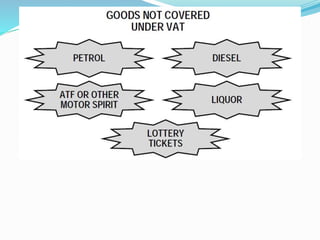
Value Added Tax
• Ajay Babu Bandi
 Practising Chartered Accountant
 M.Com, FCMA,ACA,IFRS(Certified)
VAT Basics
 Value Added Tax-
 -- is a multi-point tax on value addition i.e., increase
in value
 Which is collected at different stages of sale, and
 With a provision for set-off for tax paid at the
previous stage/tax paid on inputs against the tax
collections on sales before remitting to the
Government’s account
Objectives of VAT
 Prevents distortion – in trade and economy through
uniform tax rates
 Easy computation of tax
 Harmonization in the tax structure of various
states
 Availing of credit on inputs leading to cost
efficiency and rationalization
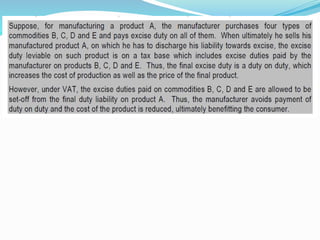
 Avoids Double taxation through input credit
 Ensure equitable distribution of tax impact
amongst dealers
 Easy compliance and procedures through
transparency
Meaning of Goods
 VAT is applicable only if there is a
transfer of property in goods from one
person to another for a consideration
 Goods means all kinds of movable
property
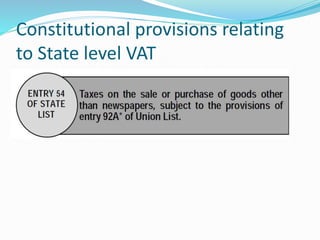
Constitutional provisions relating
to State level VAT
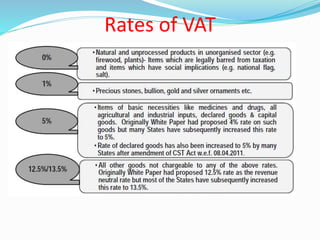
Rates of VAT
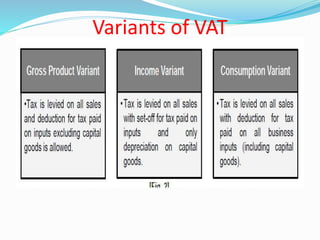
Variants of VAT
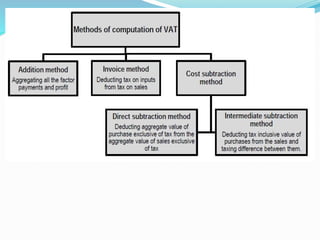
Addition Method
 Suitability : This method is mainly used with
Income variant of VAT
 Computation :
 Step1 : Aggregate all the Factor Payments including
Profits to arrive at the Total Value Addition
 Step2: Apply the Rate on Step 1 to calculate the tax
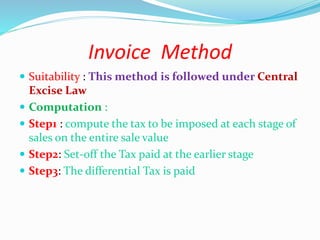
Invoice Method
 Suitability : This method is followed under Central
Excise Law
 Computation :
 Step1 : compute the tax to be imposed at each stage of
sales on the entire sale value
 Step2: Set-off the Tax paid at the earlier stage
 Step3: The differential Tax is paid
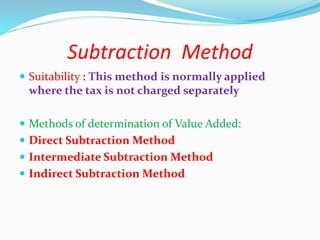
Subtraction Method
 Suitability : This method is normally applied
where the tax is not charged separately
 Methods of determination of Value Added:
 Direct Subtraction Method
 Intermediate Subtraction Method
 Indirect Subtraction Method
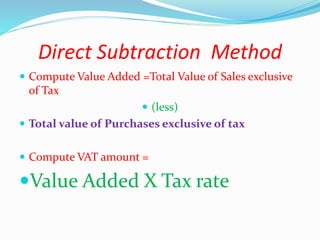
Direct Subtraction Method
 Compute Value Added =Total Value of Sales exclusive
of Tax
 (less)
 Total value of Purchases exclusive of tax
 Compute VAT amount =
Value Added X Tax rate
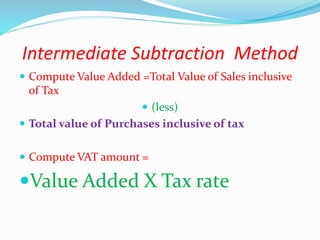
Intermediate Subtraction Method
 Compute Value Added =Total Value of Sales inclusive
of Tax
 (less)
 Total value of Purchases inclusive of tax
 Compute VAT amount =
Value Added X Tax rate
Indirect Subtraction Method
 Compute Value Added =VAT on Sales
 (less)
 VAT on Purchases
 Note :
This is same as Invoice Method
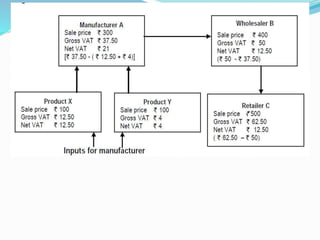
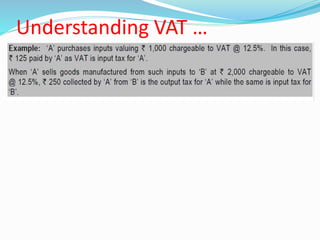
Understanding VAT …
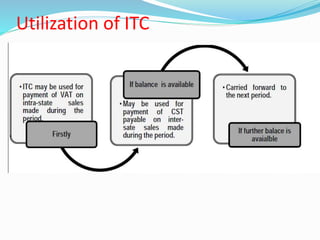
Utilization of ITC
Inputs
 Are goods meant for re-sale or use in manufacturing,
processing of other goods or packing of goods
manufactured
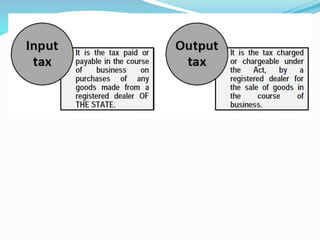
Input Tax
 Means..
 Tax paid or payable under VAT law
 By a Registered Dealer to another Registered Dealer
 On the purchase of goods ,including Capital Goods in
the course of Business
Output
 Means …
 Sale of goods made by a Registered Dealer to another
Registered Dealer
 And
 Consumers in the course of his business
Output Tax
 Is tax collected on sale of goods from the Buyer.
 The output tax is calculated by applying the rate of tax
on Taxable turnover of these goods
Dealer
 Means any person..
 Who carries on the business of
buying,selling,supplying or distributing goods,
directly or otherwise,
 Whether for Cash/Deferred payment/commission,
Remuneration/ other valuable Consideration
Sales
 Means …
 Every transfer of property in goods (other than by way
of a mortgage , hypothecation ,charge or pledge)
 By one person to another, in the course of business
 For cash , deferred payment or other valuable
consideration
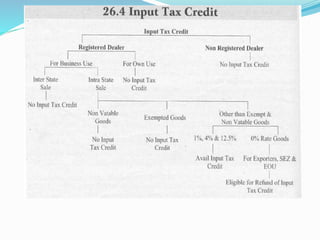
Eligibility for Input Tax Credit
 Dealer—required to be registered under the
respective state Law
 Eligible Purchases- Tax paid on purchases which
are meant for sale or for utilization in the process
of production for such sale
 Eligible Sales- Input Tax credit will be given to both
manufacturers and traders for purchase of
inputs/supplies meant for both sales within the state
as well as to other states
Tax Payment
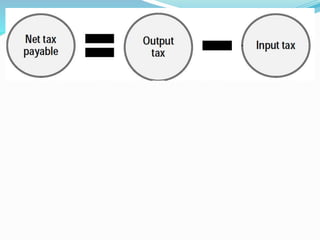
 VAT liability of the Dealer is calculated by
deducting VAT credit from Tax payable on
Sales during the tax/ payment period
Carry forward of VAT Credit &
Refund
 If VAT credit exceeds the tax payable on sales in a
month, the excess credit may be carried over to
the future month(s) and the unadjusted VAT
credit at the end of the specified period is eligible
for REFUND
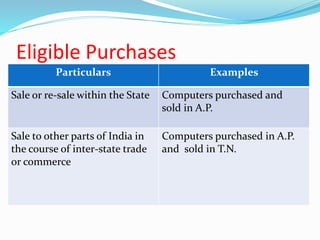
Eligible Purchases
Particulars Examples
Sale or re-sale within the State Computers purchased and
sold in A.P.
Sale to other parts of India in
the course of inter-state trade
or commerce
Computers purchased in A.P.
and sold in T.N.
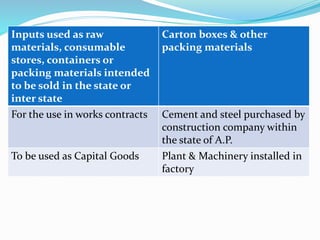
Inputs used as raw
materials, consumable
stores, containers or
packing materials intended
to be sold in the state or
inter state
Carton boxes & other
packing materials
For the use in works contracts Cement and steel purchased by
construction company within
the state of A.P.
To be used as Capital Goods Plant & Machinery installed in
factory
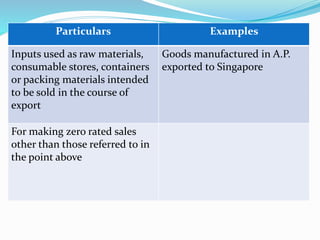
Particulars Examples
Inputs used as raw materials,
consumable stores, containers
or packing materials intended
to be sold in the course of
export
Goods manufactured in A.P.
exported to Singapore
For making zero rated sales
other than those referred to in
the point above
Non availability of Input Tax Credit
 Purchases from Unregistered Dealers
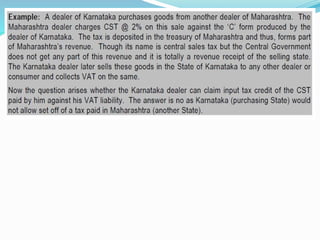
 Purchases from other states/countries
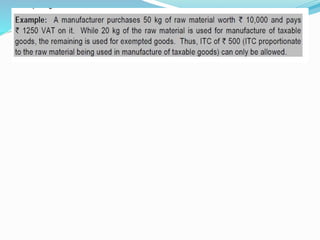
 Purchase of goods used in manufacture of exempted
goods
 Purchase of Capital Goods (credit is available in
installments)
 Purchase of goods used as a fuel in power generation
 Purchase of goods to be dispatched as branch transfers
outside states/consignment
Non availability of Input Tax Credit
 Purchase of goods where the purchase invoice is not
available
 Purchase of goods where the Dealer does not have Invoices
showing amounts of tax charged separately by the selling
Dealer
 Purchase of non-creditable goods
 Purchase from a Dealer who has opted for composition
Scheme
 Goods in Stock , which have suffered tax under an earlier
Act, but exempted under VAT
 Purchase of Goods for personal use
Zero Rated Sale
 Export
 Deemed Export /Penultimate Sale
 Zero rated Sale
 Refund to exporters (within 3 months)
Sale to Dealers in Special Economic
Zone (SEZ)
 Sale should be made to a Registered Dealer in SEZ
 Purchase for Manufacture at SEZ
 AUTHORISED by central Government
 Exemption to SEZ and EOU or refund of Input Tax
paid within 3 months
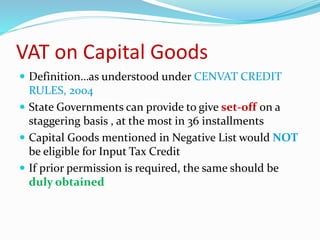
VAT on Capital Goods
 Definition…as understood under CENVAT CREDIT
RULES, 2004
 State Governments can provide to give set-off on a
staggering basis , at the most in 36 installments
 Capital Goods mentioned in Negative List would NOT
be eligible for Input Tax Credit
 If prior permission is required, the same should be
duly obtained
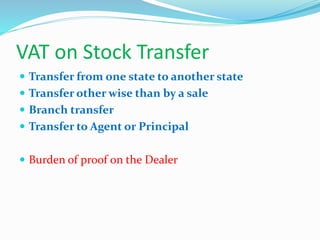
VAT on Stock Transfer
 Transfer from one state to another state
 Transfer other wise than by a sale
 Branch transfer
 Transfer to Agent or Principal
 Burden of proof on the Dealer
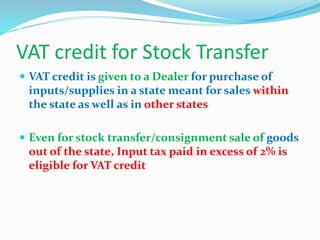
VAT credit for Stock Transfer
 VAT credit is given to a Dealer for purchase of
inputs/supplies in a state meant for sales within
the state as well as in other states
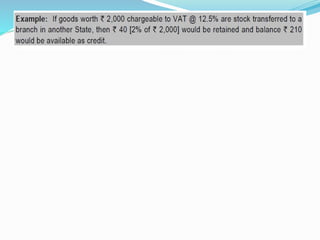
 Even for stock transfer/consignment sale of goods
out of the state, Input tax paid in excess of 2% is
eligible for VAT credit
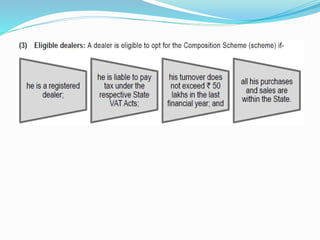
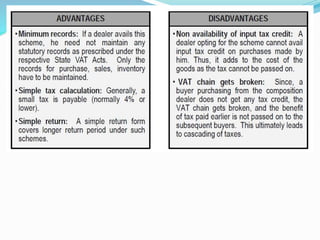
Composition Scheme for Small
Dealers
ELIGIBILITY …
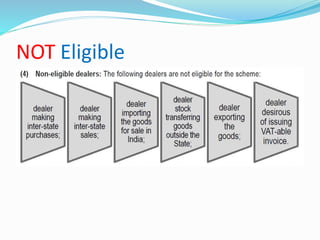
NOT Eligible
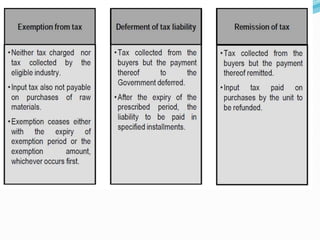
VAT and Sales tax incentives
Works Contracts
 Dealers have 2 options…
Works Contracts
 Option 1…
 Pay tax on the value of the goods at the time of
incorporation of such goods in the works executed, at
the rates applicable to the Goods….
 or
Works Contracts
 Option 2
 Pay tax by way of composition at applicable rates on a
certain percentage of the Total consideration
received as may be prescribed
 No VAT Credit or only partial VAT Credit
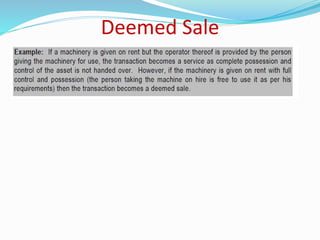
Deemed Sale
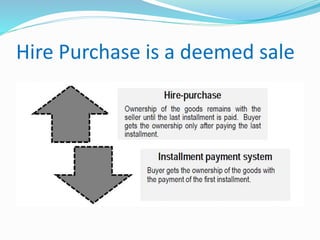
Hire Purchase is a deemed sale
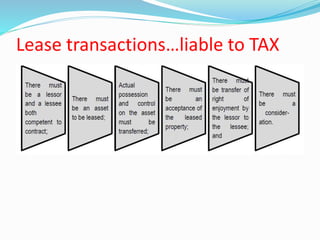
Lease transactions…liable to TAX
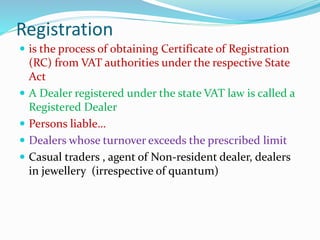
Registration
 is the process of obtaining Certificate of Registration
(RC) from VAT authorities under the respective State
Act
 A Dealer registered under the state VAT law is called a
Registered Dealer
 Persons liable…
 Dealers whose turnover exceeds the prescribed limit
 Casual traders , agent of Non-resident dealer, dealers
in jewellery (irrespective of quantum)
Registration-Cancellation
 Discontinuance of business
 Disposal of business
 Transfer of business to a new location
 Annual turnover falling below the specified amount
Taxpayer’s Identification Number
(TIN)
 is the registration number of the Dealer
 11 digit numerals (first 2 digits state code)
Maintenance of Books
 VAT invoice is a document listing goods sold with
price, tax and other details
 Contents of VAT invoice
 Tax invoice
 Name & Address of the selling Dealer
 Registration number of the selling Dealer
 Name & Address of the purchasing Dealer
 Registration number of the purchasing Dealer
Contents of VAT invoice
 Pre printed serial number
 Date of issue
 Description, quantity and value of Goods sold
 Rate and amount of tax charged
 Signature of the selling dealer
Importance of VAT invoice
 Helps in determining the input tax credit
 Prevents cascading effect of taxes
 Facilitates multi point taxation on value
addition
 Assists in audit and investigation
 Checks evasion of tax
Records to be maintained
 Sales Records
 Purchase Records
 VAT Account
 Goods Details
 Penalty –failure to maintain records
 No concessional Sales
Assessment Procedure
 Filing of Return—monthly , quarterly /annually
according to the state laws
 Assessment – no compulsory assessment..dealer can
assess himself
 Cross Checking computerized system between tax
authorities of state and central Governments
VAT Audit
 Basically a self assessment tax
 Types—Departmental audit or Audit by CAs
 Role of CA in VAT
 Record keeping
 Tax planning
 Negotiations with suppliers
 Handling departmental audit
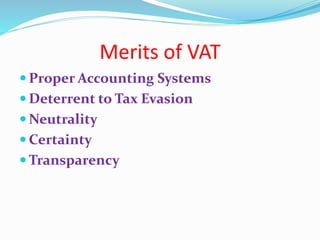
Merits of VAT
 Proper Accounting Systems
 Deterrent to Tax Evasion
 Neutrality
 Certainty
 Transparency
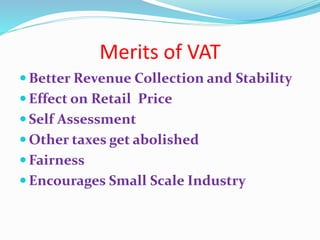
Merits of VAT
 Better Revenue Collection and Stability
 Effect on Retail Price
 Self Assessment
 Other taxes get abolished
 Fairness
 Encourages Small Scale Industry
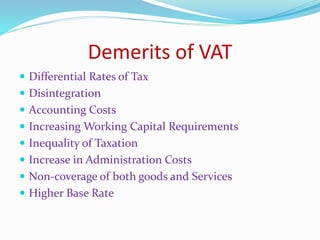
Demerits of VAT
 Differential Rates of Tax
 Disintegration
 Accounting Costs
 Increasing Working Capital Requirements
 Inequality of Taxation
 Increase in Administration Costs
 Non-coverage of both goods and Services
 Higher Base Rate
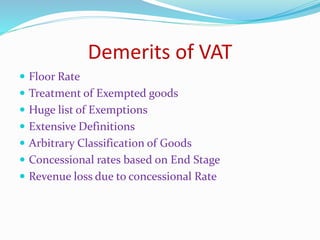
Demerits of VAT
 Floor Rate
 Treatment of Exempted goods
 Huge list of Exemptions
 Extensive Definitions
 Arbitrary Classification of Goods
 Concessional rates based on End Stage
 Revenue loss due to concessional Rate

Value Added Tax

  • 1.
    Value Added Tax •Ajay Babu Bandi  Practising Chartered Accountant  M.Com, FCMA,ACA,IFRS(Certified)
  • 2.
    VAT Basics  ValueAdded Tax-  -- is a multi-point tax on value addition i.e., increase in value  Which is collected at different stages of sale, and  With a provision for set-off for tax paid at the previous stage/tax paid on inputs against the tax collections on sales before remitting to the Government’s account
  • 3.
    Objectives of VAT Prevents distortion – in trade and economy through uniform tax rates  Easy computation of tax  Harmonization in the tax structure of various states  Availing of credit on inputs leading to cost efficiency and rationalization  Avoids Double taxation through input credit  Ensure equitable distribution of tax impact amongst dealers  Easy compliance and procedures through transparency
  • 4.
    Meaning of Goods VAT is applicable only if there is a transfer of property in goods from one person to another for a consideration  Goods means all kinds of movable property
  • 6.
  • 7.
  • 10.
  • 12.
    Addition Method  Suitability: This method is mainly used with Income variant of VAT  Computation :  Step1 : Aggregate all the Factor Payments including Profits to arrive at the Total Value Addition  Step2: Apply the Rate on Step 1 to calculate the tax
  • 13.
    Invoice Method  Suitability: This method is followed under Central Excise Law  Computation :  Step1 : compute the tax to be imposed at each stage of sales on the entire sale value  Step2: Set-off the Tax paid at the earlier stage  Step3: The differential Tax is paid
  • 14.
    Subtraction Method  Suitability: This method is normally applied where the tax is not charged separately  Methods of determination of Value Added:  Direct Subtraction Method  Intermediate Subtraction Method  Indirect Subtraction Method
  • 15.
    Direct Subtraction Method Compute Value Added =Total Value of Sales exclusive of Tax  (less)  Total value of Purchases exclusive of tax  Compute VAT amount = Value Added X Tax rate
  • 16.
    Intermediate Subtraction Method Compute Value Added =Total Value of Sales inclusive of Tax  (less)  Total value of Purchases inclusive of tax  Compute VAT amount = Value Added X Tax rate
  • 17.
    Indirect Subtraction Method Compute Value Added =VAT on Sales  (less)  VAT on Purchases  Note : This is same as Invoice Method
  • 20.
  • 24.
  • 35.
    Inputs  Are goodsmeant for re-sale or use in manufacturing, processing of other goods or packing of goods manufactured
  • 36.
    Input Tax  Means.. Tax paid or payable under VAT law  By a Registered Dealer to another Registered Dealer  On the purchase of goods ,including Capital Goods in the course of Business
  • 37.
    Output  Means … Sale of goods made by a Registered Dealer to another Registered Dealer  And  Consumers in the course of his business
  • 38.
    Output Tax  Istax collected on sale of goods from the Buyer.  The output tax is calculated by applying the rate of tax on Taxable turnover of these goods
  • 39.
    Dealer  Means anyperson..  Who carries on the business of buying,selling,supplying or distributing goods, directly or otherwise,  Whether for Cash/Deferred payment/commission, Remuneration/ other valuable Consideration
  • 40.
    Sales  Means … Every transfer of property in goods (other than by way of a mortgage , hypothecation ,charge or pledge)  By one person to another, in the course of business  For cash , deferred payment or other valuable consideration
  • 41.
    Eligibility for InputTax Credit  Dealer—required to be registered under the respective state Law  Eligible Purchases- Tax paid on purchases which are meant for sale or for utilization in the process of production for such sale  Eligible Sales- Input Tax credit will be given to both manufacturers and traders for purchase of inputs/supplies meant for both sales within the state as well as to other states
  • 42.
    Tax Payment  VATliability of the Dealer is calculated by deducting VAT credit from Tax payable on Sales during the tax/ payment period
  • 43.
    Carry forward ofVAT Credit & Refund  If VAT credit exceeds the tax payable on sales in a month, the excess credit may be carried over to the future month(s) and the unadjusted VAT credit at the end of the specified period is eligible for REFUND
  • 44.
    Eligible Purchases Particulars Examples Saleor re-sale within the State Computers purchased and sold in A.P. Sale to other parts of India in the course of inter-state trade or commerce Computers purchased in A.P. and sold in T.N.
  • 45.
    Inputs used asraw materials, consumable stores, containers or packing materials intended to be sold in the state or inter state Carton boxes & other packing materials For the use in works contracts Cement and steel purchased by construction company within the state of A.P. To be used as Capital Goods Plant & Machinery installed in factory
  • 46.
    Particulars Examples Inputs usedas raw materials, consumable stores, containers or packing materials intended to be sold in the course of export Goods manufactured in A.P. exported to Singapore For making zero rated sales other than those referred to in the point above
  • 47.
    Non availability ofInput Tax Credit  Purchases from Unregistered Dealers  Purchases from other states/countries  Purchase of goods used in manufacture of exempted goods  Purchase of Capital Goods (credit is available in installments)  Purchase of goods used as a fuel in power generation  Purchase of goods to be dispatched as branch transfers outside states/consignment
  • 48.
    Non availability ofInput Tax Credit  Purchase of goods where the purchase invoice is not available  Purchase of goods where the Dealer does not have Invoices showing amounts of tax charged separately by the selling Dealer  Purchase of non-creditable goods  Purchase from a Dealer who has opted for composition Scheme  Goods in Stock , which have suffered tax under an earlier Act, but exempted under VAT  Purchase of Goods for personal use
  • 49.
    Zero Rated Sale Export  Deemed Export /Penultimate Sale  Zero rated Sale  Refund to exporters (within 3 months)
  • 50.
    Sale to Dealersin Special Economic Zone (SEZ)  Sale should be made to a Registered Dealer in SEZ  Purchase for Manufacture at SEZ  AUTHORISED by central Government  Exemption to SEZ and EOU or refund of Input Tax paid within 3 months
  • 51.
    VAT on CapitalGoods  Definition…as understood under CENVAT CREDIT RULES, 2004  State Governments can provide to give set-off on a staggering basis , at the most in 36 installments  Capital Goods mentioned in Negative List would NOT be eligible for Input Tax Credit  If prior permission is required, the same should be duly obtained
  • 52.
    VAT on StockTransfer  Transfer from one state to another state  Transfer other wise than by a sale  Branch transfer  Transfer to Agent or Principal  Burden of proof on the Dealer
  • 53.
    VAT credit forStock Transfer  VAT credit is given to a Dealer for purchase of inputs/supplies in a state meant for sales within the state as well as in other states  Even for stock transfer/consignment sale of goods out of the state, Input tax paid in excess of 2% is eligible for VAT credit
  • 54.
  • 55.
  • 56.
  • 58.
    VAT and Salestax incentives
  • 60.
    Works Contracts  Dealershave 2 options…
  • 61.
    Works Contracts  Option1…  Pay tax on the value of the goods at the time of incorporation of such goods in the works executed, at the rates applicable to the Goods….  or
  • 62.
    Works Contracts  Option2  Pay tax by way of composition at applicable rates on a certain percentage of the Total consideration received as may be prescribed  No VAT Credit or only partial VAT Credit
  • 63.
  • 64.
    Hire Purchase isa deemed sale
  • 65.
  • 66.
    Registration  is theprocess of obtaining Certificate of Registration (RC) from VAT authorities under the respective State Act  A Dealer registered under the state VAT law is called a Registered Dealer  Persons liable…  Dealers whose turnover exceeds the prescribed limit  Casual traders , agent of Non-resident dealer, dealers in jewellery (irrespective of quantum)
  • 67.
    Registration-Cancellation  Discontinuance ofbusiness  Disposal of business  Transfer of business to a new location  Annual turnover falling below the specified amount
  • 68.
    Taxpayer’s Identification Number (TIN) is the registration number of the Dealer  11 digit numerals (first 2 digits state code)
  • 69.
    Maintenance of Books VAT invoice is a document listing goods sold with price, tax and other details  Contents of VAT invoice  Tax invoice  Name & Address of the selling Dealer  Registration number of the selling Dealer  Name & Address of the purchasing Dealer  Registration number of the purchasing Dealer
  • 70.
    Contents of VATinvoice  Pre printed serial number  Date of issue  Description, quantity and value of Goods sold  Rate and amount of tax charged  Signature of the selling dealer
  • 71.
    Importance of VATinvoice  Helps in determining the input tax credit  Prevents cascading effect of taxes  Facilitates multi point taxation on value addition  Assists in audit and investigation  Checks evasion of tax
  • 72.
    Records to bemaintained  Sales Records  Purchase Records  VAT Account  Goods Details  Penalty –failure to maintain records  No concessional Sales
  • 73.
    Assessment Procedure  Filingof Return—monthly , quarterly /annually according to the state laws  Assessment – no compulsory assessment..dealer can assess himself  Cross Checking computerized system between tax authorities of state and central Governments
  • 74.
    VAT Audit  Basicallya self assessment tax  Types—Departmental audit or Audit by CAs  Role of CA in VAT  Record keeping  Tax planning  Negotiations with suppliers  Handling departmental audit
  • 75.
    Merits of VAT Proper Accounting Systems  Deterrent to Tax Evasion  Neutrality  Certainty  Transparency
  • 76.
    Merits of VAT Better Revenue Collection and Stability  Effect on Retail Price  Self Assessment  Other taxes get abolished  Fairness  Encourages Small Scale Industry
  • 77.
    Demerits of VAT Differential Rates of Tax  Disintegration  Accounting Costs  Increasing Working Capital Requirements  Inequality of Taxation  Increase in Administration Costs  Non-coverage of both goods and Services  Higher Base Rate
  • 78.
    Demerits of VAT Floor Rate  Treatment of Exempted goods  Huge list of Exemptions  Extensive Definitions  Arbitrary Classification of Goods  Concessional rates based on End Stage  Revenue loss due to concessional Rate