Practices at Infosys

BY:
SWATI (54)
MEENAL (39)


“There is nothing training cannot do; Nothing is above
its reach; It can turn bad morals to good, it can destroy
bad principles and recreate good ones; it can lift men to
angel ship.”
-Mark Twain



“Tell me and I forget, teach me and I remember, involve
me and I learn.”
- Benjamin Franklin


In the field of human resource management,
Training and Development is the field concerned
with organizational activity aimed at bettering
the performance of individuals and groups in
organizational settings. It has been known by
several names, including employee
development, human resource development, and
learning and development.
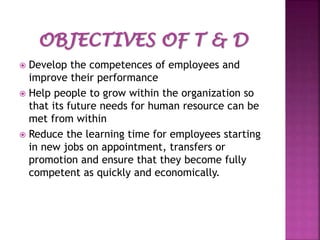
Develop the competences of employees and
improve their performance
 Help people to grow within the organization so
that its future needs for human resource can be
met from within
 Reduce the learning time for employees starting
in new jobs on appointment, transfers or
promotion and ensure that they become fully
competent as quickly and economically.

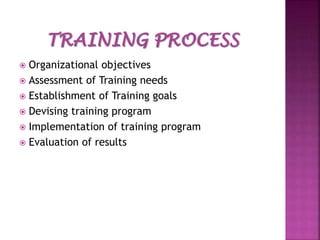
Organizational objectives
 Assessment of Training needs
 Establishment of Training goals
 Devising training program
 Implementation of training program
 Evaluation of results

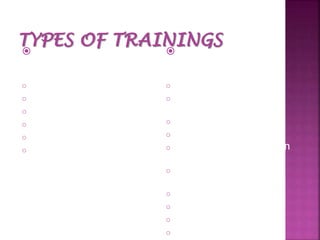
 On

the job
training

o
o
o
o
o
o

 Off

the job
training

Orientation Training
Job instruction training
Apprenticeship
Internships
Job rotations
Coaching

o
o
o
o
o
o
o
o
o
o

Vestibule Training
Demonstrations &
Example
Lectures
Audio-visuals
Programmed Instruction
(PI)
Computer-Assisted
Instruction (CAI)
Simulation
Conference
Case Studies
Role Plays
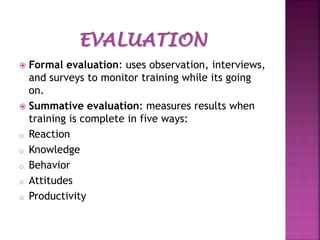
Formal evaluation: uses observation, interviews,
and surveys to monitor training while its going
on.
 Summative evaluation: measures results when
training is complete in five ways:
o Reaction
o Knowledge
o Behavior
o Attitudes
o Productivity

 Organizational

 Job

Needs Analysis

Needs Analysis

 Person

Needs Analysis
 Technical

training by Education & Research
department

 Quality

Process Training

 Personal

Effectiveness and
Managerial Programs

 ILI:

The Infosys Leadership System
1)
2)
3)
4)
5)
6)

7)
8)
9)

360 degree feedback
Development assignments
Infosys Culture workshops
Development relationships
Leadership skills training
Feedback intensive programs
Systemic process learning
Action learning
Community empathy
 Competitive advantage to

the firm
 Removes performance deficiencies
 Reduces accidents, damage, errors and wastage
 Improves productivity and profits
 Improves satisfaction and morale
 Reduces absenteeism and turnover
 Helps in knowledge up gradation
 Helps meet future personnel needs
 Improves the image of the organization
training and development at infosys

training and development at infosys

  • 1.
  • 2.
     “There is nothingtraining cannot do; Nothing is above its reach; It can turn bad morals to good, it can destroy bad principles and recreate good ones; it can lift men to angel ship.” -Mark Twain  “Tell me and I forget, teach me and I remember, involve me and I learn.” - Benjamin Franklin
  • 3.
     In the fieldof human resource management, Training and Development is the field concerned with organizational activity aimed at bettering the performance of individuals and groups in organizational settings. It has been known by several names, including employee development, human resource development, and learning and development.
  • 4.
    Develop the competencesof employees and improve their performance  Help people to grow within the organization so that its future needs for human resource can be met from within  Reduce the learning time for employees starting in new jobs on appointment, transfers or promotion and ensure that they become fully competent as quickly and economically. 
  • 5.
    Organizational objectives  Assessmentof Training needs  Establishment of Training goals  Devising training program  Implementation of training program  Evaluation of results 
  • 6.
     On the job training o o o o o o Off the job training Orientation Training Job instruction training Apprenticeship Internships Job rotations Coaching o o o o o o o o o o Vestibule Training Demonstrations & Example Lectures Audio-visuals Programmed Instruction (PI) Computer-Assisted Instruction (CAI) Simulation Conference Case Studies Role Plays
  • 7.
    Formal evaluation: usesobservation, interviews, and surveys to monitor training while its going on.  Summative evaluation: measures results when training is complete in five ways: o Reaction o Knowledge o Behavior o Attitudes o Productivity 
  • 8.
     Organizational  Job NeedsAnalysis Needs Analysis  Person Needs Analysis
  • 9.
     Technical training byEducation & Research department  Quality Process Training  Personal Effectiveness and Managerial Programs  ILI: The Infosys Leadership System
  • 10.
    1) 2) 3) 4) 5) 6) 7) 8) 9) 360 degree feedback Developmentassignments Infosys Culture workshops Development relationships Leadership skills training Feedback intensive programs Systemic process learning Action learning Community empathy
  • 11.
     Competitive advantageto the firm  Removes performance deficiencies  Reduces accidents, damage, errors and wastage  Improves productivity and profits  Improves satisfaction and morale  Reduces absenteeism and turnover  Helps in knowledge up gradation  Helps meet future personnel needs  Improves the image of the organization