Downloaded 478 times
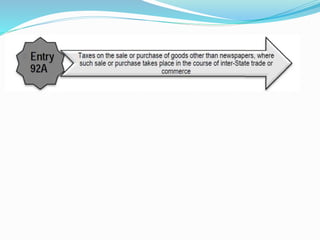
![Objects of the Central Sales Tax
Act, 1956
3. To declare certain goods to be of special
importance in the course of inter – state
trade or commerce [Sec.14]
4. Taxation of Declared Goods : To specify
the restrictions and conditions in the matter
of imposing taxes on the sale or purchase of
goods declared by the central Government
to be of special importance in the course of
inter-state trade or commerce [Sec.15]](https://image.slidesharecdn.com/cst-150924180009-lva1-app6892/85/Central-Sales-Tax-14-320.jpg)
![Objects of the Central Sales Tax
Act, 1956
5. To provide for collection of tax from
companies in the event of liquidation
[Sec.15]](https://image.slidesharecdn.com/cst-150924180009-lva1-app6892/85/Central-Sales-Tax-15-320.jpg)
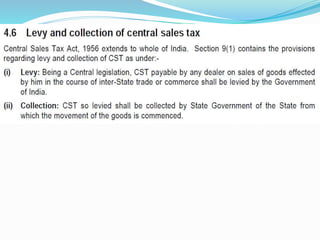
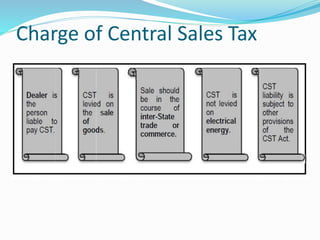

![Appropriate State [Sec.2(a) ]
Number of places of
business
Appropriate State is
Only one place of business State in which place of
business is situated
Many places of business
(a) All in one State State in which place of
business is situated
(b) In different States EACH state in which a place
of business is situated](https://image.slidesharecdn.com/cst-150924180009-lva1-app6892/85/Central-Sales-Tax-19-320.jpg)
![Business [Sec.2(aa) ]
Business includes :
1. any trade, commerce or manufacture, or
2. any adventure or concern in the nature of
trade , commerce or manufacture-
(a) with a motive to make profit or not,
(b) whether such profit actually accrues or not,
3.any activity which is incidental or ancillary
to such trade, commerce , manufacture ,
adventure or concern](https://image.slidesharecdn.com/cst-150924180009-lva1-app6892/85/Central-Sales-Tax-21-320.jpg)

![Crossing the Customs Frontiers of
India [Sec.2(ab) ]
Crossing the Customs Frontiers of India means :
(a) crossing the limits of the area of a customs
station;
(b) in which imported goods or exported
goods are ordinarily kept before clearance by
Customs Authorities](https://image.slidesharecdn.com/cst-150924180009-lva1-app6892/85/Central-Sales-Tax-23-320.jpg)
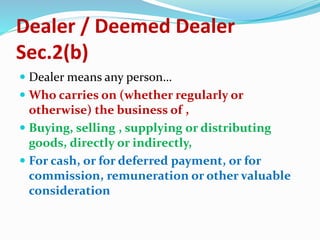

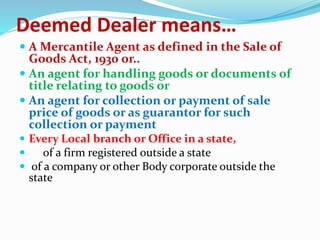
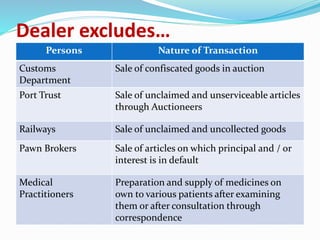

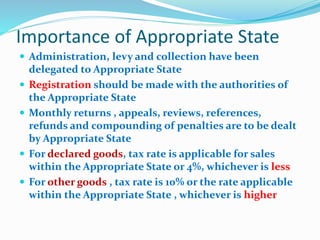
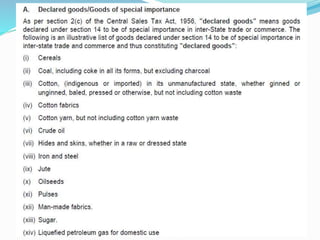
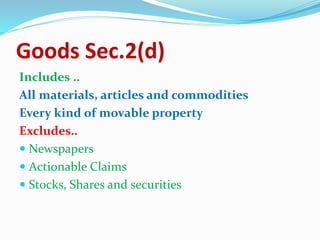
![Declared Goods Sec.2(c)
1 .Declared Goods declared u/s 14 to be of
special importance in inter-state trade or
commerce
2. Restrictions / Conditions w.r.t Declared
Goods [Sec.15]
(a) Maximum Tax Rate – 4%
(b) Reimbursement of Local Sales Tax …. To
the seller making Inter state sale](https://image.slidesharecdn.com/cst-150924180009-lva1-app6892/85/Central-Sales-Tax-32-320.jpg)

![Place of Business [Sec.2(dd)]
Includes…
Place of business of an agent, in case where a
dealer carries on business through an agent
Place where stores his goods like warehouse /
godown
Place where dealer keeps his books of account](https://image.slidesharecdn.com/cst-150924180009-lva1-app6892/85/Central-Sales-Tax-39-320.jpg)
![Works Contract [Sec.2(ja)]
Means a contract for carrying out any work
which includes…
Altering
Assembling
Building
Construction
Erection
Fabrication](https://image.slidesharecdn.com/cst-150924180009-lva1-app6892/85/Central-Sales-Tax-49-320.jpg)
![Works Contract [Sec.2(ja)]
Means a contract for carrying out any work
which includes…
Fitting out
Improvement
Installation
Manufacturing
Processing
Repair or commissioning of any movable or
immovable property](https://image.slidesharecdn.com/cst-150924180009-lva1-app6892/85/Central-Sales-Tax-50-320.jpg)
![Sale Price [Sec.2(h)]
Meaning …
Amount payable to a dealer as consideration
for sale of any goods](https://image.slidesharecdn.com/cst-150924180009-lva1-app6892/85/Central-Sales-Tax-51-320.jpg)
![(i) Returnable Containers In case of returnable goods, the
ownership vests with the Dealer and does
not pass on to the Purchaser. The
containers are required to be returned to
the Dealers. No consideration is
chargeable in respect of such returnable
containers. The definition of sale price
u/s 2(h) does not include amounts not
charged by the Dealer. Hence, cost of
returnable containers cannot constitute
sale price. [Dyer Meakin Breweries].](https://image.slidesharecdn.com/cst-150924180009-lva1-app6892/85/Central-Sales-Tax-59-320.jpg)
![Sales Tax Law [Sec.2(i)] General Sales Tax Law
(GST)
Means any law, for the time
being in fore, in any State or
part thereof which provides for
levy of Taxes on sale /
purchase of goods generally or
on any specified goods
expressly mentioned in that
behalf and includes value
Added Tax Law.
Means any law, for the time
being in force, in any State of
Part thereof which provides
for levy of taxes on sale /
purchase of goods generally
and includes Value Added
Tax Law.](https://image.slidesharecdn.com/cst-150924180009-lva1-app6892/85/Central-Sales-Tax-61-320.jpg)
![Turnover [Sec.2(j)]
Means …
The aggregate of sale price received and receivable
by a Dealer.
In respect of sale of any goods,
In the course of inter-state trade or commerce,
Made during the prescribed period, and
Determined in the prescribed manner, (as per
Rules under the Act)](https://image.slidesharecdn.com/cst-150924180009-lva1-app6892/85/Central-Sales-Tax-62-320.jpg)
![Year [Sec.2(k)]
Where GST Law of
appropriate State is
Year is
Applicable Year as applicable under the
General Sales Tax law
Not Applicable Financial year – 1st April to 31st
March.](https://image.slidesharecdn.com/cst-150924180009-lva1-app6892/85/Central-Sales-Tax-63-320.jpg)
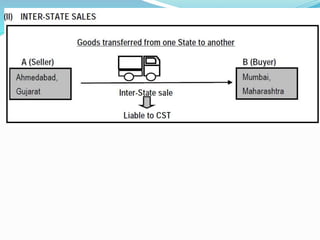
![Inter-State Trade[Sec.3]- Meaning
Meaning: A sale or purchase of goods shall be deemed
to take place in the course of inter-state trade or
commerce effected either by –
(a) Transfer of goods.
(b) Transfer of document of title to goods.](https://image.slidesharecdn.com/cst-150924180009-lva1-app6892/85/Central-Sales-Tax-65-320.jpg)
![Sale/Purchase by transfer of goods
[Sec.3(a)]
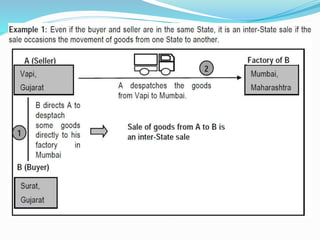
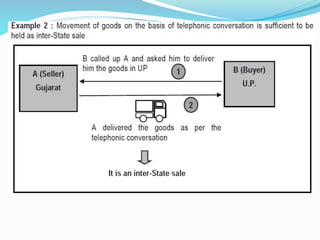
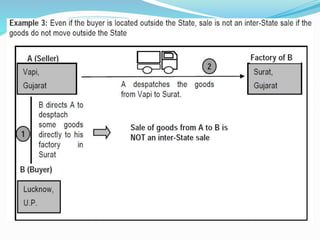
When a sale or purchase occasions the movement
of goods from one State to another.
Such movement is in pursuance of contract of sale or
purchase.](https://image.slidesharecdn.com/cst-150924180009-lva1-app6892/85/Central-Sales-Tax-66-320.jpg)
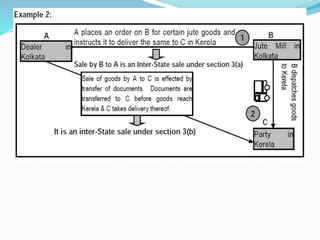
![By transfer of documents of title
to goods [Sec.3(b)]
When a sale or purchase is effected by transfer of
documents of title to goods during their movement
from one state to another.
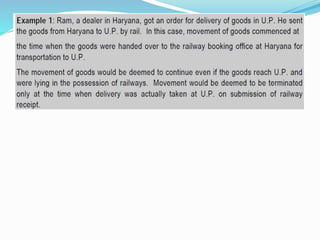
Duration of movement: Duration of movement
commences when the goods are delivered to a carrier
or other bailee for transmission and ends at the time
such delivery is taken from such carrier/ bailee.
It shall be effected during the original movement of
goods u/s 3(a).](https://image.slidesharecdn.com/cst-150924180009-lva1-app6892/85/Central-Sales-Tax-67-320.jpg)
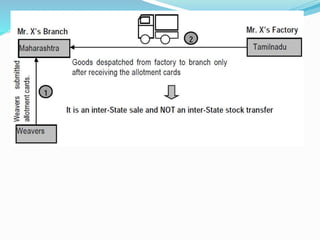
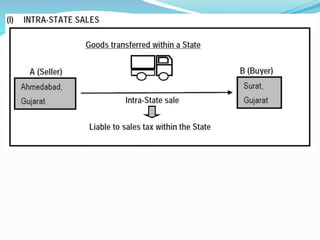
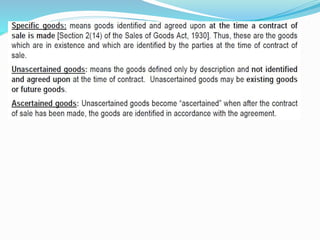
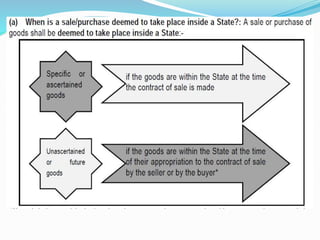
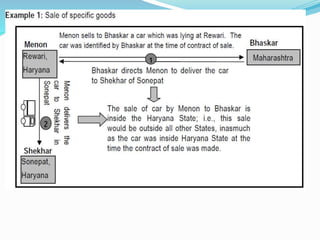
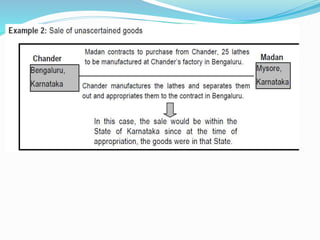
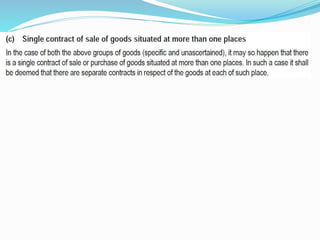
![Sale/Purchase inside a State
(intra-State) [Sec.4]](https://image.slidesharecdn.com/cst-150924180009-lva1-app6892/85/Central-Sales-Tax-83-320.jpg)
![Sale or Purchase in the course
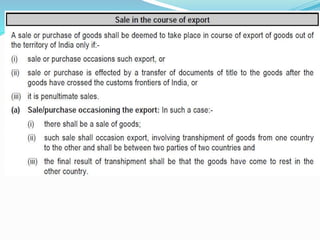
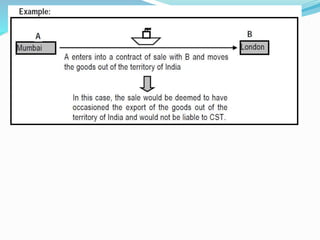
of Export [Sec.5]](https://image.slidesharecdn.com/cst-150924180009-lva1-app6892/85/Central-Sales-Tax-89-320.jpg)
![Levy of Tax on Inter-State Sale
[Sec.6]
A dealer is liable to pay tax on all sales effected by
him
In the course of inter-state trade or commerce
Liable …even if no tax is payable by him under
GST law or State tax law](https://image.slidesharecdn.com/cst-150924180009-lva1-app6892/85/Central-Sales-Tax-105-320.jpg)
![Levy of Tax on Inter-State Sale
[Sec.6]
Exceptions….
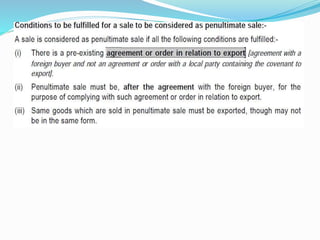
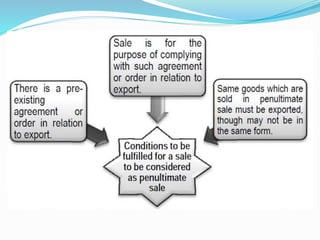
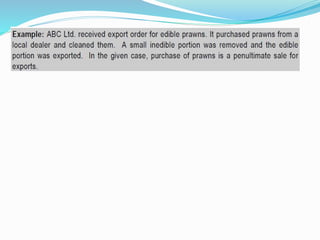
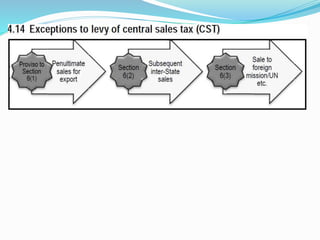
Penultimate sale which occasions for export
Inter-State sale of Electrical energy
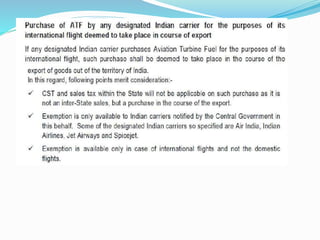
Purchase of ATF by international flights](https://image.slidesharecdn.com/cst-150924180009-lva1-app6892/85/Central-Sales-Tax-106-320.jpg)
![Determination of Turnover
[Sec.8A]
Situation 1 …
When the Turnover or Sale is given
exclusive of CST, no adjustment shall be
made to the Turnover](https://image.slidesharecdn.com/cst-150924180009-lva1-app6892/85/Central-Sales-Tax-122-320.jpg)
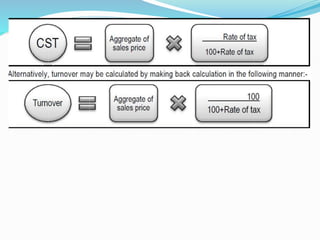
![Determination of Turnover
[Sec.8A]
Situation 2 …
If the Turnover / Sale is given inclusive of
CST, then the Taxable Turnover shall be
determined as …](https://image.slidesharecdn.com/cst-150924180009-lva1-app6892/85/Central-Sales-Tax-123-320.jpg)

The Central Sales Tax Act, 1956 provides the legal framework for levying and collecting tax on the sale of goods in the course of inter-state trade or commerce in India. Some key aspects include: 1. It defines terms like "sale", "declared goods", "place of business", and categorizes dealers as registered or unregistered. 2. The Act determines when a sale occurs within a state or inter-state and assigns an "Appropriate State" to administer the tax. 3. It empowers the central government to levy tax according to the tax rates of the Appropriate State and provides for the distribution of tax revenues among states.


