UNIT IV
INCOME TAX AND SALES TAX ACT
TAX
The term tax may be defined as compulsory
exaction of money by public authorities for
public enforceable by law and is not payment for
services.
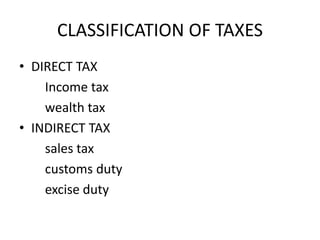
CLASSIFICATION OF TAXES
• DIRECT TAX
Income tax
wealth tax
• INDIRECT TAX
sales tax
customs duty
excise duty
TAX PLANNING
• Corporate tax planning has got a very wide
scope.
• In case of a company there is ample scope of
tax planning in respect
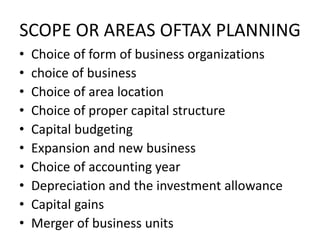
SCOPE OR AREAS OFTAX PLANNING
• Choice of form of business organizations
• choice of business
• Choice of area location
• Choice of proper capital structure
• Capital budgeting
• Expansion and new business
• Choice of accounting year
• Depreciation and the investment allowance
• Capital gains
• Merger of business units
SALES TAX
• Sales tax is a tax on the sale of goods.
• It is an indirect tax.
CLASSIFICATION OF SALES TAX
• Selective sales tax
• General sales tax
CENTRAL SALES TAX ACT, 1956
• The act formulates principles for determining
to when a sale or purchase of goods takes
place
a) in the course of inter – state trade of
commerce
b) outside a state
c) in the course of import in to or export from
India
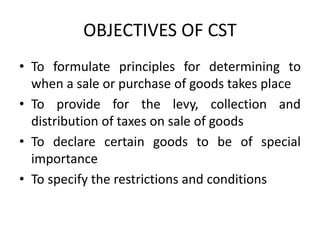
OBJECTIVES OF CST
• To formulate principles for determining to
when a sale or purchase of goods takes place
• To provide for the levy, collection and
distribution of taxes on sale of goods
• To declare certain goods to be of special
importance
• To specify the restrictions and conditions
SCOPE OF THE ACT
• Inter state sales
• Sale or purchase in the course of export and
import
• Liability and charge to sales tax
• Registration of dealers
• Determination of taxable turnover
• Levy and collection of tax
• Offences
• Declared goods
SALE OR PURCHASE OF GOODS IN THE
COURSE OF INTER-STATE TRADE
• Occasions the movement of goods from one
state to another state.
• Is effected by a transfer of the documents of
title to the goods during their movement from
one state to another.
SALE OR PURCHASE OF GOODS
OUTSIDE A STATE
• A sale which takes place in one state is said to
take place outside all other states i.e., once
the place of sale fixed in a particular state, it
shall be deemed to be outside all other states.
SALE/PURCHASE IN THE COURSE OF
EXPORT OR IMPORT
• A sale or purchase of goods shall be deemed
to take place in the course of export of goods
out of territory of India only if the sale or
purchase is effected by a transfer of
documents of title to the goods after the
goods have crossed the customs frontiers of
India.
SALE FOR EXPORT AND SALE IN THE
COURSE OF EXPORT - DISTINGUISHED
• Where the sale is effected by the seller and he
is not connected with the export of those
goods which actually takes place, it is known
as sale for export.
• In the case of sale in the course of export, the
seller would be definite that the goods sold to
the buyer are mainly for export.
VALUE ADDED TAX
• Value added tax is a method of taxation
whereby the tax is levied on the value added
at each stage of the production/ distribution
chain.
OBJECTIVES OF VAT
• Eliminates multiplicity of taxes.
• Prevents double taxation
• Eliminates inter-state tax.
• Rationalizes all tax burden in the case of goods and
services.
• Replaces existing system of inspection by built in
assessment by dealers and internal auditing.
• Makes tax structure simple, efficient and
transparent.
• Improves tax compliance
• Coordinates revenue growth with development by ad
valorem rate of tax.
• Development of fair and healthy competition.
ADVANTAGES OF VAT
• Removes the cascading of taxes
• Widening of tax base and reduction in rates of
tax
• Does not distort trade and production methods
• Encourages better compliance
• Improves economic efficiency
• Improves export competitiveness
• Creates an audit trial
METHODS OF VAT CALCULATION
• ADDITION METHOD
• SUBTRACTION METHOD
• TAX CREDIT METHOD

Legal Aspects Of Business Unit - 4 PPTs

  • 1.
    UNIT IV INCOME TAXAND SALES TAX ACT
  • 2.
    TAX The term taxmay be defined as compulsory exaction of money by public authorities for public enforceable by law and is not payment for services.
  • 3.
    CLASSIFICATION OF TAXES •DIRECT TAX Income tax wealth tax • INDIRECT TAX sales tax customs duty excise duty
  • 4.
    TAX PLANNING • Corporatetax planning has got a very wide scope. • In case of a company there is ample scope of tax planning in respect
  • 5.
    SCOPE OR AREASOFTAX PLANNING • Choice of form of business organizations • choice of business • Choice of area location • Choice of proper capital structure • Capital budgeting • Expansion and new business • Choice of accounting year • Depreciation and the investment allowance • Capital gains • Merger of business units
  • 6.
    SALES TAX • Salestax is a tax on the sale of goods. • It is an indirect tax.
  • 7.
    CLASSIFICATION OF SALESTAX • Selective sales tax • General sales tax
  • 8.
    CENTRAL SALES TAXACT, 1956 • The act formulates principles for determining to when a sale or purchase of goods takes place a) in the course of inter – state trade of commerce b) outside a state c) in the course of import in to or export from India
  • 9.
    OBJECTIVES OF CST •To formulate principles for determining to when a sale or purchase of goods takes place • To provide for the levy, collection and distribution of taxes on sale of goods • To declare certain goods to be of special importance • To specify the restrictions and conditions
  • 10.
    SCOPE OF THEACT • Inter state sales • Sale or purchase in the course of export and import • Liability and charge to sales tax • Registration of dealers • Determination of taxable turnover • Levy and collection of tax • Offences • Declared goods
  • 11.
    SALE OR PURCHASEOF GOODS IN THE COURSE OF INTER-STATE TRADE • Occasions the movement of goods from one state to another state. • Is effected by a transfer of the documents of title to the goods during their movement from one state to another.
  • 12.
    SALE OR PURCHASEOF GOODS OUTSIDE A STATE • A sale which takes place in one state is said to take place outside all other states i.e., once the place of sale fixed in a particular state, it shall be deemed to be outside all other states.
  • 13.
    SALE/PURCHASE IN THECOURSE OF EXPORT OR IMPORT • A sale or purchase of goods shall be deemed to take place in the course of export of goods out of territory of India only if the sale or purchase is effected by a transfer of documents of title to the goods after the goods have crossed the customs frontiers of India.
  • 14.
    SALE FOR EXPORTAND SALE IN THE COURSE OF EXPORT - DISTINGUISHED • Where the sale is effected by the seller and he is not connected with the export of those goods which actually takes place, it is known as sale for export. • In the case of sale in the course of export, the seller would be definite that the goods sold to the buyer are mainly for export.
  • 15.
    VALUE ADDED TAX •Value added tax is a method of taxation whereby the tax is levied on the value added at each stage of the production/ distribution chain.
  • 16.
    OBJECTIVES OF VAT •Eliminates multiplicity of taxes. • Prevents double taxation • Eliminates inter-state tax. • Rationalizes all tax burden in the case of goods and services. • Replaces existing system of inspection by built in assessment by dealers and internal auditing. • Makes tax structure simple, efficient and transparent. • Improves tax compliance • Coordinates revenue growth with development by ad valorem rate of tax. • Development of fair and healthy competition.
  • 17.
    ADVANTAGES OF VAT •Removes the cascading of taxes • Widening of tax base and reduction in rates of tax • Does not distort trade and production methods • Encourages better compliance • Improves economic efficiency • Improves export competitiveness • Creates an audit trial
  • 18.
    METHODS OF VATCALCULATION • ADDITION METHOD • SUBTRACTION METHOD • TAX CREDIT METHOD