Group 1 Abhirup Nag 001 Arindam Mitra 002 Vikram S. Dhariwal 005 Ankit Gupta 007 Smarth Tandon 010 Dhara Badiani 012 Merly Ann 014
Value-added-tax - Added at each stage of sale of a commodity . Tax is added when a product passes from  Manufacturer to a whole seller Again from the whole-seller to the retailer. As a result, under VAT tax is to be paid at every stage in the value addition chain.
The seller charges VAT to the buyer. The seller pays this VAT to the government.  If the purchaser is not an end user, the tax he has paid for such purchases can be deducted from the tax it charges to its customers. The government only receives the difference; in other words, it is paid tax on the gross margin of each transaction, by each participant in the sales chain.
Sales tax is levied on the sale of a commodity, which is produced or imported and sold for the first time. If the product is sold subsequently without being processed further, it is exempt from sales tax. It is a single point tax unlike VAT which is collected at multiple points
More equitable – tax burden is shared by all dealers. More transparent – easy procedures and only two rates, broadly speaking.  Simpler- easy computation and easy compliance.  Better Compliance - through self-policing.  Prevents cascading effect – through input rebate.  Avoids distortions in trade and economy – uniform tax rates.
VAT proposed two types of rate of tax mainly: 4% on declared goods or the goods commonly used. 12.5% on goods called Revenue Neutral Rates (RNR) on all goods. There would be no fall in such remaining goods. Two special rates - 1% on silver or gold and 20% on liquor.  Petroleum products out of the purview of CST. Uniform Rates in the VAT system. certain commodities exempted.  VAT proposes uniform rates in all the states.  States to finalize the rates.  RNR must not be less than 10%.
Input Tax Credit availed for state taxes. In case of export, the tax, paid on purchase outside India, would be refunded.  In case of the branch transfer or consignment of sale outside the state, no refund would be provided. Collection of tax by seller/dealer at each stage.  VAT is not cascading or additive.  The net effect would be as follows: - the tax, previously paid on the sale of goods, would be fully adjusted. It will be like levying tax on goods, sold in the last state or at retail stage.
National model On basis of Consumption Calculated formula Sub national model Designed by particular states Economically thought method Requisition of transfers till 50%
Does not cover services Exemptions Floor Rate General Rate of 12.5% is too high Classification of Capital goods Application of  VAT on MRP
The basic principle is ‘to collect the tax at the inception of the goods that is going to be manufactured’. The individual entities in the supply chain are required to pay taxes only with regard to the value additions done by them. VAT is not a standard denomination in all the states it is varied in different part of the country.
More than 550 items are covered under the new Indian VAT regime. Nearly 270 items including drugs and medicines, all industrial and agricultural inputs, capital goods as well as declared goods  attract 4 % VAT in India.  Remaining items attract 12.5 %. Precious metals such as gold and bullion are taxed at 1%.  Petrol and diesel are kept out of VAT.
Tax Credit method : Difference between total tax charged on outputs/sales and the total tax paid to suppliers on inputs / purchases. Subtraction Method:  Tax is collected and charged on the aggregate value of tax payable on sale & purchase.  Addition Method:  Summation of all value-added elements.
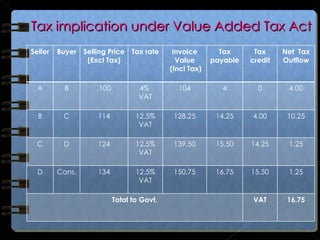
Tax implication under Value Added Tax Act Seller Buyer Selling Price (Excl Tax) Tax rate Invoice Value (Incl Tax) Tax payable Tax credit Net  Tax Outflow A B 100 4%  VAT 104 4 0 4.00 B C 114 12.5% VAT 128.25 14.25 4.00 10.25 C D 124 12.5% VAT 139.50 15.50 14.25 1.25 D Cons. 134 12.5% VAT 150.75 16.75 15.50 1.25 Total to Govt. VAT 16.75
India’s Biggest Tax reform. Set to be launched from April 2011. Economical integration for the country, cheaper goods. GST to replace VAT, Service Tax, Excise Duties and Central Sales Tax. Presently, combined levies of central and state go up to 30%. GST-Flat rate of 16% (8% for central,8% for State) Current service tax levels to go up by 4%.
Alcohol and petroleum products kept out of purview of GST. Threshold limits – Rs.10Lacs (States & U.T), Rs.1.5Crores(Central) 2011-12 – Central GST to be at 10% standard rate with 6% on essential goods. Services to be taxed at 8%. 2012-13 – Standard rate to come down to 9%, rest unchanged. 2013-14 – Combined 16% rate for Goods and Services. Input Tax Credit to go up, Less Inventory Costs.
Input generally means goods purchased by a dealer in the course of his business for re-sale or for use in the manufacture, processing, packing/storing of other goods or any other business use. The tax paid on inputs is known as Input Tax.  It is the credit for tax paid on inputs. Every dealer has to pay output tax on the taxable sale effected by him. The basic formula of VAT is that every dealer pays tax only on the value addition in his hands. In simple words input tax credit is the mechanism by which the dealer is enabled to set off against his output tax, the input tax. Dealers are not eligible for input tax credit on all inputs.
After the abolition of CST the direct marketing concept may gain ground and the necessity of having warehouse, godowns etc. in all states may decrease or finish. It would adversely affect the trade and employment of the states.  America which has similar federal and state laws/  Constitution has not implemented VAT. It needs study as to why a develop and advance economy like America has not adopted VAT. 
 

Vat And Its Applications

  • 1.
    Group 1 AbhirupNag 001 Arindam Mitra 002 Vikram S. Dhariwal 005 Ankit Gupta 007 Smarth Tandon 010 Dhara Badiani 012 Merly Ann 014
  • 2.
    Value-added-tax - Addedat each stage of sale of a commodity . Tax is added when a product passes from Manufacturer to a whole seller Again from the whole-seller to the retailer. As a result, under VAT tax is to be paid at every stage in the value addition chain.
  • 3.
    The seller chargesVAT to the buyer. The seller pays this VAT to the government. If the purchaser is not an end user, the tax he has paid for such purchases can be deducted from the tax it charges to its customers. The government only receives the difference; in other words, it is paid tax on the gross margin of each transaction, by each participant in the sales chain.
  • 4.
    Sales tax islevied on the sale of a commodity, which is produced or imported and sold for the first time. If the product is sold subsequently without being processed further, it is exempt from sales tax. It is a single point tax unlike VAT which is collected at multiple points
  • 5.
    More equitable –tax burden is shared by all dealers. More transparent – easy procedures and only two rates, broadly speaking. Simpler- easy computation and easy compliance. Better Compliance - through self-policing. Prevents cascading effect – through input rebate. Avoids distortions in trade and economy – uniform tax rates.
  • 6.
    VAT proposed twotypes of rate of tax mainly: 4% on declared goods or the goods commonly used. 12.5% on goods called Revenue Neutral Rates (RNR) on all goods. There would be no fall in such remaining goods. Two special rates - 1% on silver or gold and 20% on liquor. Petroleum products out of the purview of CST. Uniform Rates in the VAT system. certain commodities exempted. VAT proposes uniform rates in all the states. States to finalize the rates. RNR must not be less than 10%.
  • 7.
    Input Tax Creditavailed for state taxes. In case of export, the tax, paid on purchase outside India, would be refunded. In case of the branch transfer or consignment of sale outside the state, no refund would be provided. Collection of tax by seller/dealer at each stage. VAT is not cascading or additive. The net effect would be as follows: - the tax, previously paid on the sale of goods, would be fully adjusted. It will be like levying tax on goods, sold in the last state or at retail stage.
  • 8.
    National model Onbasis of Consumption Calculated formula Sub national model Designed by particular states Economically thought method Requisition of transfers till 50%
  • 9.
    Does not coverservices Exemptions Floor Rate General Rate of 12.5% is too high Classification of Capital goods Application of VAT on MRP
  • 10.
    The basic principleis ‘to collect the tax at the inception of the goods that is going to be manufactured’. The individual entities in the supply chain are required to pay taxes only with regard to the value additions done by them. VAT is not a standard denomination in all the states it is varied in different part of the country.
  • 11.
    More than 550items are covered under the new Indian VAT regime. Nearly 270 items including drugs and medicines, all industrial and agricultural inputs, capital goods as well as declared goods attract 4 % VAT in India. Remaining items attract 12.5 %. Precious metals such as gold and bullion are taxed at 1%. Petrol and diesel are kept out of VAT.
  • 12.
    Tax Credit method: Difference between total tax charged on outputs/sales and the total tax paid to suppliers on inputs / purchases. Subtraction Method: Tax is collected and charged on the aggregate value of tax payable on sale & purchase. Addition Method: Summation of all value-added elements.
  • 13.
    Tax implication underValue Added Tax Act Seller Buyer Selling Price (Excl Tax) Tax rate Invoice Value (Incl Tax) Tax payable Tax credit Net Tax Outflow A B 100 4% VAT 104 4 0 4.00 B C 114 12.5% VAT 128.25 14.25 4.00 10.25 C D 124 12.5% VAT 139.50 15.50 14.25 1.25 D Cons. 134 12.5% VAT 150.75 16.75 15.50 1.25 Total to Govt. VAT 16.75
  • 14.
    India’s Biggest Taxreform. Set to be launched from April 2011. Economical integration for the country, cheaper goods. GST to replace VAT, Service Tax, Excise Duties and Central Sales Tax. Presently, combined levies of central and state go up to 30%. GST-Flat rate of 16% (8% for central,8% for State) Current service tax levels to go up by 4%.
  • 15.
    Alcohol and petroleumproducts kept out of purview of GST. Threshold limits – Rs.10Lacs (States & U.T), Rs.1.5Crores(Central) 2011-12 – Central GST to be at 10% standard rate with 6% on essential goods. Services to be taxed at 8%. 2012-13 – Standard rate to come down to 9%, rest unchanged. 2013-14 – Combined 16% rate for Goods and Services. Input Tax Credit to go up, Less Inventory Costs.
  • 16.
    Input generally meansgoods purchased by a dealer in the course of his business for re-sale or for use in the manufacture, processing, packing/storing of other goods or any other business use. The tax paid on inputs is known as Input Tax. It is the credit for tax paid on inputs. Every dealer has to pay output tax on the taxable sale effected by him. The basic formula of VAT is that every dealer pays tax only on the value addition in his hands. In simple words input tax credit is the mechanism by which the dealer is enabled to set off against his output tax, the input tax. Dealers are not eligible for input tax credit on all inputs.
  • 17.
    After the abolitionof CST the direct marketing concept may gain ground and the necessity of having warehouse, godowns etc. in all states may decrease or finish. It would adversely affect the trade and employment of the states.  America which has similar federal and state laws/ Constitution has not implemented VAT. It needs study as to why a develop and advance economy like America has not adopted VAT. 
  • 18.