GST
(Goods and Service Tax)
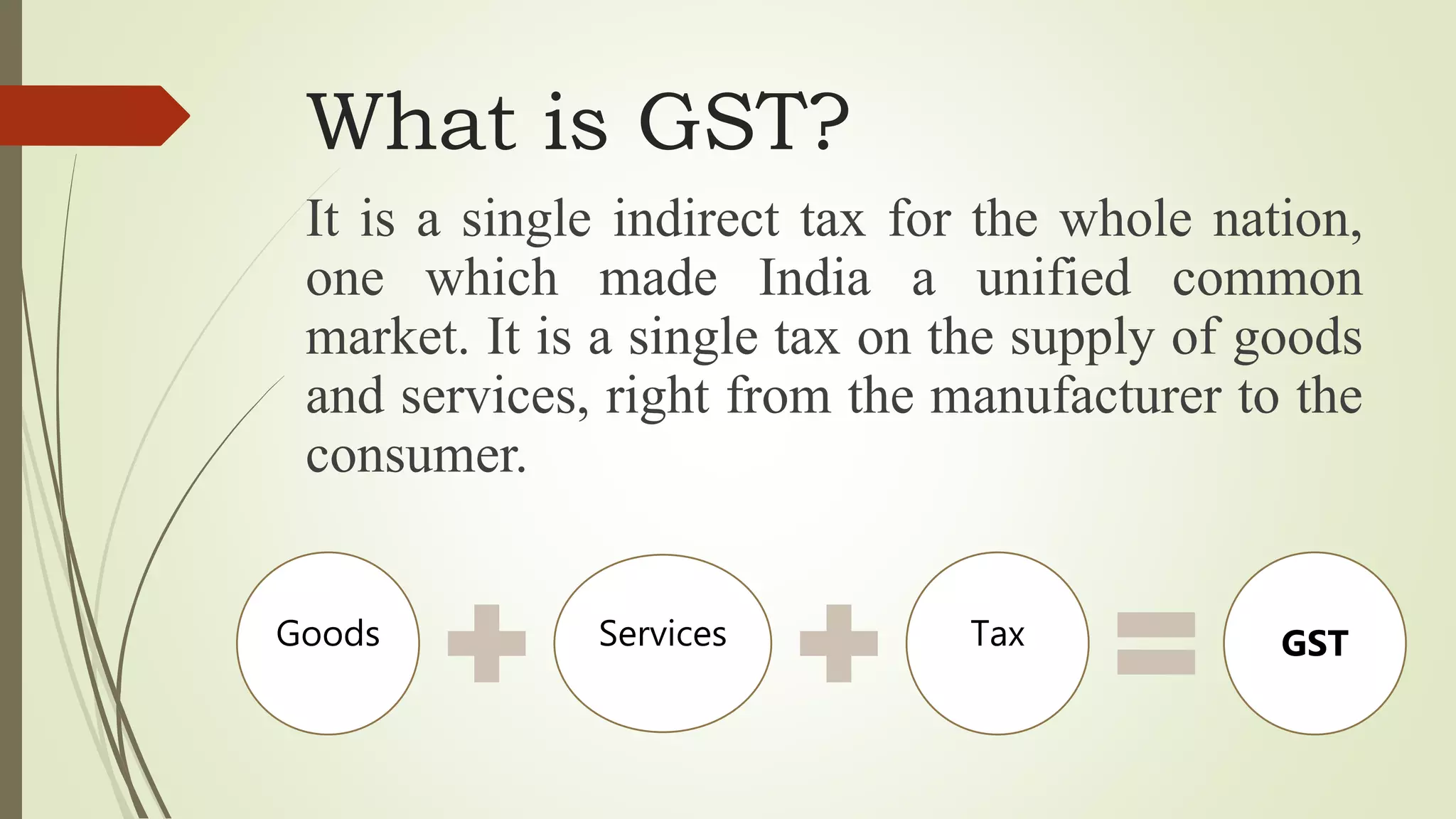
What is GST?
It is a single indirect tax for the whole nation,
one which made India a unified common
market. It is a single tax on the supply of goods
and services, right from the manufacturer to the
consumer.
Goods Services Tax GST
Countries Standard rates of GST
The government
has categorized
items in five
major slabs –
0%
5%
12%
18%
28%
India’s GST slab rates
What are the proposed taxes to be subsumed under GST?
Central Excise duty
Additional Excise duties
Excise Duty levied under the
Medicinal and Toiletries
Preparation Act
Service Tax levied under
Chapter V of the Finance Act,
1994
Countervailing Duty (CVD)
Tax Surcharges
Special Additional Duty of
Customs (SAD)
Central Sales and Central
Cesses.
 Additional Customs Duty,
commonly known as
The central taxes proposed to be subsumed under CGST include:
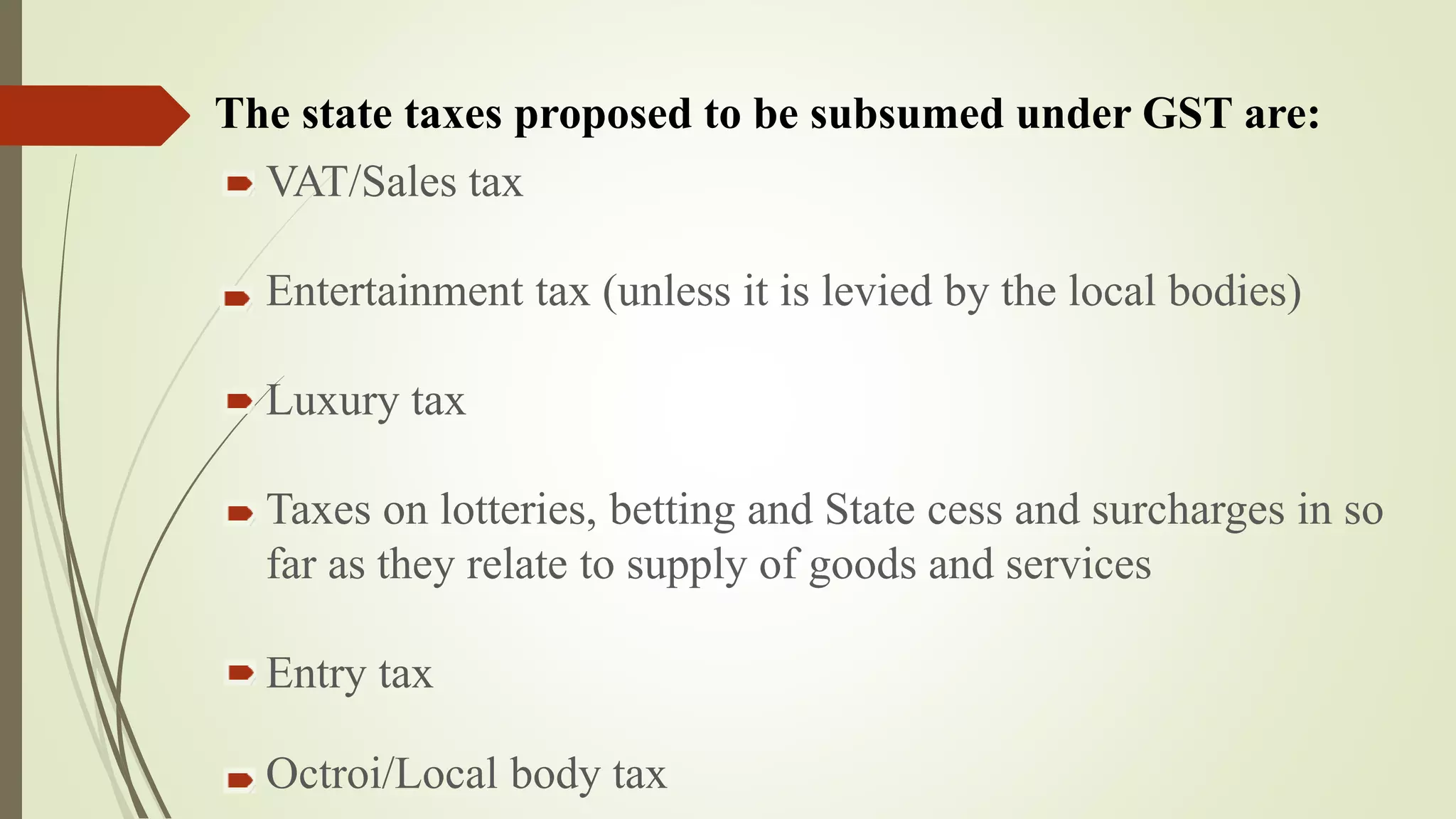
VAT/Sales tax
Entertainment tax (unless it is levied by the local bodies)
Luxury tax
Taxes on lotteries, betting and State cess and surcharges in so
far as they relate to supply of goods and services
Entry tax
Octroi/Local body tax
The state taxes proposed to be subsumed under GST are:
Structure of CGST
Governed by the Central Government.
It will include following taxes-
1. Central Excise Duty
2. Service tax
3. Countervailing duties
4. Surcharge ,education &Secondary/Higher Education Cess .
5. Additional excise Duty
CGST
CGST is a tax levied on Intra State supplies of both goods and
services by the Central Government and will be governed by the
CGST Act.
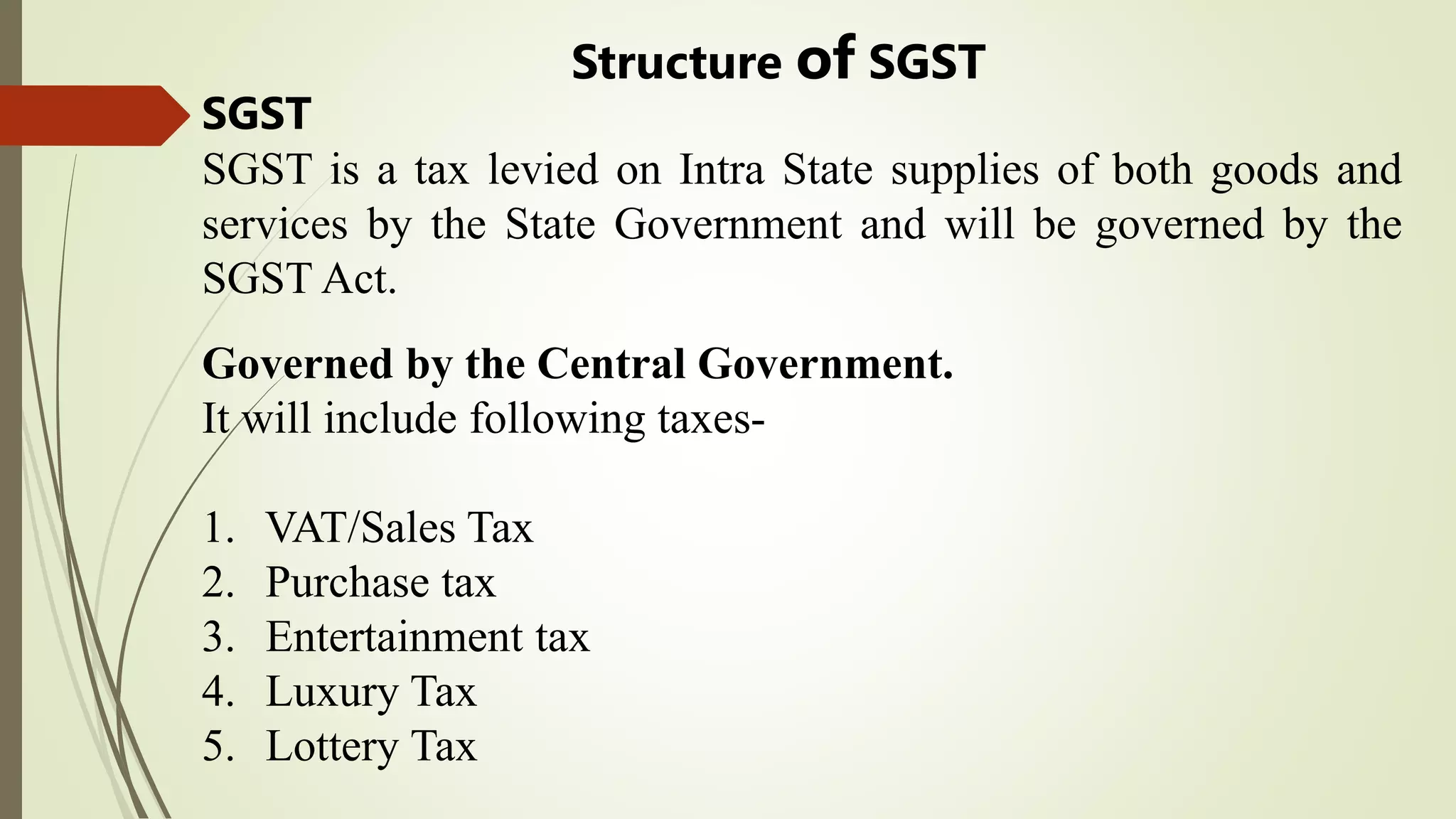
Structure of SGST
Governed by the Central Government.
It will include following taxes-
1. VAT/Sales Tax
2. Purchase tax
3. Entertainment tax
4. Luxury Tax
5. Lottery Tax
SGST
SGST is a tax levied on Intra State supplies of both goods and
services by the State Government and will be governed by the
SGST Act.
Structure of IGST
IGST
IGST will be applicable on any supply of goods and/or services in
both cases of import into India and export from India.
IGST is designed to ensure seamless flow of input tax credit
from one state to another.
It is designed so that a state doesn’t have to deal with every other
state to settle the tax amounts.
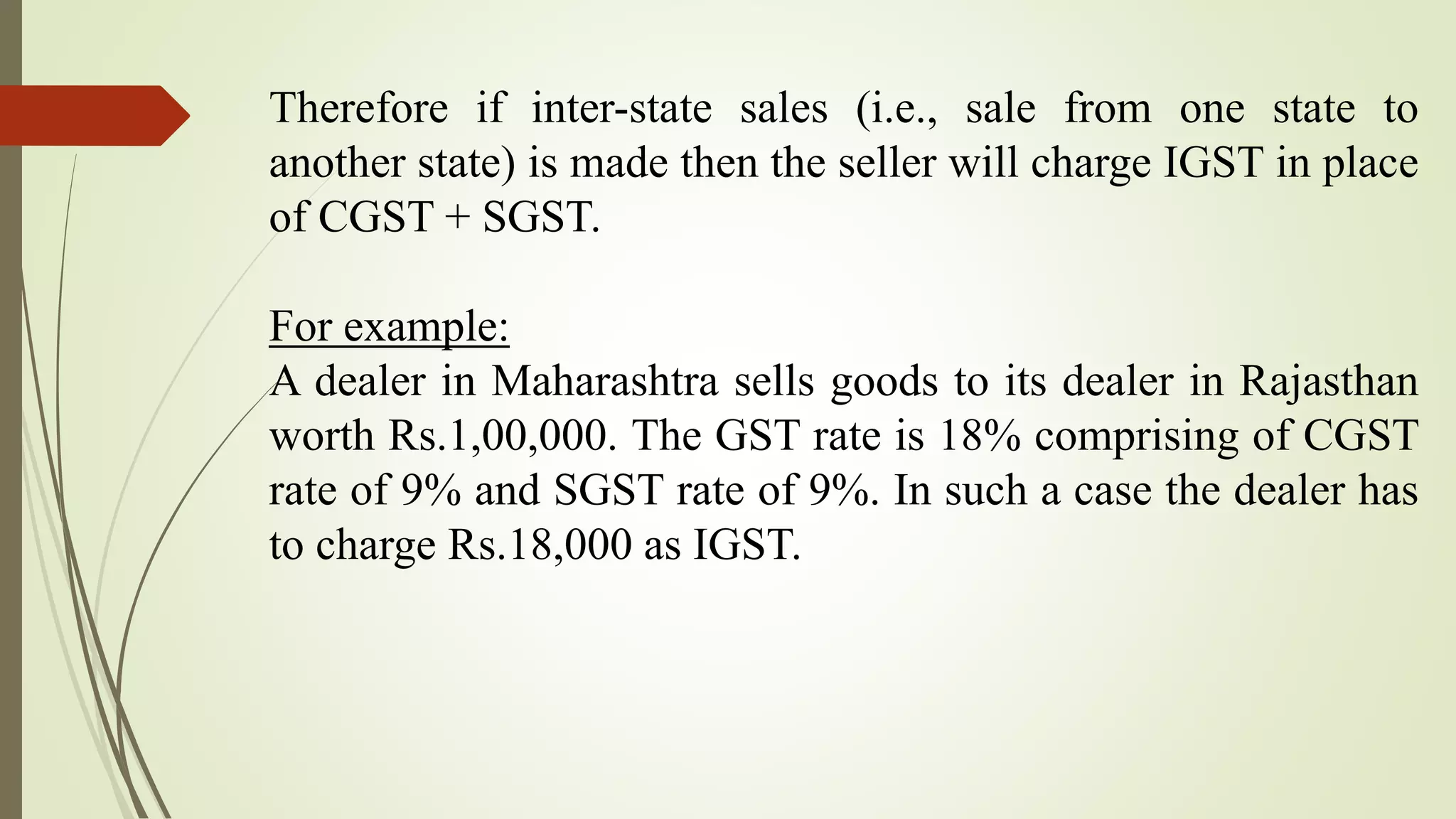
Therefore if inter-state sales (i.e., sale from one state to
another state) is made then the seller will charge IGST in place
of CGST + SGST.
For example:
A dealer in Maharashtra sells goods to its dealer in Rajasthan
worth Rs.1,00,000. The GST rate is 18% comprising of CGST
rate of 9% and SGST rate of 9%. In such a case the dealer has
to charge Rs.18,000 as IGST.
Structure of UTGST
UTGST
The UTGST bill is presented in respective states government
to implement as UTGST Act.
The Main purpose of UTGST bill is to apply a collection of
tax on every Intra UT supply of goods and service in the
union territories in absence of legislature and has similar
properties as that of SGST.
Goods and Services Tax Network
Goods and Services Tax Network (GSTN) It was incorporated
on March 28, 2013. It is a Section 8 (under new companies Act,
not for profit companies are governed under section 8), non-
Government, private limited company.
Objective:
GSTN has been entrusted with the responsibility of building
Indirect Taxation platform for GST to help tax payers prepare, file,
rectify returns and make payments of your indirect tax liabilities.
It also provides IT infrastructure and services to the Central and
State Governments
Nature of GST Council
The GST Council will be quasi-legislative–cum– administrative
body because it functions both legislative as well as
administrative duties as assigned by the Parliament to it.
Members of GST Council
• Union Finance Minister- Chairperson
• The Union Minister of State, in-charge of Revenue of
finance-Member
• The Minister In-charge of finance or taxation or any other
Minister nominated by each State Government Members
GSTCouncil
GOODS @ 0%
EXEMPTED
UNDER
GST
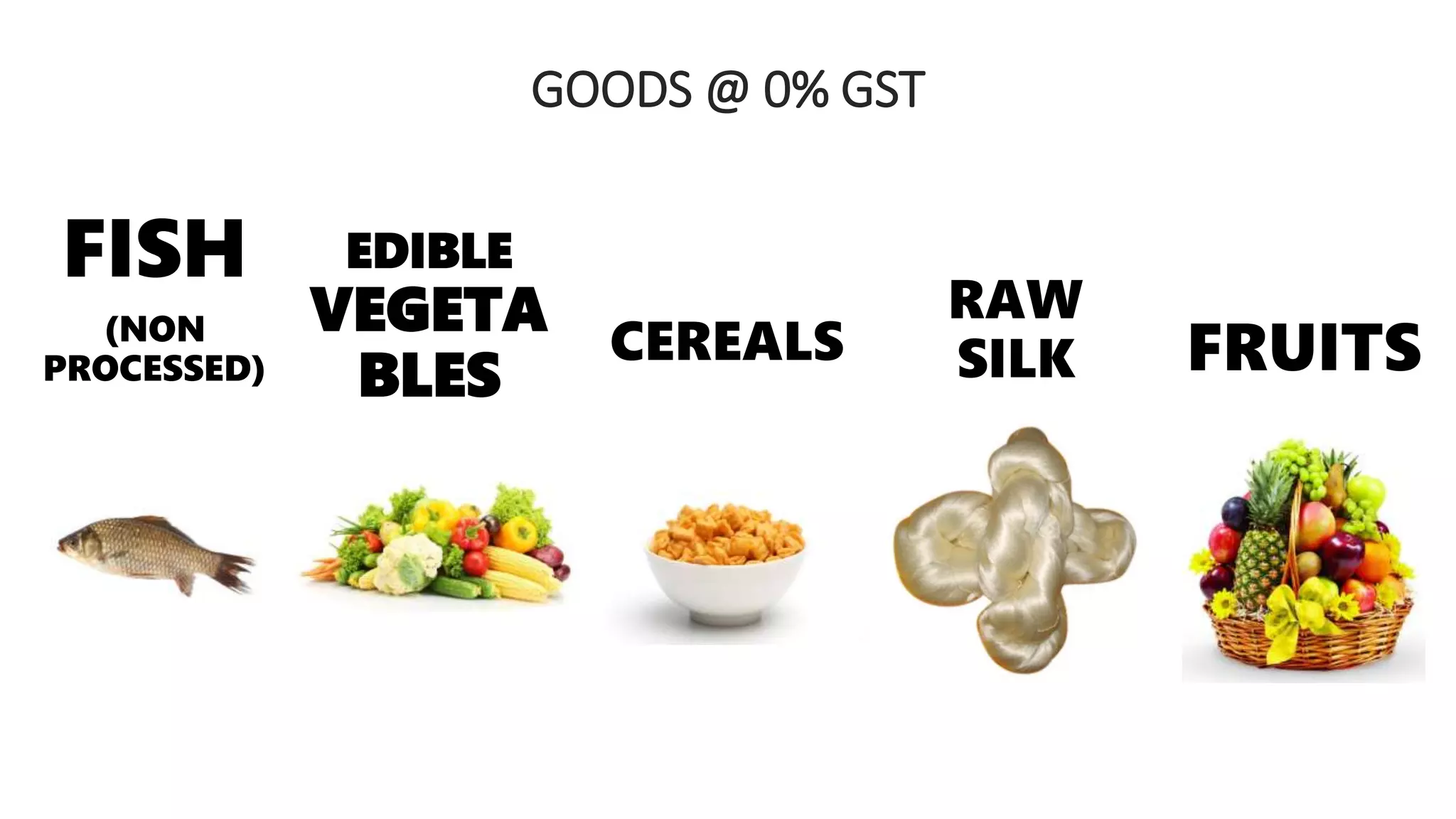
GOODS @ 0% GST
FISH
(NON
PROCESSED)
EDIBLE
VEGETA
BLES
CEREALS
RAW
SILK FRUITS
GOODS @ 0% GST
CANE
JAGGERY
HEARING
AID
BANGLES
LIVE
ANIMAL
(EXCEPT
HORSES)
TENDER
COCONUT
GOODS @ 0% GST
SILK
WASTE
ALL
SEEDS
WOOD
CHARCOL
HAND
LOOM
ORGANIC
MANURE
(NON
BRANDED)
GOODS @ 0% GST
COFFEE
BEANS
(NOT
ROASTED)
GINGER
HUMAN
BLOOD
&
COMPON
ENTS
ALL
TYPES OF
CONTRA-
-CEPTIVES
FIREWOOD
/ WOOD
FUEL
Input tax credit
Input credit means at the time of paying tax on
output, you can reduce the tax you have
already paid on inputs and pay the balance
amount.
SMALL SUPPLIES
& COMPOSITION
SCHEME
UNDER GST
Composition Scheme is a simple
and easy scheme under GST for taxpayers. Small
taxpayers can get rid of tedious GST formalities
and pay GST at a fixed rate of turnover.
This scheme can be opted by any taxpayer
whose turnover is less than Rs.1.5 crore.
Why was Composition Scheme
introduced?
The GST regime has brought in many changes along
with the following:
1. Increase in the number of GST returns
2. Payment of tax on a monthly basis
3. Small and new taxpayers will find it difficult to
comply with so many rules.
Why was Composition Scheme
introduced?
5. Hence, the government has introduced the concept of
Composition Scheme.
6. Now there is an option for small and new taxpayer to
opt for Composition scheme and have lesser
compliance.
7. Also, a taxpayer opting for composition scheme has to
pay tax at a nominal rate.
Who can opt for
Composition Scheme?
A taxpayer whose turnover is below Rs1.5
crore can opt in for Composition Scheme. In
case of North-Eastern states and Himachal
Pradesh, the limit is now Rs75 lakh.
Who cannot opt for
Composition Scheme?
The following people cannot opt for the scheme:
Supplier of services other than restaurant related services
Manufacturer of ice cream, pan masala, or tobacco
Casual taxable person or a non-resident taxable person
Businesses which supply goods through an e-commerce
operator
Conditions for availing
Composition Scheme
The following conditions must be satisfied in order to opt for
composition scheme:
No Input Tax Credit can be claimed by a dealer opting for composition
scheme.
The taxpayer cannot make any inter-state supply of goods.
Taxpayer has to pay tax at normal rates for transactions under Reverse
Charge Mechanism.
Conditions for availing
Composition Scheme
If a taxable person has different segments of businesses
(such as textile, electronic accessories, groceries, etc.)
under the same PAN, they must register all such businesses
under the scheme collectively or opt out of the scheme.
The taxpayer has to mention the words ‘composition
taxable person’ on every notice or signboard displayed
prominently at their place of business.
Conditions for availing
Composition Scheme
The taxpayer has to mention the words
‘composition taxable person’ on every bill of
supply issued by him.
Those supplying goods can provide services
of upto Rs. 5 lakh.
How can a taxpayer opt
for composition scheme ?
To opt in for composition scheme a taxpayer has to file
Form GST CMP-01 or GST CMP-02 with the
government. This can be done online after logging into
the GST Portal.
This intimation should be given at the beginning of
every Financial Year by a dealer wanting to opt for
Composition Scheme.
What documents should a composition
dealer issue while making supply?
A composition dealer cannot issue tax invoice. This is because
a composition dealer cannot charge tax from their customers.
They need to pay tax out of their own pocket.
Hence, the dealer has to issue a Bill of Supply.
The dealer should also mention “composition taxable person,
not eligible to collect tax on supplies” at the top of the Bill of
Supply.
GST rates for a
composition dealer
The rates specified above are only for taxable supplies made by
the taxpayer.
Exempted goods are to be excluded while calculating tax.
How should GST payment be
made by a composition
dealer?
GST Payment has to be made out of pocket. It means
that a dealer opting for Composition Scheme cannot
charge GST in their Invoice. The consumer/ the
receiver of supplies will not be liable to pay GST to
the supplier who has opted for Composition Scheme.
What are the returns to be
filed by a composition dealer?
1. A dealer is required to file a quarterly return GSTR-4 by 18th
of the month after the end of the quarter. Also, an annual
return GSTR-9A has to be filed by 31st December of next
financial year.
2. Also, note that a dealer registered under composition scheme
is not required to maintain detailed records.
Advantages of
Composition Scheme
Advantages of registering under composition scheme:
Lesser compliance (returns, maintaining books of
record, issuance of invoices).
Limited tax liability.
High liquidity as taxes are at a lower rate.
Disadvantages of
Composition Scheme
Disadvantages are :-
A limited territory of business. The dealer is barred
from carrying out inter-state transactions.
No Input Tax Credit available to composition dealers.
The taxpayer will not be eligible to supply goods
through an e-commerce portal.
CLASSIFICATION OF
GOODS & SERVICES
UNDER GST
GOODS &
SERVICES
MIXED
SUPPLIES
COMPOSITE
SUPPLIES
Mixed Supply
Two or more individual supplies of goods or
services, or any combination thereof, made in
conjunction with each other by a taxable person for a
single price where such supply does not constitute a
composite supply.
Composite Supply
The supply of two or more supplies of goods or
services by a taxable person, which comprises of a
combination of goods and services naturally bundled
and supplied together in the ordinary course of
business, is called as a Composite Supply.
In other words, a Composite Supply comprises goods
and services which are bundled owing to natural
necessities.
Composite Supply
The elements in a composite supply of goods and
services are generally bifurcated as:
oPrincipal Supply - the pre-dominant element in
the Composite Supply of goods or services
oDependent Supply - dependent on the principal
supply
Advantages & Disadvantages of GST
Goods And Service Tax

Goods And Service Tax

  • 1.
  • 2.
    What is GST? Itis a single indirect tax for the whole nation, one which made India a unified common market. It is a single tax on the supply of goods and services, right from the manufacturer to the consumer. Goods Services Tax GST
  • 3.
    Countries Standard ratesof GST The government has categorized items in five major slabs – 0% 5% 12% 18% 28% India’s GST slab rates
  • 4.
    What are theproposed taxes to be subsumed under GST? Central Excise duty Additional Excise duties Excise Duty levied under the Medicinal and Toiletries Preparation Act Service Tax levied under Chapter V of the Finance Act, 1994 Countervailing Duty (CVD) Tax Surcharges Special Additional Duty of Customs (SAD) Central Sales and Central Cesses.  Additional Customs Duty, commonly known as The central taxes proposed to be subsumed under CGST include:
  • 5.
    VAT/Sales tax Entertainment tax(unless it is levied by the local bodies) Luxury tax Taxes on lotteries, betting and State cess and surcharges in so far as they relate to supply of goods and services Entry tax Octroi/Local body tax The state taxes proposed to be subsumed under GST are:
  • 6.
    Structure of CGST Governedby the Central Government. It will include following taxes- 1. Central Excise Duty 2. Service tax 3. Countervailing duties 4. Surcharge ,education &Secondary/Higher Education Cess . 5. Additional excise Duty CGST CGST is a tax levied on Intra State supplies of both goods and services by the Central Government and will be governed by the CGST Act.
  • 7.
    Structure of SGST Governedby the Central Government. It will include following taxes- 1. VAT/Sales Tax 2. Purchase tax 3. Entertainment tax 4. Luxury Tax 5. Lottery Tax SGST SGST is a tax levied on Intra State supplies of both goods and services by the State Government and will be governed by the SGST Act.
  • 8.
    Structure of IGST IGST IGSTwill be applicable on any supply of goods and/or services in both cases of import into India and export from India. IGST is designed to ensure seamless flow of input tax credit from one state to another. It is designed so that a state doesn’t have to deal with every other state to settle the tax amounts.
  • 9.
    Therefore if inter-statesales (i.e., sale from one state to another state) is made then the seller will charge IGST in place of CGST + SGST. For example: A dealer in Maharashtra sells goods to its dealer in Rajasthan worth Rs.1,00,000. The GST rate is 18% comprising of CGST rate of 9% and SGST rate of 9%. In such a case the dealer has to charge Rs.18,000 as IGST.
  • 10.
    Structure of UTGST UTGST TheUTGST bill is presented in respective states government to implement as UTGST Act. The Main purpose of UTGST bill is to apply a collection of tax on every Intra UT supply of goods and service in the union territories in absence of legislature and has similar properties as that of SGST.
  • 11.
    Goods and ServicesTax Network Goods and Services Tax Network (GSTN) It was incorporated on March 28, 2013. It is a Section 8 (under new companies Act, not for profit companies are governed under section 8), non- Government, private limited company. Objective: GSTN has been entrusted with the responsibility of building Indirect Taxation platform for GST to help tax payers prepare, file, rectify returns and make payments of your indirect tax liabilities. It also provides IT infrastructure and services to the Central and State Governments
  • 12.
    Nature of GSTCouncil The GST Council will be quasi-legislative–cum– administrative body because it functions both legislative as well as administrative duties as assigned by the Parliament to it. Members of GST Council • Union Finance Minister- Chairperson • The Union Minister of State, in-charge of Revenue of finance-Member • The Minister In-charge of finance or taxation or any other Minister nominated by each State Government Members GSTCouncil
  • 13.
  • 14.
    GOODS @ 0%GST FISH (NON PROCESSED) EDIBLE VEGETA BLES CEREALS RAW SILK FRUITS
  • 15.
    GOODS @ 0%GST CANE JAGGERY HEARING AID BANGLES LIVE ANIMAL (EXCEPT HORSES) TENDER COCONUT
  • 16.
    GOODS @ 0%GST SILK WASTE ALL SEEDS WOOD CHARCOL HAND LOOM ORGANIC MANURE (NON BRANDED)
  • 17.
    GOODS @ 0%GST COFFEE BEANS (NOT ROASTED) GINGER HUMAN BLOOD & COMPON ENTS ALL TYPES OF CONTRA- -CEPTIVES FIREWOOD / WOOD FUEL
  • 18.
    Input tax credit Inputcredit means at the time of paying tax on output, you can reduce the tax you have already paid on inputs and pay the balance amount.
  • 20.
  • 21.
    Composition Scheme isa simple and easy scheme under GST for taxpayers. Small taxpayers can get rid of tedious GST formalities and pay GST at a fixed rate of turnover. This scheme can be opted by any taxpayer whose turnover is less than Rs.1.5 crore.
  • 22.
    Why was CompositionScheme introduced? The GST regime has brought in many changes along with the following: 1. Increase in the number of GST returns 2. Payment of tax on a monthly basis 3. Small and new taxpayers will find it difficult to comply with so many rules.
  • 23.
    Why was CompositionScheme introduced? 5. Hence, the government has introduced the concept of Composition Scheme. 6. Now there is an option for small and new taxpayer to opt for Composition scheme and have lesser compliance. 7. Also, a taxpayer opting for composition scheme has to pay tax at a nominal rate.
  • 24.
    Who can optfor Composition Scheme? A taxpayer whose turnover is below Rs1.5 crore can opt in for Composition Scheme. In case of North-Eastern states and Himachal Pradesh, the limit is now Rs75 lakh.
  • 25.
    Who cannot optfor Composition Scheme? The following people cannot opt for the scheme: Supplier of services other than restaurant related services Manufacturer of ice cream, pan masala, or tobacco Casual taxable person or a non-resident taxable person Businesses which supply goods through an e-commerce operator
  • 26.
    Conditions for availing CompositionScheme The following conditions must be satisfied in order to opt for composition scheme: No Input Tax Credit can be claimed by a dealer opting for composition scheme. The taxpayer cannot make any inter-state supply of goods. Taxpayer has to pay tax at normal rates for transactions under Reverse Charge Mechanism.
  • 27.
    Conditions for availing CompositionScheme If a taxable person has different segments of businesses (such as textile, electronic accessories, groceries, etc.) under the same PAN, they must register all such businesses under the scheme collectively or opt out of the scheme. The taxpayer has to mention the words ‘composition taxable person’ on every notice or signboard displayed prominently at their place of business.
  • 28.
    Conditions for availing CompositionScheme The taxpayer has to mention the words ‘composition taxable person’ on every bill of supply issued by him. Those supplying goods can provide services of upto Rs. 5 lakh.
  • 29.
    How can ataxpayer opt for composition scheme ? To opt in for composition scheme a taxpayer has to file Form GST CMP-01 or GST CMP-02 with the government. This can be done online after logging into the GST Portal. This intimation should be given at the beginning of every Financial Year by a dealer wanting to opt for Composition Scheme.
  • 30.
    What documents shoulda composition dealer issue while making supply? A composition dealer cannot issue tax invoice. This is because a composition dealer cannot charge tax from their customers. They need to pay tax out of their own pocket. Hence, the dealer has to issue a Bill of Supply. The dealer should also mention “composition taxable person, not eligible to collect tax on supplies” at the top of the Bill of Supply.
  • 31.
    GST rates fora composition dealer The rates specified above are only for taxable supplies made by the taxpayer. Exempted goods are to be excluded while calculating tax.
  • 32.
    How should GSTpayment be made by a composition dealer? GST Payment has to be made out of pocket. It means that a dealer opting for Composition Scheme cannot charge GST in their Invoice. The consumer/ the receiver of supplies will not be liable to pay GST to the supplier who has opted for Composition Scheme.
  • 33.
    What are thereturns to be filed by a composition dealer? 1. A dealer is required to file a quarterly return GSTR-4 by 18th of the month after the end of the quarter. Also, an annual return GSTR-9A has to be filed by 31st December of next financial year. 2. Also, note that a dealer registered under composition scheme is not required to maintain detailed records.
  • 34.
    Advantages of Composition Scheme Advantagesof registering under composition scheme: Lesser compliance (returns, maintaining books of record, issuance of invoices). Limited tax liability. High liquidity as taxes are at a lower rate.
  • 35.
    Disadvantages of Composition Scheme Disadvantagesare :- A limited territory of business. The dealer is barred from carrying out inter-state transactions. No Input Tax Credit available to composition dealers. The taxpayer will not be eligible to supply goods through an e-commerce portal.
  • 36.
    CLASSIFICATION OF GOODS &SERVICES UNDER GST
  • 37.
  • 38.
    Mixed Supply Two ormore individual supplies of goods or services, or any combination thereof, made in conjunction with each other by a taxable person for a single price where such supply does not constitute a composite supply.
  • 39.
    Composite Supply The supplyof two or more supplies of goods or services by a taxable person, which comprises of a combination of goods and services naturally bundled and supplied together in the ordinary course of business, is called as a Composite Supply. In other words, a Composite Supply comprises goods and services which are bundled owing to natural necessities.
  • 40.
    Composite Supply The elementsin a composite supply of goods and services are generally bifurcated as: oPrincipal Supply - the pre-dominant element in the Composite Supply of goods or services oDependent Supply - dependent on the principal supply
  • 41.