VALUE ADDED TAX
(VAT)
Presented by –
Kulbeer
Singh.
Value added tax (VAT) is an indirect tax on goods. vat is
imposed only on the amount of value addition. It is a
multi-point tax levied as a proportion of value addition,
where the tax burden can be shifted from one person to
another person till the ultimate consumer can consume
the goods.
What is VAT (value added tax)
• VAT is charged by state government,
• VAT is a intra state sales tax (sales within the state)
 WHY VAT ?
VAT comes in India in 1986, namely MODVAT
(Modified value added tax) in excise, that means it is not
a new scheme, it is vary old. VAT is not a new concept, it
is a part of sales tax, but vat comes into existence because
the sales tax was causing couple of problems, then to
remove these problems the VAT (which is a part of sales
tax) applied by central Gov. of India.
• Now a days after some amendments in MODVAT the name
was changed into CENVAT(central value added tax)
• sales tax is also known as Trade Tax and Turnover Tax.
Retailer (z) Cons (p)
(PUR) 110 (10) 220[10+10] 20 330(10+20) 30
Raw mat+exp 80
+profit 20 90 80
Sales price = 100 200 300
+sales
tax(10%)
10 20 30
Invoice price 110 220 330
 reasons
• Double tax (Multi taxation) charged.
• Tax on Tax (cascading effect)
As discussed as earlier, vat comes into existence because
the sales tax was causing couple of problems, these are:
 VAT RATES
There are four main rates for Input and Output Vat tax.
• 0% on (Exempted Goods) Agriculture products, Cotton
and silk yarn, Curd and Butter Milk, National Flag, Salt.
• 1% for Jewellery, Bullion and Specie, Precious and
Semi-precious stones.
• 4% for Pharmacy, Computers, Soaps etc.
• 12.5% for FMCG, Automobile
 RNR (revenue neutralization rates)
 VAT Terminology
INPUT TAX
• Input Tax is the Tax shown in our purchase bills.
• Apart from Trade Purchases, Tax on Capital Goods
purchases like A.C., Computers etc.. is also
considered for this Input Tax.
OUTPUT TAX
• Output Tax is the Tax charged on all the Taxable
sales of a Vat Dealer.
For Ex. Tax shown as Output Tax and it becomes Input
Tax for our customer.
 Types of Dealers
 Registered Dealers
A dealer whose gross annual turnover is above the VAT
threshold limit is required to register under VAT. This is
mandatory. A new dealer will be allowed 30 days time from
the date of liability to get registered. A VAT registered
dealer will be eligible for input tax credit.
• Registered Dealers
• unregistered Dealers
• Composite Dealers
 Unregistered Dealers
A dealer whose annual turnover is less than Rs.5 lakhs
is an Unregistered Dealer and has been granted the
status of a Consumer. So, the VAT paid by an
Unregistered Dealer is treated as his cost and is charged
no further VAT on his sale.
 Composite Dealers
Dealers with an annual gross turnover not exceeding a
prescribed limit (e.g. Rs. 50 lakh can opt for a composition
scheme with a payment of tax at a small percentage of
gross turnover. Dealers are not entitled to input tax credit
and required to submit vat returns in a separate format.
 Principles for implementation of VAT
system
There are two principles that need to implement VAT system in
any particular area, these principles are discussed as below:
• Principles of origin (source)
This is a way to implement vat in particular country that means
tax will be charged on goods within Indian territory .
• Principles of destination
This is a another way to implement vat in any particular country,
where the vat charged on the basis of destination (consumption
basis), and in India vat running on this principle in present days.
 Methods to calculate VAT system
There are four different methods which are used to calculate
VAT, these methods are given as below:
I. single point sales tax on the time of first sale .
II. single point sales tax on the time of last sale .
III.Multi point sales tax on the time of sales (every sale).
IV.Multi point VAT on every sale.
Now a days we are using fourth way to implement VAT
tax.
 Value Added Tax Reports
• VAT Computation
The VAT Computation report will be displayed for all VAT enabled
companies. Based on the State selected for VAT Compliance and the
VAT Tax classification used while recording transactions, the list of
VAT/Tax class with the respective Assessable Value and Tax Amount
will be displayed in the VAT Computation report. The difference
between Input VAT and Output VAT will be captured either as VAT
Payable or Refundable.
1.VAT Computation – Initial View
Go to Gateway of Tally > Display > Statutory
Reports > VAT > VAT Computation
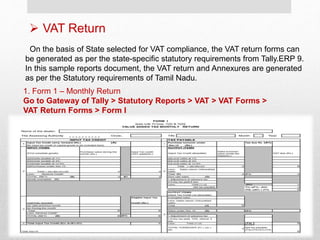
 VAT Return
On the basis of State selected for VAT compliance, the VAT return forms can
be generated as per the state-specific statutory requirements from Tally.ERP 9.
In this sample reports document, the VAT return and Annexures are generated
as per the Statutory requirements of Tamil Nadu.
1. Form 1 – Monthly Return
Go to Gateway of Tally > Statutory Reports > VAT > VAT Forms >
VAT Return Forms > Form I
2. Form I-1 – Annual Return
Go to Gateway of Tally > Display > Statutory
Reports > VAT > VAT Forms > VAT Return
Forms > Form I-1
3. Form W
Go to Gateway of Tally > Display > Statutory Reports
> VAT > VAT Forms > VAT Return
Forms > Form W
AND two more forms on ANNUAL & FORM W are:
THANKYOU

Value added tax

  • 1.
    VALUE ADDED TAX (VAT) Presentedby – Kulbeer Singh.
  • 2.
    Value added tax(VAT) is an indirect tax on goods. vat is imposed only on the amount of value addition. It is a multi-point tax levied as a proportion of value addition, where the tax burden can be shifted from one person to another person till the ultimate consumer can consume the goods. What is VAT (value added tax) • VAT is charged by state government, • VAT is a intra state sales tax (sales within the state)
  • 3.
     WHY VAT? VAT comes in India in 1986, namely MODVAT (Modified value added tax) in excise, that means it is not a new scheme, it is vary old. VAT is not a new concept, it is a part of sales tax, but vat comes into existence because the sales tax was causing couple of problems, then to remove these problems the VAT (which is a part of sales tax) applied by central Gov. of India. • Now a days after some amendments in MODVAT the name was changed into CENVAT(central value added tax) • sales tax is also known as Trade Tax and Turnover Tax.
  • 4.
    Retailer (z) Cons(p) (PUR) 110 (10) 220[10+10] 20 330(10+20) 30 Raw mat+exp 80 +profit 20 90 80 Sales price = 100 200 300 +sales tax(10%) 10 20 30 Invoice price 110 220 330  reasons • Double tax (Multi taxation) charged. • Tax on Tax (cascading effect) As discussed as earlier, vat comes into existence because the sales tax was causing couple of problems, these are:
  • 5.
     VAT RATES Thereare four main rates for Input and Output Vat tax. • 0% on (Exempted Goods) Agriculture products, Cotton and silk yarn, Curd and Butter Milk, National Flag, Salt. • 1% for Jewellery, Bullion and Specie, Precious and Semi-precious stones. • 4% for Pharmacy, Computers, Soaps etc. • 12.5% for FMCG, Automobile  RNR (revenue neutralization rates)
  • 6.
     VAT Terminology INPUTTAX • Input Tax is the Tax shown in our purchase bills. • Apart from Trade Purchases, Tax on Capital Goods purchases like A.C., Computers etc.. is also considered for this Input Tax. OUTPUT TAX • Output Tax is the Tax charged on all the Taxable sales of a Vat Dealer. For Ex. Tax shown as Output Tax and it becomes Input Tax for our customer.
  • 7.
     Types ofDealers  Registered Dealers A dealer whose gross annual turnover is above the VAT threshold limit is required to register under VAT. This is mandatory. A new dealer will be allowed 30 days time from the date of liability to get registered. A VAT registered dealer will be eligible for input tax credit. • Registered Dealers • unregistered Dealers • Composite Dealers
  • 8.
     Unregistered Dealers Adealer whose annual turnover is less than Rs.5 lakhs is an Unregistered Dealer and has been granted the status of a Consumer. So, the VAT paid by an Unregistered Dealer is treated as his cost and is charged no further VAT on his sale.  Composite Dealers Dealers with an annual gross turnover not exceeding a prescribed limit (e.g. Rs. 50 lakh can opt for a composition scheme with a payment of tax at a small percentage of gross turnover. Dealers are not entitled to input tax credit and required to submit vat returns in a separate format.
  • 9.
     Principles forimplementation of VAT system There are two principles that need to implement VAT system in any particular area, these principles are discussed as below: • Principles of origin (source) This is a way to implement vat in particular country that means tax will be charged on goods within Indian territory . • Principles of destination This is a another way to implement vat in any particular country, where the vat charged on the basis of destination (consumption basis), and in India vat running on this principle in present days.
  • 10.
     Methods tocalculate VAT system There are four different methods which are used to calculate VAT, these methods are given as below: I. single point sales tax on the time of first sale . II. single point sales tax on the time of last sale . III.Multi point sales tax on the time of sales (every sale). IV.Multi point VAT on every sale. Now a days we are using fourth way to implement VAT tax.
  • 11.
     Value AddedTax Reports • VAT Computation The VAT Computation report will be displayed for all VAT enabled companies. Based on the State selected for VAT Compliance and the VAT Tax classification used while recording transactions, the list of VAT/Tax class with the respective Assessable Value and Tax Amount will be displayed in the VAT Computation report. The difference between Input VAT and Output VAT will be captured either as VAT Payable or Refundable. 1.VAT Computation – Initial View Go to Gateway of Tally > Display > Statutory Reports > VAT > VAT Computation
  • 13.
     VAT Return Onthe basis of State selected for VAT compliance, the VAT return forms can be generated as per the state-specific statutory requirements from Tally.ERP 9. In this sample reports document, the VAT return and Annexures are generated as per the Statutory requirements of Tamil Nadu. 1. Form 1 – Monthly Return Go to Gateway of Tally > Statutory Reports > VAT > VAT Forms > VAT Return Forms > Form I
  • 14.
    2. Form I-1– Annual Return Go to Gateway of Tally > Display > Statutory Reports > VAT > VAT Forms > VAT Return Forms > Form I-1 3. Form W Go to Gateway of Tally > Display > Statutory Reports > VAT > VAT Forms > VAT Return Forms > Form W AND two more forms on ANNUAL & FORM W are:
  • 15.