DIRECT TAXES INDIRECT TAXES
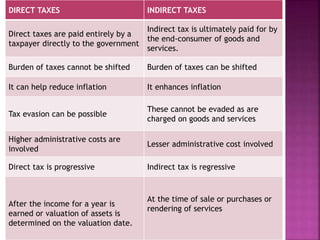
Direct taxes are paid entirely by a
taxpayer directly to the government
Indirect tax is ultimately paid for by
the end-consumer of goods and
services.
Burden of taxes cannot be shifted Burden of taxes can be shifted
It can help reduce inflation It enhances inflation
Tax evasion can be possible
These cannot be evaded as are
charged on goods and services
Higher administrative costs are
involved
Lesser administrative cost involved
Direct tax is progressive Indirect tax is regressive
After the income for a year is
earned or valuation of assets is
determined on the valuation date.
At the time of sale or purchases or
rendering of services
Advantages of direct tax Disadvantages of indirect tax
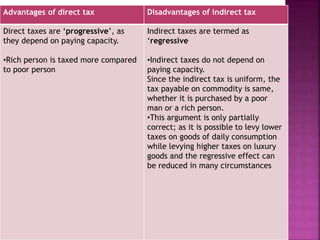
Direct taxes are ‘progressive’, as
they depend on paying capacity.
•Rich person is taxed more compared
to poor person
Indirect taxes are termed as
‘regressive
•Indirect taxes do not depend on
paying capacity.
Since the indirect tax is uniform, the
tax payable on commodity is same,
whether it is purchased by a poor
man or a rich person.
•This argument is only partially
correct; as it is possible to levy lower
taxes on goods of daily consumption
while levying higher taxes on luxury
goods and the regressive effect can
be reduced in many circumstances
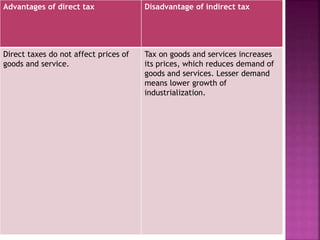
Advantages of direct tax Disadvantage of indirect tax
Direct taxes do not affect prices of
goods and service.
Tax on goods and services increases
its prices, which reduces demand of
goods and services. Lesser demand
means lower growth of
industrialization.
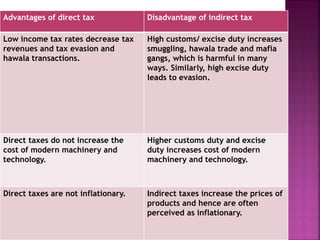
Advantages of direct tax Disadvantage of indirect tax
Low income tax rates decrease tax
revenues and tax evasion and
hawala transactions.
High customs/ excise duty increases
smuggling, hawala trade and mafia
gangs, which is harmful in many
ways. Similarly, high excise duty
leads to evasion.
Direct taxes do not increase the
cost of modern machinery and
technology.
Higher customs duty and excise
duty increases cost of modern
machinery and technology.
Direct taxes are not inflationary. Indirect taxes increase the prices of
products and hence are often
perceived as inflationary.
Disadvantages of direct tax Advantages of indirect tax
It is psychologically very difficult for a
person to pay some amount after it is
received in his hands. Hence, there is
psychological resistance .
•[This is the reason why even Income Tax
Act is widening the scope of “Tax
Deduction at Source’’ (TDS) and TCS.
Thus, a direct tax is converted to an
indirect tax].
Since the price of commodity or service is
already inclusive of indirect taxes, the
customer i.e. the ultimate tax payer does
not feel a direct pinch while paying
indirect taxes and hence, resistance to
indirect taxes is much less compared to
resistance to direct taxes.
•Manufacturer’s/ Dealer’s Psychology
favours indirect taxes- The
manufacturer/ trader
who collects the taxes in his Invoice and
pays it to Government, has a
psychological feeling that he is only
collecting the taxes and is not paying out
of his own pocket
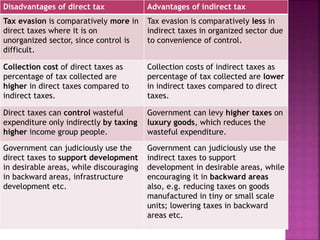
Disadvantages of direct tax Advantages of indirect tax
Tax evasion is comparatively more in
direct taxes where it is on
unorganized sector, since control is
difficult.
Tax evasion is comparatively less in
indirect taxes in organized sector due
to convenience of control.
Collection cost of direct taxes as
percentage of tax collected are
higher in direct taxes compared to
indirect taxes.
Collection costs of indirect taxes as
percentage of tax collected are lower
in indirect taxes compared to direct
taxes.
Direct taxes can control wasteful
expenditure only indirectly by taxing
higher income group people.
Government can levy higher taxes on
luxury goods, which reduces the
wasteful expenditure.
Government can judiciously use the
direct taxes to support development
in desirable areas, while discouraging
in backward areas, infrastructure
development etc.
Government can judiciously use the
indirect taxes to support
development in desirable areas, while
encouraging it in backward areas
also, e.g. reducing taxes on goods
manufactured in tiny or small scale
units; lowering taxes in backward
areas etc.
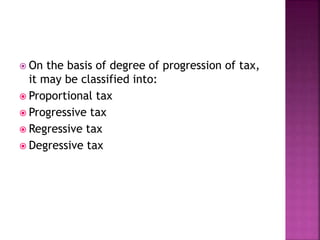
 On the basis of degree of progression of tax,
it may be classified into:
 Proportional tax
 Progressive tax
 Regressive tax
 Degressive tax
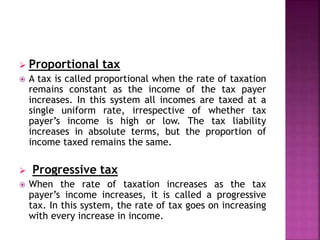
 Proportional tax
 A tax is called proportional when the rate of taxation
remains constant as the income of the tax payer
increases. In this system all incomes are taxed at a
single uniform rate, irrespective of whether tax
payer’s income is high or low. The tax liability
increases in absolute terms, but the proportion of
income taxed remains the same.
 Progressive tax
 When the rate of taxation increases as the tax
payer’s income increases, it is called a progressive
tax. In this system, the rate of tax goes on increasing
with every increase in income.
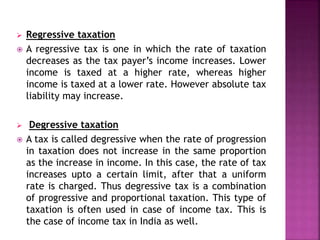
 Regressive taxation
 A regressive tax is one in which the rate of taxation
decreases as the tax payer’s income increases. Lower
income is taxed at a higher rate, whereas higher
income is taxed at a lower rate. However absolute tax
liability may increase.
 Degressive taxation
 A tax is called degressive when the rate of progression
in taxation does not increase in the same proportion
as the increase in income. In this case, the rate of tax
increases upto a certain limit, after that a uniform
rate is charged. Thus degressive tax is a combination
of progressive and proportional taxation. This type of
taxation is often used in case of income tax. This is
the case of income tax in India as well.

Direct Tax vs Indirect Tax

  • 2.
    DIRECT TAXES INDIRECTTAXES Direct taxes are paid entirely by a taxpayer directly to the government Indirect tax is ultimately paid for by the end-consumer of goods and services. Burden of taxes cannot be shifted Burden of taxes can be shifted It can help reduce inflation It enhances inflation Tax evasion can be possible These cannot be evaded as are charged on goods and services Higher administrative costs are involved Lesser administrative cost involved Direct tax is progressive Indirect tax is regressive After the income for a year is earned or valuation of assets is determined on the valuation date. At the time of sale or purchases or rendering of services
  • 4.
    Advantages of directtax Disadvantages of indirect tax Direct taxes are ‘progressive’, as they depend on paying capacity. •Rich person is taxed more compared to poor person Indirect taxes are termed as ‘regressive •Indirect taxes do not depend on paying capacity. Since the indirect tax is uniform, the tax payable on commodity is same, whether it is purchased by a poor man or a rich person. •This argument is only partially correct; as it is possible to levy lower taxes on goods of daily consumption while levying higher taxes on luxury goods and the regressive effect can be reduced in many circumstances
  • 5.
    Advantages of directtax Disadvantage of indirect tax Direct taxes do not affect prices of goods and service. Tax on goods and services increases its prices, which reduces demand of goods and services. Lesser demand means lower growth of industrialization.
  • 6.
    Advantages of directtax Disadvantage of indirect tax Low income tax rates decrease tax revenues and tax evasion and hawala transactions. High customs/ excise duty increases smuggling, hawala trade and mafia gangs, which is harmful in many ways. Similarly, high excise duty leads to evasion. Direct taxes do not increase the cost of modern machinery and technology. Higher customs duty and excise duty increases cost of modern machinery and technology. Direct taxes are not inflationary. Indirect taxes increase the prices of products and hence are often perceived as inflationary.
  • 8.
    Disadvantages of directtax Advantages of indirect tax It is psychologically very difficult for a person to pay some amount after it is received in his hands. Hence, there is psychological resistance . •[This is the reason why even Income Tax Act is widening the scope of “Tax Deduction at Source’’ (TDS) and TCS. Thus, a direct tax is converted to an indirect tax]. Since the price of commodity or service is already inclusive of indirect taxes, the customer i.e. the ultimate tax payer does not feel a direct pinch while paying indirect taxes and hence, resistance to indirect taxes is much less compared to resistance to direct taxes. •Manufacturer’s/ Dealer’s Psychology favours indirect taxes- The manufacturer/ trader who collects the taxes in his Invoice and pays it to Government, has a psychological feeling that he is only collecting the taxes and is not paying out of his own pocket
  • 9.
    Disadvantages of directtax Advantages of indirect tax Tax evasion is comparatively more in direct taxes where it is on unorganized sector, since control is difficult. Tax evasion is comparatively less in indirect taxes in organized sector due to convenience of control. Collection cost of direct taxes as percentage of tax collected are higher in direct taxes compared to indirect taxes. Collection costs of indirect taxes as percentage of tax collected are lower in indirect taxes compared to direct taxes. Direct taxes can control wasteful expenditure only indirectly by taxing higher income group people. Government can levy higher taxes on luxury goods, which reduces the wasteful expenditure. Government can judiciously use the direct taxes to support development in desirable areas, while discouraging in backward areas, infrastructure development etc. Government can judiciously use the indirect taxes to support development in desirable areas, while encouraging it in backward areas also, e.g. reducing taxes on goods manufactured in tiny or small scale units; lowering taxes in backward areas etc.
  • 10.
     On thebasis of degree of progression of tax, it may be classified into:  Proportional tax  Progressive tax  Regressive tax  Degressive tax
  • 11.
     Proportional tax A tax is called proportional when the rate of taxation remains constant as the income of the tax payer increases. In this system all incomes are taxed at a single uniform rate, irrespective of whether tax payer’s income is high or low. The tax liability increases in absolute terms, but the proportion of income taxed remains the same.  Progressive tax  When the rate of taxation increases as the tax payer’s income increases, it is called a progressive tax. In this system, the rate of tax goes on increasing with every increase in income.
  • 12.
     Regressive taxation A regressive tax is one in which the rate of taxation decreases as the tax payer’s income increases. Lower income is taxed at a higher rate, whereas higher income is taxed at a lower rate. However absolute tax liability may increase.  Degressive taxation  A tax is called degressive when the rate of progression in taxation does not increase in the same proportion as the increase in income. In this case, the rate of tax increases upto a certain limit, after that a uniform rate is charged. Thus degressive tax is a combination of progressive and proportional taxation. This type of taxation is often used in case of income tax. This is the case of income tax in India as well.