Hedging Jayendra Salunke EMBA -  ITM Kharghar Batch XIII-B, Roll no – 70
This Session Covers What is Hedging - Concept Hedging Instruments – Examples Hedge funds History Hedge Funds today Five famous Hedge Funds
Hedging -  Concept Used everywhere all time - Story Negative event can not be prevented Risk Offsetting tool Similar to insurance Two securities with Negative correlation Not to make money but to reduce losses
How do investors Hedge ? Hedging instruments Derivatives Forward Contracts Future Contracts Options –  Put option Call option Swaps
Forward Contract It is an agreement to buy or sell an asset at a certain future time for certain price.  Shyam wants to buy a TV  - Rs 10,000  -  no cash -  Can buy it 3 months later -  fears that prices will rise - contract with the dealer - contract is settled at maturity. Ram -  importer - has to make a payment in dollars for consignment in six months time -not sure what the Re/$ rate then - contract with a bank to buy dollars six months from now at a decided rate - underlying security is the foreign currency. The difference between a share and derivative is that shares/securities is an asset while derivative instrument is a contract
Future Contract A future contract is an agreement between two parties to buy or sell an asset at a certain time in the future at a certain price. Index futures are all futures contracts where the underlying is the stock index and helps trader to take a view on the market as a whole. Example - An automobile mfr  - huge quantities of steel as raw material  -  export  contract -  risk of increasing steel prices - buy steel futures contracts, - the automobile manufacturer is protected.  Increasing steel prices  -  Increase in the value of the futures contracts - corresponding loss in the physical market - offset by his gains in the futures market.  Decreasing steel prices  - Decrease in the value of the futures contracts - losses in the futures transaction - corresponding gain in the physical market . Perfect hedge to lock the profits and protect from increase or decrease in raw material prices.
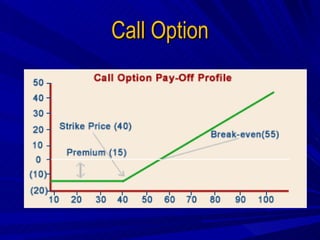
Call Option An option is a contract between two parties giving the taker (buyer) the right, but not the obligation, to buy or sell a parcel of shares at a predetermined price possibly on, or before a predetermined date. To acquire this right the taker pays a premium to the writer (seller) of the contract. Sam purchases a December call option at Rs 40 for a premium of Rs 15. That is he has purchased the right to buy that share for Rs 40 in December. If the stock rises above Rs 55 (40+15) he will break even and he will start making a profit. Suppose the stock does not rise and instead falls he will choose not to exercise the option and forego the premium of Rs 15 and thus limiting his loss to Rs 15.
Call Option
Put Option A Put Option gives the holder of the right to sell a specific number of shares of an agreed security at a fixed price for a period of time. Sam purchases 1 INFTEC (Infosys Technologies) AUG 3500 Put --Premium 200 This contract allows Sam to sell 100 shares INFTEC at Rs 3500 per share at any time between the current date and the end of August. To have this privilege, Sam pays a premium of Rs 20,000 (Rs 200 a share for 100 shares). The buyer of a put has purchased a right to sell. The owner of a put option has the right to sell.
Hedge Funds Alfred Jones –  Father of Hedge fund First Money Manager Rise of Industry  1968 – 140 Hedge funds 1969-70 Heavy Losses - 1973-74 No of hedge fund closures  1986 tiger Fund  -  1999- 2000 history repeats The Down side What Hedging means to you
Five famous Hedge Funds Goldman Sachs  Long Term Capital Management Man Group Soros Fund Management
Thank You

Hedging

  • 1.
    Hedging Jayendra SalunkeEMBA - ITM Kharghar Batch XIII-B, Roll no – 70
  • 2.
    This Session CoversWhat is Hedging - Concept Hedging Instruments – Examples Hedge funds History Hedge Funds today Five famous Hedge Funds
  • 3.
    Hedging - Concept Used everywhere all time - Story Negative event can not be prevented Risk Offsetting tool Similar to insurance Two securities with Negative correlation Not to make money but to reduce losses
  • 4.
    How do investorsHedge ? Hedging instruments Derivatives Forward Contracts Future Contracts Options – Put option Call option Swaps
  • 5.
    Forward Contract Itis an agreement to buy or sell an asset at a certain future time for certain price. Shyam wants to buy a TV - Rs 10,000 - no cash - Can buy it 3 months later - fears that prices will rise - contract with the dealer - contract is settled at maturity. Ram - importer - has to make a payment in dollars for consignment in six months time -not sure what the Re/$ rate then - contract with a bank to buy dollars six months from now at a decided rate - underlying security is the foreign currency. The difference between a share and derivative is that shares/securities is an asset while derivative instrument is a contract
  • 6.
    Future Contract Afuture contract is an agreement between two parties to buy or sell an asset at a certain time in the future at a certain price. Index futures are all futures contracts where the underlying is the stock index and helps trader to take a view on the market as a whole. Example - An automobile mfr - huge quantities of steel as raw material - export contract - risk of increasing steel prices - buy steel futures contracts, - the automobile manufacturer is protected. Increasing steel prices - Increase in the value of the futures contracts - corresponding loss in the physical market - offset by his gains in the futures market. Decreasing steel prices - Decrease in the value of the futures contracts - losses in the futures transaction - corresponding gain in the physical market . Perfect hedge to lock the profits and protect from increase or decrease in raw material prices.
  • 7.
    Call Option Anoption is a contract between two parties giving the taker (buyer) the right, but not the obligation, to buy or sell a parcel of shares at a predetermined price possibly on, or before a predetermined date. To acquire this right the taker pays a premium to the writer (seller) of the contract. Sam purchases a December call option at Rs 40 for a premium of Rs 15. That is he has purchased the right to buy that share for Rs 40 in December. If the stock rises above Rs 55 (40+15) he will break even and he will start making a profit. Suppose the stock does not rise and instead falls he will choose not to exercise the option and forego the premium of Rs 15 and thus limiting his loss to Rs 15.
  • 8.
  • 9.
    Put Option APut Option gives the holder of the right to sell a specific number of shares of an agreed security at a fixed price for a period of time. Sam purchases 1 INFTEC (Infosys Technologies) AUG 3500 Put --Premium 200 This contract allows Sam to sell 100 shares INFTEC at Rs 3500 per share at any time between the current date and the end of August. To have this privilege, Sam pays a premium of Rs 20,000 (Rs 200 a share for 100 shares). The buyer of a put has purchased a right to sell. The owner of a put option has the right to sell.
  • 10.
    Hedge Funds AlfredJones – Father of Hedge fund First Money Manager Rise of Industry 1968 – 140 Hedge funds 1969-70 Heavy Losses - 1973-74 No of hedge fund closures 1986 tiger Fund - 1999- 2000 history repeats The Down side What Hedging means to you
  • 11.
    Five famous HedgeFunds Goldman Sachs Long Term Capital Management Man Group Soros Fund Management
  • 12.