PRE GOODS AND SERVICES TAX
(GST) ERA
By
Dr. Mohmed Amin Mir
Assistant Professor
Department of Commerce & Management Studies
Islamia College of Science & Commerce
(Autonomous with CPE Status)
Srinagar - 190002, Jammu & Kashmir, India
Came into effect from July 1, 2017
GST is a Single Best Tax Reform Undertaken Since Independence to
Ease Compliance
One Nation, One Tax, One Market
One tax for:
Manufacturing
Trading
Services
GST is a ‘Destination based tax’ i.e. a tax on goods and services
which will be paid at the point of receiving
GST will be levied on all transactions such as sale, transfer, purchase,
barter, lease or import of goods and/or services
1
 GST is levied on supply of goods or services
(or both) at each stage of supply chain
starting from manufacture or import till the
last retail level.
 GST will be administered together by the Centre and the States
involving both the Central and State levies
2
 Tax system in India traces its origin to the prehistoric texts –
Arthashastra & Manusmriti
 Taxes were paid by farmers & artisans in the form of:
 Agricultural produce
 Silver
 Gold
Modern Tax system in India was introduced by the Sir James
Wilson during British Rule in India in 1860
3
 Is a Three Tier Federal Structure [Central, State & Local Municipal
Bodies]
 Power to Levy and Collect Taxes Emerges from the Constitution of
India
 Article-265 “No tax shall be levied or collected except by the authority
of Law”
 Prohibits arbitrary collection of taxes
 Article-246: Authority to enact law & Levy taxes and duties is
given by Article-246.
 The parliament may make laws for the whole of India or any part of
the territory of India
 The State legislature may make laws for whole or part of the state
4
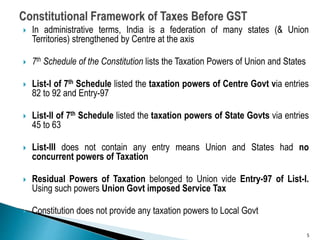
 In administrative terms, India is a federation of many states (& Union
Territories) strengthened by Centre at the axis
 7th Schedule of the Constitution lists the Taxation Powers of Union and States
 List-I of 7th Schedule listed the taxation powers of Centre Govt via entries
82 to 92 and Entry-97
 List-II of 7th Schedule listed the taxation powers of State Govts via entries
45 to 63
 List-III does not contain any entry means Union and States had no
concurrent powers of Taxation
 Residual Powers of Taxation belonged to Union vide Entry-97 of List-I.
Using such powers Union Govt imposed Service Tax
 Constitution does not provide any taxation powers to Local Govt
5
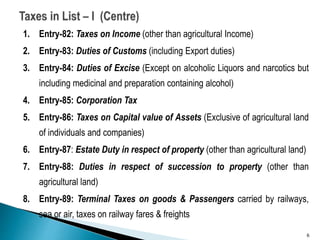
1. Entry-82: Taxes on Income (other than agricultural Income)
2. Entry-83: Duties of Customs (including Export duties)
3. Entry-84: Duties of Excise (Except on alcoholic Liquors and narcotics but
including medicinal and preparation containing alcohol)
4. Entry-85: Corporation Tax
5. Entry-86: Taxes on Capital value of Assets (Exclusive of agricultural land
of individuals and companies)
6. Entry-87: Estate Duty in respect of property (other than agricultural land)
7. Entry-88: Duties in respect of succession to property (other than
agricultural land)
8. Entry-89: Terminal Taxes on goods & Passengers carried by railways,
sea or air, taxes on railway fares & freights
6
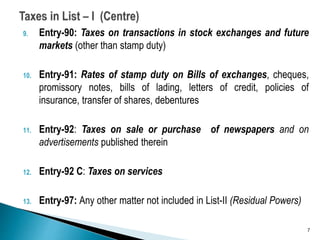
9. Entry-90: Taxes on transactions in stock exchanges and future
markets (other than stamp duty)
10. Entry-91: Rates of stamp duty on Bills of exchanges, cheques,
promissory notes, bills of lading, letters of credit, policies of
insurance, transfer of shares, debentures
11. Entry-92: Taxes on sale or purchase of newspapers and on
advertisements published therein
12. Entry-92 C: Taxes on services
13. Entry-97: Any other matter not included in List-II (Residual Powers)
7
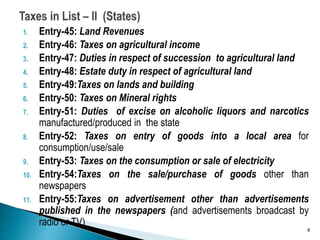
1. Entry-45: Land Revenues
2. Entry-46: Taxes on agricultural income
3. Entry-47: Duties in respect of succession to agricultural land
4. Entry-48: Estate duty in respect of agricultural land
5. Entry-49:Taxes on lands and building
6. Entry-50: Taxes on Mineral rights
7. Entry-51: Duties of excise on alcoholic liquors and narcotics
manufactured/produced in the state
8. Entry-52: Taxes on entry of goods into a local area for
consumption/use/sale
9. Entry-53: Taxes on the consumption or sale of electricity
10. Entry-54:Taxes on the sale/purchase of goods other than
newspapers
11. Entry-55:Taxes on advertisement other than advertisements
published in the newspapers (and advertisements broadcast by
radio or TV)
8
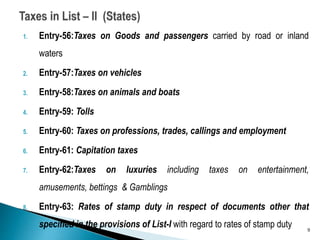
1. Entry-56:Taxes on Goods and passengers carried by road or inland
waters
2. Entry-57:Taxes on vehicles
3. Entry-58:Taxes on animals and boats
4. Entry-59: Tolls
5. Entry-60: Taxes on professions, trades, callings and employment
6. Entry-61: Capitation taxes
7. Entry-62:Taxes on luxuries including taxes on entertainment,
amusements, bettings & Gamblings
8. Entry-63: Rates of stamp duty in respect of documents other that
specified in the provisions of List-I with regard to rates of stamp duty 9
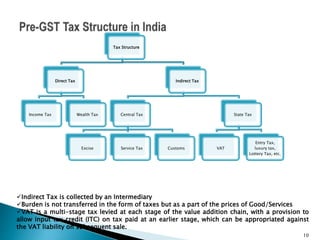
Tax Structure
Direct Tax
Income Tax Wealth Tax
Indirect Tax
Central Tax
Excise Service Tax Customs
State Tax
VAT
Entry Tax,
luxury tax,
Lottery Tax, etc.
10
Indirect Tax is collected by an Intermediary
Burden is not transferred in the form of taxes but as a part of the prices of Good/Services
VAT is a multi-stage tax levied at each stage of the value addition chain, with a provision to
allow input tax credit (ITC) on tax paid at an earlier stage, which can be appropriated against
the VAT liability on subsequent sale.
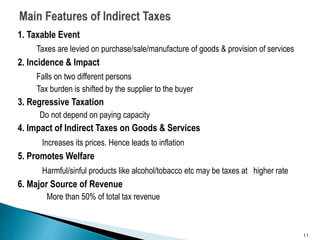
1. Taxable Event
Taxes are levied on purchase/sale/manufacture of goods & provision of services
2. Incidence & Impact
Falls on two different persons
Tax burden is shifted by the supplier to the buyer
3. Regressive Taxation
Do not depend on paying capacity
4. Impact of Indirect Taxes on Goods & Services
Increases its prices. Hence leads to inflation
5. Promotes Welfare
Harmful/sinful products like alcohol/tobacco etc may be taxes at higher rate
6. Major Source of Revenue
More than 50% of total tax revenue
11
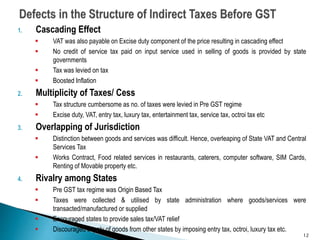
1. Cascading Effect
 VAT was also payable on Excise duty component of the price resulting in cascading effect
 No credit of service tax paid on input service used in selling of goods is provided by state
governments
 Tax was levied on tax
 Boosted Inflation
2. Multiplicity of Taxes/ Cess
 Tax structure cumbersome as no. of taxes were levied in Pre GST regime
 Excise duty, VAT, entry tax, luxury tax, entertainment tax, service tax, octroi tax etc
3. Overlapping of Jurisdiction
 Distinction between goods and services was difficult. Hence, overleaping of State VAT and Central
Services Tax
 Works Contract, Food related services in restaurants, caterers, computer software, SIM Cards,
Renting of Movable property etc.
4. Rivalry among States
 Pre GST tax regime was Origin Based Tax
 Taxes were collected & utilised by state administration where goods/services were
transacted/manufactured or supplied
 Encouraged states to provide sales tax/VAT relief
 Discouraged supply of goods from other states by imposing entry tax, octroi, luxury tax etc.
12
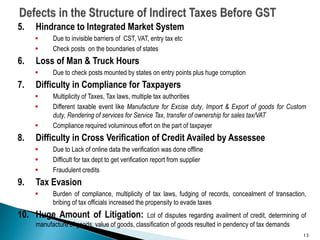
5. Hindrance to Integrated Market System
 Due to invisible barriers of CST, VAT, entry tax etc
 Check posts on the boundaries of states
6. Loss of Man & Truck Hours
 Due to check posts mounted by states on entry points plus huge corruption
7. Difficulty in Compliance for Taxpayers
 Multiplicity of Taxes, Tax laws, multiple tax authorities
 Different taxable event like Manufacture for Excise duty, Import & Export of goods for Custom
duty, Rendering of services for Service Tax, transfer of ownership for sales tax/VAT
 Compliance required voluminous effort on the part of taxpayer
8. Difficulty in Cross Verification of Credit Availed by Assessee
 Due to Lack of online data the verification was done offline
 Difficult for tax dept to get verification report from supplier
 Fraudulent credits
9. Tax Evasion
 Burden of compliance, multiplicity of tax laws, fudging of records, concealment of transaction,
bribing of tax officials increased the propensity to evade taxes
10. Huge Amount of Litigation: Lot of disputes regarding availment of credit, determining of
manufacture of goods, value of goods, classification of goods resulted in pendency of tax demands
13
11. Different Points of Taxation
13. Lack of Uniformity
13. Multiple & Repetitive Compliances
13

Pre- GST Era in India

  • 1.
    PRE GOODS ANDSERVICES TAX (GST) ERA By Dr. Mohmed Amin Mir Assistant Professor Department of Commerce & Management Studies Islamia College of Science & Commerce (Autonomous with CPE Status) Srinagar - 190002, Jammu & Kashmir, India
  • 2.
    Came into effectfrom July 1, 2017 GST is a Single Best Tax Reform Undertaken Since Independence to Ease Compliance One Nation, One Tax, One Market One tax for: Manufacturing Trading Services GST is a ‘Destination based tax’ i.e. a tax on goods and services which will be paid at the point of receiving GST will be levied on all transactions such as sale, transfer, purchase, barter, lease or import of goods and/or services 1
  • 3.
     GST islevied on supply of goods or services (or both) at each stage of supply chain starting from manufacture or import till the last retail level.  GST will be administered together by the Centre and the States involving both the Central and State levies 2
  • 4.
     Tax systemin India traces its origin to the prehistoric texts – Arthashastra & Manusmriti  Taxes were paid by farmers & artisans in the form of:  Agricultural produce  Silver  Gold Modern Tax system in India was introduced by the Sir James Wilson during British Rule in India in 1860 3
  • 5.
     Is aThree Tier Federal Structure [Central, State & Local Municipal Bodies]  Power to Levy and Collect Taxes Emerges from the Constitution of India  Article-265 “No tax shall be levied or collected except by the authority of Law”  Prohibits arbitrary collection of taxes  Article-246: Authority to enact law & Levy taxes and duties is given by Article-246.  The parliament may make laws for the whole of India or any part of the territory of India  The State legislature may make laws for whole or part of the state 4
  • 6.
     In administrativeterms, India is a federation of many states (& Union Territories) strengthened by Centre at the axis  7th Schedule of the Constitution lists the Taxation Powers of Union and States  List-I of 7th Schedule listed the taxation powers of Centre Govt via entries 82 to 92 and Entry-97  List-II of 7th Schedule listed the taxation powers of State Govts via entries 45 to 63  List-III does not contain any entry means Union and States had no concurrent powers of Taxation  Residual Powers of Taxation belonged to Union vide Entry-97 of List-I. Using such powers Union Govt imposed Service Tax  Constitution does not provide any taxation powers to Local Govt 5
  • 7.
    1. Entry-82: Taxeson Income (other than agricultural Income) 2. Entry-83: Duties of Customs (including Export duties) 3. Entry-84: Duties of Excise (Except on alcoholic Liquors and narcotics but including medicinal and preparation containing alcohol) 4. Entry-85: Corporation Tax 5. Entry-86: Taxes on Capital value of Assets (Exclusive of agricultural land of individuals and companies) 6. Entry-87: Estate Duty in respect of property (other than agricultural land) 7. Entry-88: Duties in respect of succession to property (other than agricultural land) 8. Entry-89: Terminal Taxes on goods & Passengers carried by railways, sea or air, taxes on railway fares & freights 6
  • 8.
    9. Entry-90: Taxeson transactions in stock exchanges and future markets (other than stamp duty) 10. Entry-91: Rates of stamp duty on Bills of exchanges, cheques, promissory notes, bills of lading, letters of credit, policies of insurance, transfer of shares, debentures 11. Entry-92: Taxes on sale or purchase of newspapers and on advertisements published therein 12. Entry-92 C: Taxes on services 13. Entry-97: Any other matter not included in List-II (Residual Powers) 7
  • 9.
    1. Entry-45: LandRevenues 2. Entry-46: Taxes on agricultural income 3. Entry-47: Duties in respect of succession to agricultural land 4. Entry-48: Estate duty in respect of agricultural land 5. Entry-49:Taxes on lands and building 6. Entry-50: Taxes on Mineral rights 7. Entry-51: Duties of excise on alcoholic liquors and narcotics manufactured/produced in the state 8. Entry-52: Taxes on entry of goods into a local area for consumption/use/sale 9. Entry-53: Taxes on the consumption or sale of electricity 10. Entry-54:Taxes on the sale/purchase of goods other than newspapers 11. Entry-55:Taxes on advertisement other than advertisements published in the newspapers (and advertisements broadcast by radio or TV) 8
  • 10.
    1. Entry-56:Taxes onGoods and passengers carried by road or inland waters 2. Entry-57:Taxes on vehicles 3. Entry-58:Taxes on animals and boats 4. Entry-59: Tolls 5. Entry-60: Taxes on professions, trades, callings and employment 6. Entry-61: Capitation taxes 7. Entry-62:Taxes on luxuries including taxes on entertainment, amusements, bettings & Gamblings 8. Entry-63: Rates of stamp duty in respect of documents other that specified in the provisions of List-I with regard to rates of stamp duty 9
  • 11.
    Tax Structure Direct Tax IncomeTax Wealth Tax Indirect Tax Central Tax Excise Service Tax Customs State Tax VAT Entry Tax, luxury tax, Lottery Tax, etc. 10 Indirect Tax is collected by an Intermediary Burden is not transferred in the form of taxes but as a part of the prices of Good/Services VAT is a multi-stage tax levied at each stage of the value addition chain, with a provision to allow input tax credit (ITC) on tax paid at an earlier stage, which can be appropriated against the VAT liability on subsequent sale.
  • 12.
    1. Taxable Event Taxesare levied on purchase/sale/manufacture of goods & provision of services 2. Incidence & Impact Falls on two different persons Tax burden is shifted by the supplier to the buyer 3. Regressive Taxation Do not depend on paying capacity 4. Impact of Indirect Taxes on Goods & Services Increases its prices. Hence leads to inflation 5. Promotes Welfare Harmful/sinful products like alcohol/tobacco etc may be taxes at higher rate 6. Major Source of Revenue More than 50% of total tax revenue 11
  • 13.
    1. Cascading Effect VAT was also payable on Excise duty component of the price resulting in cascading effect  No credit of service tax paid on input service used in selling of goods is provided by state governments  Tax was levied on tax  Boosted Inflation 2. Multiplicity of Taxes/ Cess  Tax structure cumbersome as no. of taxes were levied in Pre GST regime  Excise duty, VAT, entry tax, luxury tax, entertainment tax, service tax, octroi tax etc 3. Overlapping of Jurisdiction  Distinction between goods and services was difficult. Hence, overleaping of State VAT and Central Services Tax  Works Contract, Food related services in restaurants, caterers, computer software, SIM Cards, Renting of Movable property etc. 4. Rivalry among States  Pre GST tax regime was Origin Based Tax  Taxes were collected & utilised by state administration where goods/services were transacted/manufactured or supplied  Encouraged states to provide sales tax/VAT relief  Discouraged supply of goods from other states by imposing entry tax, octroi, luxury tax etc. 12
  • 14.
    5. Hindrance toIntegrated Market System  Due to invisible barriers of CST, VAT, entry tax etc  Check posts on the boundaries of states 6. Loss of Man & Truck Hours  Due to check posts mounted by states on entry points plus huge corruption 7. Difficulty in Compliance for Taxpayers  Multiplicity of Taxes, Tax laws, multiple tax authorities  Different taxable event like Manufacture for Excise duty, Import & Export of goods for Custom duty, Rendering of services for Service Tax, transfer of ownership for sales tax/VAT  Compliance required voluminous effort on the part of taxpayer 8. Difficulty in Cross Verification of Credit Availed by Assessee  Due to Lack of online data the verification was done offline  Difficult for tax dept to get verification report from supplier  Fraudulent credits 9. Tax Evasion  Burden of compliance, multiplicity of tax laws, fudging of records, concealment of transaction, bribing of tax officials increased the propensity to evade taxes 10. Huge Amount of Litigation: Lot of disputes regarding availment of credit, determining of manufacture of goods, value of goods, classification of goods resulted in pendency of tax demands 13
  • 15.
    11. Different Pointsof Taxation 13. Lack of Uniformity 13. Multiple & Repetitive Compliances 13