UV-VIS Spectroscopy
Rahul Pal*, Prachi Pandey
M. Pharm (Pharmaceutics)
Department of Pharmaceutics
NIMS Institute of Pharmacy, NIMS University, Jaipur, Rajasthan, India
MODERNPHARMACEUTICALANALYTICALTECHNIQUES
Spectroscopy
Spectroscopy is the study of interaction of electromagnetic radiation with matter. Basic
principle of spectroscopy is the Beer-Lambertโ€™s law.
In UV-VIS Spectroscopy, a continuum range of wavelengths from 200nm to 900nm is used.
Spectrophotometer device is used in UV-VIS Spectroscopy.
โ€ข Components of spectrophotometer
๏ฑ Sources of light(200nm to 900nm).
๏ฑ Monochromator.
๏ฑ Sample solution in cuvette.
๏ฑ Detectors.
๏ฑ Readout devices.
โ€ข Types of spectrophotometer Single and double beam instruments.
โ€ข Applications of UV-VIS Spectroscopy Qualitative &Quantitative analyses.
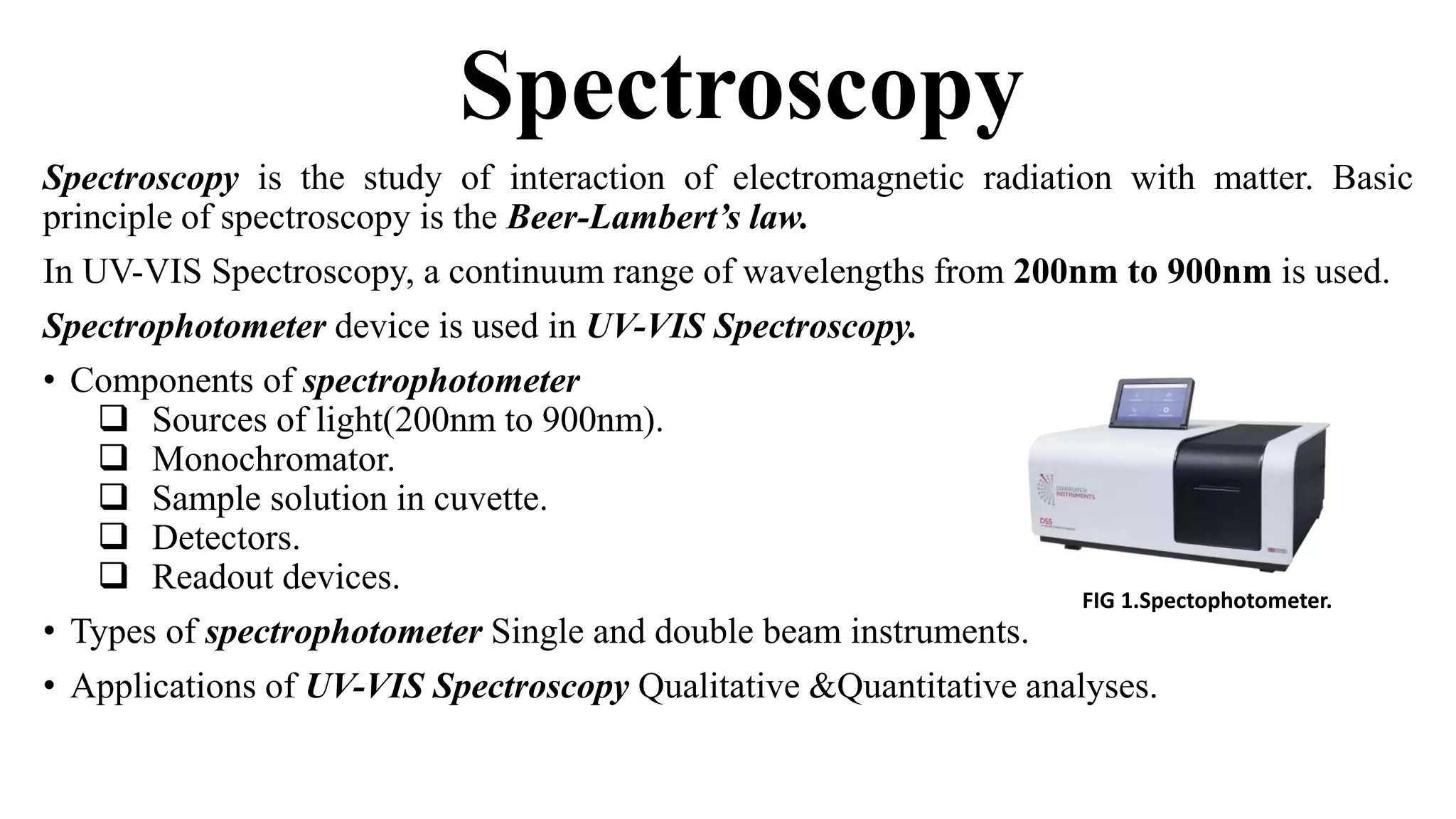
FIG 1.Spectophotometer.
INTRODUCTION
โ€ข Spectroscopy is the branch of science which deals with interaction of
electromagnetic radiation with materials. In other words it is an analytical method for
qualitative and quantitative analysis by use of light.
โ€ข The Lambert Beer law in 1852 made the basis for the quantitative evaluation of
absorption measurements.
โ€ข This led firstly to colorimetry, then to photometry and finally to spectrophotometry.
โ€ข This evolution was along with the development of detectors for measuring light
intensities, i.e. silicon photo-diode detector.
โ€ข Spectroscopy is widely used as an exploratory tool in the fields of physics, , and
chemistry, for determination of composition, physical structure and electronic structure
of matter at atomic scale, molecular scale, and macro scale.4
SPECTROSCOPY
โ€ข When an Electromagnetic radiation is incident on a matter, phenomena like reflection,
transmission, absorption ,are occurring.
โ€ข Spectroscopy is the study of interaction of electromagnetic radiation with matter based
on the Bohr-Einstein frequency relationship E=hv , here h is the proportionality
constant called Planckโ€™s constant (6.626 x 10⁻³⁴ J s) and v is frequency.
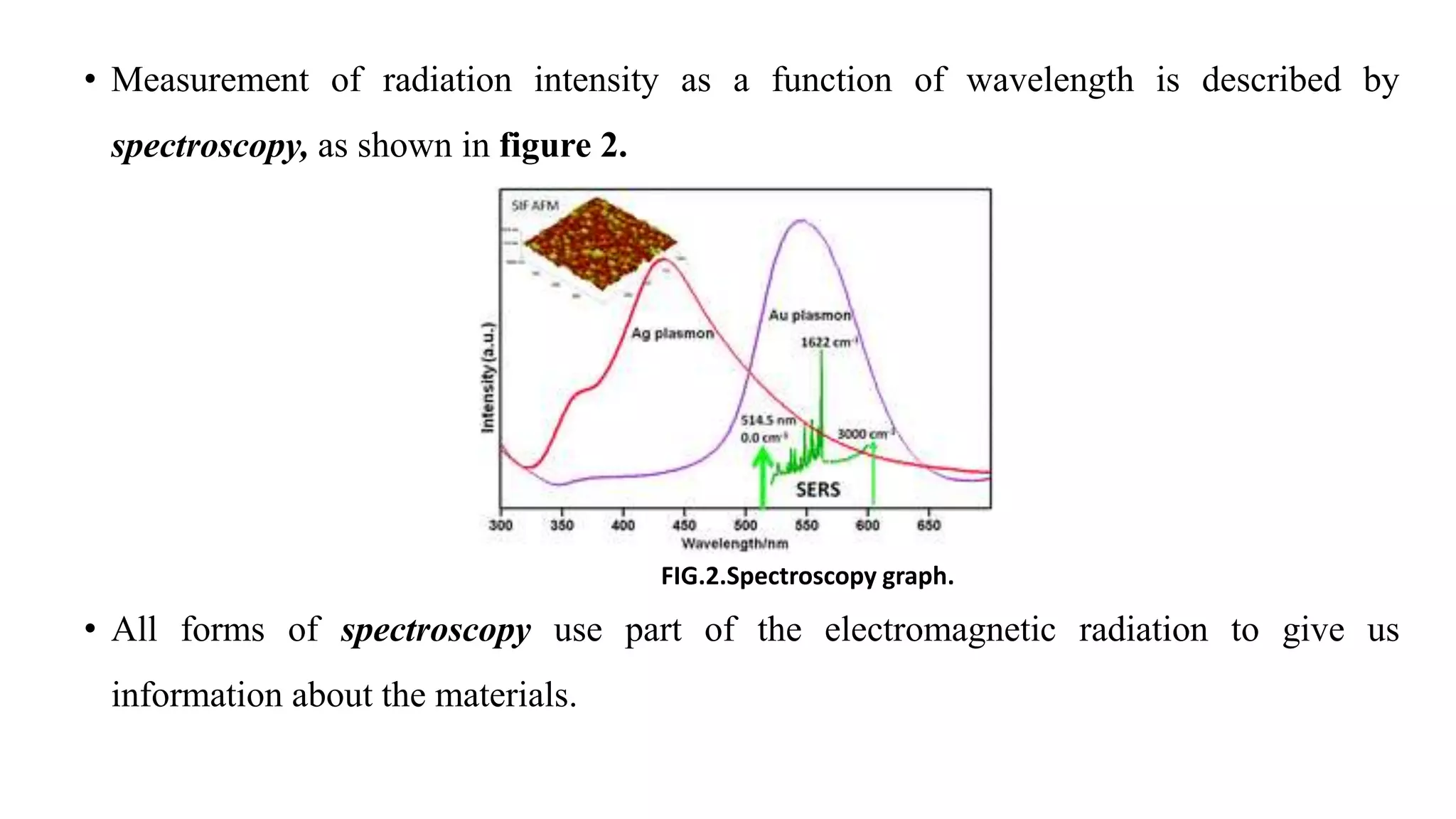
โ€ข Measurement of radiation intensity as a function of wavelength is described by
spectroscopy, as shown in figure 2.
โ€ข All forms of spectroscopy use part of the electromagnetic radiation to give us
information about the materials.
FIG.2.Spectroscopy graph.
SPECTRUM
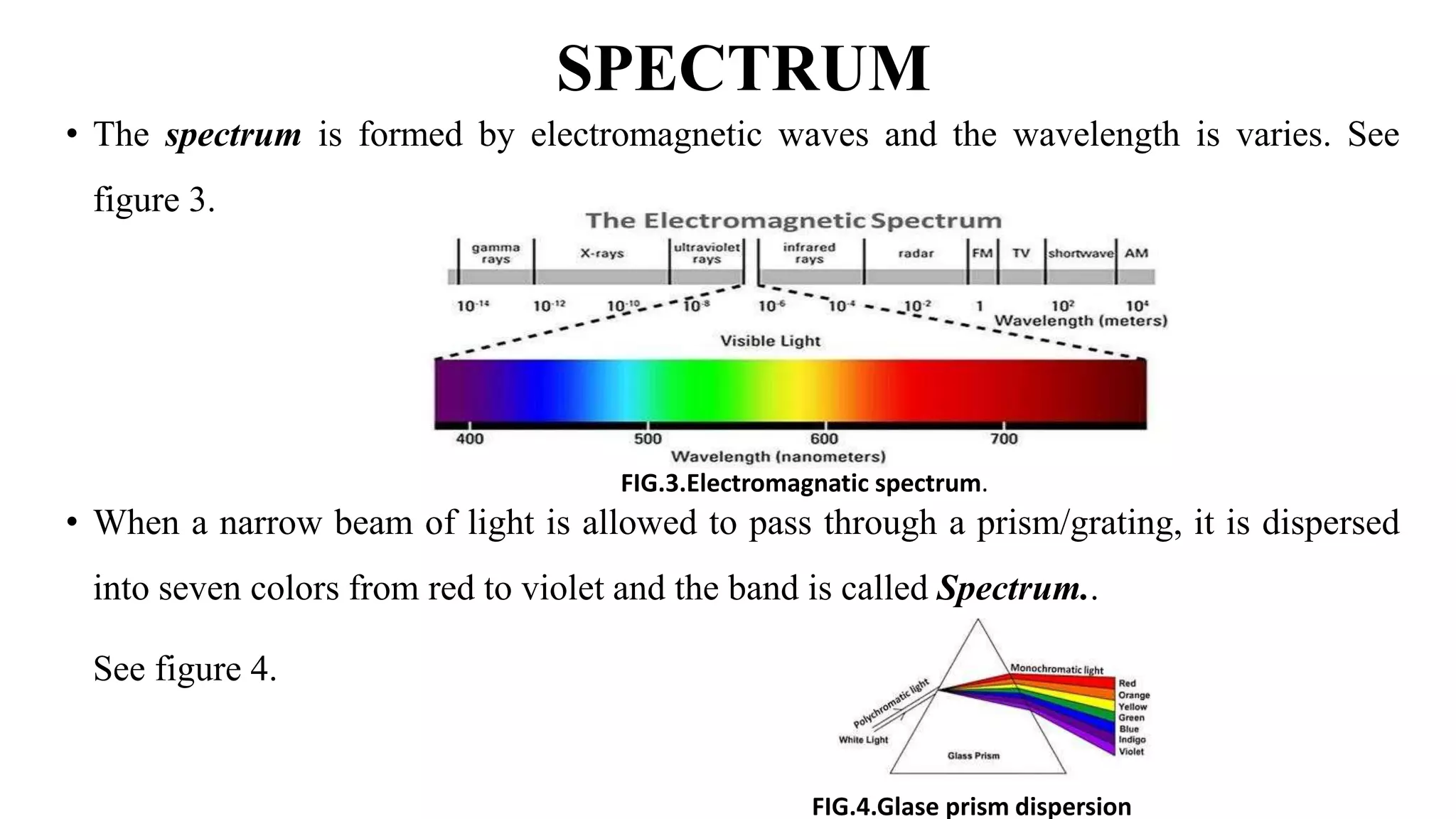
โ€ข The spectrum is formed by electromagnetic waves and the wavelength is varies. See
figure 3.
โ€ข When a narrow beam of light is allowed to pass through a prism/grating, it is dispersed
into seven colors from red to violet and the band is called Spectrum..
See figure 4.
FIG.3.Electromagnatic spectrum.
FIG.4.Glase prism dispersion
PRINCIPLE
Basic principle of spectroscopy is the Beer-Lambertโ€™s law.
1.2.1 BEER LAW
โ€ข Beer's law stated that absorbance is proportional to the concentrations of the material
sample.
1.2.2 LAMBERT LAW
โ€ข Lambert's law stated that absorbance of a material is directly proportional to its
thickness (path length).
โ€ข The modern derivation of the Beerโ€“Lambert law combines the two laws and
correlates the absorbance to both the concentrations and the thickness of the material.
FIG 5. Beerโ€“Lambert law.
UV-VISIBLE SPECTROSCOPY
โ€ข Ultravioletโ€“visible spectrum can be generated when ultraviolet light and visible light (200-
900nm) are absorbed by materials. The spectrum can be used to analyze the composition and
the structure of the materials. For a particular wavelength in the ultravioletโ€“visible ranges,
the absorption degree is proportional to the components of the materials. Therefore, the
characteristics of the materials are quantitatively reflected by the spectrum, which changes
with the wave-length.
โ€ข Ultravioletโ€“visible spectrum consists of an absorption spectrum. An absorption spectrum
gives information about the molar absorptivity, concentration of the sample, optical bath
length. See figure6, in previous slid.
INSTRUMENTATION
โ€ข SOURCE of LIGHT.
โ€ข MONOCHROMATOR.
โ€ข SAMPLE SOLIOTION in CUVETTE.
โ€ข PHOTO DETECTOR.
โ€ข READOUT DEVICE.
FIG 6.Components of spectrophotometer.
SOURCE OF LIGHT
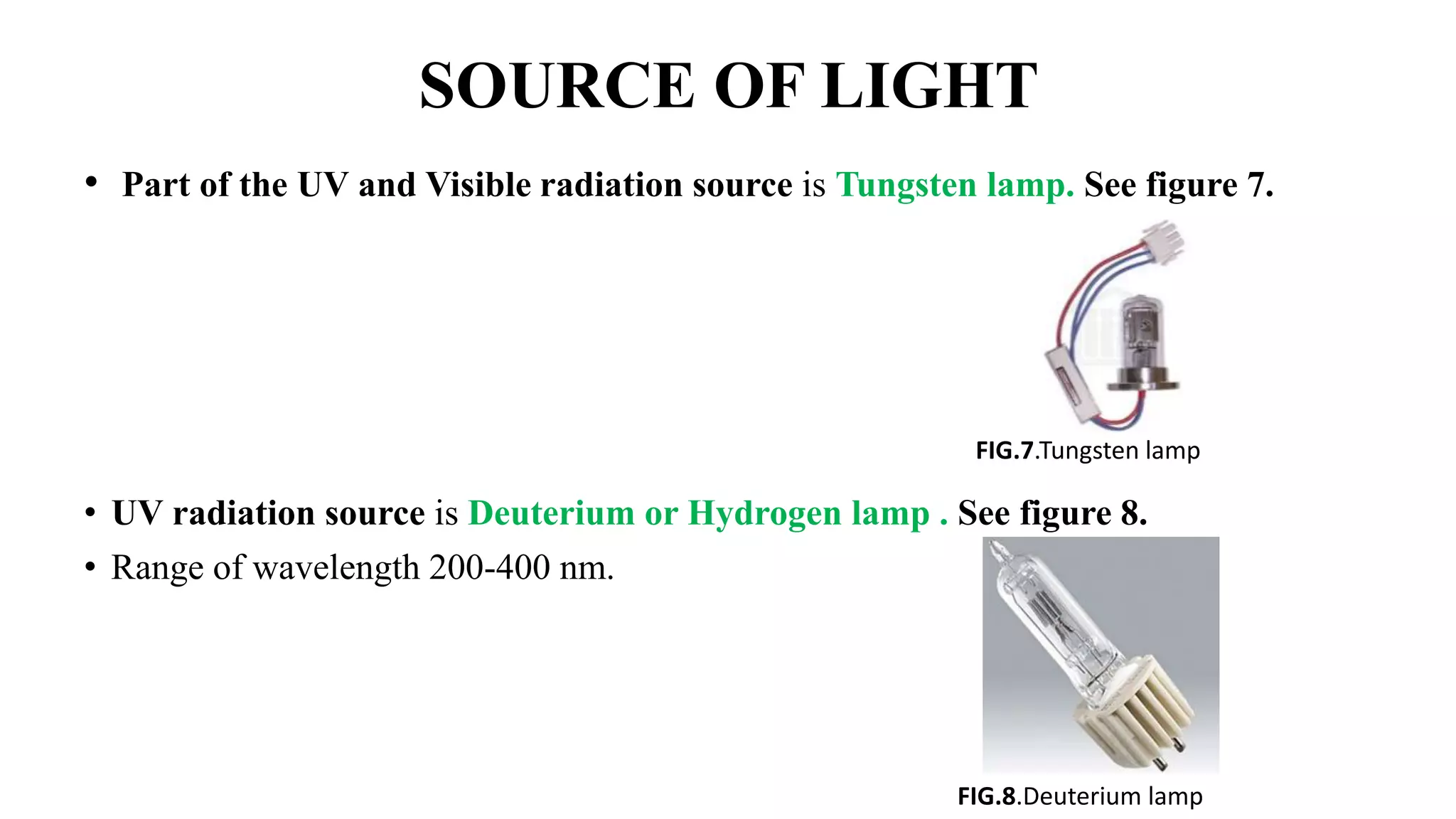
โ€ข Part of the UV and Visible radiation source is Tungsten lamp. See figure 7.
โ€ข UV radiation source is Deuterium or Hydrogen lamp . See figure 8.
โ€ข Range of wavelength 200-400 nm.
FIG.7.Tungsten lamp
FIG.8.Deuterium lamp
MONOCHROMATOR
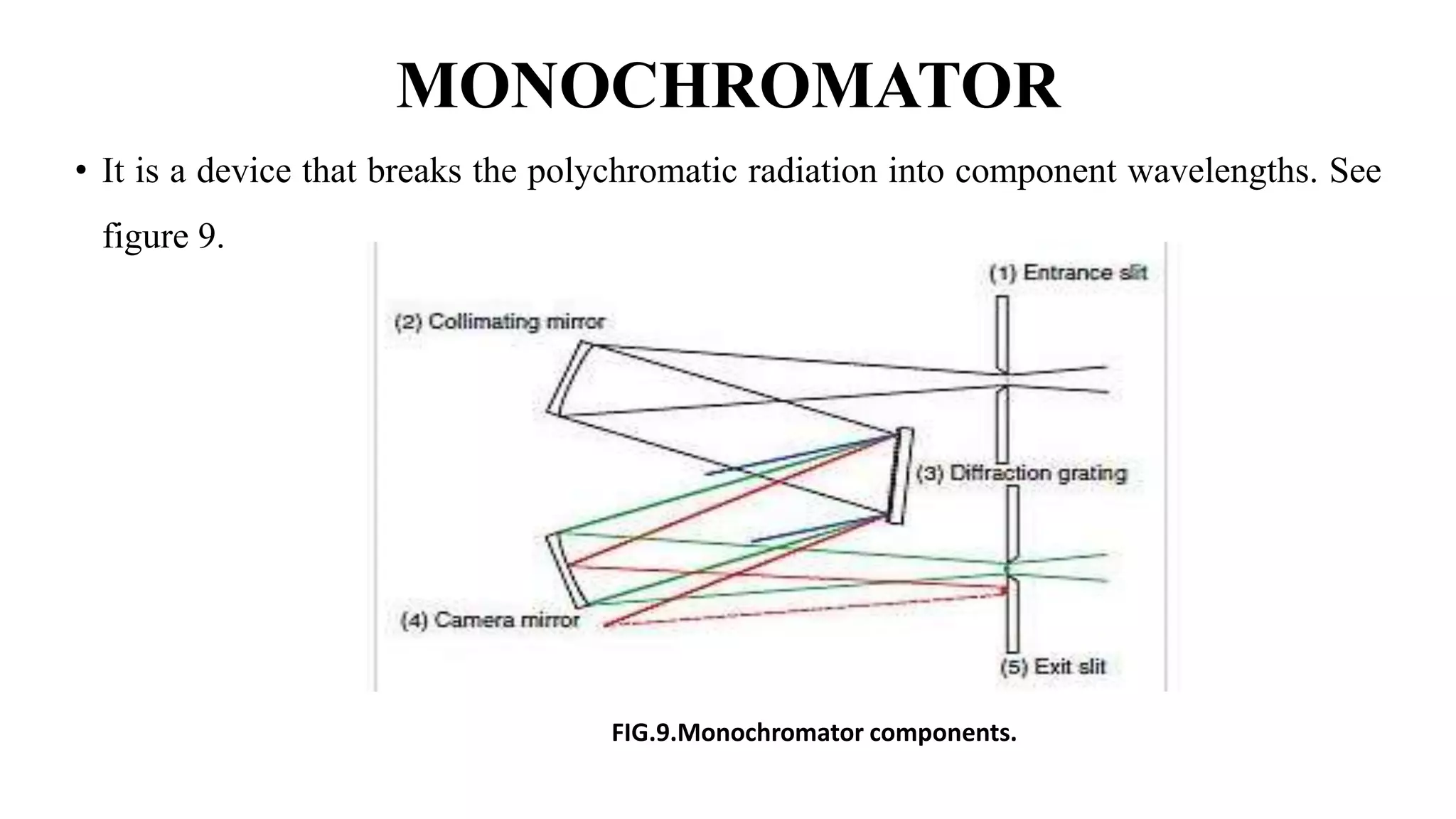
โ€ข It is a device that breaks the polychromatic radiation into component wavelengths. See
figure 9.
FIG.9.Monochromator components.
The monochromator unit consists of :
โ€ขEntrance slit: defines narrow beam of radiation from source.
โ€ขCollimating mirror:(polished surface) collimates the lights.
โ€ขDiffraction grating or Prism (make of quartz): disperses the light into specific
wavelength.
โ€ขFocusing mirror: captures the dispersed light & sharpens the same to the sample via
exit slit
โ€ขExit slit: allows the corrected wavelength of light to the sample .
SAMPLE SOLIOTION IN
CUVETTE
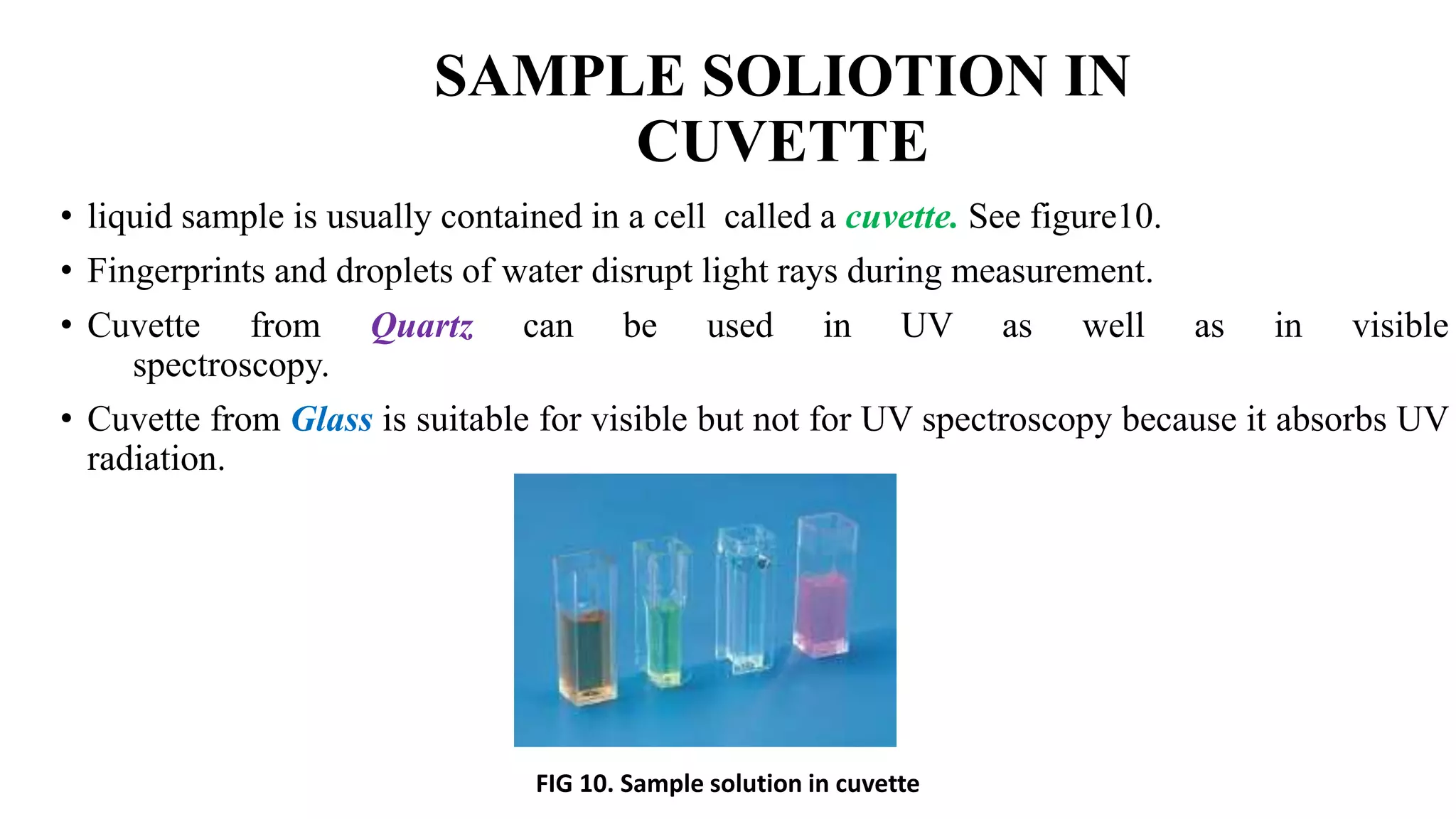
โ€ข liquid sample is usually contained in a cell called a cuvette. See figure10.
โ€ข Fingerprints and droplets of water disrupt light rays during measurement.
โ€ข Cuvette from Quartz can be used in UV as well as in visible
spectroscopy.
โ€ข Cuvette from Glass is suitable for visible but not for UV spectroscopy because it absorbs UV
radiation.
FIG 10. Sample solution in cuvette
PHOTO DETECTOR
โ€ข A photo detector is a semiconductor device which converts light energy to electrical
energy. It consists of a simple P-N junction diode and is designed to work in reverse
biased condition. The photons approaching the diode are absorbed by the photodiode and
current is generated.4 See figure 11.
FIG 11. Photodiode
READOUT DEVICE
Digital screen to record an uv spectrograph with absorbance against the wavelength.
------------------------------------------------
2.2 TYPES of SPECTROPHOTOMETER
FIG 12. Types of spectrophotometer.
Applications of UV-VIS Spectroscopy.
โ€ข UV-Vis spectroscopy is used heavily in many different research areas to identify or quantify
a sample.
โ€ข Chemical field:
1. Detection of impurities.
2. Structure of organic compounds (single or double bond, presence or absence of functional
group).
3. Kinetics of reaction.
4. Manufacturing drugs.
โ€ข Biological fields
1. quantify the amount of protein and DNA in a sample
2. quantify the amount of bacterial cells in a cell culture
ADVANTAGES/DISADVANTGES
โ€ข Major advantages of uv-vis spectroscopy are:
1. High sensitivity.
2. Require only small volume of sample.
3. Linearity over wide range of concentration.
4. Can be used with gradient elution.
โ€ข Major disadvantages of uv-vis spectroscopy are:
1. Not linear for high concentration.
2. Does not work with compounds that do not absorb light at this wavelength region.
3. Generates significant heat and requires external cooling.4
REFERENCES
1. H.H. Perkampus. UV-VIS Spectroscopy and its Applications,(2013),pp. 15-20.
2. J.Q .Brown,and G.M .Palmer. Advances in quantitative UVโ€“visible spectroscopy for
clinical and pre-clinical application in cancer,(2009), pp.30-42.
3. M.M. Giusti, and R.E. Wrolstad. Characterization and measurement of
anthocyanins by UVโ€visible spectroscopy,(2001),pp.57-60.
4. N.M.Kutty, UV-Visible spectroscopy, WWW Document
(http://reports.ias.ac.in/report/19397/uv-visible-spectroscopy)
THANK YOU!

UV- Spectroscopy (Modern Pharmaceutical Analytical Techniques.pptx

  • 1.
    UV-VIS Spectroscopy Rahul Pal*,Prachi Pandey M. Pharm (Pharmaceutics) Department of Pharmaceutics NIMS Institute of Pharmacy, NIMS University, Jaipur, Rajasthan, India MODERNPHARMACEUTICALANALYTICALTECHNIQUES
  • 2.
    Spectroscopy Spectroscopy is thestudy of interaction of electromagnetic radiation with matter. Basic principle of spectroscopy is the Beer-Lambertโ€™s law. In UV-VIS Spectroscopy, a continuum range of wavelengths from 200nm to 900nm is used. Spectrophotometer device is used in UV-VIS Spectroscopy. โ€ข Components of spectrophotometer ๏ฑ Sources of light(200nm to 900nm). ๏ฑ Monochromator. ๏ฑ Sample solution in cuvette. ๏ฑ Detectors. ๏ฑ Readout devices. โ€ข Types of spectrophotometer Single and double beam instruments. โ€ข Applications of UV-VIS Spectroscopy Qualitative &Quantitative analyses. FIG 1.Spectophotometer.
  • 3.
    INTRODUCTION โ€ข Spectroscopy isthe branch of science which deals with interaction of electromagnetic radiation with materials. In other words it is an analytical method for qualitative and quantitative analysis by use of light. โ€ข The Lambert Beer law in 1852 made the basis for the quantitative evaluation of absorption measurements.
  • 4.
    โ€ข This ledfirstly to colorimetry, then to photometry and finally to spectrophotometry. โ€ข This evolution was along with the development of detectors for measuring light intensities, i.e. silicon photo-diode detector. โ€ข Spectroscopy is widely used as an exploratory tool in the fields of physics, , and chemistry, for determination of composition, physical structure and electronic structure of matter at atomic scale, molecular scale, and macro scale.4
  • 5.
    SPECTROSCOPY โ€ข When anElectromagnetic radiation is incident on a matter, phenomena like reflection, transmission, absorption ,are occurring. โ€ข Spectroscopy is the study of interaction of electromagnetic radiation with matter based on the Bohr-Einstein frequency relationship E=hv , here h is the proportionality constant called Planckโ€™s constant (6.626 x 10⁻³⁴ J s) and v is frequency.
  • 6.
    โ€ข Measurement ofradiation intensity as a function of wavelength is described by spectroscopy, as shown in figure 2. โ€ข All forms of spectroscopy use part of the electromagnetic radiation to give us information about the materials. FIG.2.Spectroscopy graph.
  • 7.
    SPECTRUM โ€ข The spectrumis formed by electromagnetic waves and the wavelength is varies. See figure 3. โ€ข When a narrow beam of light is allowed to pass through a prism/grating, it is dispersed into seven colors from red to violet and the band is called Spectrum.. See figure 4. FIG.3.Electromagnatic spectrum. FIG.4.Glase prism dispersion
  • 8.
    PRINCIPLE Basic principle ofspectroscopy is the Beer-Lambertโ€™s law. 1.2.1 BEER LAW โ€ข Beer's law stated that absorbance is proportional to the concentrations of the material sample. 1.2.2 LAMBERT LAW โ€ข Lambert's law stated that absorbance of a material is directly proportional to its thickness (path length).
  • 9.
    โ€ข The modernderivation of the Beerโ€“Lambert law combines the two laws and correlates the absorbance to both the concentrations and the thickness of the material. FIG 5. Beerโ€“Lambert law.
  • 10.
    UV-VISIBLE SPECTROSCOPY โ€ข Ultravioletโ€“visiblespectrum can be generated when ultraviolet light and visible light (200- 900nm) are absorbed by materials. The spectrum can be used to analyze the composition and the structure of the materials. For a particular wavelength in the ultravioletโ€“visible ranges, the absorption degree is proportional to the components of the materials. Therefore, the characteristics of the materials are quantitatively reflected by the spectrum, which changes with the wave-length. โ€ข Ultravioletโ€“visible spectrum consists of an absorption spectrum. An absorption spectrum gives information about the molar absorptivity, concentration of the sample, optical bath length. See figure6, in previous slid.
  • 11.
    INSTRUMENTATION โ€ข SOURCE ofLIGHT. โ€ข MONOCHROMATOR. โ€ข SAMPLE SOLIOTION in CUVETTE. โ€ข PHOTO DETECTOR. โ€ข READOUT DEVICE. FIG 6.Components of spectrophotometer.
  • 12.
    SOURCE OF LIGHT โ€ขPart of the UV and Visible radiation source is Tungsten lamp. See figure 7. โ€ข UV radiation source is Deuterium or Hydrogen lamp . See figure 8. โ€ข Range of wavelength 200-400 nm. FIG.7.Tungsten lamp FIG.8.Deuterium lamp
  • 13.
    MONOCHROMATOR โ€ข It isa device that breaks the polychromatic radiation into component wavelengths. See figure 9. FIG.9.Monochromator components.
  • 14.
    The monochromator unitconsists of : โ€ขEntrance slit: defines narrow beam of radiation from source. โ€ขCollimating mirror:(polished surface) collimates the lights. โ€ขDiffraction grating or Prism (make of quartz): disperses the light into specific wavelength. โ€ขFocusing mirror: captures the dispersed light & sharpens the same to the sample via exit slit โ€ขExit slit: allows the corrected wavelength of light to the sample .
  • 15.
    SAMPLE SOLIOTION IN CUVETTE โ€ขliquid sample is usually contained in a cell called a cuvette. See figure10. โ€ข Fingerprints and droplets of water disrupt light rays during measurement. โ€ข Cuvette from Quartz can be used in UV as well as in visible spectroscopy. โ€ข Cuvette from Glass is suitable for visible but not for UV spectroscopy because it absorbs UV radiation. FIG 10. Sample solution in cuvette
  • 16.
    PHOTO DETECTOR โ€ข Aphoto detector is a semiconductor device which converts light energy to electrical energy. It consists of a simple P-N junction diode and is designed to work in reverse biased condition. The photons approaching the diode are absorbed by the photodiode and current is generated.4 See figure 11. FIG 11. Photodiode
  • 17.
    READOUT DEVICE Digital screento record an uv spectrograph with absorbance against the wavelength. ------------------------------------------------ 2.2 TYPES of SPECTROPHOTOMETER FIG 12. Types of spectrophotometer.
  • 18.
    Applications of UV-VISSpectroscopy. โ€ข UV-Vis spectroscopy is used heavily in many different research areas to identify or quantify a sample. โ€ข Chemical field: 1. Detection of impurities. 2. Structure of organic compounds (single or double bond, presence or absence of functional group). 3. Kinetics of reaction. 4. Manufacturing drugs. โ€ข Biological fields 1. quantify the amount of protein and DNA in a sample 2. quantify the amount of bacterial cells in a cell culture
  • 19.
    ADVANTAGES/DISADVANTGES โ€ข Major advantagesof uv-vis spectroscopy are: 1. High sensitivity. 2. Require only small volume of sample. 3. Linearity over wide range of concentration. 4. Can be used with gradient elution. โ€ข Major disadvantages of uv-vis spectroscopy are: 1. Not linear for high concentration. 2. Does not work with compounds that do not absorb light at this wavelength region. 3. Generates significant heat and requires external cooling.4
  • 20.
    REFERENCES 1. H.H. Perkampus.UV-VIS Spectroscopy and its Applications,(2013),pp. 15-20. 2. J.Q .Brown,and G.M .Palmer. Advances in quantitative UVโ€“visible spectroscopy for clinical and pre-clinical application in cancer,(2009), pp.30-42. 3. M.M. Giusti, and R.E. Wrolstad. Characterization and measurement of anthocyanins by UVโ€visible spectroscopy,(2001),pp.57-60. 4. N.M.Kutty, UV-Visible spectroscopy, WWW Document (http://reports.ias.ac.in/report/19397/uv-visible-spectroscopy)
  • 21.