
EVIDENCE BASED
MEDICINE (EBM)
PRESENTED BY
ANJALI RARICHAN
FIRST M.PHARM
DEPT. OF PHARMACY PRACTICE
DEFINITION
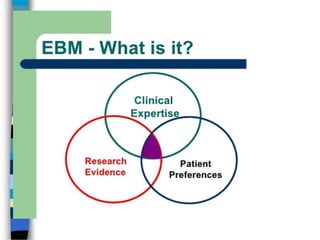
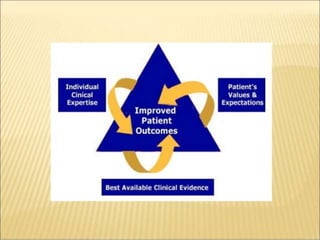
 Evidence Based Medicine (EBM) was defined
more recently as “the integration of best
research evidence with clinical expertise and
patient values”
 Now a days , the importance of using “best
evidence” to underpin practice is recognized,
thereby increasing the likelihood that an effect can
be predicted with confidence.
 The growth in EBM has been accompanied by a
greater understanding of the different levels of
evidence.
 Evidence-based
 The term "evidence-based medicine", as it is
currently used, has two main tributaries.
Chronologically, the first is the insistence on
explicit evaluation of evidence of effectiveness
when issuing clinical practice guidelines and
other population-level policies. The second is
the introduction of epidemiological methods
into medical education and individual patient-
level decision-making.
EVIDNCE BASED
 Recently, the process by which research results
were incorporated in medical decisions was
highly subjective. Called "clinical judgment" and
"the art of medicine", the traditional approach to
making decisions about individual patients
depended on having each individual physician
determine what research evidence, if any, to
consider, and how to merge that evidence with
personal beliefs and other factors.
 In the case of decisions that applied to groups of
patients or populations, the guidelines and
policies would usually be developed by
committees of experts.
 It teaches medical students and physicians how
to apply clinical and epidemiological research
studies to their practices.
 The term "evidence-based medicine" was introduced
slightly later, in the context of medical education.
 This branch of evidence-based medicine has its roots
in clinical epidemiology.
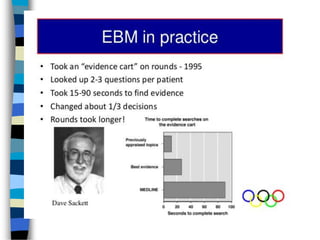
 David Sackett and colleagues clarified the definition
of this tributary of evidence-based medicine as "the
conscientious, explicit and judicious use of current
best evidence in making decisions about the care of
individual patients. It means integrating individual
clinical expertise with the best available external
clinical evidence from systematic research.
MEDICAL EDUCATION
 This branch of evidence-based medicine aims to
make individual decision making more structured
and objective by better reflecting the evidence
from research. It requires the application of
population-based data to the care of an individual
patient, while respecting the fact that practitioners
have clinical expertise reflected in effective and
efficient diagnosis and thoughtful identification
and compassionate use of individual patients'
predicaments, rights, and preferences
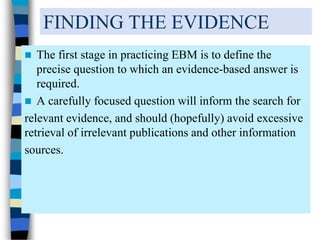
FINDING THE EVIDENCE
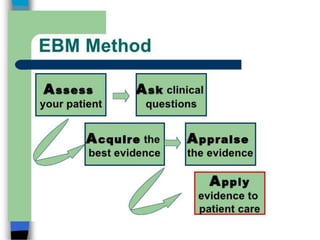
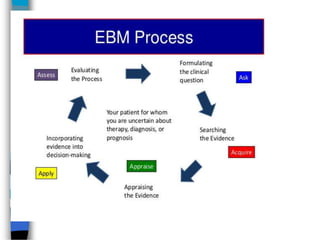
 The first stage in practicing EBM is to define the
precise question to which an evidence-based answer is
required.
 A carefully focused question will inform the search for
relevant evidence, and should (hopefully) avoid excessive
retrieval of irrelevant publications and other information
sources.
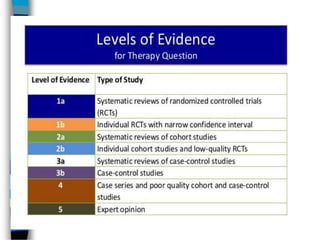
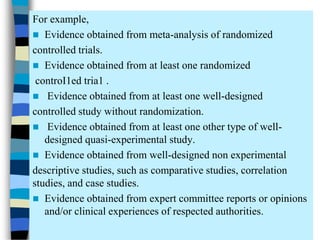
For example,
 Evidence obtained from meta-analysis of randomized
controlled trials.
 Evidence obtained from at least one randomized
controI1ed tria1 .
 Evidence obtained from at least one well-designed
controlled study without randomization.
 Evidence obtained from at least one other type of well-
designed quasi-experimental study.
 Evidence obtained from well-designed non experimental
descriptive studies, such as comparative studies, correlation
studies, and case studies.
 Evidence obtained from expert committee reports or opinions
and/or clinical experiences of respected authorities.
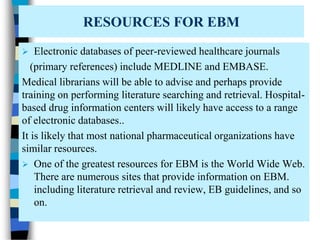
RESOURCES FOR EBM
 Electronic databases of peer-reviewed healthcare journals
(primary references) include MEDLINE and EMBASE.
Medical librarians will be able to advise and perhaps provide
training on performing literature searching and retrieval. Hospital-
based drug information centers will likely have access to a range
of electronic databases..
It is likely that most national pharmaceutical organizations have
similar resources.
 One of the greatest resources for EBM is the World Wide Web.
There are numerous sites that provide information on EBM.
including literature retrieval and review, EB guidelines, and so
on.
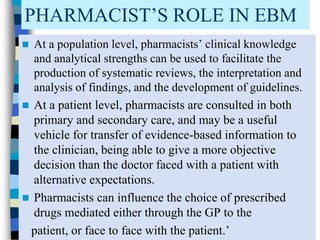
PHARMACIST’S ROLE IN EBM
 At a population level, pharmacists’ clinical knowledge
and analytical strengths can be used to facilitate the
production of systematic reviews, the interpretation and
analysis of findings, and the development of guidelines.
 At a patient level, pharmacists are consulted in both
primary and secondary care, and may be a useful
vehicle for transfer of evidence-based information to
the clinician, being able to give a more objective
decision than the doctor faced with a patient with
alternative expectations.
 Pharmacists can influence the choice of prescribed
drugs mediated either through the GP to the
patient, or face to face with the patient.’
REFERENCE
 Encyclopaedia of clinical pharmacy by Joseph.T.
Dipiro.
 Evidence Based Medicine Working Group 1992.
Evidence based medicine. A new approach to
teaching the practice of medicine. J. Am. Med.
Assoc.
EBM ppt by ANN

EBM ppt by ANN

  • 1.
    EVIDENCE BASED MEDICINE (EBM) PRESENTEDBY ANJALI RARICHAN FIRST M.PHARM DEPT. OF PHARMACY PRACTICE
  • 2.
    DEFINITION  Evidence BasedMedicine (EBM) was defined more recently as “the integration of best research evidence with clinical expertise and patient values”
  • 3.
     Now adays , the importance of using “best evidence” to underpin practice is recognized, thereby increasing the likelihood that an effect can be predicted with confidence.  The growth in EBM has been accompanied by a greater understanding of the different levels of evidence.
  • 4.
     Evidence-based  Theterm "evidence-based medicine", as it is currently used, has two main tributaries. Chronologically, the first is the insistence on explicit evaluation of evidence of effectiveness when issuing clinical practice guidelines and other population-level policies. The second is the introduction of epidemiological methods into medical education and individual patient- level decision-making. EVIDNCE BASED
  • 5.
     Recently, theprocess by which research results were incorporated in medical decisions was highly subjective. Called "clinical judgment" and "the art of medicine", the traditional approach to making decisions about individual patients depended on having each individual physician determine what research evidence, if any, to consider, and how to merge that evidence with personal beliefs and other factors.  In the case of decisions that applied to groups of patients or populations, the guidelines and policies would usually be developed by committees of experts.
  • 6.
     It teachesmedical students and physicians how to apply clinical and epidemiological research studies to their practices.
  • 7.
     The term"evidence-based medicine" was introduced slightly later, in the context of medical education.  This branch of evidence-based medicine has its roots in clinical epidemiology.  David Sackett and colleagues clarified the definition of this tributary of evidence-based medicine as "the conscientious, explicit and judicious use of current best evidence in making decisions about the care of individual patients. It means integrating individual clinical expertise with the best available external clinical evidence from systematic research. MEDICAL EDUCATION
  • 8.
     This branchof evidence-based medicine aims to make individual decision making more structured and objective by better reflecting the evidence from research. It requires the application of population-based data to the care of an individual patient, while respecting the fact that practitioners have clinical expertise reflected in effective and efficient diagnosis and thoughtful identification and compassionate use of individual patients' predicaments, rights, and preferences
  • 16.
    FINDING THE EVIDENCE The first stage in practicing EBM is to define the precise question to which an evidence-based answer is required.  A carefully focused question will inform the search for relevant evidence, and should (hopefully) avoid excessive retrieval of irrelevant publications and other information sources.
  • 17.
    For example,  Evidenceobtained from meta-analysis of randomized controlled trials.  Evidence obtained from at least one randomized controI1ed tria1 .  Evidence obtained from at least one well-designed controlled study without randomization.  Evidence obtained from at least one other type of well- designed quasi-experimental study.  Evidence obtained from well-designed non experimental descriptive studies, such as comparative studies, correlation studies, and case studies.  Evidence obtained from expert committee reports or opinions and/or clinical experiences of respected authorities.
  • 18.
    RESOURCES FOR EBM Electronic databases of peer-reviewed healthcare journals (primary references) include MEDLINE and EMBASE. Medical librarians will be able to advise and perhaps provide training on performing literature searching and retrieval. Hospital- based drug information centers will likely have access to a range of electronic databases.. It is likely that most national pharmaceutical organizations have similar resources.  One of the greatest resources for EBM is the World Wide Web. There are numerous sites that provide information on EBM. including literature retrieval and review, EB guidelines, and so on.
  • 19.
    PHARMACIST’S ROLE INEBM  At a population level, pharmacists’ clinical knowledge and analytical strengths can be used to facilitate the production of systematic reviews, the interpretation and analysis of findings, and the development of guidelines.  At a patient level, pharmacists are consulted in both primary and secondary care, and may be a useful vehicle for transfer of evidence-based information to the clinician, being able to give a more objective decision than the doctor faced with a patient with alternative expectations.  Pharmacists can influence the choice of prescribed drugs mediated either through the GP to the patient, or face to face with the patient.’
  • 22.
    REFERENCE  Encyclopaedia ofclinical pharmacy by Joseph.T. Dipiro.  Evidence Based Medicine Working Group 1992. Evidence based medicine. A new approach to teaching the practice of medicine. J. Am. Med. Assoc.