Electromagnetic Radiation
a) These are produced by the oscillation of electronic charge and
magnetic field residing on the atom. The electric and magnetic
components are mutually perpendicular to each other and are
coplanar.
b) These are characterized by their wavelengths or frequencies or
wave numbers.
c) The energy carried by an EMR is directly proportional to its
frequency. The emission or absorption of radiation is
quantized and each quantum of radiation is called photon.
Electromagnetic Radiations (EMR)
d) All types of radiations travel with the same velocity and no medium
is required for their propagation. They can travel through vacuum.
e) When a visible light (a group of electromagnetic radiations) is
passed through a prism, it is split up into seven colors which
correspond to definite wavelengths. This phenomenon is called
dispersion.
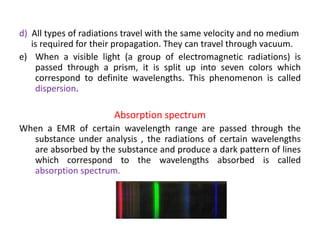
Absorption spectrum
When a EMR of certain wavelength range are passed through the
substance under analysis , the radiations of certain wavelengths
are absorbed by the substance and produce a dark pattern of lines
which correspond to the wavelengths absorbed is called
absorption spectrum.
Units Used in Spectroscopy
Wavelength: It is the distance between the two adjacent crests (C-
C) or troughs (T-T) in a particular wave and denoted by λ
(lambda). It can be expressed in Angstrom/in millimicrons (mµ).
1 Å = 10-8 cm; 1 mµ = 10-7 cm
For UV, λ < 3800 Å
Units Used in Spectroscopy
Wave number: It is defined as the total number of waves which can
pass through a space of one cm. It is the reciprocal of wavelength
and is expressed incm-1.
If the wavelength of a light is known, the corresponding wave number
can be calculated. For example, if the wavelength of a radiation is
2.5 µ, then the corresponding wave number can be calculated as
follows;
λ = 2.5 µ = 2.5 X 10⁻⁴ cm
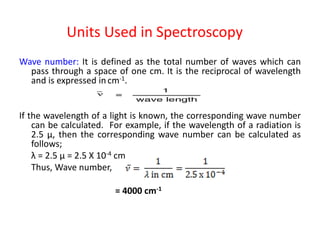
Thus, Wave number,
= 4000 cm-1
Units Used in Spectroscopy
Frequency: It is defined as the number of waves which can pass
through a point in one second. It is expressed as ν is
cycles/sec or in Hertz (Hz) where 1 Hz = 1 cycle sec-1
Frequency is inversely proportional to the wavelength, thus
greater the wavelength, smaller is the frequency.
Frequency,
Where, C = Velocity of EMR = 2.998 x 1010 cm sec-1
Units Used in Spectroscopy
Frequency continued………
The wavelength of the visible light is 3800 -7600 Å, calculate the corresponding
frequency range.
a) λ = 3800 Å
= 3800 x 10-8 cm
Thus,
=
b) For λ = 7600 Å, do it by yourself
Units Used in Spectroscopy
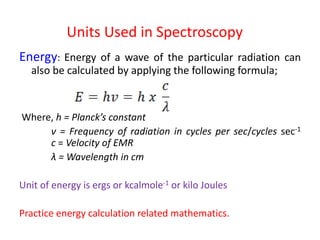
Energy: Energy of a wave of the particular radiation can
also be calculated by applying the following formula;
Where, h = Planck’s constant
ν = Frequency of radiation in cycles per sec/cycles sec-1
c = Velocity of EMR
λ = Wavelength in cm
Unit of energy is ergs or kcalmole-1 or kilo Joules
Practice energy calculation related mathematics.
• Spectroscopy: Measures the interaction of a compound with
electromagnetic radiation of different wavelengths. There are three
different types of spectroscopy;
1. Ultraviolet-Visible (UV-Vis) Spectroscopy measures the absorption of
ultraviolet and visible light by  bonds in an organic compound.
Bonds of different types and with different extents of conjugation
(C=C, C=O, C=C–C=C, aromatic) absorb energy of different
wavelengths.
2. Infrared (IR) Spectroscopy measures the absorption of infrared
(heat) radiation by organic compounds. Different functional groups
(C=O, -OH) absorb energy of different wavelengths.
3. Nuclear Magnetic Resonance Spectroscopy (NMR) measures the
absorption of radio waves by C and H in a magnetic field. Different
kinds of C and H absorb energy of different wavelengths.
Spectroscopy
Regions of Different Electromagnetic
Radiations

Electromagnetic Radiations (EMR)

  • 1.
    Electromagnetic Radiation a) Theseare produced by the oscillation of electronic charge and magnetic field residing on the atom. The electric and magnetic components are mutually perpendicular to each other and are coplanar. b) These are characterized by their wavelengths or frequencies or wave numbers. c) The energy carried by an EMR is directly proportional to its frequency. The emission or absorption of radiation is quantized and each quantum of radiation is called photon. Electromagnetic Radiations (EMR)
  • 2.
    d) All typesof radiations travel with the same velocity and no medium is required for their propagation. They can travel through vacuum. e) When a visible light (a group of electromagnetic radiations) is passed through a prism, it is split up into seven colors which correspond to definite wavelengths. This phenomenon is called dispersion. Absorption spectrum When a EMR of certain wavelength range are passed through the substance under analysis , the radiations of certain wavelengths are absorbed by the substance and produce a dark pattern of lines which correspond to the wavelengths absorbed is called absorption spectrum.
  • 3.
    Units Used inSpectroscopy Wavelength: It is the distance between the two adjacent crests (C- C) or troughs (T-T) in a particular wave and denoted by λ (lambda). It can be expressed in Angstrom/in millimicrons (mµ). 1 Å = 10-8 cm; 1 mµ = 10-7 cm For UV, λ < 3800 Å
  • 4.
    Units Used inSpectroscopy Wave number: It is defined as the total number of waves which can pass through a space of one cm. It is the reciprocal of wavelength and is expressed incm-1. If the wavelength of a light is known, the corresponding wave number can be calculated. For example, if the wavelength of a radiation is 2.5 µ, then the corresponding wave number can be calculated as follows; λ = 2.5 µ = 2.5 X 10⁻⁴ cm Thus, Wave number, = 4000 cm-1
  • 5.
    Units Used inSpectroscopy Frequency: It is defined as the number of waves which can pass through a point in one second. It is expressed as ν is cycles/sec or in Hertz (Hz) where 1 Hz = 1 cycle sec-1 Frequency is inversely proportional to the wavelength, thus greater the wavelength, smaller is the frequency. Frequency, Where, C = Velocity of EMR = 2.998 x 1010 cm sec-1
  • 6.
    Units Used inSpectroscopy Frequency continued……… The wavelength of the visible light is 3800 -7600 Å, calculate the corresponding frequency range. a) λ = 3800 Å = 3800 x 10-8 cm Thus, = b) For λ = 7600 Å, do it by yourself
  • 7.
    Units Used inSpectroscopy Energy: Energy of a wave of the particular radiation can also be calculated by applying the following formula; Where, h = Planck’s constant ν = Frequency of radiation in cycles per sec/cycles sec-1 c = Velocity of EMR λ = Wavelength in cm Unit of energy is ergs or kcalmole-1 or kilo Joules Practice energy calculation related mathematics.
  • 8.
    • Spectroscopy: Measuresthe interaction of a compound with electromagnetic radiation of different wavelengths. There are three different types of spectroscopy; 1. Ultraviolet-Visible (UV-Vis) Spectroscopy measures the absorption of ultraviolet and visible light by  bonds in an organic compound. Bonds of different types and with different extents of conjugation (C=C, C=O, C=C–C=C, aromatic) absorb energy of different wavelengths. 2. Infrared (IR) Spectroscopy measures the absorption of infrared (heat) radiation by organic compounds. Different functional groups (C=O, -OH) absorb energy of different wavelengths. 3. Nuclear Magnetic Resonance Spectroscopy (NMR) measures the absorption of radio waves by C and H in a magnetic field. Different kinds of C and H absorb energy of different wavelengths. Spectroscopy
  • 9.
    Regions of DifferentElectromagnetic Radiations