Presented by,
Venkatesan R
M.Pharm 1st year
Department of pharmaceutical analysis
karnataka college of pharmacy
Presented to,
T. Sreenivas Rao sir
Assistant Professor
Department of pharmaceutical chemistry
karnataka college of pharmcy
Content
01
02
03
05
Introduction
Theory / Principle
Laws
Choice of solvent and solvent
effect
Chromophores / Auxachromes
04
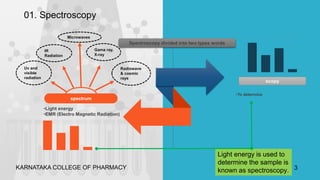
01. Spectroscopy
Spectroscopy divided into two types words
•To determine
scopy
•Light energy
•EMR (Electro Magnetic Radiation)
spectrum
Light energy is used to
determine the sample is
known as spectroscopy.
Uv and
visible
radiation
Microwaves
IR
Radiation
Gama ray,
X-ray
Radiowave
& cosmic
rays
KARNATAKA COLLEGE OF PHARMACY 3
Spectroscopy
40% 50%
60%
80%
Spectroscopy is the branch of science which is used for quantitative analysis of
sample or matter by using (EMR) electromagnetic radiation
Spectroscopy is the measurement and interpretation of EMR absorbed or
emitted. Then the molecule are atoms of sample moves from one energy state
to another energy state.
KARNATAKA COLLEGE OF PHARMACY 4
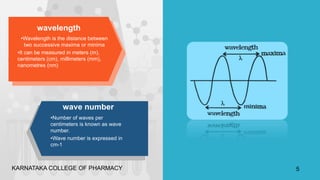
•Wavelength is the distance between
two successive maxima or minima
•It can be measured in meters (m),
centimeters (cm), millimeters (mm),
nanometres (nm)
wavelength
•Number of waves per
centimeters is known as wave
number.
•Wave number is expressed in
cm-1
wave number
KARNATAKA COLLEGE OF PHARMACY 5
•Electromagnetic radiation
It’s a combination of electric and
magnetic radiation
Light flow in the form of wave which
contain photon (means packet of energy)
The electric and magnetic radiation
produces the transition
•Frequency
Frequency is the number of complete
wavelength units passing through a given
point in unit time.
Frequency is measured in Hertz (Hz),
cycles per second (CPS).
KARNATAKA COLLEGE OF PHARMACY 6
Uv- visible spectroscopy
• Used for quantitative analysis of matter or sample by using
uv (ultra-violet) and visible light.
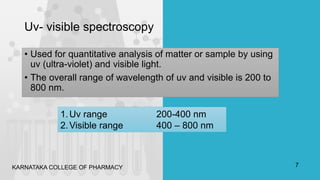
• The overall range of wavelength of uv and visible is 200 to
800 nm.
1.Uv range 200-400 nm
2.Visible range 400 – 800 nm
KARNATAKA COLLEGE OF PHARMACY 7
Theory / Principle
• EMR light contain packets of energy now, when this light passes
through the sample.
• A particles or molecules of sample absorb this light so, particle get
excited.
• Now uv visible spectroscopy principle depends upon the absorption
of light.
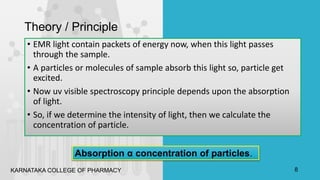
• So, if we determine the intensity of light, then we calculate the
concentration of particle.
Absorption α concentration of particles.
KARNATAKA COLLEGE OF PHARMACY 8
Beer’s and Lambert’s laws
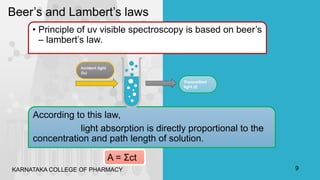
According to this law,
light absorption is directly proportional to the
concentration and path length of solution.
• Principle of uv visible spectroscopy is based on beer’s
– lambert’s law.
Incident light
(Io)
Transmitted
light (I)
A = Σct
KARNATAKA COLLEGE OF PHARMACY 9
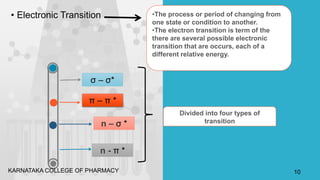
• Electronic Transition
n – σ *
π – π *
n - π *
Divided into four types of
transition
σ – σ*
•The process or period of changing from
one state or condition to another.
•The electron transition is term of the
there are several possible electronic
transition that are occurs, each of a
different relative energy.
KARNATAKA COLLEGE OF PHARMACY 10
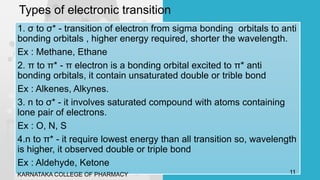
Types of electronic transition
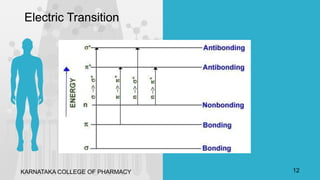
1. σ to σ* - transition of electron from sigma bonding orbitals to anti
bonding orbitals , higher energy required, shorter the wavelength.
Ex : Methane, Ethane
2. π to π* - π electron is a bonding orbital excited to π* anti
bonding orbitals, it contain unsaturated double or trible bond
Ex : Alkenes, Alkynes.
3. n to σ* - it involves saturated compound with atoms containing
lone pair of electrons.
Ex : O, N, S
4.n to π* - it require lowest energy than all transition so, wavelength
is higher, it observed double or triple bond
Ex : Aldehyde, Ketone
KARNATAKA COLLEGE OF PHARMACY 11
Electric Transition
Electric Transition
KARNATAKA COLLEGE OF PHARMACY 12
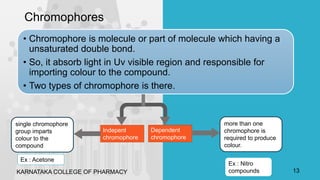
Chromophores
• Chromophore is molecule or part of molecule which having a
unsaturated double bond.
• So, it absorb light in Uv visible region and responsible for
importing colour to the compound.
• Two types of chromophore is there.
Indepent
chromophore
Dependent
chromophore
single chromophore
group imparts
colour to the
compound
more than one
chromophore is
required to produce
colour.
Ex : Acetone
Ex : Nitro
compounds
KARNATAKA COLLEGE OF PHARMACY 13
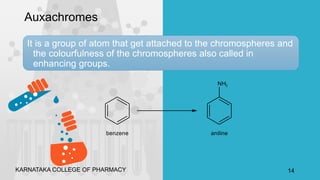
Auxachromes
It is a group of atom that get attached to the chromospheres and
the colourfulness of the chromospheres also called in
enhancing groups.
KARNATAKA COLLEGE OF PHARMACY 14
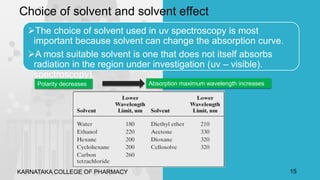
Choice of solvent and solvent effect
The choice of solvent used in uv spectroscopy is most
important because solvent can change the absorption curve.
A most suitable solvent is one that does not itself absorbs
radiation in the region under investigation (uv – visible).
spectroscopy).
Polarity decreases Absorption maximum wavelength increases
KARNATAKA COLLEGE OF PHARMACY 15
References
• Pharmaceutical analysis – Ravishankar
• Modern Pharmaceutical analysis –
Dr.Shashikant D.Barhate.
• Pharmaceutical Chemical analysis - Austhoskar
KARNATAKA COLLEGE OF PHARMACY 16
THANK YOU

UV VISIBLE SPECTROSCOPY INTRO

  • 1.
    Presented by, Venkatesan R M.Pharm1st year Department of pharmaceutical analysis karnataka college of pharmacy Presented to, T. Sreenivas Rao sir Assistant Professor Department of pharmaceutical chemistry karnataka college of pharmcy
  • 2.
    Content 01 02 03 05 Introduction Theory / Principle Laws Choiceof solvent and solvent effect Chromophores / Auxachromes 04
  • 3.
    01. Spectroscopy Spectroscopy dividedinto two types words •To determine scopy •Light energy •EMR (Electro Magnetic Radiation) spectrum Light energy is used to determine the sample is known as spectroscopy. Uv and visible radiation Microwaves IR Radiation Gama ray, X-ray Radiowave & cosmic rays KARNATAKA COLLEGE OF PHARMACY 3
  • 4.
    Spectroscopy 40% 50% 60% 80% Spectroscopy isthe branch of science which is used for quantitative analysis of sample or matter by using (EMR) electromagnetic radiation Spectroscopy is the measurement and interpretation of EMR absorbed or emitted. Then the molecule are atoms of sample moves from one energy state to another energy state. KARNATAKA COLLEGE OF PHARMACY 4
  • 5.
    •Wavelength is thedistance between two successive maxima or minima •It can be measured in meters (m), centimeters (cm), millimeters (mm), nanometres (nm) wavelength •Number of waves per centimeters is known as wave number. •Wave number is expressed in cm-1 wave number KARNATAKA COLLEGE OF PHARMACY 5
  • 6.
    •Electromagnetic radiation It’s acombination of electric and magnetic radiation Light flow in the form of wave which contain photon (means packet of energy) The electric and magnetic radiation produces the transition •Frequency Frequency is the number of complete wavelength units passing through a given point in unit time. Frequency is measured in Hertz (Hz), cycles per second (CPS). KARNATAKA COLLEGE OF PHARMACY 6
  • 7.
    Uv- visible spectroscopy •Used for quantitative analysis of matter or sample by using uv (ultra-violet) and visible light. • The overall range of wavelength of uv and visible is 200 to 800 nm. 1.Uv range 200-400 nm 2.Visible range 400 – 800 nm KARNATAKA COLLEGE OF PHARMACY 7
  • 8.
    Theory / Principle •EMR light contain packets of energy now, when this light passes through the sample. • A particles or molecules of sample absorb this light so, particle get excited. • Now uv visible spectroscopy principle depends upon the absorption of light. • So, if we determine the intensity of light, then we calculate the concentration of particle. Absorption α concentration of particles. KARNATAKA COLLEGE OF PHARMACY 8
  • 9.
    Beer’s and Lambert’slaws According to this law, light absorption is directly proportional to the concentration and path length of solution. • Principle of uv visible spectroscopy is based on beer’s – lambert’s law. Incident light (Io) Transmitted light (I) A = Σct KARNATAKA COLLEGE OF PHARMACY 9
  • 10.
    • Electronic Transition n– σ * π – π * n - π * Divided into four types of transition σ – σ* •The process or period of changing from one state or condition to another. •The electron transition is term of the there are several possible electronic transition that are occurs, each of a different relative energy. KARNATAKA COLLEGE OF PHARMACY 10
  • 11.
    Types of electronictransition 1. σ to σ* - transition of electron from sigma bonding orbitals to anti bonding orbitals , higher energy required, shorter the wavelength. Ex : Methane, Ethane 2. π to π* - π electron is a bonding orbital excited to π* anti bonding orbitals, it contain unsaturated double or trible bond Ex : Alkenes, Alkynes. 3. n to σ* - it involves saturated compound with atoms containing lone pair of electrons. Ex : O, N, S 4.n to π* - it require lowest energy than all transition so, wavelength is higher, it observed double or triple bond Ex : Aldehyde, Ketone KARNATAKA COLLEGE OF PHARMACY 11
  • 12.
  • 13.
    Chromophores • Chromophore ismolecule or part of molecule which having a unsaturated double bond. • So, it absorb light in Uv visible region and responsible for importing colour to the compound. • Two types of chromophore is there. Indepent chromophore Dependent chromophore single chromophore group imparts colour to the compound more than one chromophore is required to produce colour. Ex : Acetone Ex : Nitro compounds KARNATAKA COLLEGE OF PHARMACY 13
  • 14.
    Auxachromes It is agroup of atom that get attached to the chromospheres and the colourfulness of the chromospheres also called in enhancing groups. KARNATAKA COLLEGE OF PHARMACY 14
  • 15.
    Choice of solventand solvent effect The choice of solvent used in uv spectroscopy is most important because solvent can change the absorption curve. A most suitable solvent is one that does not itself absorbs radiation in the region under investigation (uv – visible). spectroscopy). Polarity decreases Absorption maximum wavelength increases KARNATAKA COLLEGE OF PHARMACY 15
  • 16.
    References • Pharmaceutical analysis– Ravishankar • Modern Pharmaceutical analysis – Dr.Shashikant D.Barhate. • Pharmaceutical Chemical analysis - Austhoskar KARNATAKA COLLEGE OF PHARMACY 16
  • 17.