UV Visible Spectroscopy
Karolinekersin E
Contents
• Introduction
• Principle
• Instrumentation
• Procedure
• Application
• Merits
• Demerits
4/2/2022 2
UV-Visible Spectroscopy
• Ultraviolet-visible (UV-Vis) spectroscopy is one of the most popular
analytical techniques because it is very versatile and able to detect
nearly every molecule
• UV-Vis Spectroscopy is a quantitative technique used to measure
how much a chemical substance absorbs light.
• This is done by measuring the intensity of light that passes through
a sample with respect to the intensity of light through a reference
sample or blank.
4/2/2022 3
• With UV-Vis spectroscopy, the UV-Vis light is passed through a
sample and the transmittance of light by a sample is measured.
• From the transmittance (T), the absorbance can be calculated as
A=-log (T).
• An absorbance spectrum is obtained that shows the absorbance of a
compound at different wavelengths.
• The amount of absorbance at any wavelength is due to the chemical
structure of the molecule
4/2/2022 4
• UV-Vis can be used in a qualitative manner, to identify functional
groups or confirm the identity of a compound by matching the
absorbance spectrum.
• It can also be used in a quantitative manner, as concentration of the
analyte is related to the absorbance using Beer's Law.
• UV-Vis spectroscopy is used to quantify the amount of DNA or
protein in a sample, for water analysis, and as a detector for many
types of chromatography.
4/2/2022 5
Principles
• UV-Vis is often called a general technique because most molecules
will absorb in the UV-Vis wavelength range.
• The UV extends from 100–400 nm and the visible spectrum from
400–700 nm.
• The 100–200 nm range is called the deep UV. Light sources are
more difficult to find for this range, so it is not routinely used for
UV-Vis measurements.
• Typical UV-Vis spectrometers use a deuterium lamp for the UV that
produces light from 170–375 nm and a tungsten filament lamp for
visible, which produces light from 350–2,500 nm.
4/2/2022 6
• When a photon hits a molecule and is absorbed, the molecule is
promoted into a more excited energetic state.
• UV-visible light has enough energy to promote electrons to a higher
electronic state, from the highest occupied molecular orbital
(HOMO) to the lowest unoccupied molecular orbital (LUMO).
• The energy difference between the HOMO and the LUMO is called
the band gap.
• Typically, these orbitals are called bonding and anti-bonding. The
energy of the photon must exactly match the band gap for the
photon to be absorbed.
4/2/2022 7
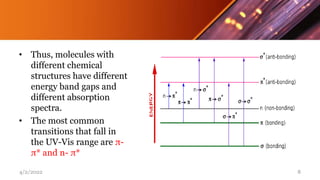
• Thus, molecules with
different chemical
structures have different
energy band gaps and
different absorption
spectra.
• The most common
transitions that fall in
the UV-Vis range are π-
π* and n- π*
4/2/2022 8
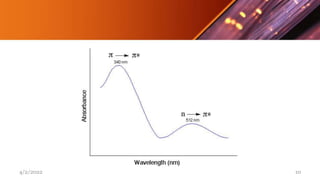
• Pi orbitals arise due to double bonds, and n orbitals are for non-bonding
electrons.
• Pi star are anti-bonding pi orbitals.
• Thus, the best UV-Vis absorption is by molecules that contain double bonds.
• Pi orbitals adjacent to each other that are connected, called conjugation,
typically increases absorption.
• Sigma-σ* transitions, associated with single bonds, are higher energy and
fall in the deep UV, so they are less useful for routine use.
• The appearance of broad bands or shoulders on the UV-Vis structure is due
to the numerous vibrational and rotational states of a molecule, which lead
to separate energy band gaps of slightly different energies.
4/2/2022 9
4/2/2022 10
• For molecules with absorption in the visible region, the compounds
will often appear colored.
• However, a common misconception is that the wavelength of peak
absorption (λmax) for a compound is the color it appears.
• A compound that appears red does not have much absorption in the
red region of the spectrum.
• Instead, the λmaxfor a compound that looks red is green.
4/2/2022 11
• The color of a compound arises because those wavelengths of light
are selectively transmitted through the sample, and thus they are not
absorbed.
• A color wheel is helpful in determining what color a compound will
absorb and what range the λmax will be, as the color directly across
the wheel from the observed color is the color that is most absorbed.
4/2/2022 12
Beer’s law
• Absorption follows Beer's Law, A=εbC where ε is the molar
attenuation coefficient, b is path length, and C is concentration.
• The molar attenuation coefficient is the characteristic of an
individual compound to absorb at a given wavelength and this
property is due to functional groups, conjugation, etc.
• If a compound does not have a high attenuation coefficient, it could
be tagged with an appropriate group to increase its absorbance. Path
length is generally related to the size of the cuvette and is 1 cm in
standard spectrophotometers
4/2/2022 13
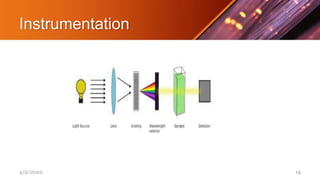
Instrumentation
4/2/2022 14
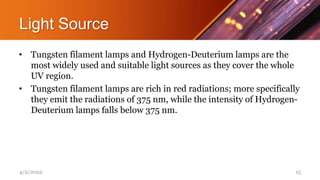
Light Source
• Tungsten filament lamps and Hydrogen-Deuterium lamps are the
most widely used and suitable light sources as they cover the whole
UV region.
• Tungsten filament lamps are rich in red radiations; more specifically
they emit the radiations of 375 nm, while the intensity of Hydrogen-
Deuterium lamps falls below 375 nm.
4/2/2022 15
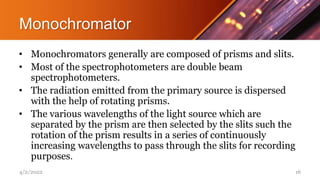
Monochromator
• Monochromators generally are composed of prisms and slits.
• Most of the spectrophotometers are double beam
spectrophotometers.
• The radiation emitted from the primary source is dispersed
with the help of rotating prisms.
• The various wavelengths of the light source which are
separated by the prism are then selected by the slits such the
rotation of the prism results in a series of continuously
increasing wavelengths to pass through the slits for recording
purposes.
4/2/2022 16
• The beam selected by the slit is monochromatic and further
divided into two beams with the help of another prism.
4/2/2022 17
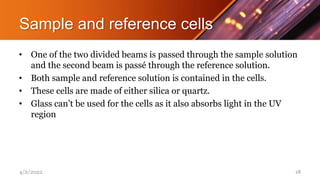
Sample and reference cells
• One of the two divided beams is passed through the sample solution
and the second beam is passé through the reference solution.
• Both sample and reference solution is contained in the cells.
• These cells are made of either silica or quartz.
• Glass can’t be used for the cells as it also absorbs light in the UV
region
4/2/2022 18
• Generally, two photocells serve the purpose of the detector in UV
spectroscopy.
• One of the photocells receives the beam from the sample cell and the
second detector receives the beam from the reference.
• The intensity of the radiation from the reference cell is stronger than
the beam of the sample cell.
• This results in the generation of pulsating or alternating currents in
the photocells
4/2/2022 19
Amplifier
• The alternating current generated in the photocells is
transferred to the amplifier.
• The amplifier is coupled to a small servometer.
• Generally, the current generated in the photocells is of very
low intensity, the main purpose of the amplifier is to amplify
the signals many times so we can get clear and recordable
signals.
4/2/2022 20
Recording devices
• Most of the time amplifier is coupled to a pen recorder which
is connected to the computer.
• The computer stores all the data generated and produces the
spectrum of the desired compound.
4/2/2022 21
Procedure
• Perform an Absorbance Spectrum
• Kinetics Experiments with UV-Vis Spectroscopy
4/2/2022 22
Calibrate the Spectrometer
1. Turn on the UV-Vis spectrometer and allow the lamps to warm up
for an appropriate period of time (around 20 min) to stabilize them.
2. Fill a cuvette with the solvent for the sample and make sure the
outside is clean. This will serve as a blank and help account for light
losses due to scattering or absorption by the solvent.
3. Place the cuvette in the spectrometer. Make sure to align the cuvette
properly, as often the cuvette has two sides, which are meant for
handling (may be grooved) and are not meant to shine light through.
4. Take a reading for the blank. The absorbance should be minimal, but
any absorbance should be subtracted out from future samples. Some
instruments might store the blank data and perform the subtraction
automatically.
4/2/2022 23
Perform an Absorbance Spectrum
1. Fill the cuvette with the sample.
2. To make sure the transfer is quantitative, rinse the cuvette twice
with the sample and then fill it about ¾ full.
3. Make sure the outside is clean of any fingerprints, etc.
4. Place the cuvette in the spectrometer in the correct direction.
5. Cover the cuvette to prevent any ambient light.
4/2/2022 24
• Collect an absorbance spectrum by allowing the instrument to scan
through different wavelengths and collect the absorbance.
• The wavelength range can be set with information about the specific
sample, but a range of 200–800 nm is standard.
• A diode-array instrument is able to collect an entire absorbance
spectrum in one run.
• From the collected absorbance spectrum, determine the absorbance
maximum (λmax).
4/2/2022 25
• Repeat the collection of spectra to get an estimate of error in
λmax.
• To make a calibration curve, collect the UV-Vis spectrum of a
variety of different concentration samples.
• Spectrometers are often limited in linear range and will not be
able to measure an absorbance value greater than 1.5.
• If the absorbance values for the sample are outside the
instrument's linear range, dilute the sample to get the values
within the linear range.
4/2/2022 26
Kinetics Experiments with UV-Vis Spectroscopy
1. UV-Vis can be used for kinetics experiments by examining the change in
absorbance over time. For a kinetics experiment, take an initial reading of the
sample.
2. Quickly add the reagent to start the chemical reaction.
3. Stir it well to mix with the sample. If a small amount is added, this could be done
in a cuvette. Alternatively, mix the reagent with sample and quickly pour some in
a cuvette for a measurement.
4. Measure the absorbance at the λmax for the analyte of interest over time. If using
up the reagent being measuring (i.e. absorbance is going up because there is less
reagent to absorb), then the decay will indicate the order of the reaction.
5. Using a calibration curve, make a plot of analyte concentration vs time,
converting the absorbance value into concentration. From there, this graph can
be fit with appropriate equations to determine the reaction rate constants
4/2/2022 27
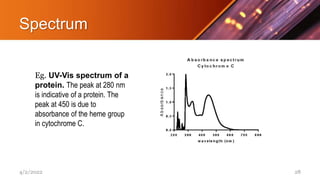
Spectrum
Eg. UV-Vis spectrum of a
protein. The peak at 280 nm
is indicative of a protein. The
peak at 450 is due to
absorbance of the heme group
in cytochrome C.
4/2/2022 28
Applications
• UV-Vis is used in many chemical analyses.
• Determination of the optical properties of liquids
and solids between 175 nm and 3300 nm
• Quantification of analytes in solutions
4/2/2022 29
Merits
• Suitable for the determination of the concentrations of a wide
variety of analytes in solution
• Quantification of analytes in solutions using UV/VIS/NIR is simpler
and less time-consuming than chromatographic analysis
4/2/2022 30
Demerits
• Other components in solution may cause interferences
• Chromatographic analysis methods are more accurate and precise
than UV/VIS/NIR methods
• Sample size/sample volume have specific requirements (see
technical specifications)
4/2/2022 31
UV/VIS/NIR Technical Spécifications
• Wavelength Range: 175-3300 nm (175-2500 nm when
using the integrating sphere)
• Beam Size: between 2 mm diameter and 12×8 mm
• Sample Size: between 0.5×0.5 cm and 10×10 cm for solid
samples
• Sample Volume: >0.2 mL for liquid samples
4/2/2022 32
THANK YOU
4/2/2022 33

UV VISIBLE SPECTROSCOPY

  • 1.
  • 2.
    Contents • Introduction • Principle •Instrumentation • Procedure • Application • Merits • Demerits 4/2/2022 2
  • 3.
    UV-Visible Spectroscopy • Ultraviolet-visible(UV-Vis) spectroscopy is one of the most popular analytical techniques because it is very versatile and able to detect nearly every molecule • UV-Vis Spectroscopy is a quantitative technique used to measure how much a chemical substance absorbs light. • This is done by measuring the intensity of light that passes through a sample with respect to the intensity of light through a reference sample or blank. 4/2/2022 3
  • 4.
    • With UV-Visspectroscopy, the UV-Vis light is passed through a sample and the transmittance of light by a sample is measured. • From the transmittance (T), the absorbance can be calculated as A=-log (T). • An absorbance spectrum is obtained that shows the absorbance of a compound at different wavelengths. • The amount of absorbance at any wavelength is due to the chemical structure of the molecule 4/2/2022 4
  • 5.
    • UV-Vis canbe used in a qualitative manner, to identify functional groups or confirm the identity of a compound by matching the absorbance spectrum. • It can also be used in a quantitative manner, as concentration of the analyte is related to the absorbance using Beer's Law. • UV-Vis spectroscopy is used to quantify the amount of DNA or protein in a sample, for water analysis, and as a detector for many types of chromatography. 4/2/2022 5
  • 6.
    Principles • UV-Vis isoften called a general technique because most molecules will absorb in the UV-Vis wavelength range. • The UV extends from 100–400 nm and the visible spectrum from 400–700 nm. • The 100–200 nm range is called the deep UV. Light sources are more difficult to find for this range, so it is not routinely used for UV-Vis measurements. • Typical UV-Vis spectrometers use a deuterium lamp for the UV that produces light from 170–375 nm and a tungsten filament lamp for visible, which produces light from 350–2,500 nm. 4/2/2022 6
  • 7.
    • When aphoton hits a molecule and is absorbed, the molecule is promoted into a more excited energetic state. • UV-visible light has enough energy to promote electrons to a higher electronic state, from the highest occupied molecular orbital (HOMO) to the lowest unoccupied molecular orbital (LUMO). • The energy difference between the HOMO and the LUMO is called the band gap. • Typically, these orbitals are called bonding and anti-bonding. The energy of the photon must exactly match the band gap for the photon to be absorbed. 4/2/2022 7
  • 8.
    • Thus, moleculeswith different chemical structures have different energy band gaps and different absorption spectra. • The most common transitions that fall in the UV-Vis range are π- π* and n- π* 4/2/2022 8
  • 9.
    • Pi orbitalsarise due to double bonds, and n orbitals are for non-bonding electrons. • Pi star are anti-bonding pi orbitals. • Thus, the best UV-Vis absorption is by molecules that contain double bonds. • Pi orbitals adjacent to each other that are connected, called conjugation, typically increases absorption. • Sigma-σ* transitions, associated with single bonds, are higher energy and fall in the deep UV, so they are less useful for routine use. • The appearance of broad bands or shoulders on the UV-Vis structure is due to the numerous vibrational and rotational states of a molecule, which lead to separate energy band gaps of slightly different energies. 4/2/2022 9
  • 10.
  • 11.
    • For moleculeswith absorption in the visible region, the compounds will often appear colored. • However, a common misconception is that the wavelength of peak absorption (λmax) for a compound is the color it appears. • A compound that appears red does not have much absorption in the red region of the spectrum. • Instead, the λmaxfor a compound that looks red is green. 4/2/2022 11
  • 12.
    • The colorof a compound arises because those wavelengths of light are selectively transmitted through the sample, and thus they are not absorbed. • A color wheel is helpful in determining what color a compound will absorb and what range the λmax will be, as the color directly across the wheel from the observed color is the color that is most absorbed. 4/2/2022 12
  • 13.
    Beer’s law • Absorptionfollows Beer's Law, A=εbC where ε is the molar attenuation coefficient, b is path length, and C is concentration. • The molar attenuation coefficient is the characteristic of an individual compound to absorb at a given wavelength and this property is due to functional groups, conjugation, etc. • If a compound does not have a high attenuation coefficient, it could be tagged with an appropriate group to increase its absorbance. Path length is generally related to the size of the cuvette and is 1 cm in standard spectrophotometers 4/2/2022 13
  • 14.
  • 15.
    Light Source • Tungstenfilament lamps and Hydrogen-Deuterium lamps are the most widely used and suitable light sources as they cover the whole UV region. • Tungsten filament lamps are rich in red radiations; more specifically they emit the radiations of 375 nm, while the intensity of Hydrogen- Deuterium lamps falls below 375 nm. 4/2/2022 15
  • 16.
    Monochromator • Monochromators generallyare composed of prisms and slits. • Most of the spectrophotometers are double beam spectrophotometers. • The radiation emitted from the primary source is dispersed with the help of rotating prisms. • The various wavelengths of the light source which are separated by the prism are then selected by the slits such the rotation of the prism results in a series of continuously increasing wavelengths to pass through the slits for recording purposes. 4/2/2022 16
  • 17.
    • The beamselected by the slit is monochromatic and further divided into two beams with the help of another prism. 4/2/2022 17
  • 18.
    Sample and referencecells • One of the two divided beams is passed through the sample solution and the second beam is passé through the reference solution. • Both sample and reference solution is contained in the cells. • These cells are made of either silica or quartz. • Glass can’t be used for the cells as it also absorbs light in the UV region 4/2/2022 18
  • 19.
    • Generally, twophotocells serve the purpose of the detector in UV spectroscopy. • One of the photocells receives the beam from the sample cell and the second detector receives the beam from the reference. • The intensity of the radiation from the reference cell is stronger than the beam of the sample cell. • This results in the generation of pulsating or alternating currents in the photocells 4/2/2022 19
  • 20.
    Amplifier • The alternatingcurrent generated in the photocells is transferred to the amplifier. • The amplifier is coupled to a small servometer. • Generally, the current generated in the photocells is of very low intensity, the main purpose of the amplifier is to amplify the signals many times so we can get clear and recordable signals. 4/2/2022 20
  • 21.
    Recording devices • Mostof the time amplifier is coupled to a pen recorder which is connected to the computer. • The computer stores all the data generated and produces the spectrum of the desired compound. 4/2/2022 21
  • 22.
    Procedure • Perform anAbsorbance Spectrum • Kinetics Experiments with UV-Vis Spectroscopy 4/2/2022 22
  • 23.
    Calibrate the Spectrometer 1.Turn on the UV-Vis spectrometer and allow the lamps to warm up for an appropriate period of time (around 20 min) to stabilize them. 2. Fill a cuvette with the solvent for the sample and make sure the outside is clean. This will serve as a blank and help account for light losses due to scattering or absorption by the solvent. 3. Place the cuvette in the spectrometer. Make sure to align the cuvette properly, as often the cuvette has two sides, which are meant for handling (may be grooved) and are not meant to shine light through. 4. Take a reading for the blank. The absorbance should be minimal, but any absorbance should be subtracted out from future samples. Some instruments might store the blank data and perform the subtraction automatically. 4/2/2022 23
  • 24.
    Perform an AbsorbanceSpectrum 1. Fill the cuvette with the sample. 2. To make sure the transfer is quantitative, rinse the cuvette twice with the sample and then fill it about ¾ full. 3. Make sure the outside is clean of any fingerprints, etc. 4. Place the cuvette in the spectrometer in the correct direction. 5. Cover the cuvette to prevent any ambient light. 4/2/2022 24
  • 25.
    • Collect anabsorbance spectrum by allowing the instrument to scan through different wavelengths and collect the absorbance. • The wavelength range can be set with information about the specific sample, but a range of 200–800 nm is standard. • A diode-array instrument is able to collect an entire absorbance spectrum in one run. • From the collected absorbance spectrum, determine the absorbance maximum (λmax). 4/2/2022 25
  • 26.
    • Repeat thecollection of spectra to get an estimate of error in λmax. • To make a calibration curve, collect the UV-Vis spectrum of a variety of different concentration samples. • Spectrometers are often limited in linear range and will not be able to measure an absorbance value greater than 1.5. • If the absorbance values for the sample are outside the instrument's linear range, dilute the sample to get the values within the linear range. 4/2/2022 26
  • 27.
    Kinetics Experiments withUV-Vis Spectroscopy 1. UV-Vis can be used for kinetics experiments by examining the change in absorbance over time. For a kinetics experiment, take an initial reading of the sample. 2. Quickly add the reagent to start the chemical reaction. 3. Stir it well to mix with the sample. If a small amount is added, this could be done in a cuvette. Alternatively, mix the reagent with sample and quickly pour some in a cuvette for a measurement. 4. Measure the absorbance at the λmax for the analyte of interest over time. If using up the reagent being measuring (i.e. absorbance is going up because there is less reagent to absorb), then the decay will indicate the order of the reaction. 5. Using a calibration curve, make a plot of analyte concentration vs time, converting the absorbance value into concentration. From there, this graph can be fit with appropriate equations to determine the reaction rate constants 4/2/2022 27
  • 28.
    Spectrum Eg. UV-Vis spectrumof a protein. The peak at 280 nm is indicative of a protein. The peak at 450 is due to absorbance of the heme group in cytochrome C. 4/2/2022 28
  • 29.
    Applications • UV-Vis isused in many chemical analyses. • Determination of the optical properties of liquids and solids between 175 nm and 3300 nm • Quantification of analytes in solutions 4/2/2022 29
  • 30.
    Merits • Suitable forthe determination of the concentrations of a wide variety of analytes in solution • Quantification of analytes in solutions using UV/VIS/NIR is simpler and less time-consuming than chromatographic analysis 4/2/2022 30
  • 31.
    Demerits • Other componentsin solution may cause interferences • Chromatographic analysis methods are more accurate and precise than UV/VIS/NIR methods • Sample size/sample volume have specific requirements (see technical specifications) 4/2/2022 31
  • 32.
    UV/VIS/NIR Technical Spécifications •Wavelength Range: 175-3300 nm (175-2500 nm when using the integrating sphere) • Beam Size: between 2 mm diameter and 12×8 mm • Sample Size: between 0.5×0.5 cm and 10×10 cm for solid samples • Sample Volume: >0.2 mL for liquid samples 4/2/2022 32
  • 33.