MAXWELL BRIDGE
KAROLINEKERSIN.E
Asst.prof /BMIE
MAXWELL
BRIDGE
 The bridge used for the measurement of self-
inductance of the circuit is known as the
Maxwell bridge.
 It is the advanced form of the Wheatstone
bridge.
 A Maxwell bridge uses the null deflection
method (also known as the “bridge method”) to
calculate an unknown inductance in a circuit.
 When the calibrated components are a parallel
capacitor and resistor, the bridge is known as a
Maxwell-Wien bridge.
12/7/2020 2
PRINCIPLE
 It works on the principle of comparison of known and unknown
inductance values.
 The working principle is that the positive phase angle of an
inductive impedance can be compensated by the negative
phase angle of a capacitive impedance when put in the opposite
arm and the circuit is at resonance (i.e., no potential difference
across the detector and hence no current flowing through it).
 The unknown inductance then becomes known in terms of this
capacitance.
12/7/2020 3
MAXWELL
BRIDGE
FORMULA
 If the maxwell’s bridge is in balance condition, the
unknown inductance can be measured by using a
variable standard capacitor. The maxwell’s bridge
formula is given as (in terms of inductance, resistance,
and capacitance)
 R1 = R2R3/R4
 L1= R2R3C4
The quality factor of Maxwell’s bridge circuit is given as,
Q = ωL1/R1 = ωC4R4
12/7/2020 4
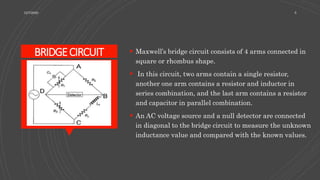
BRIDGECIRCUIT  Maxwell’s bridge circuit consists of 4 arms connected in
square or rhombus shape.
 In this circuit, two arms contain a single resistor,
another one arm contains a resistor and inductor in
series combination, and the last arm contains a resistor
and capacitor in parallel combination.
 An AC voltage source and a null detector are connected
in diagonal to the bridge circuit to measure the unknown
inductance value and compared with the known values.
12/7/2020 5
TYPESOF
MAXWELL’S
BRIDGE
 Two methods are used for determining the self-
inductance of the circuit. They are
 Maxwell’s Inductance Bridge
 Maxwell’s inductance Capacitance Bridge
12/7/2020 6
MAXWELL
INDUCTANCE
BRIDGE
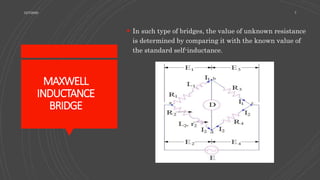
 In such type of bridges, the value of unknown resistance
is determined by comparing it with the known value of
the standard self-inductance.
12/7/2020 7
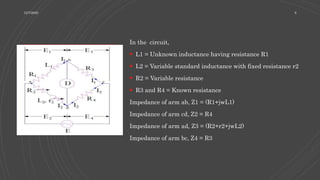
In the circuit,
 L1 = Unknown inductance having resistance R1
 L2 = Variable standard inductance with fixed resistance r2
 R2 = Variable resistance
 R3 and R4 = Known resistance
Impedance of arm ab, Z1 = (R1+jwL1)
Impedance of arm cd, Z2 = R4
Impedance of arm ad, Z3 = (R2+r2+jwL2)
Impedance of arm bc, Z4 = R3
12/7/2020 8
Hence for balanced bridge,
Z1Z2 =Z3Z4
(R1+jwL1)xR4 = (R2+r2+jwL2)xR3
R1R4-R2R3-r2R3+jw(L1R4-L2R3) = 0
Equating real and imaginary part we get,
R1R4-R2R3-r2R3 = 0 ……………(1)
and (L1R4-L2R3) = 0 ……………(2)
Thus unknown inductance L1 and its resistance R1
may be calculated.
12/7/2020 9
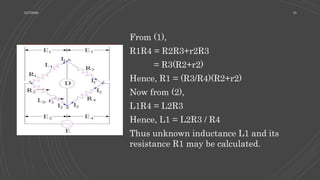
From (1),
R1R4 = R2R3+r2R3
= R3(R2+r2)
Hence, R1 = (R3/R4)(R2+r2)
Now from (2),
L1R4 = L2R3
Hence, L1 = L2R3 / R4
Thus unknown inductance L1 and its
resistance R1 may be calculated.
12/7/2020 10
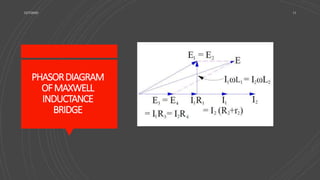
PHASORDIAGRAM
OFMAXWELL
INDUCTANCE
BRIDGE
12/7/2020 11
MAXWELLINDUCTANCE
CAPACITANCEBRIDGE
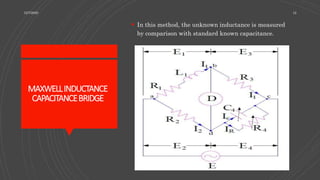
 In this method, the unknown inductance is measured
by comparison with standard known capacitance.
12/7/2020 12
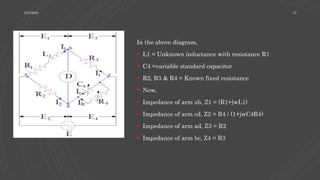
In the above diagram,
 L1 = Unknown inductance with resistance R1
 C4 =variable standard capacitor
 R2, R3 & R4 = Known fixed resistance
 Now,
 Impedance of arm ab, Z1 = (R1+jwL1)
 Impedance of arm cd, Z2 = R4 / (1+jwC4R4)
 Impedance of arm ad, Z3 = R2
 Impedance of arm bc, Z4 = R3
12/7/2020 13
For bridge to be balance,
 Z1Z2 =Z3Z4
 (R1+jwL1)x [R4 / (1+jwC4R4)] = R2R3
 R1R4-R2R3 +jw(L1R4-R2R3C4R4) = 0
 Equating real and imaginary parts we get,
 R1 = R2R3 / R4
 and L1 = R2R3C4
12/7/2020 14
QUALITYFACTOR
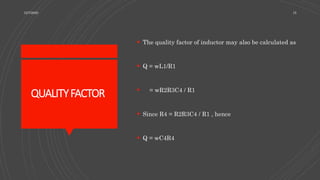
 The quality factor of inductor may also be calculated as
 Q = wL1/R1
 = wR2R3C4 / R1
 Since R4 = R2R3C4 / R1 , hence
 Q = wC4R4
12/7/2020 15
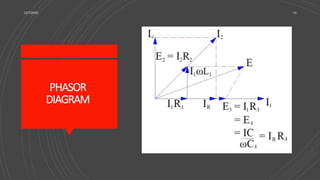
PHASOR
DIAGRAM
12/7/2020 16
ADVANTAGE
 The expression of inductance is independent of
frequency.
 A wide range of inductance can be measured at power
and audio frequencies.
 The expression for inductance is simple and can easily
be calculated.
12/7/2020 17
DISADVANTAGE
 The fixed capacitor in Maxwell’s bridge circuit
may create interaction between resistance and
reactance balance.
 It is not suitable to measure a high range of
quality factor ( Q values >=10)
 The variable standard capacitor used in the
circuit is very costly.
 It is not used to measure the low-quality factor (
Q value) due to the circuit balance condition.
Hence it is used for medium quality coils.
12/7/2020 18
APPLICATIONS
 Used in communication systems
 Used in electronic circuits
 Used in power and audio frequency circuits
 Used to measure unknown inductance values of the
circuit and compared with a standard value.
 Used to measure medium quality coils.
 Used in filter circuits, instrumentation, linear and non-
linear circuits
 Used in power conversion circuits.
12/7/2020 19
THANK YOU
12/7/2020 20

Maxwell bridge and its types

  • 1.
  • 2.
    MAXWELL BRIDGE  The bridgeused for the measurement of self- inductance of the circuit is known as the Maxwell bridge.  It is the advanced form of the Wheatstone bridge.  A Maxwell bridge uses the null deflection method (also known as the “bridge method”) to calculate an unknown inductance in a circuit.  When the calibrated components are a parallel capacitor and resistor, the bridge is known as a Maxwell-Wien bridge. 12/7/2020 2
  • 3.
    PRINCIPLE  It workson the principle of comparison of known and unknown inductance values.  The working principle is that the positive phase angle of an inductive impedance can be compensated by the negative phase angle of a capacitive impedance when put in the opposite arm and the circuit is at resonance (i.e., no potential difference across the detector and hence no current flowing through it).  The unknown inductance then becomes known in terms of this capacitance. 12/7/2020 3
  • 4.
    MAXWELL BRIDGE FORMULA  If themaxwell’s bridge is in balance condition, the unknown inductance can be measured by using a variable standard capacitor. The maxwell’s bridge formula is given as (in terms of inductance, resistance, and capacitance)  R1 = R2R3/R4  L1= R2R3C4 The quality factor of Maxwell’s bridge circuit is given as, Q = ωL1/R1 = ωC4R4 12/7/2020 4
  • 5.
    BRIDGECIRCUIT  Maxwell’sbridge circuit consists of 4 arms connected in square or rhombus shape.  In this circuit, two arms contain a single resistor, another one arm contains a resistor and inductor in series combination, and the last arm contains a resistor and capacitor in parallel combination.  An AC voltage source and a null detector are connected in diagonal to the bridge circuit to measure the unknown inductance value and compared with the known values. 12/7/2020 5
  • 6.
    TYPESOF MAXWELL’S BRIDGE  Two methodsare used for determining the self- inductance of the circuit. They are  Maxwell’s Inductance Bridge  Maxwell’s inductance Capacitance Bridge 12/7/2020 6
  • 7.
    MAXWELL INDUCTANCE BRIDGE  In suchtype of bridges, the value of unknown resistance is determined by comparing it with the known value of the standard self-inductance. 12/7/2020 7
  • 8.
    In the circuit, L1 = Unknown inductance having resistance R1  L2 = Variable standard inductance with fixed resistance r2  R2 = Variable resistance  R3 and R4 = Known resistance Impedance of arm ab, Z1 = (R1+jwL1) Impedance of arm cd, Z2 = R4 Impedance of arm ad, Z3 = (R2+r2+jwL2) Impedance of arm bc, Z4 = R3 12/7/2020 8
  • 9.
    Hence for balancedbridge, Z1Z2 =Z3Z4 (R1+jwL1)xR4 = (R2+r2+jwL2)xR3 R1R4-R2R3-r2R3+jw(L1R4-L2R3) = 0 Equating real and imaginary part we get, R1R4-R2R3-r2R3 = 0 ……………(1) and (L1R4-L2R3) = 0 ……………(2) Thus unknown inductance L1 and its resistance R1 may be calculated. 12/7/2020 9
  • 10.
    From (1), R1R4 =R2R3+r2R3 = R3(R2+r2) Hence, R1 = (R3/R4)(R2+r2) Now from (2), L1R4 = L2R3 Hence, L1 = L2R3 / R4 Thus unknown inductance L1 and its resistance R1 may be calculated. 12/7/2020 10
  • 11.
  • 12.
    MAXWELLINDUCTANCE CAPACITANCEBRIDGE  In thismethod, the unknown inductance is measured by comparison with standard known capacitance. 12/7/2020 12
  • 13.
    In the abovediagram,  L1 = Unknown inductance with resistance R1  C4 =variable standard capacitor  R2, R3 & R4 = Known fixed resistance  Now,  Impedance of arm ab, Z1 = (R1+jwL1)  Impedance of arm cd, Z2 = R4 / (1+jwC4R4)  Impedance of arm ad, Z3 = R2  Impedance of arm bc, Z4 = R3 12/7/2020 13
  • 14.
    For bridge tobe balance,  Z1Z2 =Z3Z4  (R1+jwL1)x [R4 / (1+jwC4R4)] = R2R3  R1R4-R2R3 +jw(L1R4-R2R3C4R4) = 0  Equating real and imaginary parts we get,  R1 = R2R3 / R4  and L1 = R2R3C4 12/7/2020 14
  • 15.
    QUALITYFACTOR  The qualityfactor of inductor may also be calculated as  Q = wL1/R1  = wR2R3C4 / R1  Since R4 = R2R3C4 / R1 , hence  Q = wC4R4 12/7/2020 15
  • 16.
  • 17.
    ADVANTAGE  The expressionof inductance is independent of frequency.  A wide range of inductance can be measured at power and audio frequencies.  The expression for inductance is simple and can easily be calculated. 12/7/2020 17
  • 18.
    DISADVANTAGE  The fixedcapacitor in Maxwell’s bridge circuit may create interaction between resistance and reactance balance.  It is not suitable to measure a high range of quality factor ( Q values >=10)  The variable standard capacitor used in the circuit is very costly.  It is not used to measure the low-quality factor ( Q value) due to the circuit balance condition. Hence it is used for medium quality coils. 12/7/2020 18
  • 19.
    APPLICATIONS  Used incommunication systems  Used in electronic circuits  Used in power and audio frequency circuits  Used to measure unknown inductance values of the circuit and compared with a standard value.  Used to measure medium quality coils.  Used in filter circuits, instrumentation, linear and non- linear circuits  Used in power conversion circuits. 12/7/2020 19
  • 20.