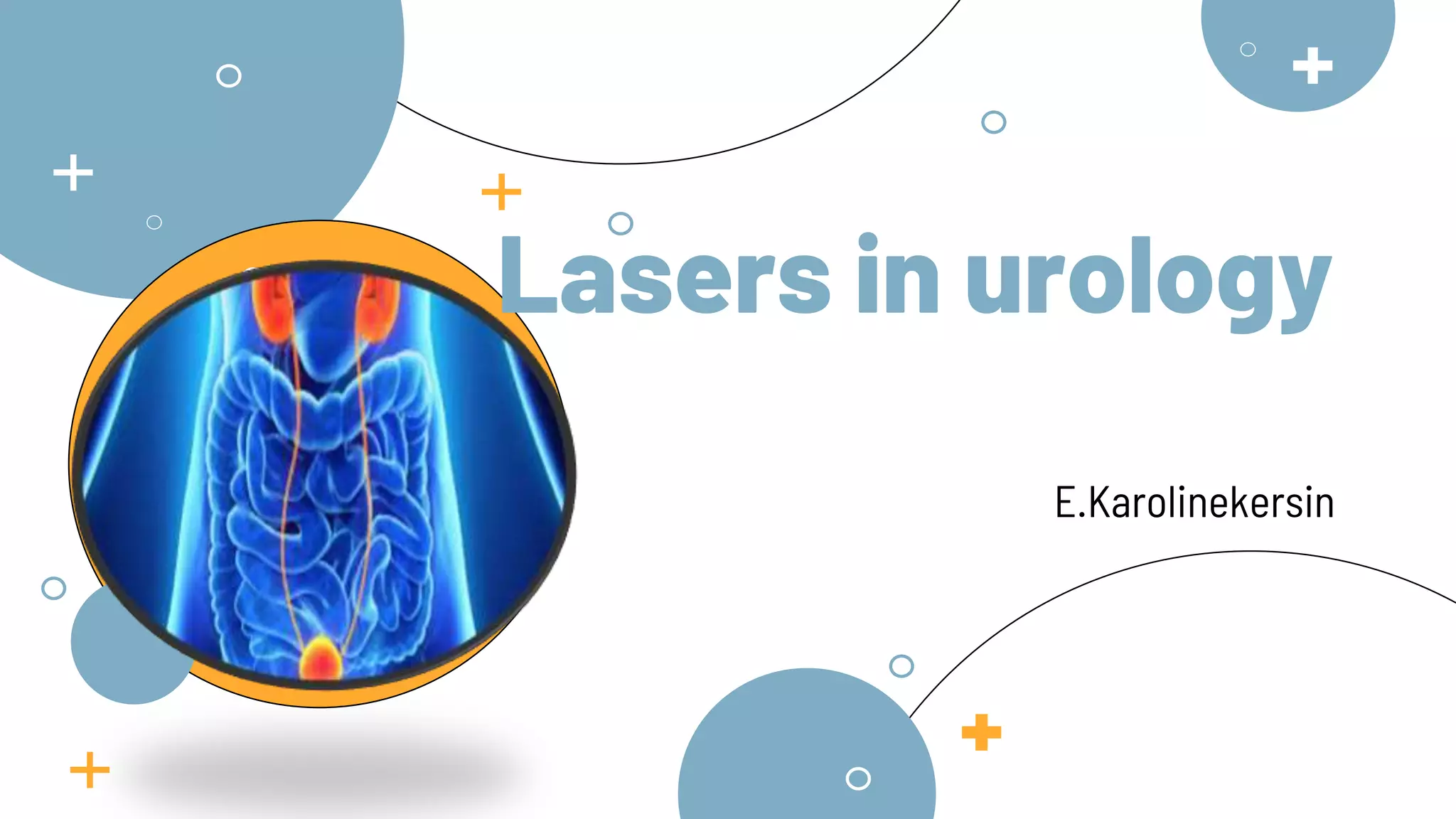
Lasers in urology
E.Karolinekersin
UROLOGY
• Urology is the field of medicine that focuses on diseases of
the urinary tract and the male reproductive tract.
• Urologists diagnose and treat diseases of the urinary tract in
both men and women. They also diagnose and treat
anything involving the reproductive tract in men
UROLOGY
SPECIALIZATION
Female urology conditions of a woman’s
reproductive and urinary tract
Male infertility Problems that leads to infertility
Neurourology
Urinary problems due to conditions of
the nervous system
Urinary problems in children
Urologic oncology Cancers of the urinary system,
including the bladder, kidneys,
prostate, and testicles
Pediatric urology
kidneys, which are the organs that filter waste out of the blood
to produce urine
Ureters, which are the tubes through which urine flows from
the kidneys to the bladder
Bladder, which is the hollow sac that stores urine
Urethra, which is the tube through which urine travels from
the bladder out of the body
Adrenal glands, which are the glands located on top of each
kidney that release hormones
URINARY TRACT SYSTEM
Male reproductive
system
Urologists also treat all parts of the male reproductive system.
This system is made up of the:
Penis, which is the organ that releases urine and carries sperm
out of the body
Prostate, which is the gland underneath the bladder that adds
fluid to sperm to produce semen
Testicles, which are the two oval organs inside the scrotum that
make the hormone testosterone and produce sperm
 In the last two decades laser techniques have become an
increasingly popular method of treatment for patients with benign
prostatic hyperplasia, bladder tumours, urolithiasis, urinary tract
strictures or lesions of the external genitalia.
 The first reported use of laser technique in urology was published
by Staethler in 1976.
 Some of initially introduced laser procedures had to be modified
or abolished because of numerous postoperative complications,
the need for prolonged catheter maintenance and because of
unpredictable therapeutic effects.
Lasers in
urology
 Nowadays due to equipment advancement, better
understanding of urologists’ needs on the part of
producers, and growing experience of the operators laser
treatments are a favourable alternative to traditional
surgical procedures.
 Increasing accessibility to the appropriate equipment,
relatively short learning curve and promising therapeutic
effects has caused a growing interest in these methods.
Lasers in
urology
 Laser use in urology practice goes back to the 1970s, when a Nd-
YAG laser was used to destroy urinary bladder tumours (Staehler,
1978).
 Experiments were performed in the 1980s and 1990s in BPH (benign
prostatic hyperplasia) laser treatment.
 Different types of Nd:YAG laser equipment have been introduced,
such as TULIP (transurethral ultrasound guided laser-induced
prostatectomy), VLAP (visual laser ablation of the prostate), ILC
(interstitial laser coagulation) and their modifications
History of
lasers
• For prostate tissue ablation, diode lasers were also tested.
• A significant breakthrough came in the 1990s with the invention
of the pulse Ho:YAG laser, which can be used not only for
resection and enucleation of prostatic tissue but for precise
stricture incision throughout the whole urinary tract, urothelial
bladder tumour resection and ablation in both upper and lower
urinary tract, and can be utilised for contact lithotripsy of all
types of urinary calculi as well.
History of
lasers
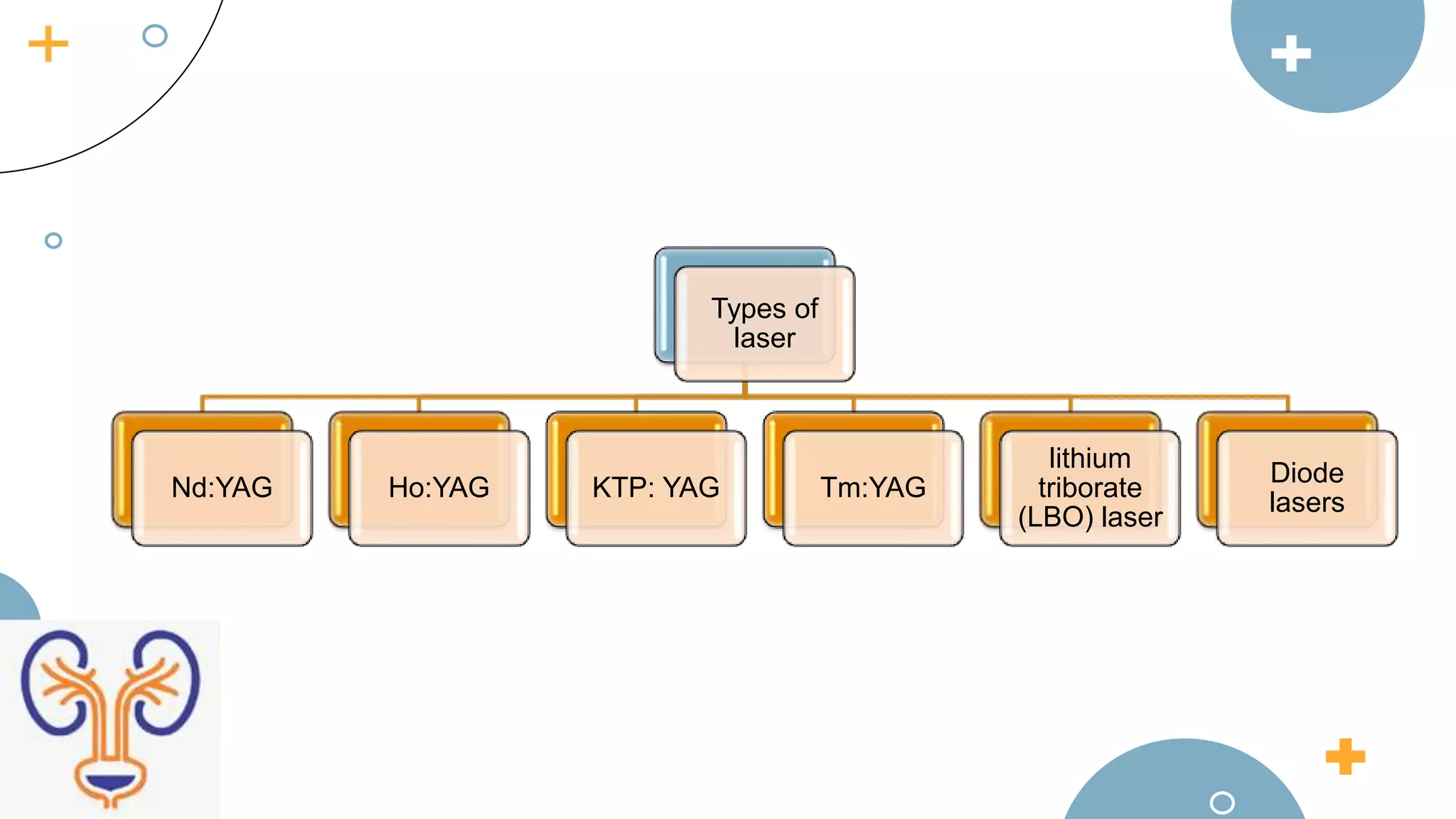
Types of
laser
Nd:YAG Ho:YAG KTP: YAG Tm:YAG
lithium
triborate
(LBO) laser
Diode
lasers
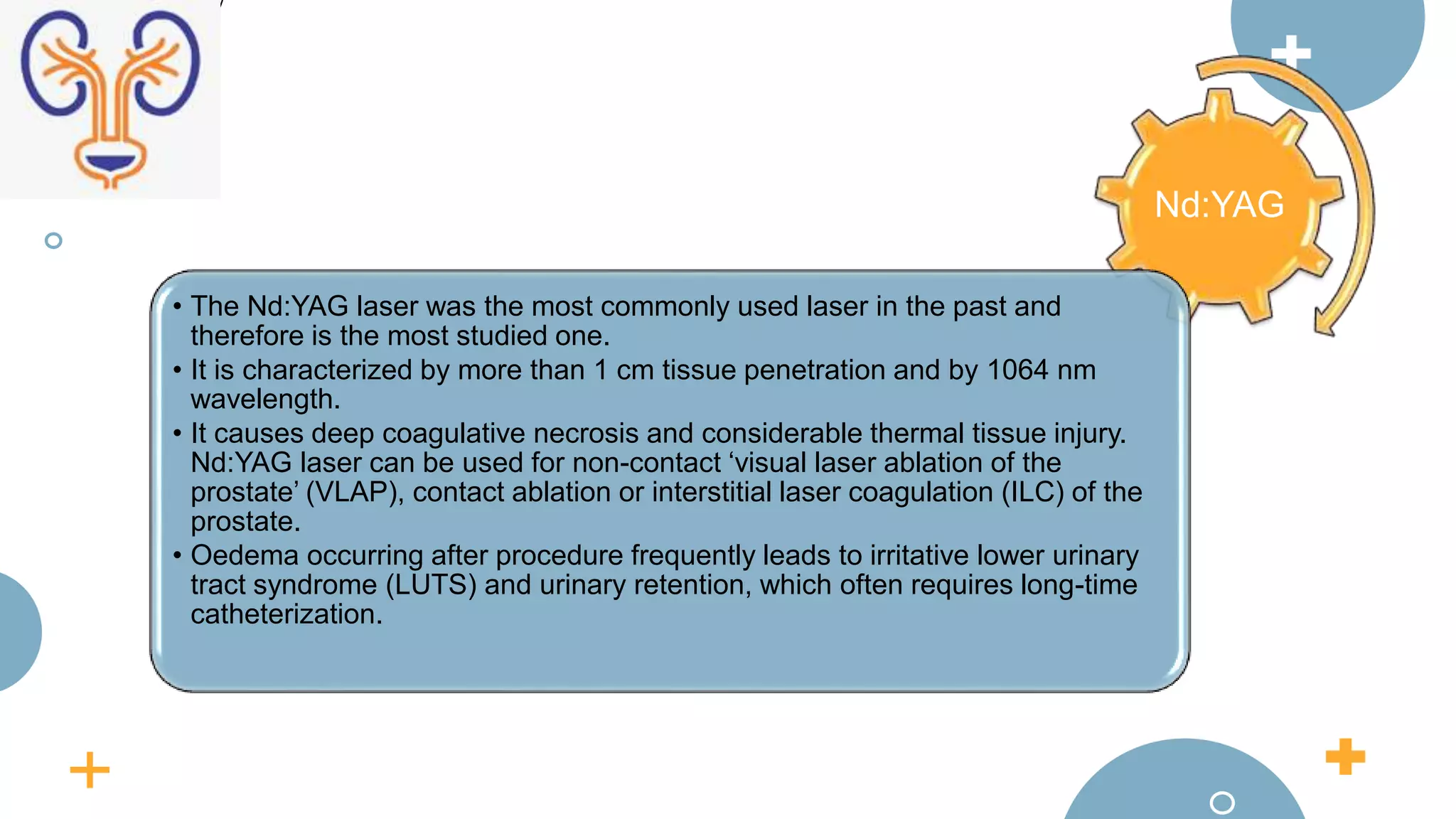
Nd:YAG
• The Nd:YAG laser was the most commonly used laser in the past and
therefore is the most studied one.
• It is characterized by more than 1 cm tissue penetration and by 1064 nm
wavelength.
• It causes deep coagulative necrosis and considerable thermal tissue injury.
Nd:YAG laser can be used for non-contact ‘visual laser ablation of the
prostate’ (VLAP), contact ablation or interstitial laser coagulation (ILC) of the
prostate.
• Oedema occurring after procedure frequently leads to irritative lower urinary
tract syndrome (LUTS) and urinary retention, which often requires long-time
catheterization.
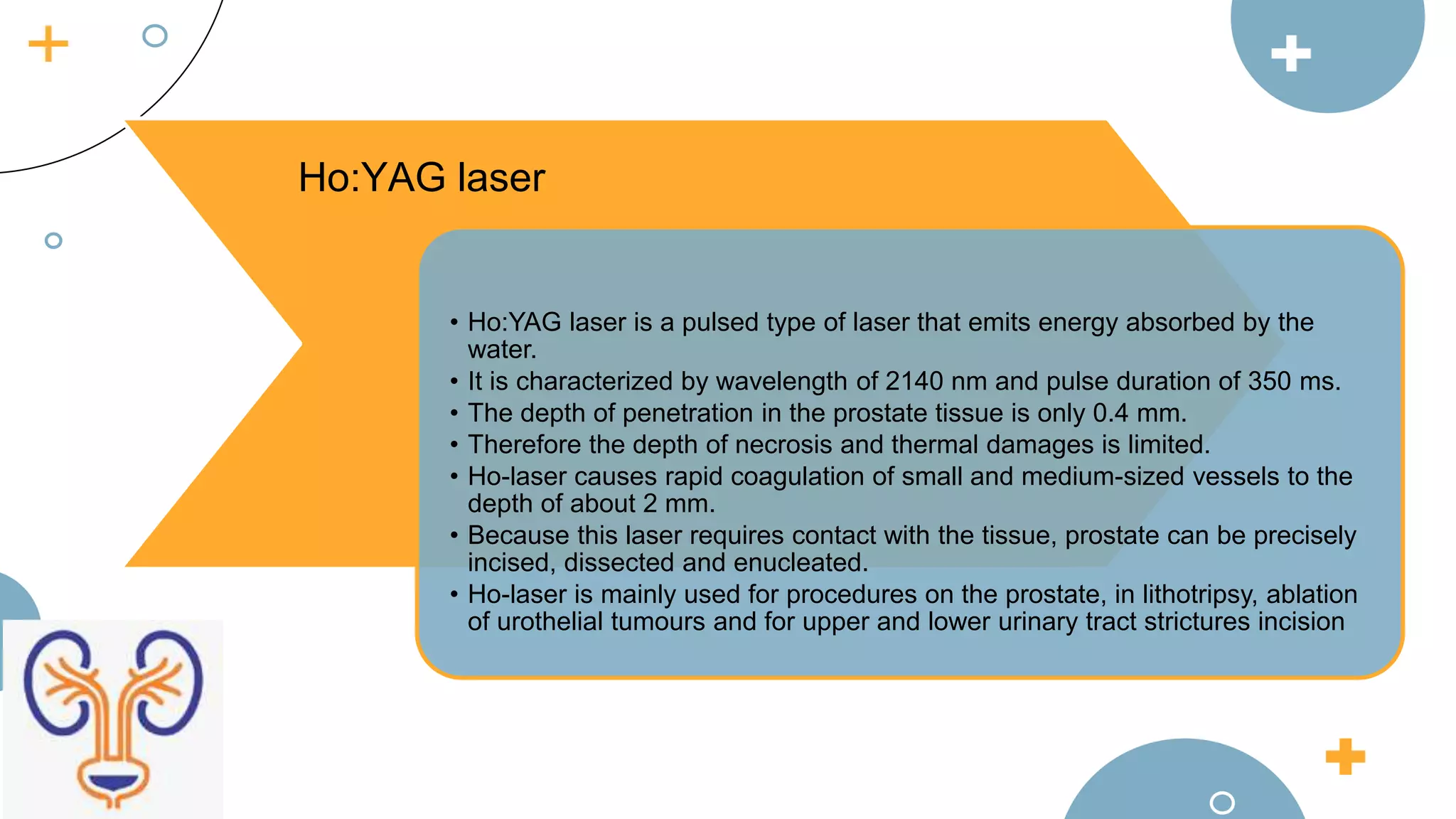
• Ho:YAG laser is a pulsed type of laser that emits energy absorbed by the
water.
• It is characterized by wavelength of 2140 nm and pulse duration of 350 ms.
• The depth of penetration in the prostate tissue is only 0.4 mm.
• Therefore the depth of necrosis and thermal damages is limited.
• Ho-laser causes rapid coagulation of small and medium-sized vessels to the
depth of about 2 mm.
• Because this laser requires contact with the tissue, prostate can be precisely
incised, dissected and enucleated.
• Ho-laser is mainly used for procedures on the prostate, in lithotripsy, ablation
of urothelial tumours and for upper and lower urinary tract strictures incision
Ho:YAG laser
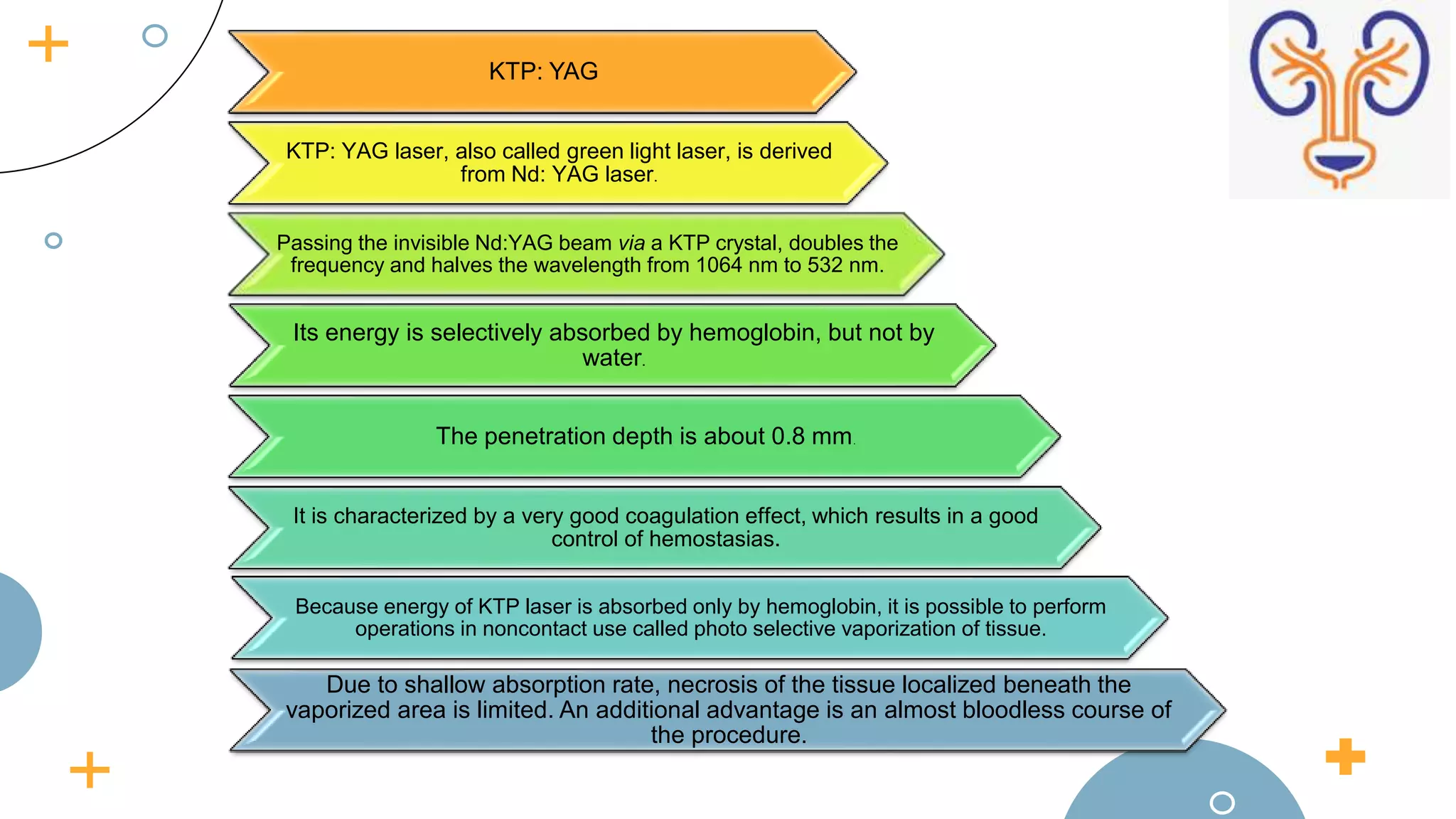
KTP: YAG
KTP: YAG laser, also called green light laser, is derived
from Nd: YAG laser.
Passing the invisible Nd:YAG beam via a KTP crystal, doubles the
frequency and halves the wavelength from 1064 nm to 532 nm.
Its energy is selectively absorbed by hemoglobin, but not by
water.
The penetration depth is about 0.8 mm.
It is characterized by a very good coagulation effect, which results in a good
control of hemostasias.
Because energy of KTP laser is absorbed only by hemoglobin, it is possible to perform
operations in noncontact use called photo selective vaporization of tissue.
Due to shallow absorption rate, necrosis of the tissue localized beneath the
vaporized area is limited. An additional advantage is an almost bloodless course of
the procedure.
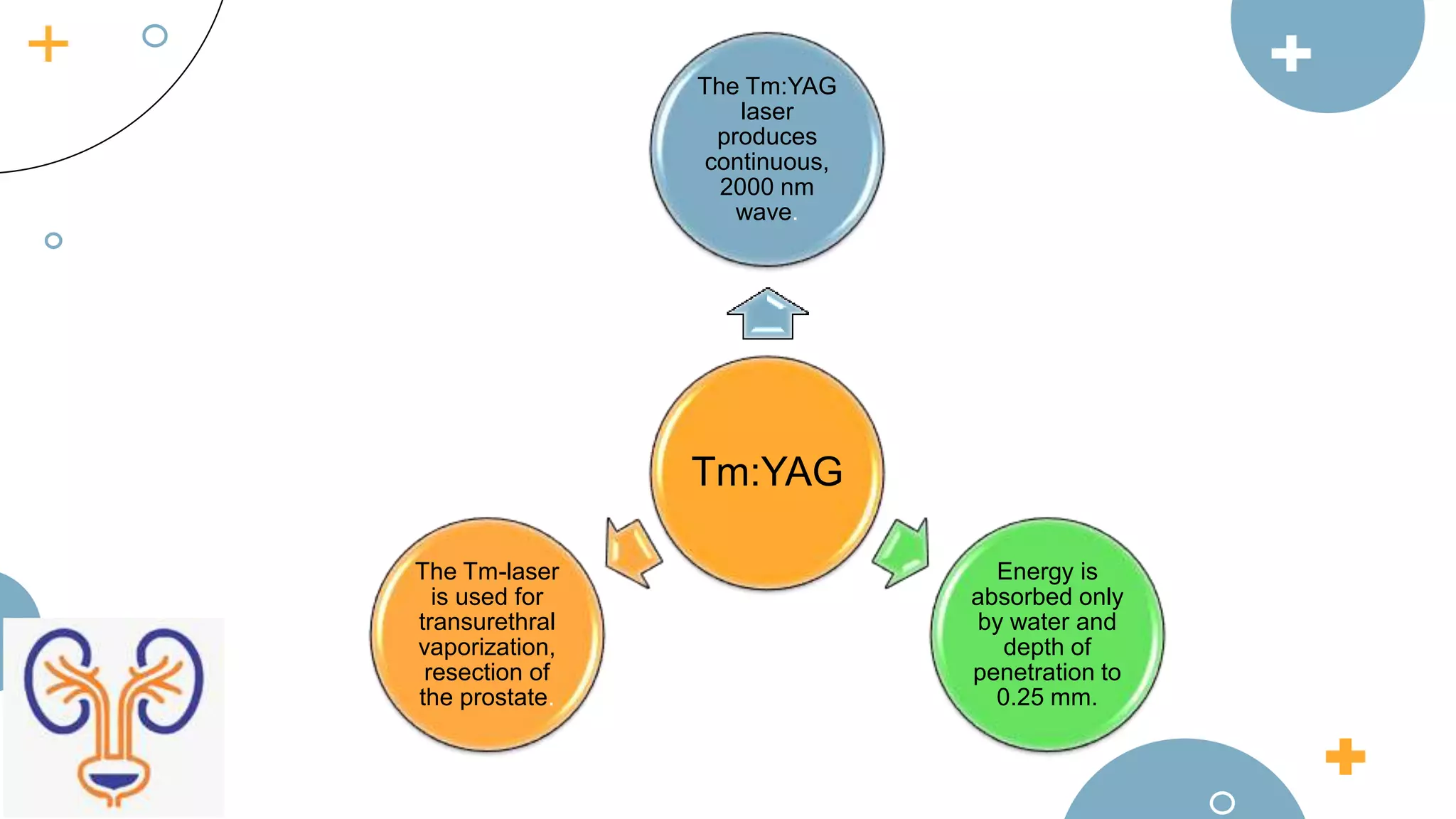
Tm:YAG
The Tm:YAG
laser
produces
continuous,
2000 nm
wave.
Energy is
absorbed only
by water and
depth of
penetration to
0.25 mm.
The Tm-laser
is used for
transurethral
vaporization,
resection of
the prostate.
LBO LASER
 Laser lithotripsy is a procedure to break apart kidney stones in the urinary tract. It is done with a ureteroscope passed
into the tubes of the urinary tract. Incisions are not needed.
 The laser breaks the kidney stones into smaller pieces that can either be removed by the surgeon or pass out of the body
in the urine
 A ureteroscope is an instrument with a long thin tube that is hollow like a straw. The doctor can use this scope to view
the urinary tract, find kidney stones, and pass instruments to the stone.
 The scope enters the urinary tract through the urethra, the tube that carries urine out of the body. The scope continues
to pass through the urethra, bladder, and into the ureter or kidney (if necessary) to access the stone.
 Once the doctor sees the stone, a fiber will be sent through the scope to the stone. The fiber can create a laser beam to
break up the stone. Small pieces may be removed using a basket that is passed through the scope. Small sand-like
pieces may remain and will be gradually passed through the urine.
Lasers lithotripsy
LASER
LITHOTRIPSY
MECHANISM
Photomechanical Photothermal
Photothermal lithotripsy
produces small
fragments and is
effective in all stone
compositions
Photomechanical
lithotripsy produces larger
fragments and is not
effective in calcium oxalate
monohydrate and cysteine
stones
 Benign prostatic hyperplasia (BPH) is one of the most important causes of
lower urinary tract symptoms (LUTS) in men, especially the elder men.
 Prostate laser surgery is used to relieve moderate to severe urinary symptoms
caused by an enlarged prostate — a condition known as benign prostatic
hyperplasia (BPH)
 During prostate laser surgery, scope is inserted through the tip of your penis
into the tube that carries urine from your bladder (urethra).
 The prostate surrounds the urethra.
 A laser passed through the scope delivers energy that shrinks or removes
excess tissue that is preventing urine flow.
 Lasers use concentrated light to generate precise and intense heat.
Benign prostatic hyperplasia
Photoselective vaporization of
the prostate
• Photoselective vaporization of the prostate (PVP). A laser is
used to melt away (vaporize) excess prostate tissue and
enlarge the urinary channel.
• Holmium laser ablation of the prostate (HoLAP).
• This procedure is similar to PVP but uses a different type of
laser.
• Holmium laser enucleation of the prostate (HoLEP).
• A laser is used to cut and remove the excess tissue that is
blocking the urethra.
• Another instrument is then used to cut the prostate tissue into
small pieces that are easily removed.
• HoLEP can be an option for men who have a severely
enlarged prostate.
 FLA is defined as the thermal destruction of tissue by laser.
 For prostate cancer, this denomination is preferred to the other
names such as photothermal therapy, laser interstitial tumor
therapy, and laser interstitial photocoagulation because it describes
both the intention and the treatment
Focal laser ablation of prostate
 Wavelengths in the range of 590 to 1064 nm are the most adequate to
induce a maximal photothermal effect in human tissue.
 At the beginning of interstitial laser coagulation development, Nd:YAG
laser (1064 nm) was used.
 This laser source allowed deep penetration into the tissue (10 mm);
Lasers
 FLA action is based on a photothermal effect.
 The thermal action results from the absorption of radiant energy by
tissue receptive chromophores inducing heat energy in a very short
time (few seconds) .
 This increased temperature may cause irreversible damages and
remotely in vivo destruction.
 The thermal effect depends on the amount of heat energy delivered but
also on the depth of light distribution. Consequently, the deep tissue
damage is dependent on the wavelength of the laser in action.
 Due to weak absorption by water or hemoglobin, wavelengths between
590 and 1064 nm are classically used to obtain a deeper tissue
penetration.
Mechanism
 The extension of thermal tissue damage depends on both temperature
and heating duration.
 Cell viability is in relation with thermostability of several critical
proteins. Irreversible protein denaturation may occur around 60°C .
 While over 60°C, coagulation is quasi-instantaneous, between 42 and
60°C, a thermal damage is obtained with longer heating periods.
 The area submitted to supraphysiological hyperthermia less than 60°C
will develop coagulative necrosis in 24 to 72 h after treatment .
 Macroscopic appearance of coagulation areas of FLA corresponds to
well-demarcated foci of necrosis surrounded by a small rim of
hemorrhage with no viable glandular tissue (benign or malignant) after
vital staining, based on immunoreactivity with cytokeratin
Holmium laser enucleation of the prostate (HoLEP) is a type
of laser surgery used to treat obstruction (blockage) of urine
flow as a result of benign prostatic hyperplasia (BPH).
Laser enucleation of prostate
Thank you

Lasers in urology

  • 1.
  • 2.
    UROLOGY • Urology isthe field of medicine that focuses on diseases of the urinary tract and the male reproductive tract. • Urologists diagnose and treat diseases of the urinary tract in both men and women. They also diagnose and treat anything involving the reproductive tract in men
  • 3.
    UROLOGY SPECIALIZATION Female urology conditionsof a woman’s reproductive and urinary tract Male infertility Problems that leads to infertility Neurourology Urinary problems due to conditions of the nervous system Urinary problems in children Urologic oncology Cancers of the urinary system, including the bladder, kidneys, prostate, and testicles Pediatric urology
  • 4.
    kidneys, which arethe organs that filter waste out of the blood to produce urine Ureters, which are the tubes through which urine flows from the kidneys to the bladder Bladder, which is the hollow sac that stores urine Urethra, which is the tube through which urine travels from the bladder out of the body Adrenal glands, which are the glands located on top of each kidney that release hormones URINARY TRACT SYSTEM
  • 5.
    Male reproductive system Urologists alsotreat all parts of the male reproductive system. This system is made up of the: Penis, which is the organ that releases urine and carries sperm out of the body Prostate, which is the gland underneath the bladder that adds fluid to sperm to produce semen Testicles, which are the two oval organs inside the scrotum that make the hormone testosterone and produce sperm
  • 6.
     In thelast two decades laser techniques have become an increasingly popular method of treatment for patients with benign prostatic hyperplasia, bladder tumours, urolithiasis, urinary tract strictures or lesions of the external genitalia.  The first reported use of laser technique in urology was published by Staethler in 1976.  Some of initially introduced laser procedures had to be modified or abolished because of numerous postoperative complications, the need for prolonged catheter maintenance and because of unpredictable therapeutic effects. Lasers in urology
  • 7.
     Nowadays dueto equipment advancement, better understanding of urologists’ needs on the part of producers, and growing experience of the operators laser treatments are a favourable alternative to traditional surgical procedures.  Increasing accessibility to the appropriate equipment, relatively short learning curve and promising therapeutic effects has caused a growing interest in these methods. Lasers in urology
  • 8.
     Laser usein urology practice goes back to the 1970s, when a Nd- YAG laser was used to destroy urinary bladder tumours (Staehler, 1978).  Experiments were performed in the 1980s and 1990s in BPH (benign prostatic hyperplasia) laser treatment.  Different types of Nd:YAG laser equipment have been introduced, such as TULIP (transurethral ultrasound guided laser-induced prostatectomy), VLAP (visual laser ablation of the prostate), ILC (interstitial laser coagulation) and their modifications History of lasers
  • 9.
    • For prostatetissue ablation, diode lasers were also tested. • A significant breakthrough came in the 1990s with the invention of the pulse Ho:YAG laser, which can be used not only for resection and enucleation of prostatic tissue but for precise stricture incision throughout the whole urinary tract, urothelial bladder tumour resection and ablation in both upper and lower urinary tract, and can be utilised for contact lithotripsy of all types of urinary calculi as well. History of lasers
  • 10.
    Types of laser Nd:YAG Ho:YAGKTP: YAG Tm:YAG lithium triborate (LBO) laser Diode lasers
  • 11.
    Nd:YAG • The Nd:YAGlaser was the most commonly used laser in the past and therefore is the most studied one. • It is characterized by more than 1 cm tissue penetration and by 1064 nm wavelength. • It causes deep coagulative necrosis and considerable thermal tissue injury. Nd:YAG laser can be used for non-contact ‘visual laser ablation of the prostate’ (VLAP), contact ablation or interstitial laser coagulation (ILC) of the prostate. • Oedema occurring after procedure frequently leads to irritative lower urinary tract syndrome (LUTS) and urinary retention, which often requires long-time catheterization.
  • 12.
    • Ho:YAG laseris a pulsed type of laser that emits energy absorbed by the water. • It is characterized by wavelength of 2140 nm and pulse duration of 350 ms. • The depth of penetration in the prostate tissue is only 0.4 mm. • Therefore the depth of necrosis and thermal damages is limited. • Ho-laser causes rapid coagulation of small and medium-sized vessels to the depth of about 2 mm. • Because this laser requires contact with the tissue, prostate can be precisely incised, dissected and enucleated. • Ho-laser is mainly used for procedures on the prostate, in lithotripsy, ablation of urothelial tumours and for upper and lower urinary tract strictures incision Ho:YAG laser
  • 13.
    KTP: YAG KTP: YAGlaser, also called green light laser, is derived from Nd: YAG laser. Passing the invisible Nd:YAG beam via a KTP crystal, doubles the frequency and halves the wavelength from 1064 nm to 532 nm. Its energy is selectively absorbed by hemoglobin, but not by water. The penetration depth is about 0.8 mm. It is characterized by a very good coagulation effect, which results in a good control of hemostasias. Because energy of KTP laser is absorbed only by hemoglobin, it is possible to perform operations in noncontact use called photo selective vaporization of tissue. Due to shallow absorption rate, necrosis of the tissue localized beneath the vaporized area is limited. An additional advantage is an almost bloodless course of the procedure.
  • 14.
    Tm:YAG The Tm:YAG laser produces continuous, 2000 nm wave. Energyis absorbed only by water and depth of penetration to 0.25 mm. The Tm-laser is used for transurethral vaporization, resection of the prostate.
  • 15.
  • 17.
     Laser lithotripsyis a procedure to break apart kidney stones in the urinary tract. It is done with a ureteroscope passed into the tubes of the urinary tract. Incisions are not needed.  The laser breaks the kidney stones into smaller pieces that can either be removed by the surgeon or pass out of the body in the urine  A ureteroscope is an instrument with a long thin tube that is hollow like a straw. The doctor can use this scope to view the urinary tract, find kidney stones, and pass instruments to the stone.  The scope enters the urinary tract through the urethra, the tube that carries urine out of the body. The scope continues to pass through the urethra, bladder, and into the ureter or kidney (if necessary) to access the stone.  Once the doctor sees the stone, a fiber will be sent through the scope to the stone. The fiber can create a laser beam to break up the stone. Small pieces may be removed using a basket that is passed through the scope. Small sand-like pieces may remain and will be gradually passed through the urine. Lasers lithotripsy
  • 18.
    LASER LITHOTRIPSY MECHANISM Photomechanical Photothermal Photothermal lithotripsy producessmall fragments and is effective in all stone compositions Photomechanical lithotripsy produces larger fragments and is not effective in calcium oxalate monohydrate and cysteine stones
  • 19.
     Benign prostatichyperplasia (BPH) is one of the most important causes of lower urinary tract symptoms (LUTS) in men, especially the elder men.  Prostate laser surgery is used to relieve moderate to severe urinary symptoms caused by an enlarged prostate — a condition known as benign prostatic hyperplasia (BPH)  During prostate laser surgery, scope is inserted through the tip of your penis into the tube that carries urine from your bladder (urethra).  The prostate surrounds the urethra.  A laser passed through the scope delivers energy that shrinks or removes excess tissue that is preventing urine flow.  Lasers use concentrated light to generate precise and intense heat. Benign prostatic hyperplasia
  • 21.
    Photoselective vaporization of theprostate • Photoselective vaporization of the prostate (PVP). A laser is used to melt away (vaporize) excess prostate tissue and enlarge the urinary channel. • Holmium laser ablation of the prostate (HoLAP). • This procedure is similar to PVP but uses a different type of laser. • Holmium laser enucleation of the prostate (HoLEP). • A laser is used to cut and remove the excess tissue that is blocking the urethra. • Another instrument is then used to cut the prostate tissue into small pieces that are easily removed. • HoLEP can be an option for men who have a severely enlarged prostate.
  • 22.
     FLA isdefined as the thermal destruction of tissue by laser.  For prostate cancer, this denomination is preferred to the other names such as photothermal therapy, laser interstitial tumor therapy, and laser interstitial photocoagulation because it describes both the intention and the treatment Focal laser ablation of prostate
  • 23.
     Wavelengths inthe range of 590 to 1064 nm are the most adequate to induce a maximal photothermal effect in human tissue.  At the beginning of interstitial laser coagulation development, Nd:YAG laser (1064 nm) was used.  This laser source allowed deep penetration into the tissue (10 mm); Lasers
  • 24.
     FLA actionis based on a photothermal effect.  The thermal action results from the absorption of radiant energy by tissue receptive chromophores inducing heat energy in a very short time (few seconds) .  This increased temperature may cause irreversible damages and remotely in vivo destruction.  The thermal effect depends on the amount of heat energy delivered but also on the depth of light distribution. Consequently, the deep tissue damage is dependent on the wavelength of the laser in action.  Due to weak absorption by water or hemoglobin, wavelengths between 590 and 1064 nm are classically used to obtain a deeper tissue penetration. Mechanism
  • 25.
     The extensionof thermal tissue damage depends on both temperature and heating duration.  Cell viability is in relation with thermostability of several critical proteins. Irreversible protein denaturation may occur around 60°C .  While over 60°C, coagulation is quasi-instantaneous, between 42 and 60°C, a thermal damage is obtained with longer heating periods.  The area submitted to supraphysiological hyperthermia less than 60°C will develop coagulative necrosis in 24 to 72 h after treatment .  Macroscopic appearance of coagulation areas of FLA corresponds to well-demarcated foci of necrosis surrounded by a small rim of hemorrhage with no viable glandular tissue (benign or malignant) after vital staining, based on immunoreactivity with cytokeratin
  • 26.
    Holmium laser enucleationof the prostate (HoLEP) is a type of laser surgery used to treat obstruction (blockage) of urine flow as a result of benign prostatic hyperplasia (BPH). Laser enucleation of prostate
  • 27.