Protein Based
Nanostructures
Karolinekersin E
Nanostructured based
protein
• Protein based nanostructures has recently revolutionized
the nanomedicine era .
• Protein nanoparticles have better biocompatibility and
biodegradability and also have the possibilities for
surface modification.
• They are actively used in pharmaceuticals like targeted
therapies , cancer therapy ,pulmonary delivery ,vaccine
in which nanoparticles can be incorporated into
biodegradable polymer in the form of microspheres for
controlled and sustained drug release
4/6/2022 2
Protein Nanoparticles
• Proteins are kind of natural molecule in the size of 1-100
nm which show unique functionalities and properties in
biological field.
• Nanostructures can be prepared from the protein like
albumin, gelatin ,whey protein ,gliadin, legumin, elastin,
zein ,soy protein and milk protein.
• Protein nanoparticles have plethora of advantages;
Helps in reducing toxicity
Enhance the release of drug
Improve bioavailability
Provide better formulation
• Protein nanoparticles are able to show better action at
minimum dose and also decrease the drug resistance in
body
4/6/2022 3
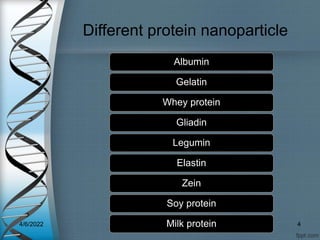
Different protein nanoparticle
Albumin
Gelatin
Whey protein
Gliadin
Legumin
Elastin
Zein
Soy protein
Milk protein
4/6/2022 4
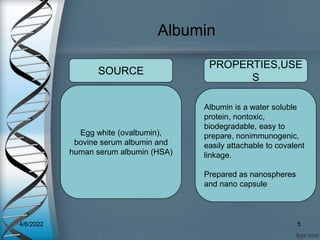
Albumin
Egg white (ovalbumin),
bovine serum albumin and
human serum albumin (HSA)
Albumin is a water soluble
protein, nontoxic,
biodegradable, easy to
prepare, nonimmunogenic,
easily attachable to covalent
linkage.
Prepared as nanospheres
and nano capsule
SOURCE
PROPERTIES,USE
S
4/6/2022 5
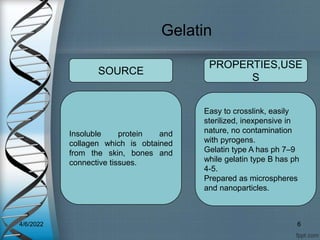
Gelatin
Insoluble protein and
collagen which is obtained
from the skin, bones and
connective tissues.
Easy to crosslink, easily
sterilized, inexpensive in
nature, no contamination
with pyrogens.
Gelatin type A has ph 7–9
while gelatin type B has ph
4-5.
Prepared as microspheres
and nanoparticles.
SOURCE
PROPERTIES,USE
S
4/6/2022 6
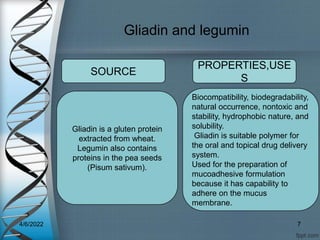
Gliadin and legumin
Gliadin is a gluten protein
extracted from wheat.
Legumin also contains
proteins in the pea seeds
(Pisum sativum).
Biocompatibility, biodegradability,
natural occurrence, nontoxic and
stability, hydrophobic nature, and
solubility.
Gliadin is suitable polymer for
the oral and topical drug delivery
system.
Used for the preparation of
mucoadhesive formulation
because it has capability to
adhere on the mucus
membrane.
SOURCE
PROPERTIES,USE
S
4/6/2022 7
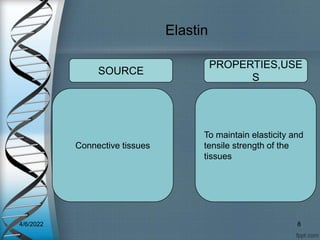
Elastin
Connective tissues
To maintain elasticity and
tensile strength of the
tissues
SOURCE
PROPERTIES,USE
S
4/6/2022 8
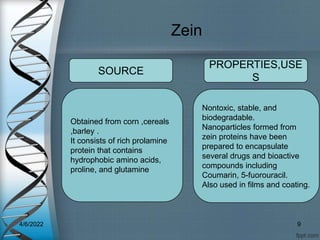
Zein
Obtained from corn ,cereals
,barley .
It consists of rich prolamine
protein that contains
hydrophobic amino acids,
proline, and glutamine
Nontoxic, stable, and
biodegradable.
Nanoparticles formed from
zein proteins have been
prepared to encapsulate
several drugs and bioactive
compounds including
Coumarin, 5-fuorouracil.
Also used in films and coating.
SOURCE
PROPERTIES,USE
S
4/6/2022 9
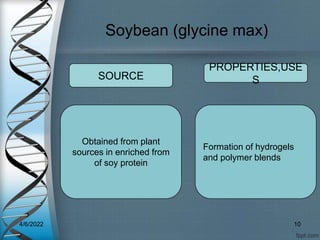
Soybean (glycine max)
Obtained from plant
sources in enriched from
of soy protein
Formation of hydrogels
and polymer blends
SOURCE
PROPERTIES,USE
S
4/6/2022 10
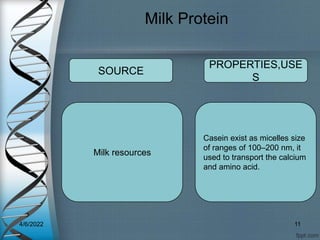
Milk Protein
Milk resources
Casein exist as micelles size
of ranges of 100–200 nm, it
used to transport the calcium
and amino acid.
SOURCE
PROPERTIES,USE
S
4/6/2022 11
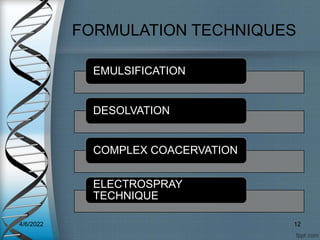
FORMULATION TECHNIQUES
EMULSIFICATION
DESOLVATION
COMPLEX COACERVATION
ELECTROSPRAY
TECHNIQUE
4/6/2022 12
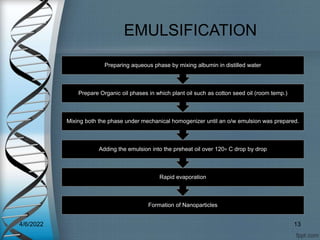
EMULSIFICATION
Formation of Nanoparticles
Rapid evaporation
Adding the emulsion into the preheat oil over 120∘ C drop by drop
Mixing both the phase under mechanical homogenizer until an o/w emulsion was prepared.
Prepare Organic oil phases in which plant oil such as cotton seed oil (room temp.)
Preparing aqueous phase by mixing albumin in distilled water
4/6/2022 13
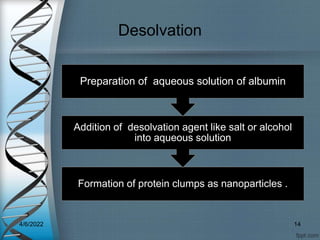
Desolvation
Formation of protein clumps as nanoparticles .
Addition of desolvation agent like salt or alcohol
into aqueous solution
Preparation of aqueous solution of albumin
4/6/2022 14
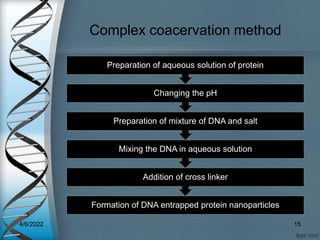
Complex coacervation method
Formation of DNA entrapped protein nanoparticles
Addition of cross linker
Mixing the DNA in aqueous solution
Preparation of mixture of DNA and salt
Changing the pH
Preparation of aqueous solution of protein
4/6/2022 15
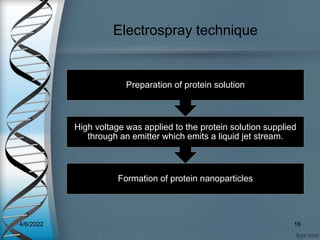
Electrospray technique
Formation of protein nanoparticles
High voltage was applied to the protein solution supplied
through an emitter which emits a liquid jet stream.
Preparation of protein solution
4/6/2022 16
Applications
Used as carrier for the delivery of drugs
,peptides and genes through various
routes like Oral Route, Pulmonary
,Nasal, Ocular .
Drug carrier
4/6/2022 17
Immunological Adjuvant
Gelatin nanoparticles are used as
immunological adjuvant to enhance both
humoral and cellular responses to
antigen
4/6/2022 18
Antibiotics
In antibiotics also protein nanoparticles
show effective results. Antibiotics show
an increase in efficacy or a decrease in
toxicity after binding to protein
nanoparticles.
4/6/2022 19
diseases
• Tuberculosis
• Leishmaniasis
• Cancer Therapy.
• Parkinson’s Disease
• Rheumatoid Arthritis
4/6/2022 20
Conclusion
• Protein nanoparticles hold promising results in
nasal, pulmonary, oral, and ocular delivery,
nonviral gene delivery, blood brain barrier route,
and immunological adjuvant.
• Also numerous protein synthesized nanoparticles
like albumin and gelatin show advancement in
commercial level.
• Advancement in various field of nanoparticles
can lead to the enhancement in application of
protein nanoparticles for the treatment of
diseases
4/6/2022 21
References
• Y. Dastagiri Reddy, D. Dhachinamoorthi, and K. B. Chandra Sekhar,
“A brief review on polymeric nanoparticles for drug delivery and
targeting,” Journal of Medical and Pharmaceutical Innovation, vol. 2,
no. 7, pp. 19–32, 2015
• R. Kaintura, P. Sharma, S. Singh, K. Rawat, and P. R. Solanki,
“Gelatin nanoparticles as a delivery system for proteins,” Journal of
Nanomedicine Research, vol. 2, no. 1, pp. 1–3, 2015.
• Verma D, Gulati N, Kaul S, Mukherjee S, Nagaich U. Protein Based
Nanostructures for Drug Delivery. J Pharm (Cairo). 2018 May
16;2018:9285854. doi: 10.1155/2018/9285854. PMID: 29862118;
PMCID: PMC5976961.
• K. Ren, A. Dusad, R. Dong, and L. Quan, “Albumin as a delivery
carrier for rheumatoid arthritis,” Journal of Nanomedicine &
Nanotechnology, vol. 4, no. 4, article 176, pp. 1–4, 2013.
4/6/2022 22
THANK YOU
4/6/2022 23

Protein based nanostructures for biomedical applications

  • 1.
  • 2.
    Nanostructured based protein • Proteinbased nanostructures has recently revolutionized the nanomedicine era . • Protein nanoparticles have better biocompatibility and biodegradability and also have the possibilities for surface modification. • They are actively used in pharmaceuticals like targeted therapies , cancer therapy ,pulmonary delivery ,vaccine in which nanoparticles can be incorporated into biodegradable polymer in the form of microspheres for controlled and sustained drug release 4/6/2022 2
  • 3.
    Protein Nanoparticles • Proteinsare kind of natural molecule in the size of 1-100 nm which show unique functionalities and properties in biological field. • Nanostructures can be prepared from the protein like albumin, gelatin ,whey protein ,gliadin, legumin, elastin, zein ,soy protein and milk protein. • Protein nanoparticles have plethora of advantages; Helps in reducing toxicity Enhance the release of drug Improve bioavailability Provide better formulation • Protein nanoparticles are able to show better action at minimum dose and also decrease the drug resistance in body 4/6/2022 3
  • 4.
    Different protein nanoparticle Albumin Gelatin Wheyprotein Gliadin Legumin Elastin Zein Soy protein Milk protein 4/6/2022 4
  • 5.
    Albumin Egg white (ovalbumin), bovineserum albumin and human serum albumin (HSA) Albumin is a water soluble protein, nontoxic, biodegradable, easy to prepare, nonimmunogenic, easily attachable to covalent linkage. Prepared as nanospheres and nano capsule SOURCE PROPERTIES,USE S 4/6/2022 5
  • 6.
    Gelatin Insoluble protein and collagenwhich is obtained from the skin, bones and connective tissues. Easy to crosslink, easily sterilized, inexpensive in nature, no contamination with pyrogens. Gelatin type A has ph 7–9 while gelatin type B has ph 4-5. Prepared as microspheres and nanoparticles. SOURCE PROPERTIES,USE S 4/6/2022 6
  • 7.
    Gliadin and legumin Gliadinis a gluten protein extracted from wheat. Legumin also contains proteins in the pea seeds (Pisum sativum). Biocompatibility, biodegradability, natural occurrence, nontoxic and stability, hydrophobic nature, and solubility. Gliadin is suitable polymer for the oral and topical drug delivery system. Used for the preparation of mucoadhesive formulation because it has capability to adhere on the mucus membrane. SOURCE PROPERTIES,USE S 4/6/2022 7
  • 8.
    Elastin Connective tissues To maintainelasticity and tensile strength of the tissues SOURCE PROPERTIES,USE S 4/6/2022 8
  • 9.
    Zein Obtained from corn,cereals ,barley . It consists of rich prolamine protein that contains hydrophobic amino acids, proline, and glutamine Nontoxic, stable, and biodegradable. Nanoparticles formed from zein proteins have been prepared to encapsulate several drugs and bioactive compounds including Coumarin, 5-fuorouracil. Also used in films and coating. SOURCE PROPERTIES,USE S 4/6/2022 9
  • 10.
    Soybean (glycine max) Obtainedfrom plant sources in enriched from of soy protein Formation of hydrogels and polymer blends SOURCE PROPERTIES,USE S 4/6/2022 10
  • 11.
    Milk Protein Milk resources Caseinexist as micelles size of ranges of 100–200 nm, it used to transport the calcium and amino acid. SOURCE PROPERTIES,USE S 4/6/2022 11
  • 12.
  • 13.
    EMULSIFICATION Formation of Nanoparticles Rapidevaporation Adding the emulsion into the preheat oil over 120∘ C drop by drop Mixing both the phase under mechanical homogenizer until an o/w emulsion was prepared. Prepare Organic oil phases in which plant oil such as cotton seed oil (room temp.) Preparing aqueous phase by mixing albumin in distilled water 4/6/2022 13
  • 14.
    Desolvation Formation of proteinclumps as nanoparticles . Addition of desolvation agent like salt or alcohol into aqueous solution Preparation of aqueous solution of albumin 4/6/2022 14
  • 15.
    Complex coacervation method Formationof DNA entrapped protein nanoparticles Addition of cross linker Mixing the DNA in aqueous solution Preparation of mixture of DNA and salt Changing the pH Preparation of aqueous solution of protein 4/6/2022 15
  • 16.
    Electrospray technique Formation ofprotein nanoparticles High voltage was applied to the protein solution supplied through an emitter which emits a liquid jet stream. Preparation of protein solution 4/6/2022 16
  • 17.
    Applications Used as carrierfor the delivery of drugs ,peptides and genes through various routes like Oral Route, Pulmonary ,Nasal, Ocular . Drug carrier 4/6/2022 17
  • 18.
    Immunological Adjuvant Gelatin nanoparticlesare used as immunological adjuvant to enhance both humoral and cellular responses to antigen 4/6/2022 18
  • 19.
    Antibiotics In antibiotics alsoprotein nanoparticles show effective results. Antibiotics show an increase in efficacy or a decrease in toxicity after binding to protein nanoparticles. 4/6/2022 19
  • 20.
    diseases • Tuberculosis • Leishmaniasis •Cancer Therapy. • Parkinson’s Disease • Rheumatoid Arthritis 4/6/2022 20
  • 21.
    Conclusion • Protein nanoparticleshold promising results in nasal, pulmonary, oral, and ocular delivery, nonviral gene delivery, blood brain barrier route, and immunological adjuvant. • Also numerous protein synthesized nanoparticles like albumin and gelatin show advancement in commercial level. • Advancement in various field of nanoparticles can lead to the enhancement in application of protein nanoparticles for the treatment of diseases 4/6/2022 21
  • 22.
    References • Y. DastagiriReddy, D. Dhachinamoorthi, and K. B. Chandra Sekhar, “A brief review on polymeric nanoparticles for drug delivery and targeting,” Journal of Medical and Pharmaceutical Innovation, vol. 2, no. 7, pp. 19–32, 2015 • R. Kaintura, P. Sharma, S. Singh, K. Rawat, and P. R. Solanki, “Gelatin nanoparticles as a delivery system for proteins,” Journal of Nanomedicine Research, vol. 2, no. 1, pp. 1–3, 2015. • Verma D, Gulati N, Kaul S, Mukherjee S, Nagaich U. Protein Based Nanostructures for Drug Delivery. J Pharm (Cairo). 2018 May 16;2018:9285854. doi: 10.1155/2018/9285854. PMID: 29862118; PMCID: PMC5976961. • K. Ren, A. Dusad, R. Dong, and L. Quan, “Albumin as a delivery carrier for rheumatoid arthritis,” Journal of Nanomedicine & Nanotechnology, vol. 4, no. 4, article 176, pp. 1–4, 2013. 4/6/2022 22
  • 23.