© 2013 City and Guilds of London Institute. All rights reserved.
Level 2 Diploma in Painting and Decorating
1 of 13
PowerPoint
presentation
Unit 218: Producing specialist finishes for
decorative work
Using paints and solvents safely and correctly
© 2013 City and Guilds of London Institute. All rights reserved.
Level 2 Diploma in Painting and Decorating
2 of 13
Types of paint
There are three types of paint materials that are commonly used when carrying
out decorative effects.
• Oil based
• Water based
• Spirit based
© 2013 City and Guilds of London Institute. All rights reserved.
Level 2 Diploma in Painting and Decorating
3 of 13
Discuss what you think the main hazards are:
• Fumes can affect the eyes, lungs, stomach and balance.
• Prolonged skin contact over many years can lead to dry skin,
dermatitis and skin cancer.
• Fire due to incorrect storage; can lead to burns or even death.
Hazards associated with oil/spirit-based paints
© 2013 City and Guilds of London Institute. All rights reserved.
Level 2 Diploma in Painting and Decorating
4 of 13
Prevention
Discuss how you think the hazards can be avoided.
• Fumes: Always work in a well-ventilated area; open windows and doors if
it is safe and practical to do so; wear respirator masks if needed; do not
eat or drink in the work area; take frequent breaks.
• Skin contact: Wear appropriate PPE; use barrier cream; wash
frequently.
• Fire: Read manufacturers’ instructions, data sheets and product
information on safe handling and storage; keep away from heat and
ignition sources.
© 2013 City and Guilds of London Institute. All rights reserved.
Level 2 Diploma in Painting and Decorating
5 of 13
Hazards associated with water-based paints
What do you think the main hazards are?
Fumes
It is considered good working practice to make sure you have adequate
ventilation when you are working with water-based paints. Or substitute the
material for a safer alternative.
Skin problems
Wear gloves or barrier cream.
© 2013 City and Guilds of London Institute. All rights reserved.
Level 2 Diploma in Painting and Decorating
6 of 13
Types of PPE (personal protective equipment)
• There are many different types of PPE available to you and many versions
of each type.
• The type of PPE you select should be correct for the task; it should be
clean, undamaged and it should fit properly.
• It is the employer’s responsibility to provide PPE; it is the employee’s
responsibility to wear it.
© 2013 City and Guilds of London Institute. All rights reserved.
Level 2 Diploma in Painting and Decorating
7 of 13
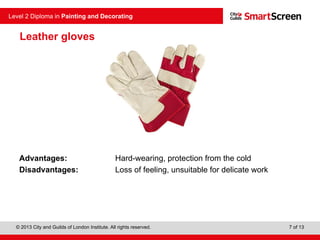
Leather gloves
Advantages: Hard-wearing, protection from the cold
Disadvantages: Loss of feeling, unsuitable for delicate work
© 2013 City and Guilds of London Institute. All rights reserved.
Level 2 Diploma in Painting and Decorating
8 of 13
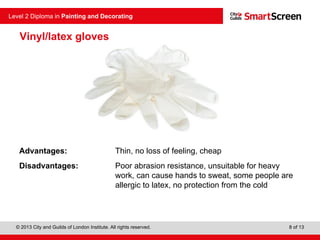
Vinyl/latex gloves
Advantages: Thin, no loss of feeling, cheap
Disadvantages: Poor abrasion resistance, unsuitable for heavy
work, can cause hands to sweat, some people are
allergic to latex, no protection from the cold
© 2013 City and Guilds of London Institute. All rights reserved.
Level 2 Diploma in Painting and Decorating
9 of 13
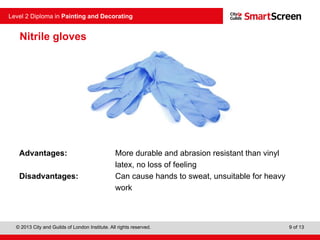
Nitrile gloves
Advantages: More durable and abrasion resistant than vinyl
latex, no loss of feeling
Disadvantages: Can cause hands to sweat, unsuitable for heavy
work
© 2013 City and Guilds of London Institute. All rights reserved.
Level 2 Diploma in Painting and Decorating
10 of 13
Gripper gloves
Advantages: Strong and durable, keep hands warm
Disadvantages: Loss of feeling, unsuitable for delicate work
© 2013 City and Guilds of London Institute. All rights reserved.
Level 2 Diploma in Painting and Decorating
11 of 13
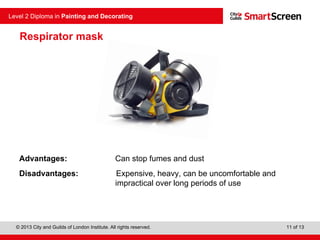
Respirator mask
Advantages: Can stop fumes and dust
Disadvantages: Expensive, heavy, can be uncomfortable and
impractical over long periods of use
© 2013 City and Guilds of London Institute. All rights reserved.
Level 2 Diploma in Painting and Decorating
12 of 13
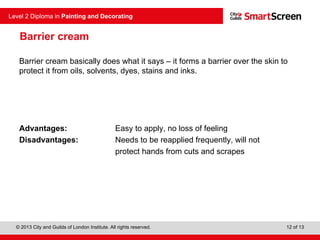
Barrier cream
Barrier cream basically does what it says – it forms a barrier over the skin to
protect it from oils, solvents, dyes, stains and inks.
Advantages: Easy to apply, no loss of feeling
Disadvantages: Needs to be reapplied frequently, will not
protect hands from cuts and scrapes
© 2013 City and Guilds of London Institute. All rights reserved.
Level 2 Diploma in Painting and Decorating
13 of 13
Moving, handling and storage
Task
Choose three paints – spirit based, oil based, and water based – from
manufacturers’ product information catalogues, the internet or textbooks, and
find out how they should be handled and stored correctly.

Using paints and solvents safely and correctly 3

  • 1.
    © 2013 Cityand Guilds of London Institute. All rights reserved. Level 2 Diploma in Painting and Decorating 1 of 13 PowerPoint presentation Unit 218: Producing specialist finishes for decorative work Using paints and solvents safely and correctly
  • 2.
    © 2013 Cityand Guilds of London Institute. All rights reserved. Level 2 Diploma in Painting and Decorating 2 of 13 Types of paint There are three types of paint materials that are commonly used when carrying out decorative effects. • Oil based • Water based • Spirit based
  • 3.
    © 2013 Cityand Guilds of London Institute. All rights reserved. Level 2 Diploma in Painting and Decorating 3 of 13 Discuss what you think the main hazards are: • Fumes can affect the eyes, lungs, stomach and balance. • Prolonged skin contact over many years can lead to dry skin, dermatitis and skin cancer. • Fire due to incorrect storage; can lead to burns or even death. Hazards associated with oil/spirit-based paints
  • 4.
    © 2013 Cityand Guilds of London Institute. All rights reserved. Level 2 Diploma in Painting and Decorating 4 of 13 Prevention Discuss how you think the hazards can be avoided. • Fumes: Always work in a well-ventilated area; open windows and doors if it is safe and practical to do so; wear respirator masks if needed; do not eat or drink in the work area; take frequent breaks. • Skin contact: Wear appropriate PPE; use barrier cream; wash frequently. • Fire: Read manufacturers’ instructions, data sheets and product information on safe handling and storage; keep away from heat and ignition sources.
  • 5.
    © 2013 Cityand Guilds of London Institute. All rights reserved. Level 2 Diploma in Painting and Decorating 5 of 13 Hazards associated with water-based paints What do you think the main hazards are? Fumes It is considered good working practice to make sure you have adequate ventilation when you are working with water-based paints. Or substitute the material for a safer alternative. Skin problems Wear gloves or barrier cream.
  • 6.
    © 2013 Cityand Guilds of London Institute. All rights reserved. Level 2 Diploma in Painting and Decorating 6 of 13 Types of PPE (personal protective equipment) • There are many different types of PPE available to you and many versions of each type. • The type of PPE you select should be correct for the task; it should be clean, undamaged and it should fit properly. • It is the employer’s responsibility to provide PPE; it is the employee’s responsibility to wear it.
  • 7.
    © 2013 Cityand Guilds of London Institute. All rights reserved. Level 2 Diploma in Painting and Decorating 7 of 13 Leather gloves Advantages: Hard-wearing, protection from the cold Disadvantages: Loss of feeling, unsuitable for delicate work
  • 8.
    © 2013 Cityand Guilds of London Institute. All rights reserved. Level 2 Diploma in Painting and Decorating 8 of 13 Vinyl/latex gloves Advantages: Thin, no loss of feeling, cheap Disadvantages: Poor abrasion resistance, unsuitable for heavy work, can cause hands to sweat, some people are allergic to latex, no protection from the cold
  • 9.
    © 2013 Cityand Guilds of London Institute. All rights reserved. Level 2 Diploma in Painting and Decorating 9 of 13 Nitrile gloves Advantages: More durable and abrasion resistant than vinyl latex, no loss of feeling Disadvantages: Can cause hands to sweat, unsuitable for heavy work
  • 10.
    © 2013 Cityand Guilds of London Institute. All rights reserved. Level 2 Diploma in Painting and Decorating 10 of 13 Gripper gloves Advantages: Strong and durable, keep hands warm Disadvantages: Loss of feeling, unsuitable for delicate work
  • 11.
    © 2013 Cityand Guilds of London Institute. All rights reserved. Level 2 Diploma in Painting and Decorating 11 of 13 Respirator mask Advantages: Can stop fumes and dust Disadvantages: Expensive, heavy, can be uncomfortable and impractical over long periods of use
  • 12.
    © 2013 Cityand Guilds of London Institute. All rights reserved. Level 2 Diploma in Painting and Decorating 12 of 13 Barrier cream Barrier cream basically does what it says – it forms a barrier over the skin to protect it from oils, solvents, dyes, stains and inks. Advantages: Easy to apply, no loss of feeling Disadvantages: Needs to be reapplied frequently, will not protect hands from cuts and scrapes
  • 13.
    © 2013 Cityand Guilds of London Institute. All rights reserved. Level 2 Diploma in Painting and Decorating 13 of 13 Moving, handling and storage Task Choose three paints – spirit based, oil based, and water based – from manufacturers’ product information catalogues, the internet or textbooks, and find out how they should be handled and stored correctly.