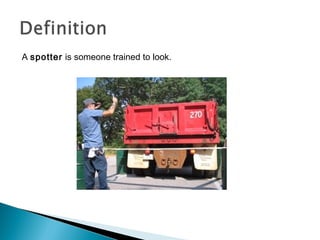
A spotter is someone trained to look.
 A spotter is necessary when the driver/operator
does not have a full view of the working area and
need someone to direct him/her.
 Not only if is there the possibility of injuring
someone, but of causing property damage
Source: U.S. Department of Labor, OSHA, Office of Regulatory Analysis
3%
10%
22%
21%
12%
5%
27%
Under 20
20 - 24
25 - 34
35 - 44
45 - 54
56 - 64
65 & over
Source: Bureau of Labor Statistics
Source: OSHA Fatality/Catastrophe Reports, complied by OSHA
Office of Electrical/Electronic and
Mechanical Engineering Safety Standards.
 BEING STRUCK BY, OR CAUGHT IN- BETWEEN, ARE
TWO OF THE LEADING CAUSE OF INJURIES AND
FATALITIES ON CONSTRUCTION SITES!
 STRUCK BY (22%)
 CAUGHT IN-BETWEEN (18%)
 Heavy Equipment is an essential part of most
industry around the world. However, statistics
indicate that they also present a very significant
hazard to people occupying the same workspace,
since injuries can be severe or fatal as equipment
is heavy and powerful.
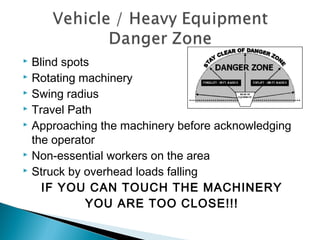
 Blind spots
 Rotating machinery
 Swing radius
 Travel Path
 Approaching the machinery before acknowledging
the operator
 Non-essential workers on the area
 Struck by overhead loads falling
IF YOU CAN TOUCH THE MACHINERY
YOU ARE TOO CLOSE!!!
Danger-ZONE
Learn to know the…
THE SHADED AREA SURROUNDING EACH
VEHICLE REPRESENTS THE DANGER ZONE IN
WHICH THE VEHICLE OPERATOR’S VIEW OF
PEDESTRAN TRAFFIC IS GREATLY REDUCED OR
OBSCURRED ALTOGETHER.
Eye level 10 ft - 0 in above
ground level
34’ 0”
95’ 0”
Manlift
36’ 4”
68’ 0”
Eye level 7 ft - 0 in above
ground level
27’ 2”
17’ 8”
16’ 4”
Hydraulic Crane
10’ 0”
15’ 9”
3’ 0”
25’ 5”
Area of fully
obstructed view
Eye level 7 ft - 7 in above
ground level
Backhoe
9’ 1”
7’ 7”
18’ 5”
29’ 1”8’ 4”
Eye level 6 ft - 3 in above
ground level
Bulldozer
12’ 1”
18’ 7”
8’ 2”
12’ 5”
8’ 2”
16’ 0”
3’ 10”
Eye level 10 ft - 0 in above
ground level
Front End Loader
14’ 10”21’ 11”
14’ 3”
16’ 2”
14’ 8”
28’11”
Eye level 5 ft - 5 in above
ground level
6’ 1”
11’ 7”
6’ 3”
Bobcat/Skid Steer
3’ 1”
4’ 10”
11’ 5”
21’ 8”
Eye level 7 ft - 3 in above
ground level
39’ 0”
21’ 2”
High Reach
RT Fork Lift
10’ 9”
7’ 9”
3’ 0”
85’ 0”
14’ 10”
18’ 2”
Eye level 6 ft above
ground level
5’ 7”
3’ 1”
8’ 6”
3’ 8”
3 Ton Forklift
Eye level 8 ft - 8 in above
ground level
9’ 2”
13’ 7”
13’ 0”
12’ 2”
10 Ton Forklift
10’ 7”
7’ 0”
6’ 4”
Eye level 8 ft - 9 in above
ground level
13’ 6”
26’ 8”
14’ 1”
17 Ton Forklift
8’ 8”
4’ 5”
4’ 8”
15’ 5”
Eye level 6 ft - 10 in above
ground level
40’ 6”
36’ 8”
Semi-Truck & Trailer
27’ 1”
42’ 8”
6’ 5”
Area of fully
obstructed view
Eye level 8 ft - 0 in above
ground level
8’ 10”
13’ 2”
Refuse Truck
13’ 3”
3’ 4”
8’ 0”
Area of fully
obstructed view
HiVac Truck
Eye level 8 ft - 0 in above
ground level
8’ 7”
31’ 0”
29’ 0”
24’ 6”
37’ 4”
41’ 0”
24’ 0”
Area of fully
obstructed view
from Eductor Hose
(more than 100 ft)
Area of fully
obstructed view
(more than 300 ft)
 Make sure no one enters the danger zone while the
machinery is in operation, the danger zone is the area
around the equipment/vehicle where the operator
don’t have a full visibility during normal operation.
Stay at least ten feet away from all sides of the
Machinery
 Front
 Both Sides (left, right) Yes, the right rear side is one of the most dangerous
 Back Yes, behind the machinery is also one of the most dangerous
 Up and Bottom
If you’re working near moving vehicles or equipment,
what are the most important safety points to
remember?
1. Stay alert at all times.
2. Don’t distract yourself.
3. Keep a safe distance.
4. Keep off the equipment unless authorized.
5. Watch out for shifting or unstable loads.
6. Wear a bright orange vest if you are working near
moving vehicles or heavy equipment.
7. Wear reflectorize clothing at night.
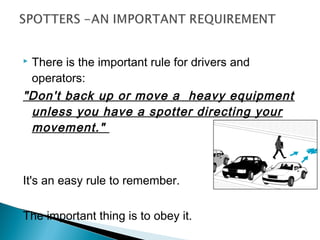
 There is the important rule for drivers and
operators:
"Don't back up or move a heavy equipment
unless you have a spotter directing your
movement."
It's an easy rule to remember.
The important thing is to obey it.  
 When:
 backing a vehicle or machinery
 entering or moving a vehicle or
machinery in a congested area
 poor visibility
 close proximity
 Pedestrians/coworkers or other contractors on the
surroundings
 lateral, overhead, or other obstructions
 This person has to watch out for others as well as
for himself (keeping enough distance in
between spotter and equipment moving), and
make sure the vehicle doesn't damage property.
 It may appear as an easy task. But there are a lot
of dangers involved. 
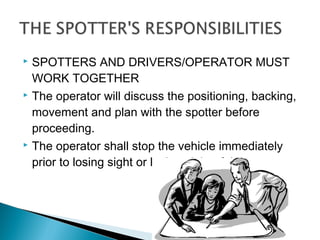
 SPOTTERS AND DRIVERS/OPERATOR MUST
WORK TOGETHER
 The operator will discuss the positioning, backing,
movement and plan with the spotter before
proceeding.
 The operator shall stop the vehicle immediately
prior to losing sight or losing sight of the spotter.
 In order to give you an unobstructed view of the
entire movement, when directing the
driver/operator, stand at the driver's side.
 It's important that the driver understands your
signals, so get together with the driver before any
movement and explain the signals you will use.
 allow for sufficient stopping distance
and clearance
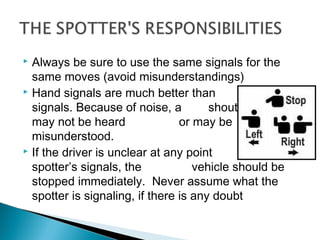
 Always be sure to use the same signals for the
same moves (avoid misunderstandings)
 Hand signals are much better than vocal
signals. Because of noise, a shouted signal
may not be heard or may be
misunderstood.
 If the driver is unclear at any point about the
spotter’s signals, the vehicle should be
stopped immediately.  Never assume what the
spotter is signaling, if there is any doubt  
STRAIGHT BACKWARD OR FORWARD – To move the vehicle
in a straight line either forward or backward.
TURN – To move the vehicle either to the right or left while the
vehicle is moving
DISTANCE TO STOPPING POINT – To provide the driver a visual
reference for the distance to the stop point.
CLEARED TO LEAVE THE AREA – To show the driver the vehicle
is clear of obstructions and is cleared to leave in the direction
indicated.
STOP – Stop all movement of the vehicle, await further
instructions.
 When spotting, concentrate on spotting –The task
at hand.
 Maintain eye contact with the driver/operator,
even if you have to change position frequently.
 If the spotter needs to stop spotting momentarily
for any reason, first make sure that the
driver/operator stops the equipment.
 If you or someone else have to pass behind a
vehicle or equipment:
1. stop the vehicle or equipment first.
2. As you're passing behind it, extend your hand at arm's
length and place it against the back of the
vehicle/equipment. Then if the vehicle/equipment starts
to move,  you'll be able to feel the movement and get
out of the way.  
 In addition to standing well to the driver's side of
the vehicle/equipment, wear a fluorescent vest.
 In the dark, don't blind the driver by shining your
flashlight in the rearview mirror.
 Day or night, avoid walking backward. If you have
to, when walking backwards, be careful not to trip
(check the path). 
Spotter training

Spotter training

  • 2.
    A spotter issomeone trained to look.
  • 3.
     A spotteris necessary when the driver/operator does not have a full view of the working area and need someone to direct him/her.  Not only if is there the possibility of injuring someone, but of causing property damage
  • 4.
    Source: U.S. Departmentof Labor, OSHA, Office of Regulatory Analysis
  • 5.
    3% 10% 22% 21% 12% 5% 27% Under 20 20 -24 25 - 34 35 - 44 45 - 54 56 - 64 65 & over Source: Bureau of Labor Statistics
  • 6.
    Source: OSHA Fatality/CatastropheReports, complied by OSHA Office of Electrical/Electronic and Mechanical Engineering Safety Standards.
  • 7.
     BEING STRUCKBY, OR CAUGHT IN- BETWEEN, ARE TWO OF THE LEADING CAUSE OF INJURIES AND FATALITIES ON CONSTRUCTION SITES!  STRUCK BY (22%)  CAUGHT IN-BETWEEN (18%)
  • 8.
     Heavy Equipmentis an essential part of most industry around the world. However, statistics indicate that they also present a very significant hazard to people occupying the same workspace, since injuries can be severe or fatal as equipment is heavy and powerful.
  • 9.
     Blind spots Rotating machinery  Swing radius  Travel Path  Approaching the machinery before acknowledging the operator  Non-essential workers on the area  Struck by overhead loads falling IF YOU CAN TOUCH THE MACHINERY YOU ARE TOO CLOSE!!!
  • 10.
    Danger-ZONE Learn to knowthe… THE SHADED AREA SURROUNDING EACH VEHICLE REPRESENTS THE DANGER ZONE IN WHICH THE VEHICLE OPERATOR’S VIEW OF PEDESTRAN TRAFFIC IS GREATLY REDUCED OR OBSCURRED ALTOGETHER.
  • 11.
    Eye level 10ft - 0 in above ground level 34’ 0” 95’ 0” Manlift 36’ 4” 68’ 0”
  • 12.
    Eye level 7ft - 0 in above ground level 27’ 2” 17’ 8” 16’ 4” Hydraulic Crane 10’ 0” 15’ 9” 3’ 0” 25’ 5” Area of fully obstructed view
  • 13.
    Eye level 7ft - 7 in above ground level Backhoe 9’ 1” 7’ 7” 18’ 5” 29’ 1”8’ 4”
  • 14.
    Eye level 6ft - 3 in above ground level Bulldozer 12’ 1” 18’ 7” 8’ 2” 12’ 5” 8’ 2” 16’ 0” 3’ 10”
  • 15.
    Eye level 10ft - 0 in above ground level Front End Loader 14’ 10”21’ 11” 14’ 3” 16’ 2” 14’ 8” 28’11”
  • 16.
    Eye level 5ft - 5 in above ground level 6’ 1” 11’ 7” 6’ 3” Bobcat/Skid Steer 3’ 1” 4’ 10” 11’ 5” 21’ 8”
  • 17.
    Eye level 7ft - 3 in above ground level 39’ 0” 21’ 2” High Reach RT Fork Lift 10’ 9” 7’ 9” 3’ 0” 85’ 0” 14’ 10” 18’ 2”
  • 18.
    Eye level 6ft above ground level 5’ 7” 3’ 1” 8’ 6” 3’ 8” 3 Ton Forklift
  • 19.
    Eye level 8ft - 8 in above ground level 9’ 2” 13’ 7” 13’ 0” 12’ 2” 10 Ton Forklift 10’ 7” 7’ 0” 6’ 4”
  • 20.
    Eye level 8ft - 9 in above ground level 13’ 6” 26’ 8” 14’ 1” 17 Ton Forklift 8’ 8” 4’ 5” 4’ 8” 15’ 5”
  • 21.
    Eye level 6ft - 10 in above ground level 40’ 6” 36’ 8” Semi-Truck & Trailer 27’ 1” 42’ 8” 6’ 5” Area of fully obstructed view
  • 22.
    Eye level 8ft - 0 in above ground level 8’ 10” 13’ 2” Refuse Truck 13’ 3” 3’ 4” 8’ 0” Area of fully obstructed view
  • 23.
    HiVac Truck Eye level8 ft - 0 in above ground level 8’ 7” 31’ 0” 29’ 0” 24’ 6” 37’ 4” 41’ 0” 24’ 0” Area of fully obstructed view from Eductor Hose (more than 100 ft) Area of fully obstructed view (more than 300 ft)
  • 24.
     Make sureno one enters the danger zone while the machinery is in operation, the danger zone is the area around the equipment/vehicle where the operator don’t have a full visibility during normal operation. Stay at least ten feet away from all sides of the Machinery  Front  Both Sides (left, right) Yes, the right rear side is one of the most dangerous  Back Yes, behind the machinery is also one of the most dangerous  Up and Bottom
  • 26.
    If you’re workingnear moving vehicles or equipment, what are the most important safety points to remember? 1. Stay alert at all times. 2. Don’t distract yourself. 3. Keep a safe distance. 4. Keep off the equipment unless authorized. 5. Watch out for shifting or unstable loads. 6. Wear a bright orange vest if you are working near moving vehicles or heavy equipment. 7. Wear reflectorize clothing at night.
  • 27.
     There isthe important rule for drivers and operators: "Don't back up or move a heavy equipment unless you have a spotter directing your movement." It's an easy rule to remember. The important thing is to obey it.  
  • 28.
     When:  backinga vehicle or machinery  entering or moving a vehicle or machinery in a congested area  poor visibility  close proximity  Pedestrians/coworkers or other contractors on the surroundings  lateral, overhead, or other obstructions
  • 29.
     This personhas to watch out for others as well as for himself (keeping enough distance in between spotter and equipment moving), and make sure the vehicle doesn't damage property.  It may appear as an easy task. But there are a lot of dangers involved. 
  • 30.
     SPOTTERS ANDDRIVERS/OPERATOR MUST WORK TOGETHER  The operator will discuss the positioning, backing, movement and plan with the spotter before proceeding.  The operator shall stop the vehicle immediately prior to losing sight or losing sight of the spotter.
  • 31.
     In orderto give you an unobstructed view of the entire movement, when directing the driver/operator, stand at the driver's side.  It's important that the driver understands your signals, so get together with the driver before any movement and explain the signals you will use.  allow for sufficient stopping distance and clearance
  • 32.
     Always besure to use the same signals for the same moves (avoid misunderstandings)  Hand signals are much better than vocal signals. Because of noise, a shouted signal may not be heard or may be misunderstood.  If the driver is unclear at any point about the spotter’s signals, the vehicle should be stopped immediately.  Never assume what the spotter is signaling, if there is any doubt  
  • 33.
    STRAIGHT BACKWARD ORFORWARD – To move the vehicle in a straight line either forward or backward.
  • 34.
    TURN – Tomove the vehicle either to the right or left while the vehicle is moving
  • 35.
    DISTANCE TO STOPPINGPOINT – To provide the driver a visual reference for the distance to the stop point.
  • 36.
    CLEARED TO LEAVETHE AREA – To show the driver the vehicle is clear of obstructions and is cleared to leave in the direction indicated.
  • 37.
    STOP – Stopall movement of the vehicle, await further instructions.
  • 38.
     When spotting,concentrate on spotting –The task at hand.  Maintain eye contact with the driver/operator, even if you have to change position frequently.  If the spotter needs to stop spotting momentarily for any reason, first make sure that the driver/operator stops the equipment.
  • 39.
     If youor someone else have to pass behind a vehicle or equipment: 1. stop the vehicle or equipment first. 2. As you're passing behind it, extend your hand at arm's length and place it against the back of the vehicle/equipment. Then if the vehicle/equipment starts to move,  you'll be able to feel the movement and get out of the way.  
  • 40.
     In additionto standing well to the driver's side of the vehicle/equipment, wear a fluorescent vest.  In the dark, don't blind the driver by shining your flashlight in the rearview mirror.
  • 41.
     Day ornight, avoid walking backward. If you have to, when walking backwards, be careful not to trip (check the path).