AWARENESS
PROGRAM
Banksman /Flagman
Training
HSE Department
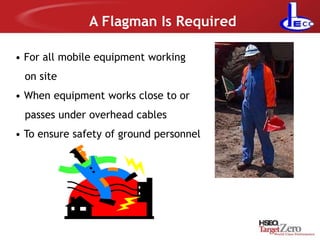
A Flagman Is Required
• For all mobile equipment working
on site
• When equipment works close to or
passes under overhead cables
• To ensure safety of ground personnel
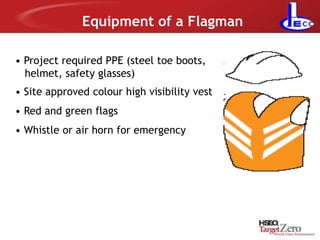
Equipment of a Flagman
• Project required PPE (steel toe boots,
helmet, safety glasses)
• Site approved colour high visibility vest
• Red and green flags
• Whistle or air horn for emergency
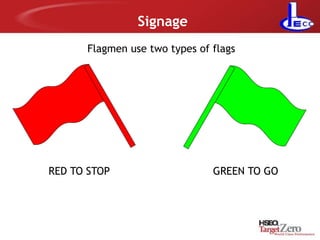
Signage
Flagmen use two types of flags
RED TO STOP GREEN TO GO
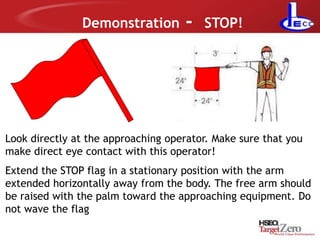
Demonstration - STOP!
Look directly at the approaching operator. Make sure that you
make direct eye contact with this operator!
Extend the STOP flag in a stationary position with the arm
extended horizontally away from the body. The free arm should
be raised with the palm toward the approaching equipment. Do
not wave the flag
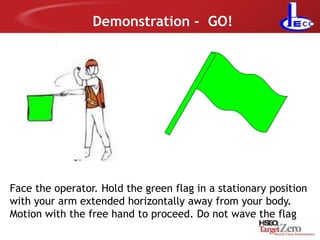
Demonstration - GO!
Face the operator. Hold the green flag in a stationary position
with your arm extended horizontally away from your body.
Motion with the free hand to proceed. Do not wave the flag
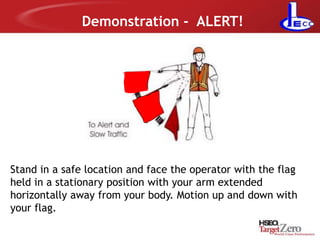
Demonstration - ALERT!
Stand in a safe location and face the operator with the flag
held in a stationary position with your arm extended
horizontally away from your body. Motion up and down with
your flag.
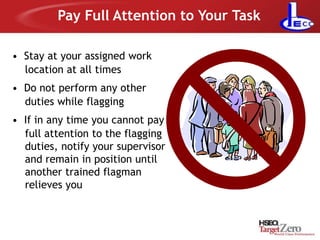
Pay Full Attention to Your Task
• Stay at your assigned work
location at all times
• Do not perform any other
duties while flagging
• If in any time you cannot pay
full attention to the flagging
duties, notify your supervisor
and remain in position until
another trained flagman
relieves you
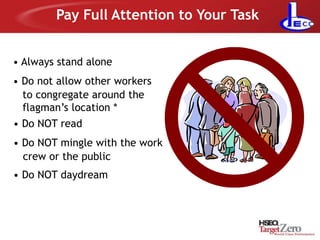
Pay Full Attention to Your Task
• Always stand alone
• Do not allow other workers
to congregate around the
flagman’s location *
• Do NOT read
• Do NOT mingle with the work
crew or the public
• Do NOT daydream
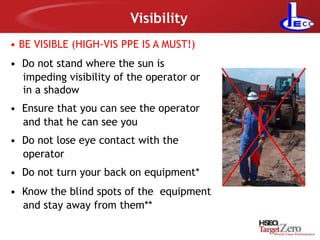
Visibility
• BE VISIBLE (HIGH-VIS PPE IS A MUST!)
• Do not stand where the sun is
impeding visibility of the operator or
in a shadow
• Ensure that you can see the operator
and that he can see you
• Do not lose eye contact with the
operator
• Do not turn your back on equipment*
• Know the blind spots of the equipment
and stay away from them**
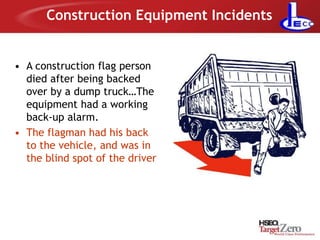
• A construction flag person
died after being backed
over by a dump truck…The
equipment had a working
back-up alarm.
• The flagman had his back
to the vehicle, and was in
the blind spot of the driver
Construction Equipment Incidents
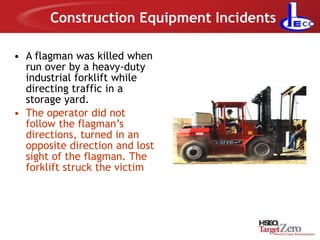
• A flagman was killed when
run over by a heavy-duty
industrial forklift while
directing traffic in a
storage yard.
• The operator did not
follow the flagman’s
directions, turned in an
opposite direction and lost
sight of the flagman. The
forklift struck the victim
Construction Equipment Incidents
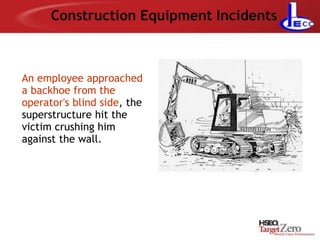
An employee approached
a backhoe from the
operator's blind side, the
superstructure hit the
victim crushing him
against the wall.
Construction Equipment Incidents
Blind Spots
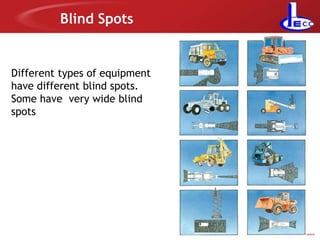
Different types of equipment
have different blind spots.
Some have very wide blind
spots
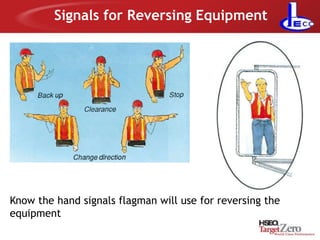
Signals for Reversing Equipment
Know the hand signals flagman will use for reversing the
equipment
Distance
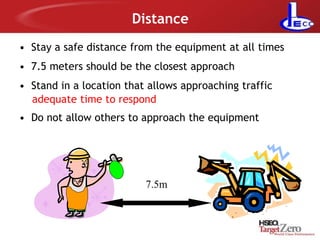
• Stay a safe distance from the equipment at all times
• 7.5 meters should be the closest approach
• Stand in a location that allows approaching traffic
adequate time to respond
• Do not allow others to approach the equipment
7.5m
Flagman’s Responsibilities - General
• Do NOT abandon your post for any reason until the work
is finished or a trained replacement flagman arrives.
• Ensure warning methods you will use are understandable
for the operator
• Warn ground personnel that the equipment is coming
• Keep ground personnel away from the equipment path of
travel until permission is received from equipment
operator
• Know your work zone setup and navigate equipment
through narrow passages
• Be alert for emergency vehicles. They have “priority
rights.” Allow them to pass as quickly as possible.
Flagman’s Responsibilities -
Power Lines
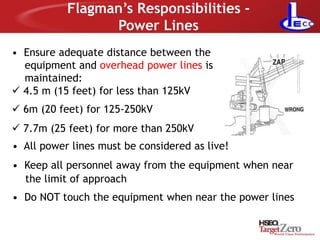
• Ensure adequate distance between the
equipment and overhead power lines is
maintained:
 4.5 m (15 feet) for less than 125kV
 6m (20 feet) for 125-250kV
 7.7m (25 feet) for more than 250kV
• All power lines must be considered as live!
• Keep all personnel away from the equipment when near
the limit of approach
• Do NOT touch the equipment when near the power lines
Flagman’s Responsibilities -
Backing Up
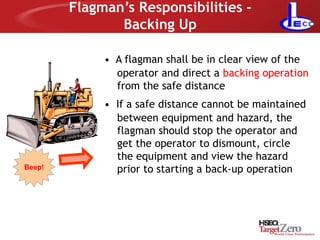
• A flagman shall be in clear view of the
operator and direct a backing operation
from the safe distance
• If a safe distance cannot be maintained
between equipment and hazard, the
flagman should stop the operator and
get the operator to dismount, circle
the equipment and view the hazard
prior to starting a back-up operation
Beep!
Your Own Safety
At the start of each activity, it is YOUR
responsibility to require the equipment operator
to STOP immediately when he loses sight of
you!!!*
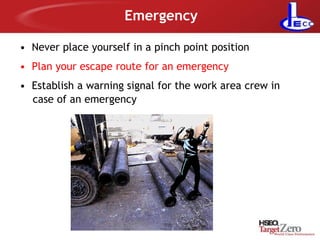
Emergency
• Never place yourself in a pinch point position
• Plan your escape route for an emergency
• Establish a warning signal for the work area crew in
case of an emergency
Summary
• A flagman is required for the safety of moving heavy
equipment and ground personnel on the job site
• Have your Flagman’s PPE ready – all PPE + high-visibility
vest + red and green flags + whistle/ horn
• Stay at the assigned location at all times unless relieved
by another trained flagman
• Pay full attention to your duties
• Don’t mingle with others, don’t read/ sleep/ use phone/
radio.
• Stand alone and don’t let people gather around you
• Ensure that you are seen by the operator AT ALL TIMES
Summary
• Keep a safe distance between the ground personnel
(including yourself) and equipment
• Be alert for emergency vehicles
• Be extremely alert when equipment is working around
power lines or backing up
• Do not put yourself in an unsafe situation
• Do not turn your back to the equipment
• Have an escape route and a warning whistle/ horn signal
for emergency
• Have the operator STOP immediately if he loses sight of
you
Any
Questions

Flagman-Training.ppt

  • 1.
  • 2.
    A Flagman IsRequired • For all mobile equipment working on site • When equipment works close to or passes under overhead cables • To ensure safety of ground personnel
  • 3.
    Equipment of aFlagman • Project required PPE (steel toe boots, helmet, safety glasses) • Site approved colour high visibility vest • Red and green flags • Whistle or air horn for emergency
  • 4.
    Signage Flagmen use twotypes of flags RED TO STOP GREEN TO GO
  • 5.
    Demonstration - STOP! Lookdirectly at the approaching operator. Make sure that you make direct eye contact with this operator! Extend the STOP flag in a stationary position with the arm extended horizontally away from the body. The free arm should be raised with the palm toward the approaching equipment. Do not wave the flag
  • 6.
    Demonstration - GO! Facethe operator. Hold the green flag in a stationary position with your arm extended horizontally away from your body. Motion with the free hand to proceed. Do not wave the flag
  • 7.
    Demonstration - ALERT! Standin a safe location and face the operator with the flag held in a stationary position with your arm extended horizontally away from your body. Motion up and down with your flag.
  • 8.
    Pay Full Attentionto Your Task • Stay at your assigned work location at all times • Do not perform any other duties while flagging • If in any time you cannot pay full attention to the flagging duties, notify your supervisor and remain in position until another trained flagman relieves you
  • 9.
    Pay Full Attentionto Your Task • Always stand alone • Do not allow other workers to congregate around the flagman’s location * • Do NOT read • Do NOT mingle with the work crew or the public • Do NOT daydream
  • 10.
    Visibility • BE VISIBLE(HIGH-VIS PPE IS A MUST!) • Do not stand where the sun is impeding visibility of the operator or in a shadow • Ensure that you can see the operator and that he can see you • Do not lose eye contact with the operator • Do not turn your back on equipment* • Know the blind spots of the equipment and stay away from them**
  • 11.
    • A constructionflag person died after being backed over by a dump truck…The equipment had a working back-up alarm. • The flagman had his back to the vehicle, and was in the blind spot of the driver Construction Equipment Incidents
  • 12.
    • A flagmanwas killed when run over by a heavy-duty industrial forklift while directing traffic in a storage yard. • The operator did not follow the flagman’s directions, turned in an opposite direction and lost sight of the flagman. The forklift struck the victim Construction Equipment Incidents
  • 13.
    An employee approached abackhoe from the operator's blind side, the superstructure hit the victim crushing him against the wall. Construction Equipment Incidents
  • 14.
    Blind Spots Different typesof equipment have different blind spots. Some have very wide blind spots
  • 15.
    Signals for ReversingEquipment Know the hand signals flagman will use for reversing the equipment
  • 16.
    Distance • Stay asafe distance from the equipment at all times • 7.5 meters should be the closest approach • Stand in a location that allows approaching traffic adequate time to respond • Do not allow others to approach the equipment 7.5m
  • 17.
    Flagman’s Responsibilities -General • Do NOT abandon your post for any reason until the work is finished or a trained replacement flagman arrives. • Ensure warning methods you will use are understandable for the operator • Warn ground personnel that the equipment is coming • Keep ground personnel away from the equipment path of travel until permission is received from equipment operator • Know your work zone setup and navigate equipment through narrow passages • Be alert for emergency vehicles. They have “priority rights.” Allow them to pass as quickly as possible.
  • 18.
    Flagman’s Responsibilities - PowerLines • Ensure adequate distance between the equipment and overhead power lines is maintained:  4.5 m (15 feet) for less than 125kV  6m (20 feet) for 125-250kV  7.7m (25 feet) for more than 250kV • All power lines must be considered as live! • Keep all personnel away from the equipment when near the limit of approach • Do NOT touch the equipment when near the power lines
  • 19.
    Flagman’s Responsibilities - BackingUp • A flagman shall be in clear view of the operator and direct a backing operation from the safe distance • If a safe distance cannot be maintained between equipment and hazard, the flagman should stop the operator and get the operator to dismount, circle the equipment and view the hazard prior to starting a back-up operation Beep!
  • 20.
    Your Own Safety Atthe start of each activity, it is YOUR responsibility to require the equipment operator to STOP immediately when he loses sight of you!!!*
  • 21.
    Emergency • Never placeyourself in a pinch point position • Plan your escape route for an emergency • Establish a warning signal for the work area crew in case of an emergency
  • 22.
    Summary • A flagmanis required for the safety of moving heavy equipment and ground personnel on the job site • Have your Flagman’s PPE ready – all PPE + high-visibility vest + red and green flags + whistle/ horn • Stay at the assigned location at all times unless relieved by another trained flagman • Pay full attention to your duties • Don’t mingle with others, don’t read/ sleep/ use phone/ radio. • Stand alone and don’t let people gather around you • Ensure that you are seen by the operator AT ALL TIMES
  • 23.
    Summary • Keep asafe distance between the ground personnel (including yourself) and equipment • Be alert for emergency vehicles • Be extremely alert when equipment is working around power lines or backing up • Do not put yourself in an unsafe situation • Do not turn your back to the equipment • Have an escape route and a warning whistle/ horn signal for emergency • Have the operator STOP immediately if he loses sight of you
  • 24.