Level 1 Diploma in Painting and Decorating
© 2013 City and Guilds of London Institute. All rights reserved. 1 of 8
PowerPoint
presentationPreparation tools and equipment
Unit 117: Preparing surfaces for decoration
Level 1 Diploma in Painting and Decorating
© 2013 City and Guilds of London Institute. All rights reserved. 2 of 8
Why do we prepare surfaces?
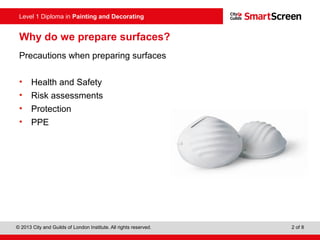
Precautions when preparing surfaces
• Health and Safety
• Risk assessments
• Protection
• PPE
Level 1 Diploma in Painting and Decorating
© 2013 City and Guilds of London Institute. All rights reserved. 3 of 8
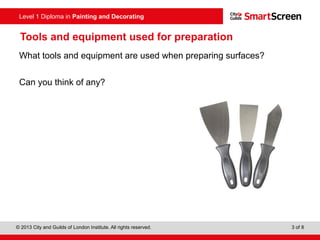
Tools and equipment used for preparation
What tools and equipment are used when preparing surfaces?
Can you think of any?
Level 1 Diploma in Painting and Decorating
© 2013 City and Guilds of London Institute. All rights reserved. 4 of 8
Removing old paint systems
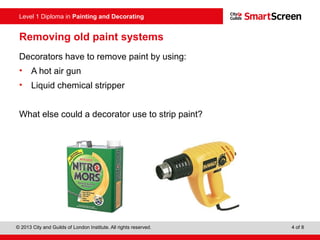
Decorators have to remove paint by using:
• A hot air gun
• Liquid chemical stripper
What else could a decorator use to strip paint?
Level 1 Diploma in Painting and Decorating
© 2013 City and Guilds of London Institute. All rights reserved. 5 of 8
Abrasive papers
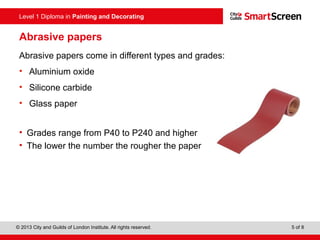
Abrasive papers come in different types and grades:
• Aluminium oxide
• Silicone carbide
• Glass paper
• Grades range from P40 to P240 and higher
• The lower the number the rougher the paper
Level 1 Diploma in Painting and Decorating
© 2013 City and Guilds of London Institute. All rights reserved. 6 of 8
Common defects
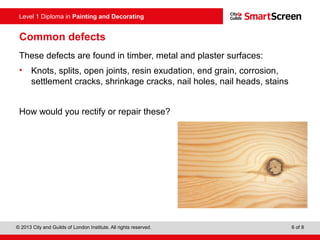
These defects are found in timber, metal and plaster surfaces:
• Knots, splits, open joints, resin exudation, end grain, corrosion,
settlement cracks, shrinkage cracks, nail holes, nail heads, stains
How would you rectify or repair these?
Level 1 Diploma in Painting and Decorating
© 2013 City and Guilds of London Institute. All rights reserved. 7 of 8
Surface contamination
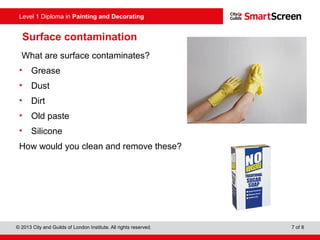
What are surface contaminates?
• Grease
• Dust
• Dirt
• Old paste
• Silicone
How would you clean and remove these?
Level 1 Diploma in Painting and Decorating
© 2013 City and Guilds of London Institute. All rights reserved. 8 of 8
Any questions?

Preparation tools and equipment

  • 1.
    Level 1 Diplomain Painting and Decorating © 2013 City and Guilds of London Institute. All rights reserved. 1 of 8 PowerPoint presentationPreparation tools and equipment Unit 117: Preparing surfaces for decoration
  • 2.
    Level 1 Diplomain Painting and Decorating © 2013 City and Guilds of London Institute. All rights reserved. 2 of 8 Why do we prepare surfaces? Precautions when preparing surfaces • Health and Safety • Risk assessments • Protection • PPE
  • 3.
    Level 1 Diplomain Painting and Decorating © 2013 City and Guilds of London Institute. All rights reserved. 3 of 8 Tools and equipment used for preparation What tools and equipment are used when preparing surfaces? Can you think of any?
  • 4.
    Level 1 Diplomain Painting and Decorating © 2013 City and Guilds of London Institute. All rights reserved. 4 of 8 Removing old paint systems Decorators have to remove paint by using: • A hot air gun • Liquid chemical stripper What else could a decorator use to strip paint?
  • 5.
    Level 1 Diplomain Painting and Decorating © 2013 City and Guilds of London Institute. All rights reserved. 5 of 8 Abrasive papers Abrasive papers come in different types and grades: • Aluminium oxide • Silicone carbide • Glass paper • Grades range from P40 to P240 and higher • The lower the number the rougher the paper
  • 6.
    Level 1 Diplomain Painting and Decorating © 2013 City and Guilds of London Institute. All rights reserved. 6 of 8 Common defects These defects are found in timber, metal and plaster surfaces: • Knots, splits, open joints, resin exudation, end grain, corrosion, settlement cracks, shrinkage cracks, nail holes, nail heads, stains How would you rectify or repair these?
  • 7.
    Level 1 Diplomain Painting and Decorating © 2013 City and Guilds of London Institute. All rights reserved. 7 of 8 Surface contamination What are surface contaminates? • Grease • Dust • Dirt • Old paste • Silicone How would you clean and remove these?
  • 8.
    Level 1 Diplomain Painting and Decorating © 2013 City and Guilds of London Institute. All rights reserved. 8 of 8 Any questions?