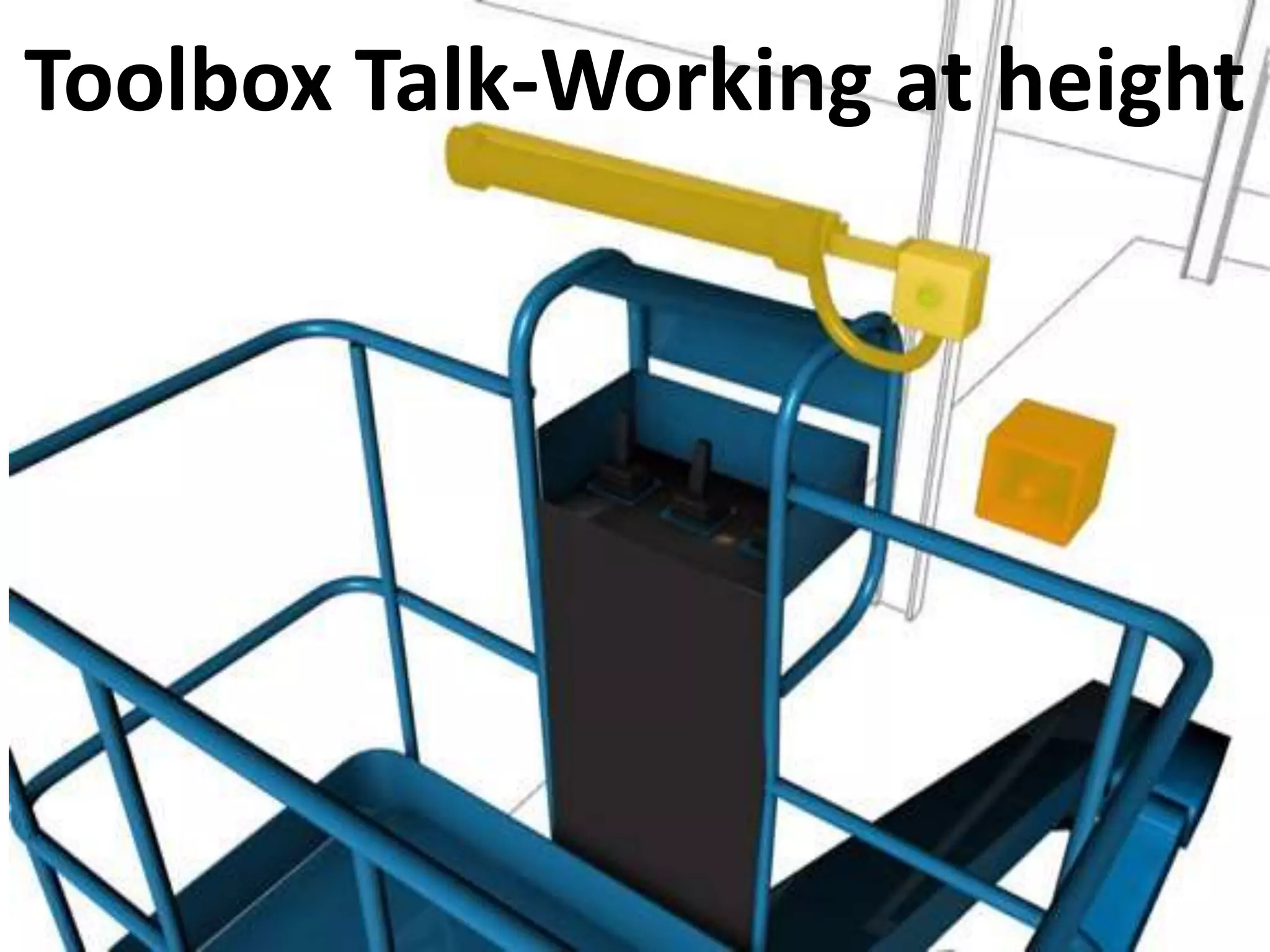
Toolbox Talk-Working at height
What is working at height?
• Working at height remains one of the biggest causes of
fatalities and major injuries. Common cases include falls from
ladders and through fragile surfaces.
What dose work height mean?
• ‘Work at height’ means work in any place where, if there were
no precautions in place, a person could fall a distance liable to
cause personal injury (for example a fall through a fragile
roof).
Working at height – Preparation
• You must make sure work is properly planned,
supervised and carried out by competent people with
the skills, knowledge and experience to do the job. You
must use the right type of equipment for working at
height.
• Take a sensible approach when considering
precautions. Low-risk, relatively straightforward tasks
will require less effort when it comes to planning and
there may be some low-risk situations where common
sense tells you no particular precautions are necessary.
Do’s and don’ts of working at height
and ground.
Do….
· As much work as possible from the ground
· Ensure workers can get safely to and from where they work at height
· Ensure equipment is suitable, stable and strong enough for the job, maintained and
checked regularly
· Take precautions when working on or near fragile surfaces
· Provide protection from falling objects
Don’t…
· Overload ladders – consider the equipment or materials workers are carrying before
working at height. Check the pictogram or label on the ladder for information
· Overreach on ladders or stepladders
· Rest a ladder against weak upper surfaces, eg glazing or plastic gutters
· Use ladders or stepladders for strenuous or heavy tasks, only use them for light work
of short duration (a maximum of 30 minutes at a time)
· Let anyone who is not competent (who doesn’t have the skills, knowledge and
experience to do the job) work at height
Working at height — Main accidents
that occur:
• Ladders
• Trestles and stepladders
• Hoists and hoist towers
• System scaffolds
• Mobile scaffold towers
• Tube and fittings scaffolding
• Safe working at height
• Fall arrest and suspension equipment
• Mobile elevating work platforms
• Safety with steelwork
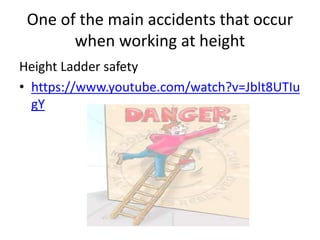
One of the main accidents that occur
when working at height
Height Ladder safety
• https://www.youtube.com/watch?v=Jblt8UTIu
gY
How to reduce or control working at
height accidents
• Special equipment e.g.
• Avoid work at height
• Minimise the risks that may occur
• Used right type of equipment
Working at height regulation 2005
• The purpose of The Work at Height
Regulations 2005 is to prevent death and
injury caused by a fall from height. If you are
an employer or you control work at height (for
example facilities managers or building
owners who may contract others to work at
height) the Regulations apply to you.
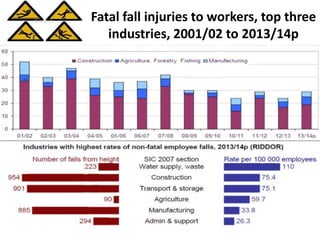
Fatal fall injuries to workers, top three
industries, 2001/02 to 2013/14p

Toolbox Talk-Working at height

  • 1.
  • 2.
    What is workingat height? What is working at height? • Working at height remains one of the biggest causes of fatalities and major injuries. Common cases include falls from ladders and through fragile surfaces. What dose work height mean? • ‘Work at height’ means work in any place where, if there were no precautions in place, a person could fall a distance liable to cause personal injury (for example a fall through a fragile roof).
  • 3.
    Working at height– Preparation • You must make sure work is properly planned, supervised and carried out by competent people with the skills, knowledge and experience to do the job. You must use the right type of equipment for working at height. • Take a sensible approach when considering precautions. Low-risk, relatively straightforward tasks will require less effort when it comes to planning and there may be some low-risk situations where common sense tells you no particular precautions are necessary.
  • 4.
    Do’s and don’tsof working at height and ground. Do…. · As much work as possible from the ground · Ensure workers can get safely to and from where they work at height · Ensure equipment is suitable, stable and strong enough for the job, maintained and checked regularly · Take precautions when working on or near fragile surfaces · Provide protection from falling objects Don’t… · Overload ladders – consider the equipment or materials workers are carrying before working at height. Check the pictogram or label on the ladder for information · Overreach on ladders or stepladders · Rest a ladder against weak upper surfaces, eg glazing or plastic gutters · Use ladders or stepladders for strenuous or heavy tasks, only use them for light work of short duration (a maximum of 30 minutes at a time) · Let anyone who is not competent (who doesn’t have the skills, knowledge and experience to do the job) work at height
  • 5.
    Working at height— Main accidents that occur: • Ladders • Trestles and stepladders • Hoists and hoist towers • System scaffolds • Mobile scaffold towers • Tube and fittings scaffolding • Safe working at height • Fall arrest and suspension equipment • Mobile elevating work platforms • Safety with steelwork
  • 6.
    One of themain accidents that occur when working at height Height Ladder safety • https://www.youtube.com/watch?v=Jblt8UTIu gY
  • 7.
    How to reduceor control working at height accidents • Special equipment e.g. • Avoid work at height • Minimise the risks that may occur • Used right type of equipment
  • 8.
    Working at heightregulation 2005 • The purpose of The Work at Height Regulations 2005 is to prevent death and injury caused by a fall from height. If you are an employer or you control work at height (for example facilities managers or building owners who may contract others to work at height) the Regulations apply to you.
  • 9.
    Fatal fall injuriesto workers, top three industries, 2001/02 to 2013/14p