Joseph Mallord William Turner

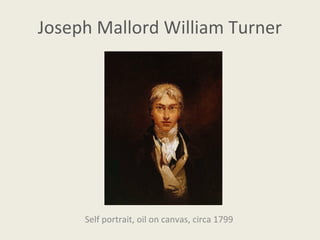
Self portrait, oil on canvas, circa 1799
J. Turner Biography
• Born on April 23rd, 1775
• His father was a barber and a wig maker and
his mother was mentally ill
• Turner was sent to stay with his uncle in 1785
• A year later he went to a school in Margate –
his father displayed his sons drawings in his
shop window
J. Turner Biography Continued…
• Turner entered the Royal Academy of Art
schools in 1789, when he was only 14 years
old
• He was accepted into the academy a year
later
• After one year of study, one of his
watercolours was accepted for the Summer
Exhibition
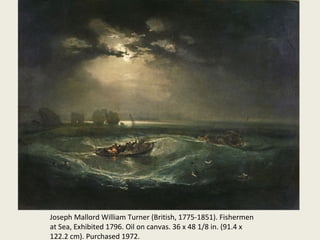
• In 1796, Turner exhibited Fishermen at Sea,
his first oil
Joseph Mallord William Turner (British, 1775-1851). Fishermen
at Sea, Exhibited 1796. Oil on canvas. 36 x 48 1/8 in. (91.4 x
122.2 cm). Purchased 1972.
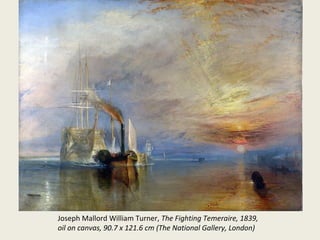
Joseph Mallord William Turner, The Fighting Temeraire, 1839,
oil on canvas, 90.7 x 121.6 cm (The National Gallery, London)
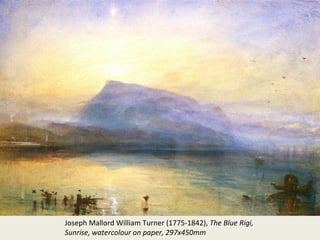
Joseph Mallord William Turner (1775-1842), The Blue Rigi,
Sunrise, watercolour on paper, 297x450mm
Legacy
• Paintings became increasingly abstract as he
was driven to portray light, space and nature
• Turner encountered violet criticisms as his
style became increasingly free
• His paintings were revolutionary, and
extremely influential, laying the groundwork
for impressionism, post-impressionism,
abstract expressionism, colour-field painting,
and the list goes on.
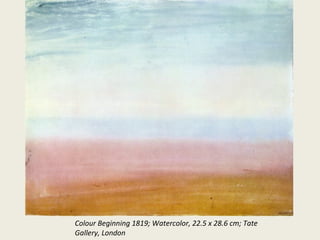
Colour Beginning 1819; Watercolor, 22.5 x 28.6 cm; Tate
Gallery, London
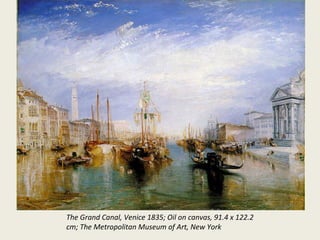
The Grand Canal, Venice 1835; Oil on canvas, 91.4 x 122.2
cm; The Metropolitan Museum of Art, New York
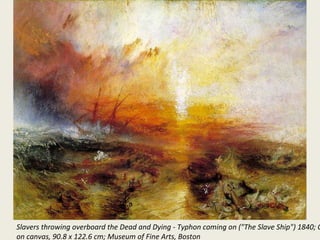
Slavers throwing overboard the Dead and Dying - Typhon coming on ("The Slave Ship") 1840; O
on canvas, 90.8 x 122.6 cm; Museum of Fine Arts, Boston

Art history II presentation

  • 1.
    Joseph Mallord WilliamTurner Self portrait, oil on canvas, circa 1799
  • 2.
    J. Turner Biography •Born on April 23rd, 1775 • His father was a barber and a wig maker and his mother was mentally ill • Turner was sent to stay with his uncle in 1785 • A year later he went to a school in Margate – his father displayed his sons drawings in his shop window
  • 3.
    J. Turner BiographyContinued… • Turner entered the Royal Academy of Art schools in 1789, when he was only 14 years old • He was accepted into the academy a year later • After one year of study, one of his watercolours was accepted for the Summer Exhibition • In 1796, Turner exhibited Fishermen at Sea, his first oil
  • 4.
    Joseph Mallord WilliamTurner (British, 1775-1851). Fishermen at Sea, Exhibited 1796. Oil on canvas. 36 x 48 1/8 in. (91.4 x 122.2 cm). Purchased 1972.
  • 5.
    Joseph Mallord WilliamTurner, The Fighting Temeraire, 1839, oil on canvas, 90.7 x 121.6 cm (The National Gallery, London)
  • 6.
    Joseph Mallord WilliamTurner (1775-1842), The Blue Rigi, Sunrise, watercolour on paper, 297x450mm
  • 7.
    Legacy • Paintings becameincreasingly abstract as he was driven to portray light, space and nature • Turner encountered violet criticisms as his style became increasingly free • His paintings were revolutionary, and extremely influential, laying the groundwork for impressionism, post-impressionism, abstract expressionism, colour-field painting, and the list goes on.
  • 8.
    Colour Beginning 1819;Watercolor, 22.5 x 28.6 cm; Tate Gallery, London
  • 9.
    The Grand Canal,Venice 1835; Oil on canvas, 91.4 x 122.2 cm; The Metropolitan Museum of Art, New York
  • 10.
    Slavers throwing overboardthe Dead and Dying - Typhon coming on ("The Slave Ship") 1840; O on canvas, 90.8 x 122.6 cm; Museum of Fine Arts, Boston

Editor's Notes

  • #2 -Joseph Mallord William Turner was an english romantic landscape painter, watercolourist, and printmaker. -His style is said to have laid the foundation for Impressionism -He is now considered the artist who elevated landscape painting as a subject to paint
  • #3 Turner was born on April 23rd in London, England. His father was a barber and a wig maker and his mother was mentally ill – His mother died in 1804 after having been comitted to a mental asylum in 1779 Due to difficult family circumstances, Turner was sent to say with his uncle in 1785, that is where he first expressed any interest in painting From his uncle’s house he was sent to a school in Margate and by this time he had created many drawings, his father displayed them in his shop window for sale. – this gained him some attention
  • #4 -Turner entered the Royal Academy of Art schools in 1789, when he was only 14 years old -He was accepted into the academy a year later -After one year of study, one of his watercolours was accepted for the Summer Exhibition -In 1796, Turner exhibited Fishermen at Sea, his first oil – he exhibitioned nearly every year thereafter for the rest of his life
  • #5 This is the fishermen at sea that I just mentioned It portrays a moonlit scene, where the potency of the moonlight contrasting against the weak and flickering lantern on the fishermen’s boat It is meant to emphasize the power that nature has over mankinf
  • #6 The Temeraire had a dramatic and victorious career in her more useful days. She earned her legendary place in British naval history after coming to the aid of fellow British ship, the Victory, during the important Battle of Trafalgar in 1805 Turner uses colour to dictate the composition of this piece – the main subjects are envelopped in a triangle of blue Because most of the painting is of a warmer colour palate, the eye is drawn immediately to the tugboat and the temeraire The lighting in this piece is achieved through Turner’s light and loose brush stroke – this is what give the atmosphere a nostalgic and hazy feel
  • #7 This painting has an interesting story – especially considering the movie called “Monumental Men” This painting was seized by pro-Nazi French officials during WWII from it’s Jewish owners It was sold at a record breaking $10.9 million to an anonymous telephone bidder 19th century art critic John Ruskin says that it is the best watercolour that Turner has ever painted “The painting has been held by the Kimbell Art Museum in Fort Worth, Texas, which agreed to hand it over to the heirs of its former owners, John and Anna Jaffe, after an investigation into the work's history. Pro-Nazi Vichy authorities illegally seized and sold the family's property in 1943. A group of Jaffe heirs has been searching for the past two years for confiscated paintings from the Jewish art collector's collection. The Turner painting changed hands several times until 1966, when it was purchased by the Kimbell Art Foundation.” Does anyone know why this painting was so important?