SCD- 2006 HSE-P-LOP-00
Lifting Operations
SCD- 2006 HSE-P-LOP-00
Objectives
Upon completion of the lesson, participants will be able to:
 List the four major causes of crane accidents.
 Describe the pre-planning that is required before putting a
crane in use.
 State the two main precautions that apply to working with
cranes near power lines.
 Explain at least three ways to eliminate hazards that may lead
to injury when using forklifts, cranes or slings to handle
materials.
 Describe at least three actions that can reduce or eliminate
hazards when storing, using or disposing of materials.
SCD- 2006 HSE-P-LOP-00
Roles and Responsibilities
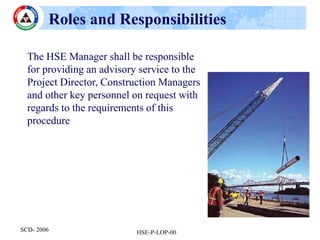
The HSE Manager shall be responsible
for providing an advisory service to the
Project Director, Construction Managers
and other key personnel on request with
regards to the requirements of this
procedure
SCD- 2006 HSE-P-LOP-00
Roles and Responsibilities (Cont.)
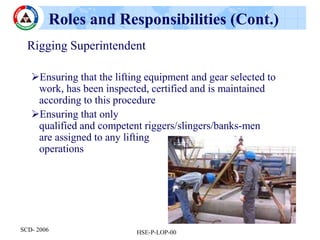
Rigging Superintendent
Ensuring that the lifting equipment and gear selected to
work, has been inspected, certified and is maintained
according to this procedure
Ensuring that only
qualified and competent riggers/slingers/banks-men
are assigned to any lifting
operations
SCD- 2006 HSE-P-LOP-00
Roles and Responsibilities (Cont.)
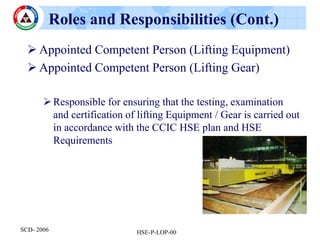
 Appointed Competent Person (Lifting Equipment)
 Appointed Competent Person (Lifting Gear)
Responsible for ensuring that the testing, examination
and certification of lifting Equipment / Gear is carried out
in accordance with the CCIC HSE plan and HSE
Requirements
SCD- 2006 HSE-P-LOP-00
Roles and Responsibilities (Cont.)
Line Supervisors
Ensuring the adequate supervision of personnel, carrying
out, or involved in, lifting operations
Ensuring that work method statements, task risk
assessments, Lifting Plan /Rigging Study have been carried
out
Ensuring that areas around the lifts are suitably barricaded
and warning signs posted
Ensuring that the Load weight, shape and radius of lift are
suitable for selected lifting equipment and gear
SCD- 2006 HSE-P-LOP-00
Roles and Responsibilities (Cont.)
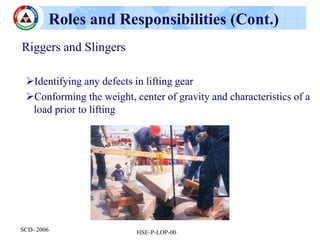
Riggers and Slingers
Identifying any defects in lifting gear
Conforming the weight, center of gravity and characteristics of a
load prior to lifting
SCD- 2006 HSE-P-LOP-00
Roles and Responsibilities (Cont.)
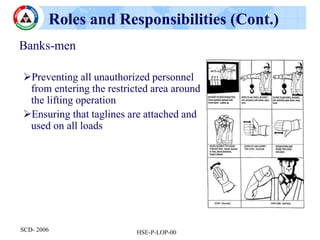
Banks-men
Preventing all unauthorized personnel
from entering the restricted area around
the lifting operation
Ensuring that taglines are attached and
used on all loads
SCD- 2006 HSE-P-LOP-00
Lifting Operations Procedure
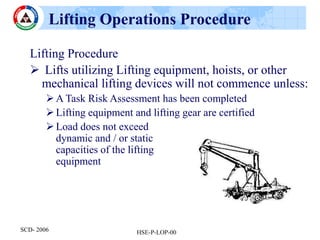
Lifting Procedure
 Lifts utilizing Lifting equipment, hoists, or other
mechanical lifting devices will not commence unless:
A Task Risk Assessment has been completed
Lifting equipment and lifting gear are certified
Load does not exceed
dynamic and / or static
capacities of the lifting
equipment
SCD- 2006 HSE-P-LOP-00
Lifting Operations Procedure (Cont.)
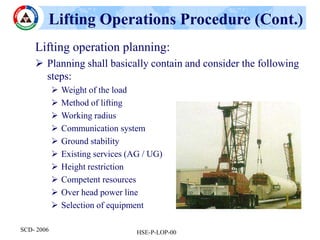
Lifting operation planning:
 Planning shall basically contain and consider the following
steps:
 Weight of the load
 Method of lifting
 Working radius
 Communication system
 Ground stability
 Existing services (AG / UG)
 Height restriction
 Competent resources
 Over head power line
 Selection of equipment
SCD- 2006 HSE-P-LOP-00
Lifting Operations Procedure (Cont.)
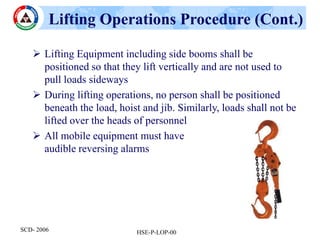
 Lifting Equipment including side booms shall be
positioned so that they lift vertically and are not used to
pull loads sideways
 During lifting operations, no person shall be positioned
beneath the load, hoist and jib. Similarly, loads shall not be
lifted over the heads of personnel
 All mobile equipment must have
audible reversing alarms
SCD- 2006 HSE-P-LOP-00
Lifting Operations Procedure (Cont.)
 Ground stability
When planning a lift, consideration must be given to
the ground conditions.
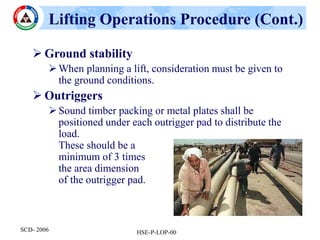
 Outriggers
Sound timber packing or metal plates shall be
positioned under each outrigger pad to distribute the
load.
These should be a
minimum of 3 times
the area dimension
of the outrigger pad.
SCD- 2006 HSE-P-LOP-00
Lifting Operations Procedure (Cont.)
Outriggers must be fully extended on both sides when
performing a lifting operation.
Outrigger pads are not to be permanently attached to
outriggers
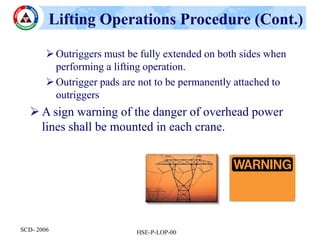
 A sign warning of the danger of overhead power
lines shall be mounted in each crane.
SCD- 2006 HSE-P-LOP-00
Lifting Operations Procedure (Cont.)
Lifting Equipment
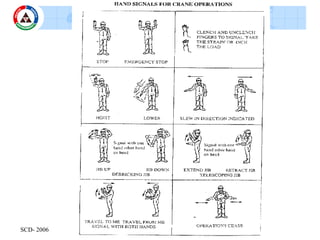
The lifting equipment operator shall not begin the machine
movement, until the banks-man is within his range of vision,
or in radio contact, and the signal is given and understood.
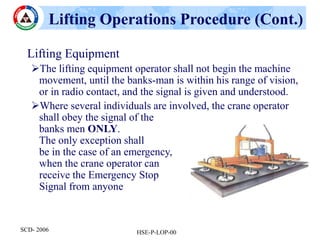
Where several individuals are involved, the crane operator
shall obey the signal of the
banks men ONLY.
The only exception shall
be in the case of an emergency,
when the crane operator can
receive the Emergency Stop
Signal from anyone
SCD- 2006 HSE-P-LOP-00
Lifting Operations Procedure (Cont.)
Precautions
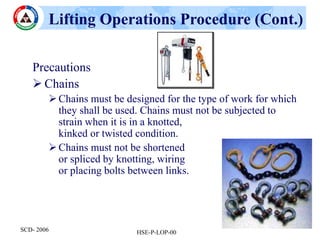
 Chains
Chains must be designed for the type of work for which
they shall be used. Chains must not be subjected to
strain when it is in a knotted,
kinked or twisted condition.
Chains must not be shortened
or spliced by knotting, wiring
or placing bolts between links.
SCD- 2006 HSE-P-LOP-00
Lifting Operations Procedure (Cont.)
Slings and Shackles
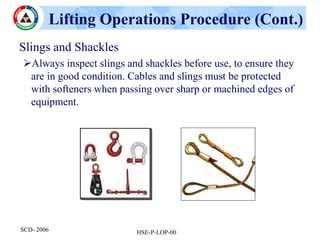
Always inspect slings and shackles before use, to ensure they
are in good condition. Cables and slings must be protected
with softeners when passing over sharp or machined edges of
equipment.
SCD- 2006 HSE-P-LOP-00
Lifting Operations Procedure (Cont.)
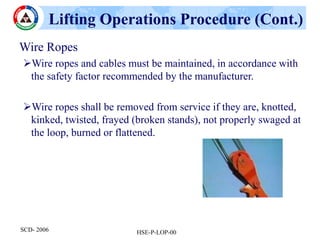
Wire Ropes
Wire ropes and cables must be maintained, in accordance with
the safety factor recommended by the manufacturer.
Wire ropes shall be removed from service if they are, knotted,
kinked, twisted, frayed (broken stands), not properly swaged at
the loop, burned or flattened.
SCD- 2006 HSE-P-LOP-00
Lifting Operations Procedure (Cont.)
Restrictions to crane operations
The most common restriction to lifting operations is bad
weather, specifically high wind.
However, No lifts will be permitted at wind speeds
exceeding 30 Knots or 35 Miles per hour.
When working in close proximity to overhead electric lines
or cables, the crane shall not be positioned closer to the
plumb of the nearest line or cable than a distance equal to the
length of the crane Jib fitted, plus 6 meters measured along
the ground.
SCD- 2006 HSE-P-LOP-00
Lifting Operations Procedure (Cont.)
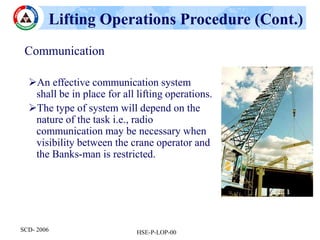
Communication
An effective communication system
shall be in place for all lifting operations.
The type of system will depend on the
nature of the task i.e., radio
communication may be necessary when
visibility between the crane operator and
the Banks-man is restricted.
SCD- 2006 HSE-P-LOP-00
Lifting Operations Procedure (Cont.)
Color Code System
The Color Code System shall be developed and implemented for all Lifting
Gear used within the Project such as for slings, shackles, rope wire, belts.
The color shall indicate to the user and the inspector, that an examination
has been performed within the prescribed period.
A new color shall be introduced on regular basis as per the Project Color
Coding System and each color shall be current for a specified period
Information boards showing the current
color coding shall be posted at prominent
locations at each work site where it is
anticipated lifting operations will take
place.
SCD- 2006 HSE-P-LOP-00
Lifting Operations Procedure (Cont.)
Lifting Operations Check List
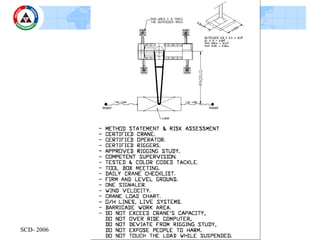
A Risk assessment shall be conducted prior to any lift being
performed.
The lifting operations check list acts as a reminder and
guidelines to the personnel concerned, and basically consists
of the items shown below and listed in the Lifting Operations
Procedure.
SCD- 2006 HSE-P-LOP-00

Lifting Operation.ppt

  • 1.
  • 2.
    SCD- 2006 HSE-P-LOP-00 Objectives Uponcompletion of the lesson, participants will be able to:  List the four major causes of crane accidents.  Describe the pre-planning that is required before putting a crane in use.  State the two main precautions that apply to working with cranes near power lines.  Explain at least three ways to eliminate hazards that may lead to injury when using forklifts, cranes or slings to handle materials.  Describe at least three actions that can reduce or eliminate hazards when storing, using or disposing of materials.
  • 3.
    SCD- 2006 HSE-P-LOP-00 Rolesand Responsibilities The HSE Manager shall be responsible for providing an advisory service to the Project Director, Construction Managers and other key personnel on request with regards to the requirements of this procedure
  • 4.
    SCD- 2006 HSE-P-LOP-00 Rolesand Responsibilities (Cont.) Rigging Superintendent Ensuring that the lifting equipment and gear selected to work, has been inspected, certified and is maintained according to this procedure Ensuring that only qualified and competent riggers/slingers/banks-men are assigned to any lifting operations
  • 5.
    SCD- 2006 HSE-P-LOP-00 Rolesand Responsibilities (Cont.)  Appointed Competent Person (Lifting Equipment)  Appointed Competent Person (Lifting Gear) Responsible for ensuring that the testing, examination and certification of lifting Equipment / Gear is carried out in accordance with the CCIC HSE plan and HSE Requirements
  • 6.
    SCD- 2006 HSE-P-LOP-00 Rolesand Responsibilities (Cont.) Line Supervisors Ensuring the adequate supervision of personnel, carrying out, or involved in, lifting operations Ensuring that work method statements, task risk assessments, Lifting Plan /Rigging Study have been carried out Ensuring that areas around the lifts are suitably barricaded and warning signs posted Ensuring that the Load weight, shape and radius of lift are suitable for selected lifting equipment and gear
  • 7.
    SCD- 2006 HSE-P-LOP-00 Rolesand Responsibilities (Cont.) Riggers and Slingers Identifying any defects in lifting gear Conforming the weight, center of gravity and characteristics of a load prior to lifting
  • 8.
    SCD- 2006 HSE-P-LOP-00 Rolesand Responsibilities (Cont.) Banks-men Preventing all unauthorized personnel from entering the restricted area around the lifting operation Ensuring that taglines are attached and used on all loads
  • 9.
    SCD- 2006 HSE-P-LOP-00 LiftingOperations Procedure Lifting Procedure  Lifts utilizing Lifting equipment, hoists, or other mechanical lifting devices will not commence unless: A Task Risk Assessment has been completed Lifting equipment and lifting gear are certified Load does not exceed dynamic and / or static capacities of the lifting equipment
  • 10.
    SCD- 2006 HSE-P-LOP-00 LiftingOperations Procedure (Cont.) Lifting operation planning:  Planning shall basically contain and consider the following steps:  Weight of the load  Method of lifting  Working radius  Communication system  Ground stability  Existing services (AG / UG)  Height restriction  Competent resources  Over head power line  Selection of equipment
  • 11.
    SCD- 2006 HSE-P-LOP-00 LiftingOperations Procedure (Cont.)  Lifting Equipment including side booms shall be positioned so that they lift vertically and are not used to pull loads sideways  During lifting operations, no person shall be positioned beneath the load, hoist and jib. Similarly, loads shall not be lifted over the heads of personnel  All mobile equipment must have audible reversing alarms
  • 12.
    SCD- 2006 HSE-P-LOP-00 LiftingOperations Procedure (Cont.)  Ground stability When planning a lift, consideration must be given to the ground conditions.  Outriggers Sound timber packing or metal plates shall be positioned under each outrigger pad to distribute the load. These should be a minimum of 3 times the area dimension of the outrigger pad.
  • 13.
    SCD- 2006 HSE-P-LOP-00 LiftingOperations Procedure (Cont.) Outriggers must be fully extended on both sides when performing a lifting operation. Outrigger pads are not to be permanently attached to outriggers  A sign warning of the danger of overhead power lines shall be mounted in each crane.
  • 14.
    SCD- 2006 HSE-P-LOP-00 LiftingOperations Procedure (Cont.) Lifting Equipment The lifting equipment operator shall not begin the machine movement, until the banks-man is within his range of vision, or in radio contact, and the signal is given and understood. Where several individuals are involved, the crane operator shall obey the signal of the banks men ONLY. The only exception shall be in the case of an emergency, when the crane operator can receive the Emergency Stop Signal from anyone
  • 15.
    SCD- 2006 HSE-P-LOP-00 LiftingOperations Procedure (Cont.) Precautions  Chains Chains must be designed for the type of work for which they shall be used. Chains must not be subjected to strain when it is in a knotted, kinked or twisted condition. Chains must not be shortened or spliced by knotting, wiring or placing bolts between links.
  • 16.
    SCD- 2006 HSE-P-LOP-00 LiftingOperations Procedure (Cont.) Slings and Shackles Always inspect slings and shackles before use, to ensure they are in good condition. Cables and slings must be protected with softeners when passing over sharp or machined edges of equipment.
  • 17.
    SCD- 2006 HSE-P-LOP-00 LiftingOperations Procedure (Cont.) Wire Ropes Wire ropes and cables must be maintained, in accordance with the safety factor recommended by the manufacturer. Wire ropes shall be removed from service if they are, knotted, kinked, twisted, frayed (broken stands), not properly swaged at the loop, burned or flattened.
  • 18.
    SCD- 2006 HSE-P-LOP-00 LiftingOperations Procedure (Cont.) Restrictions to crane operations The most common restriction to lifting operations is bad weather, specifically high wind. However, No lifts will be permitted at wind speeds exceeding 30 Knots or 35 Miles per hour. When working in close proximity to overhead electric lines or cables, the crane shall not be positioned closer to the plumb of the nearest line or cable than a distance equal to the length of the crane Jib fitted, plus 6 meters measured along the ground.
  • 19.
    SCD- 2006 HSE-P-LOP-00 LiftingOperations Procedure (Cont.) Communication An effective communication system shall be in place for all lifting operations. The type of system will depend on the nature of the task i.e., radio communication may be necessary when visibility between the crane operator and the Banks-man is restricted.
  • 20.
    SCD- 2006 HSE-P-LOP-00 LiftingOperations Procedure (Cont.) Color Code System The Color Code System shall be developed and implemented for all Lifting Gear used within the Project such as for slings, shackles, rope wire, belts. The color shall indicate to the user and the inspector, that an examination has been performed within the prescribed period. A new color shall be introduced on regular basis as per the Project Color Coding System and each color shall be current for a specified period Information boards showing the current color coding shall be posted at prominent locations at each work site where it is anticipated lifting operations will take place.
  • 21.
    SCD- 2006 HSE-P-LOP-00 LiftingOperations Procedure (Cont.) Lifting Operations Check List A Risk assessment shall be conducted prior to any lift being performed. The lifting operations check list acts as a reminder and guidelines to the personnel concerned, and basically consists of the items shown below and listed in the Lifting Operations Procedure.
  • 22.
  • 23.