COLOUR SCHEMES
Session 1
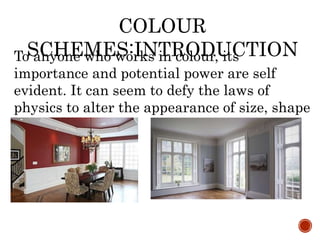
To anyone who works in colour, its
importance and potential power are self
evident. It can seem to defy the laws of
physics to alter the appearance of size, shape
and form.
COLOUR
SCHEMES:INTRODUCTION
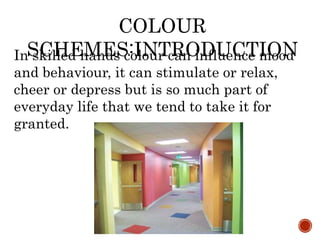
In skilled hands colour can influence mood
and behaviour, it can stimulate or relax,
cheer or depress but is so much part of
everyday life that we tend to take it for
granted.
COLOUR
SCHEMES:INTRODUCTION
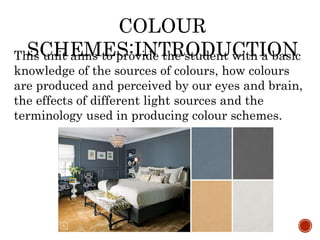
This unit aims to provide the student with a basic
knowledge of the sources of colours, how colours
are produced and perceived by our eyes and brain,
the effects of different light sources and the
terminology used in producing colour schemes.
COLOUR
SCHEMES:INTRODUCTION
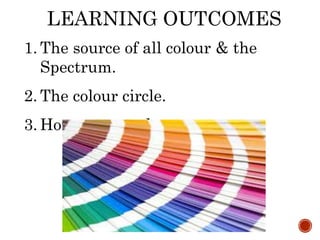
LEARNING OUTCOMES
1. The source of all colour & the
Spectrum.
2. The colour circle.
3. How we see colour.
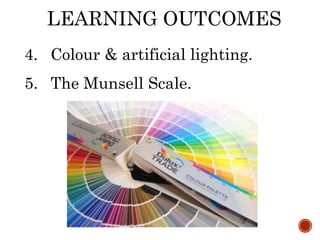
LEARNING OUTCOMES
4. Colour & artificial lighting.
5. The Munsell Scale.
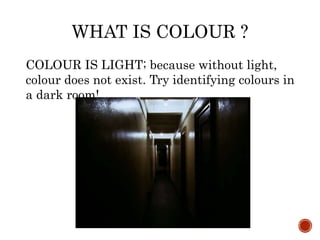
WHAT IS COLOUR ?
COLOUR IS LIGHT; because without light,
colour does not exist. Try identifying colours in
a dark room!
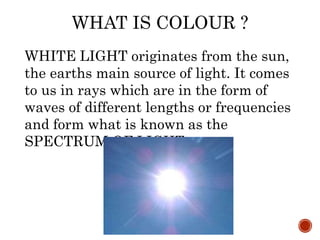
WHAT IS COLOUR ?
WHITE LIGHT originates from the sun,
the earths main source of light. It comes
to us in rays which are in the form of
waves of different lengths or frequencies
and form what is known as the
SPECTRUM OF LIGHT.
THE SPECTRUM
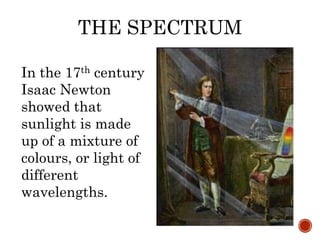
In the 17th century
Isaac Newton
showed that
sunlight is made
up of a mixture of
colours, or light of
different
wavelengths.
THE SPECTRUM
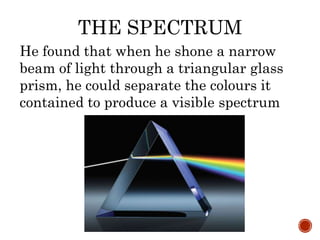
He found that when he shone a narrow
beam of light through a triangular glass
prism, he could separate the colours it
contained to produce a visible spectrum
THE SPECTRUM
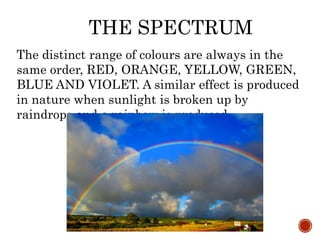
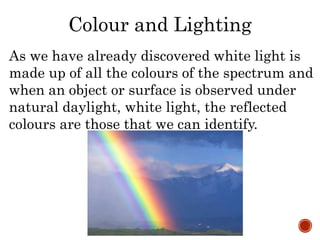
The distinct range of colours are always in the
same order, RED, ORANGE, YELLOW, GREEN,
BLUE AND VIOLET. A similar effect is produced
in nature when sunlight is broken up by
raindrops and a rainbow is produced
THE COLOUR CIRCLE
THE COLOUR CIRCLE
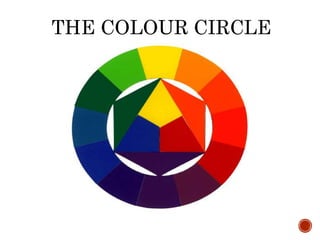
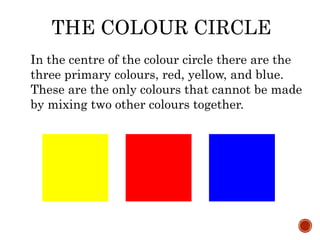
In the centre of the colour circle there are the
three primary colours, red, yellow, and blue.
These are the only colours that cannot be made
by mixing two other colours together.
THE COLOUR CIRCLE
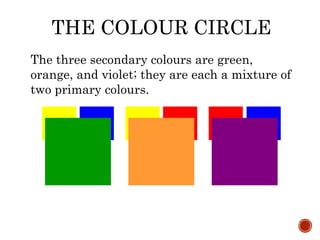
The three secondary colours are green,
orange, and violet; they are each a mixture of
two primary colours.
THE COLOUR CIRCLE
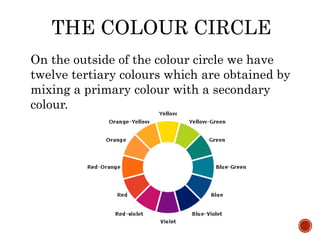
On the outside of the colour circle we have
twelve tertiary colours which are obtained by
mixing a primary colour with a secondary
colour.
Name the spectrum of light that comes from the sun, which
is known as ‘daylight’:
a) white light
b) dark light
c) ultraviolet rays
d) sunlight
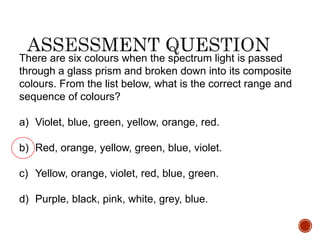
There are six colours when the spectrum light is passed
through a glass prism and broken down into its composite
colours. From the list below, what is the correct range and
sequence of colours?
a) Violet, blue, green, yellow, orange, red.
b) Red, orange, yellow, green, blue, violet.
c) Yellow, orange, violet, red, blue, green.
d) Purple, black, pink, white, grey, blue.
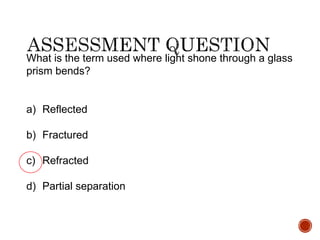
What is the term used where light shone through a glass
prism bends?
a) Reflected
b) Fractured
c) Refracted
d) Partial separation
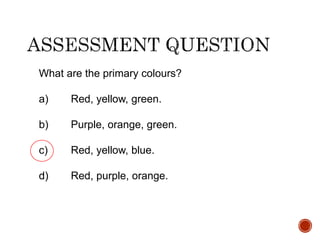
What are the primary colours?
a) Red, yellow, green.
b) Purple, orange, green.
c) Red, yellow, blue.
d) Red, purple, orange.
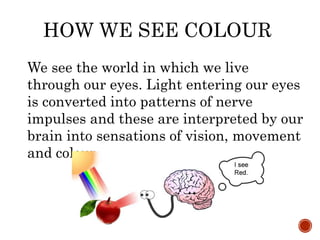
HOW WE SEE COLOUR
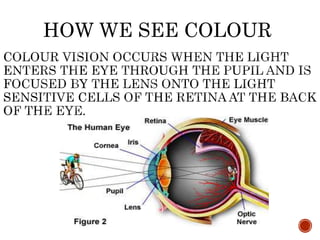
We see the world in which we live
through our eyes. Light entering our eyes
is converted into patterns of nerve
impulses and these are interpreted by our
brain into sensations of vision, movement
and colour.
HOW WE SEE COLOUR
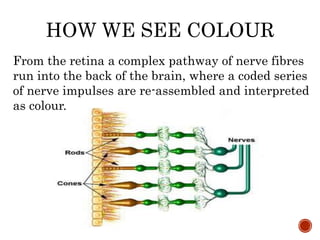
From the retina a complex pathway of nerve fibres
run into the back of the brain, where a coded series
of nerve impulses are re-assembled and interpreted
as colour.
HOW WE SEE COLOUR
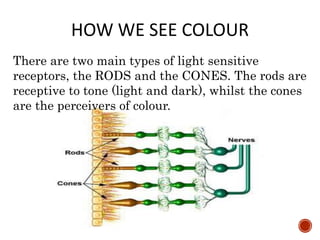
There are two main types of light sensitive
receptors, the RODS and the CONES. The rods are
receptive to tone (light and dark), whilst the cones
are the perceivers of colour.
HOW WE SEE COLOUR
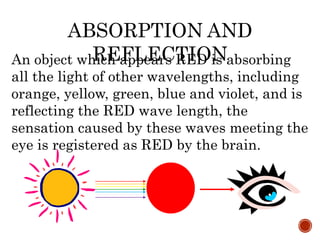
ABSORPTION AND
REFLECTIONAn object which appears RED is absorbing
all the light of other wavelengths, including
orange, yellow, green, blue and violet, and is
reflecting the RED wave length, the
sensation caused by these waves meeting the
eye is registered as RED by the brain.
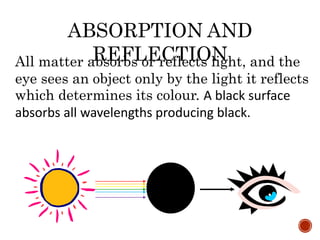
All matter absorbs or reflects light, and the
eye sees an object only by the light it reflects
which determines its colour. A black surface
absorbs all wavelengths producing black.
ABSORPTION AND
REFLECTION
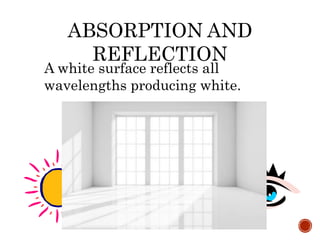
A white surface reflects all
wavelengths producing white.
ABSORPTION AND
REFLECTION
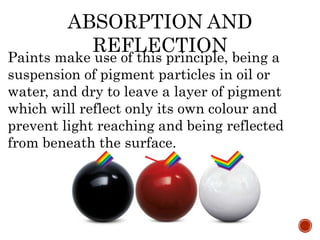
Paints make use of this principle, being a
suspension of pigment particles in oil or
water, and dry to leave a layer of pigment
which will reflect only its own colour and
prevent light reaching and being reflected
from beneath the surface.
ABSORPTION AND
REFLECTION
Why does a white painted surface appear white when
looked at in daylight?
a) white surface absorbs all waves of light.
b) white surface only partially absorbs all waves of light.
c) white painted surface will always appear white
regardless of day or night.
d) A white surface reflects all waves of light.
Why does a black painted surface appear black when
looked at in daylight?
a) A black surface absorbs all waves of light and reflects
none.
b) A black painted surface partially absorbs all waves of
light.
c) A black painted surface will always appear black
regardless of day or night.
d) A black painted surface absorbs no waves of light.
Colour and Lighting
As we have already discovered white light is
made up of all the colours of the spectrum and
when an object or surface is observed under
natural daylight, white light, the reflected
colours are those that we can identify.
Colour and Lighting
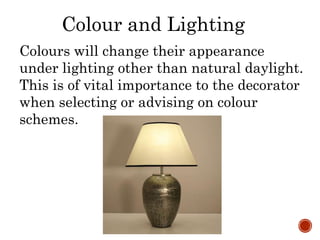
Colours will change their appearance
under lighting other than natural daylight.
This is of vital importance to the decorator
when selecting or advising on colour
schemes.
Colour and Lighting
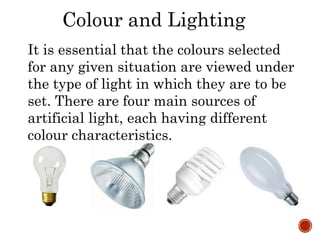
It is essential that the colours selected
for any given situation are viewed under
the type of light in which they are to be
set. There are four main sources of
artificial light, each having different
colour characteristics.
Incandescent (or Tungsten) Lighting
This is the most common type of domestic lighting,
emitted from a bulb containing a tungsten metal
wire which becomes white hot when heated.
Incandescent (or Tungsten) Lighting
It provides a full spectrum but the red/yellow
waves are much stronger than the blue/ violet
waves. Under tungsten light, yellows and reds
appear bright, but blues and violets look dull.
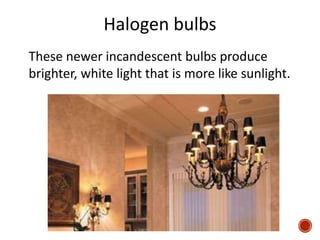
Halogen bulbs
These newer incandescent bulbs produce
brighter, white light that is more like sunlight.
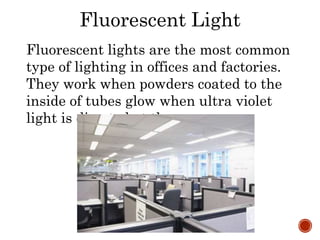
Fluorescent Light
Fluorescent lights are the most common
type of lighting in offices and factories.
They work when powders coated to the
inside of tubes glow when ultra violet
light is directed at them.
Fluorescent Light
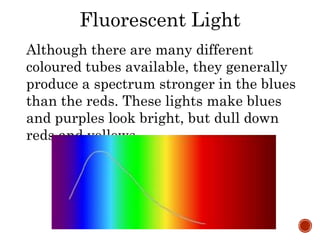
Although there are many different
coloured tubes available, they generally
produce a spectrum stronger in the blues
than the reds. These lights make blues
and purples look bright, but dull down
reds and yellows.
Sodium discharge Lighting
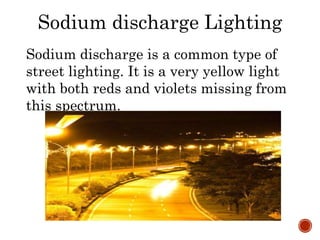
Sodium discharge is a common type of
street lighting. It is a very yellow light
with both reds and violets missing from
this spectrum.
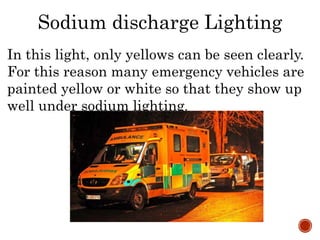
In this light, only yellows can be seen clearly.
For this reason many emergency vehicles are
painted yellow or white so that they show up
well under sodium lighting.
Sodium discharge Lighting
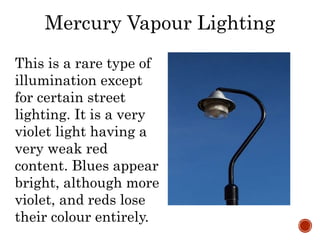
Mercury Vapour Lighting
This is a rare type of
illumination except
for certain street
lighting. It is a very
violet light having a
very weak red
content. Blues appear
bright, although more
violet, and reds lose
their colour entirely.
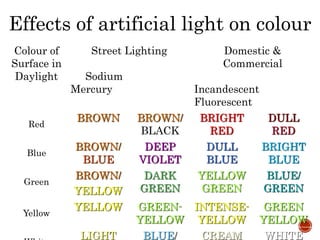
Effects of artificial light on colour
Colour of
Surface in
Daylight
Street Lighting
Sodium
Mercury
Domestic &
Commercial
Incandescent
Fluorescent
Red
BROWN BROWN/
BLACK
BRIGHT
RED
DULL
RED
Blue
BROWN/
BLUE
DEEP
VIOLET
DULL
BLUE
BRIGHT
BLUE
Green
BROWN/
YELLOW
DARK
GREEN
YELLOW
GREEN
BLUE/
GREEN
Yellow
YELLOW GREEN-
YELLOW
INTENSE-
YELLOW
GREEN
YELLOW
LIGHT BLUE/ CREAM WHITE
METAMERIC COLOUR EFFECT
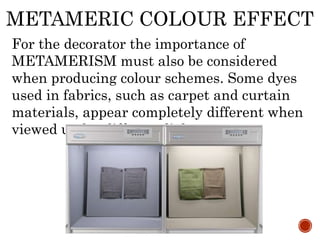
For the decorator the importance of
METAMERISM must also be considered
when producing colour schemes. Some dyes
used in fabrics, such as carpet and curtain
materials, appear completely different when
viewed under different light sources.
METAMERIC COLOUR
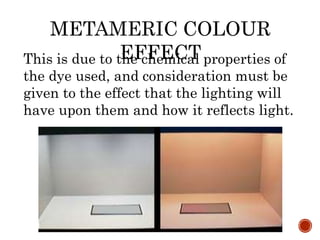
EFFECTThis is due to the chemical properties of
the dye used, and consideration must be
given to the effect that the lighting will
have upon them and how it reflects light.
METAMERIC COLOUR
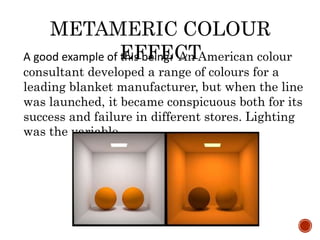
EFFECTA good example of this being: An American colour
consultant developed a range of colours for a
leading blanket manufacturer, but when the line
was launched, it became conspicuous both for its
success and failure in different stores. Lighting
was the variable.
METAMERIC COLOUR
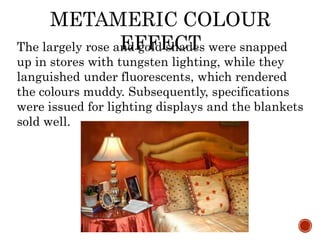
EFFECTThe largely rose and gold shades were snapped
up in stores with tungsten lighting, while they
languished under fluorescents, which rendered
the colours muddy. Subsequently, specifications
were issued for lighting displays and the blankets
sold well.
MUNSELL SCALE
This is an international systems which
permits an accurate verbal description of
colour. The method can be used:
a) to describe a colour without using colour
names:
‘light orange or ‘off-white’ may suggest
different colours to different people, whereas a
Munsell notation defines one exact colour.
MUNSELL SCALE
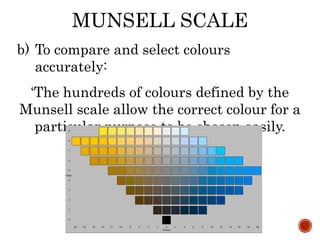
b) To compare and select colours
accurately:
‘The hundreds of colours defined by the
Munsell scale allow the correct colour for a
particular purpose to be chosen easily.
MUNSELL SCALE
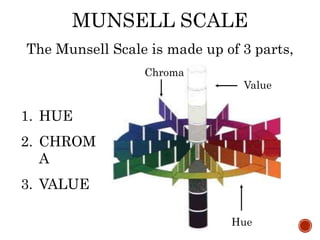
The Munsell Scale is made up of 3 parts,
1. HUE
2. CHROM
A
3. VALUE
Value
Hue
Chroma
YELLOW (Y) PURPLE-
BLUE (PB)
YELLOW-RED (YR) BLUE (B)
RED (R) BLUE-GREEN
(BG)
RED-PURPLE (RP) GREEN (G)
PURPLE (P) GREEN-
MUNSELL SCALE: HUE
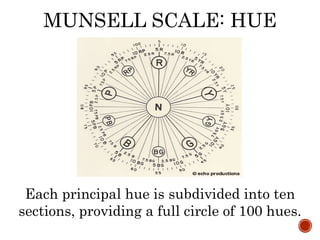
Hue denotes the basic colour,
distinguishing yellow from red, blue from
green, etc. Munsell uses ten principal
hues:
Each principal hue is subdivided into ten
sections, providing a full circle of 100 hues.
MUNSELL SCALE: HUE
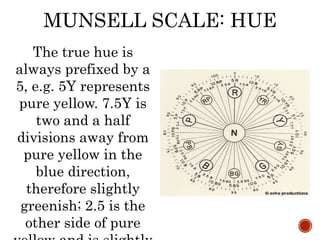
The true hue is
always prefixed by a
5, e.g. 5Y represents
pure yellow. 7.5Y is
two and a half
divisions away from
pure yellow in the
blue direction,
therefore slightly
greenish; 2.5 is the
other side of pure
MUNSELL SCALE: HUE
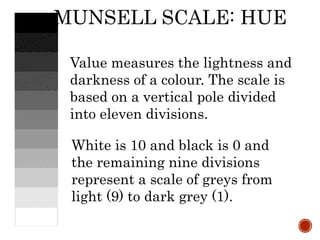
Value measures the lightness and
darkness of a colour. The scale is
based on a vertical pole divided
into eleven divisions.
White is 10 and black is 0 and
the remaining nine divisions
represent a scale of greys from
light (9) to dark grey (1).
MUNSELL SCALE: HUE
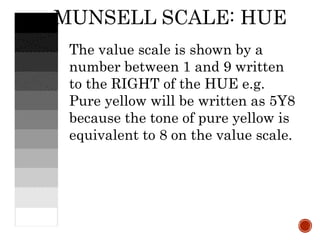
The value scale is shown by a
number between 1 and 9 written
to the RIGHT of the HUE e.g.
Pure yellow will be written as 5Y8
because the tone of pure yellow is
equivalent to 8 on the value scale.
MUNSELL SCALE: HUE
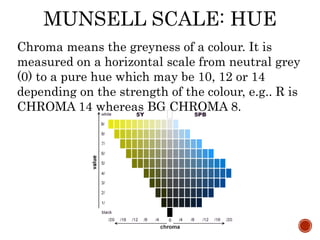
Chroma means the greyness of a colour. It is
measured on a horizontal scale from neutral grey
(0) to a pure hue which may be 10, 12 or 14
depending on the strength of the colour, e.g.. R is
CHROMA 14 whereas BG CHROMA 8.
MUNSELL SCALE: HUE
MUNSELL SCALE: HUE
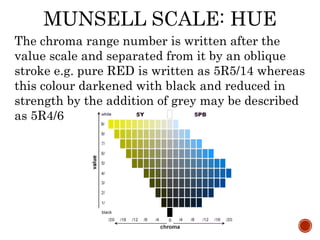
The chroma range number is written after the
value scale and separated from it by an oblique
stroke e.g. pure RED is written as 5R5/14 whereas
this colour darkened with black and reduced in
strength by the addition of grey may be described
as 5R4/6
Name the international system which permits an accurate
verbal description of colour?
a) BS 4800: 1989 schedule of paint colours for building
purposes.
b) BS 5252: 1976 framework for colour co-ordination for
building purposes.
c) The numeric colour scale.
d) The Munsell scale.
In relation to colour terminology, define the term ‘hue’:
a) measures the lightness and darkness of a colour; the
scale is based on a vertical pole divided into 11 divisions
b) measures the greyness of a colour; it is measured on a
horizontal scale from neutral grey to the pure hue
c) denotes the basic colour, distinguishing yellow from red,
blue from green, etc
d) measures the lightness, darkness and greyness of a
colour
In relation to colour terminology, define the term ‘value’:
a) measures the lightness and darkness of a colour; the
scale is based on a vertical pole divided into 11 divisions
b) measures the greyness of a colour; it is measured on a
horizontal scale from neutral grey to the pure hue
c) denotes the basic colour, distinguishing yellow from red,
blue from green, etc.
d) measures the lightness, darkness and greyness of a
colour
In relation to colour terminology, define the term chroma:
a) measures the lightness and darkness of a colour; the
scale is based on a vertical pole divided into 11 divisions
b) measures the greyness of a colour, it is measured on a
horizontal scale from neutral grey to the pure hue
c) denotes the basic colour, distinguishing yellow from red,
blue from green, etc.
d) measures the lightness, darkness and greyness of a
colour
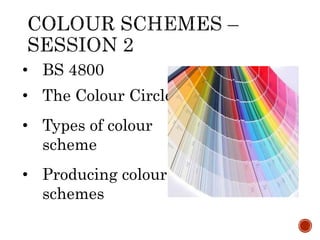
• BS 4800
• The Colour Circle
• Types of colour
scheme
• Producing colour
schemes

Colour schemes lesson 1

  • 1.
  • 2.
    To anyone whoworks in colour, its importance and potential power are self evident. It can seem to defy the laws of physics to alter the appearance of size, shape and form. COLOUR SCHEMES:INTRODUCTION
  • 3.
    In skilled handscolour can influence mood and behaviour, it can stimulate or relax, cheer or depress but is so much part of everyday life that we tend to take it for granted. COLOUR SCHEMES:INTRODUCTION
  • 4.
    This unit aimsto provide the student with a basic knowledge of the sources of colours, how colours are produced and perceived by our eyes and brain, the effects of different light sources and the terminology used in producing colour schemes. COLOUR SCHEMES:INTRODUCTION
  • 5.
    LEARNING OUTCOMES 1. Thesource of all colour & the Spectrum. 2. The colour circle. 3. How we see colour.
  • 6.
    LEARNING OUTCOMES 4. Colour& artificial lighting. 5. The Munsell Scale.
  • 7.
    WHAT IS COLOUR? COLOUR IS LIGHT; because without light, colour does not exist. Try identifying colours in a dark room!
  • 8.
    WHAT IS COLOUR? WHITE LIGHT originates from the sun, the earths main source of light. It comes to us in rays which are in the form of waves of different lengths or frequencies and form what is known as the SPECTRUM OF LIGHT.
  • 9.
    THE SPECTRUM In the17th century Isaac Newton showed that sunlight is made up of a mixture of colours, or light of different wavelengths.
  • 10.
    THE SPECTRUM He foundthat when he shone a narrow beam of light through a triangular glass prism, he could separate the colours it contained to produce a visible spectrum
  • 11.
    THE SPECTRUM The distinctrange of colours are always in the same order, RED, ORANGE, YELLOW, GREEN, BLUE AND VIOLET. A similar effect is produced in nature when sunlight is broken up by raindrops and a rainbow is produced
  • 12.
  • 13.
    THE COLOUR CIRCLE Inthe centre of the colour circle there are the three primary colours, red, yellow, and blue. These are the only colours that cannot be made by mixing two other colours together.
  • 14.
    THE COLOUR CIRCLE Thethree secondary colours are green, orange, and violet; they are each a mixture of two primary colours.
  • 15.
    THE COLOUR CIRCLE Onthe outside of the colour circle we have twelve tertiary colours which are obtained by mixing a primary colour with a secondary colour.
  • 16.
    Name the spectrumof light that comes from the sun, which is known as ‘daylight’: a) white light b) dark light c) ultraviolet rays d) sunlight
  • 17.
    There are sixcolours when the spectrum light is passed through a glass prism and broken down into its composite colours. From the list below, what is the correct range and sequence of colours? a) Violet, blue, green, yellow, orange, red. b) Red, orange, yellow, green, blue, violet. c) Yellow, orange, violet, red, blue, green. d) Purple, black, pink, white, grey, blue.
  • 18.
    What is theterm used where light shone through a glass prism bends? a) Reflected b) Fractured c) Refracted d) Partial separation
  • 19.
    What are theprimary colours? a) Red, yellow, green. b) Purple, orange, green. c) Red, yellow, blue. d) Red, purple, orange.
  • 20.
    HOW WE SEECOLOUR We see the world in which we live through our eyes. Light entering our eyes is converted into patterns of nerve impulses and these are interpreted by our brain into sensations of vision, movement and colour.
  • 21.
    HOW WE SEECOLOUR
  • 22.
    From the retinaa complex pathway of nerve fibres run into the back of the brain, where a coded series of nerve impulses are re-assembled and interpreted as colour. HOW WE SEE COLOUR
  • 23.
    There are twomain types of light sensitive receptors, the RODS and the CONES. The rods are receptive to tone (light and dark), whilst the cones are the perceivers of colour. HOW WE SEE COLOUR
  • 24.
    ABSORPTION AND REFLECTIONAn objectwhich appears RED is absorbing all the light of other wavelengths, including orange, yellow, green, blue and violet, and is reflecting the RED wave length, the sensation caused by these waves meeting the eye is registered as RED by the brain.
  • 25.
    All matter absorbsor reflects light, and the eye sees an object only by the light it reflects which determines its colour. A black surface absorbs all wavelengths producing black. ABSORPTION AND REFLECTION
  • 26.
    A white surfacereflects all wavelengths producing white. ABSORPTION AND REFLECTION
  • 27.
    Paints make useof this principle, being a suspension of pigment particles in oil or water, and dry to leave a layer of pigment which will reflect only its own colour and prevent light reaching and being reflected from beneath the surface. ABSORPTION AND REFLECTION
  • 28.
    Why does awhite painted surface appear white when looked at in daylight? a) white surface absorbs all waves of light. b) white surface only partially absorbs all waves of light. c) white painted surface will always appear white regardless of day or night. d) A white surface reflects all waves of light.
  • 29.
    Why does ablack painted surface appear black when looked at in daylight? a) A black surface absorbs all waves of light and reflects none. b) A black painted surface partially absorbs all waves of light. c) A black painted surface will always appear black regardless of day or night. d) A black painted surface absorbs no waves of light.
  • 30.
    Colour and Lighting Aswe have already discovered white light is made up of all the colours of the spectrum and when an object or surface is observed under natural daylight, white light, the reflected colours are those that we can identify.
  • 31.
    Colour and Lighting Colourswill change their appearance under lighting other than natural daylight. This is of vital importance to the decorator when selecting or advising on colour schemes.
  • 32.
    Colour and Lighting Itis essential that the colours selected for any given situation are viewed under the type of light in which they are to be set. There are four main sources of artificial light, each having different colour characteristics.
  • 33.
    Incandescent (or Tungsten)Lighting This is the most common type of domestic lighting, emitted from a bulb containing a tungsten metal wire which becomes white hot when heated.
  • 34.
    Incandescent (or Tungsten)Lighting It provides a full spectrum but the red/yellow waves are much stronger than the blue/ violet waves. Under tungsten light, yellows and reds appear bright, but blues and violets look dull.
  • 35.
    Halogen bulbs These newerincandescent bulbs produce brighter, white light that is more like sunlight.
  • 36.
    Fluorescent Light Fluorescent lightsare the most common type of lighting in offices and factories. They work when powders coated to the inside of tubes glow when ultra violet light is directed at them.
  • 37.
    Fluorescent Light Although thereare many different coloured tubes available, they generally produce a spectrum stronger in the blues than the reds. These lights make blues and purples look bright, but dull down reds and yellows.
  • 38.
    Sodium discharge Lighting Sodiumdischarge is a common type of street lighting. It is a very yellow light with both reds and violets missing from this spectrum.
  • 39.
    In this light,only yellows can be seen clearly. For this reason many emergency vehicles are painted yellow or white so that they show up well under sodium lighting. Sodium discharge Lighting
  • 40.
    Mercury Vapour Lighting Thisis a rare type of illumination except for certain street lighting. It is a very violet light having a very weak red content. Blues appear bright, although more violet, and reds lose their colour entirely.
  • 41.
    Effects of artificiallight on colour Colour of Surface in Daylight Street Lighting Sodium Mercury Domestic & Commercial Incandescent Fluorescent Red BROWN BROWN/ BLACK BRIGHT RED DULL RED Blue BROWN/ BLUE DEEP VIOLET DULL BLUE BRIGHT BLUE Green BROWN/ YELLOW DARK GREEN YELLOW GREEN BLUE/ GREEN Yellow YELLOW GREEN- YELLOW INTENSE- YELLOW GREEN YELLOW LIGHT BLUE/ CREAM WHITE
  • 42.
    METAMERIC COLOUR EFFECT Forthe decorator the importance of METAMERISM must also be considered when producing colour schemes. Some dyes used in fabrics, such as carpet and curtain materials, appear completely different when viewed under different light sources.
  • 43.
    METAMERIC COLOUR EFFECTThis isdue to the chemical properties of the dye used, and consideration must be given to the effect that the lighting will have upon them and how it reflects light.
  • 44.
    METAMERIC COLOUR EFFECTA goodexample of this being: An American colour consultant developed a range of colours for a leading blanket manufacturer, but when the line was launched, it became conspicuous both for its success and failure in different stores. Lighting was the variable.
  • 45.
    METAMERIC COLOUR EFFECTThe largelyrose and gold shades were snapped up in stores with tungsten lighting, while they languished under fluorescents, which rendered the colours muddy. Subsequently, specifications were issued for lighting displays and the blankets sold well.
  • 46.
    MUNSELL SCALE This isan international systems which permits an accurate verbal description of colour. The method can be used: a) to describe a colour without using colour names: ‘light orange or ‘off-white’ may suggest different colours to different people, whereas a Munsell notation defines one exact colour.
  • 47.
    MUNSELL SCALE b) Tocompare and select colours accurately: ‘The hundreds of colours defined by the Munsell scale allow the correct colour for a particular purpose to be chosen easily.
  • 48.
    MUNSELL SCALE The MunsellScale is made up of 3 parts, 1. HUE 2. CHROM A 3. VALUE Value Hue Chroma
  • 49.
    YELLOW (Y) PURPLE- BLUE(PB) YELLOW-RED (YR) BLUE (B) RED (R) BLUE-GREEN (BG) RED-PURPLE (RP) GREEN (G) PURPLE (P) GREEN- MUNSELL SCALE: HUE Hue denotes the basic colour, distinguishing yellow from red, blue from green, etc. Munsell uses ten principal hues:
  • 50.
    Each principal hueis subdivided into ten sections, providing a full circle of 100 hues. MUNSELL SCALE: HUE
  • 51.
    The true hueis always prefixed by a 5, e.g. 5Y represents pure yellow. 7.5Y is two and a half divisions away from pure yellow in the blue direction, therefore slightly greenish; 2.5 is the other side of pure MUNSELL SCALE: HUE
  • 52.
    Value measures thelightness and darkness of a colour. The scale is based on a vertical pole divided into eleven divisions. White is 10 and black is 0 and the remaining nine divisions represent a scale of greys from light (9) to dark grey (1). MUNSELL SCALE: HUE
  • 53.
    The value scaleis shown by a number between 1 and 9 written to the RIGHT of the HUE e.g. Pure yellow will be written as 5Y8 because the tone of pure yellow is equivalent to 8 on the value scale. MUNSELL SCALE: HUE
  • 54.
    Chroma means thegreyness of a colour. It is measured on a horizontal scale from neutral grey (0) to a pure hue which may be 10, 12 or 14 depending on the strength of the colour, e.g.. R is CHROMA 14 whereas BG CHROMA 8. MUNSELL SCALE: HUE
  • 55.
    MUNSELL SCALE: HUE Thechroma range number is written after the value scale and separated from it by an oblique stroke e.g. pure RED is written as 5R5/14 whereas this colour darkened with black and reduced in strength by the addition of grey may be described as 5R4/6
  • 56.
    Name the internationalsystem which permits an accurate verbal description of colour? a) BS 4800: 1989 schedule of paint colours for building purposes. b) BS 5252: 1976 framework for colour co-ordination for building purposes. c) The numeric colour scale. d) The Munsell scale.
  • 57.
    In relation tocolour terminology, define the term ‘hue’: a) measures the lightness and darkness of a colour; the scale is based on a vertical pole divided into 11 divisions b) measures the greyness of a colour; it is measured on a horizontal scale from neutral grey to the pure hue c) denotes the basic colour, distinguishing yellow from red, blue from green, etc d) measures the lightness, darkness and greyness of a colour
  • 58.
    In relation tocolour terminology, define the term ‘value’: a) measures the lightness and darkness of a colour; the scale is based on a vertical pole divided into 11 divisions b) measures the greyness of a colour; it is measured on a horizontal scale from neutral grey to the pure hue c) denotes the basic colour, distinguishing yellow from red, blue from green, etc. d) measures the lightness, darkness and greyness of a colour
  • 59.
    In relation tocolour terminology, define the term chroma: a) measures the lightness and darkness of a colour; the scale is based on a vertical pole divided into 11 divisions b) measures the greyness of a colour, it is measured on a horizontal scale from neutral grey to the pure hue c) denotes the basic colour, distinguishing yellow from red, blue from green, etc. d) measures the lightness, darkness and greyness of a colour
  • 60.
    • BS 4800 •The Colour Circle • Types of colour scheme • Producing colour schemes