© City of Glasgow College
Charity Number SC0 36198
Paperhanging
Surface Preparation
• Manufacturers and suppliers of wall coverings often give
comprehensive instructions regarding surface preparation for
their products. These cover the various types of untreated
substrates that are usual in painting and buildings and various
paint systems that may be superimposed on them; and
treatment for surfaces in good and poor condition
Due regard should be shown to this information
Wall coverings are expensive and it is imperative that
the preparation is carried out as near to perfection as
circumstances permit
Lining Paper
• A most important aspect of preparation is the application of
lining paper prior to the wall covering.
• The Benefits are.
Evens out the porosity on surfaces of uneven porosity
Provides a surface controlled even porosity
Prevents springing of joints on non-porous surfaces
I.E. Eggshell and Gloss oil painted surfaces
Ensures drying out. Its controlled porosity takes
moisture from the pasted wall covering and prevents
it remaining wet which can result in delamination
and staining
Helps mask irregularities in the surface
Wallboards
• This type of surface should be stripped dry, unless prior knowledge as to
whether or not the surface had been sealed before being papered, if
sealed then it would be possible to remove the paper using water. Care
must be taken to ensure that the surface is not over soaked as this would
damage the surface
Removing the paper dry can be very difficult, only extreme care and
patience will ensure that the removal of the paper takes place
without damaging the surface. Dry abrading the surface after the
paper being removed ensures that the surface will be suitable for
further wall covering
It is essential that prior to any re-papering, sealing of the surface
should take place using an oily sealer. This will make the
subsequent stripping of the surface easier
Previously Painted surfaces
• Previously painted, non-porous surfaces require after removal
careful preparation by the abrading to roughen the surface in
order to provide extra adhesion for the wall paper paste
Filling Cracks
Cracks on the surface should be cut out, wetted and
filled with filler. It may be necessary to refill over the
cracks a second time to ensure cracks are filled flush
with the surface
Filling Holes
• Any deep holes must have all loose deposits removed before
“wetting”. Plaster filler should have sand added in order to
reduce shrinkage and cracking, after this filling has set it may
be necessary to go over the filled surface again with neat
plaster filler in order to ensure holes are filled flush with the
surface
Mould Growth
Any old paper which has been effected with mould
growth should be burnt in order to eradicate the
spread of mould. Surfaces should then be washed
with a mould inhibitor. It is necessary to ensure that
the cause of the mould growth has been rectified
before re-papering takes place
New Plaster
• If possible all furniture, fittings and carpets should be
removed before commencing the stripping of wall and ceiling
papers. Anything which cannot be removed. Particularly
carpets must be protected with polythene waterproof sheets
1st
Method
• Ceilings are normally stripped before walls
• Soak the paper with water as hot as can be tolerated
• Scratch the surface of washable papers with a nail block or
wire brush
• Re-soak the paper
• With the blade of the scraper held at a shallow angle to the
wall, carefully scrape away the saturated paper
• Remove all paper whilst wet
• Wash the stripped surface to remove paste
• Dry Off
• Clean away stripped paper
• Mop up water as required
Tools and Equipment
• Flexible scraper or stripping knife
• Steam stripping equipment
• Sponges and leathers
• Container for stripped paper
• Brush and shovel
• Mop and Bucket
• Nail Block or coarse wire brush
Materials
Liquid detergent or proprietary wetting agent
Method 2
• Place steaming concentrator pad of steam stripper
flat on the working surface
• After a few seconds, slide the pad to a dry area
• Scrape the area already steamed, as the next is being
soaked
Points to watch
• Stripping hangings from ceilings whilst using a steam stripper
can be dangerous because of hot dripping water
Make sure all paper is removed whilst wet. It is much
easier an cleaner than having to dry rub ‘NIBS’
afterward
Do not damage plaster by scraping to soon or by
stabbing at the surface
If Vymura or vinyl papers are to be stripped, the
surface must be peeled off first
If using a brush commence ‘soaking’ at the top of the
wall
• Do not let stripped paper dry, it is easier and cleaner to
remove whilst wet
Do not forget to clean away any bits of paper stuck to
window frames, doors etc
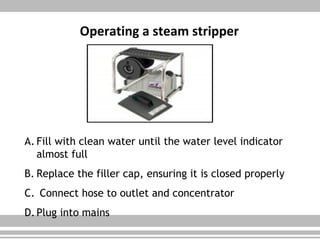
Operating a steam stripper
A. Fill with clean water until the water level indicator
almost full
B. Replace the filler cap, ensuring it is closed properly
C. Connect hose to outlet and concentrator
D.Plug into mains
• E. Wait until steam is produced; steam coming from the
concentrator pad indicates the equipment is ready for use.
• F. Concentrator is held against the wall or ceiling surface until
the paper is soft enough to remove readily with a scraper
• G. The concentrator should be held in the next position whilst
stripping off to soften the next section to be stripped and so
on until the surface area has been completely stripped
Pastes and Adhesives
• Cold Water paste, stir the powder slowly into cold water, it has a high
water content and can be used for light to medium weight papers
Standard Cellulose, stir the powder slowly into cold water and allow to
stand, it has a high water content and can be used for light to medium
weight papers
Heavy duty cellulose, stir the powder slowly into cold water and
allow to stand, it has a medium water content and can be used for paper
and cloth backed vinyl's and expanded polystyrene
Hot water Powder, Make powder into a batter with a little cold
water, quickly stir in boiling water allow to cool and then beat up, it has
a low water content and can be used for all papers except vinyl's
• Tub Paste, This paste is ready mixed but may require thinning slightly, it has a
low water content and is suitable for all types of paper except vinyl's
Glue size powder, Mix with a little cold water. Allow to soak for
about 15- 20 minutes, stir in boiling water and allow to cool. For coating
porous surfaces before paperhanging. The adhesive evens out porosity and
provides ‘slip’
Clearcole (claircolle), mix as for glue size and stir thoroughly, for
coating non-porous surfaces to aid in adhesion
PVA, This is a ready mixed paste with a medium to high water content
and is used with paper and cloth backed vinyl’s
• Paste powders, mix to a stiff consistency, if it is to stiff it can always be eased
to a thick but smooth consistency
Tub paste, Beat up vigorously; this will make the paste softer and
smoother, ease with water until desired consistency is obtained
PVA Adhesives, Use as provided, do not thin unless absolutely
necessary and then fine judgement must be exercised
Impact Adhesives, must be used exactly according to
manufacturers instructions. Particular care should be exercised as
these adhesives are highly inflammable and give off intoxicating
vapours which are dangerous in close, unventilated conditions
Paste Consistency
• Thin paste is very easy to apply but will cause:- Over soaking,
Overstretching, Weak Adhesion, Opening Joints, Delamination
• Thick paste is difficult to apply and will cause:- Uneven
Application, Uneven Soaking and Stretching, Lumpiness in
smooth faced coverings
•How is Wallpaper
Manufactured
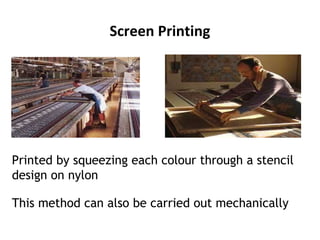
Screen Printing
Printed by squeezing each colour through a stencil
design on nylon
This method can also be carried out mechanically
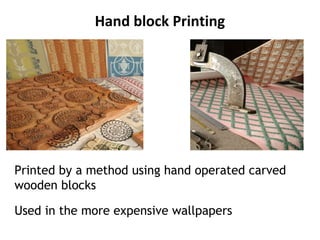
Hand block Printing
Printed by a method using hand operated carved
wooden blocks
Used in the more expensive wallpapers
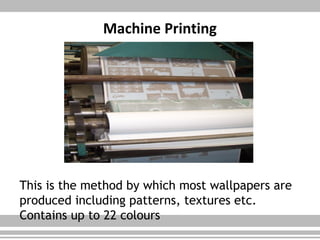
Machine Printing
This is the method by which most wallpapers are
produced including patterns, textures etc.
Contains up to 22 colours
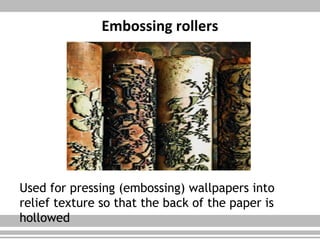
Embossing rollers
Used for pressing (embossing) wallpapers into
relief texture so that the back of the paper is
hollowed
Types of Wallpaper
• Grounds :- Paper completely coated with a casein-
bound paint before being printed with a repeating
pattern. Pattern or texture. It has a non washable
surface
Machine Prints:- Repeating pattern, overall
surface textures or stripes printed by rollers and
containing up to 22 colours. This is the method
by which most papers are produced. Some
grounds have a particular character and may be
known by other titles
The Following are the most common of the
other Titles
• Jaspe:- A fine irregular vertical texture similar to that of scumble texture
dragging
Chintz:- Patterns based on natural forms treated in a realistic
manner to imitate the cotton furnishing fabric of the same name
Satin:- Ground colours polished or glazed to produce a sheen before
being printed
Moir:- Satin or satinette ground finely textured to produce a water silk
effect. Most commonly produced as a vinyl
Satinette:- Fine mica flakes incorporated in ground colour to produce
a sheen
Metallic:- Bronze or aluminium powder included in a ground colour or
print to produce a metallic sheen
Hand Prints
• Good quality ground coated papers printed by hand
process. There are two principle types and are as
follows.
• Block Prints:- Printed by the hand method using
hand-operated carved wooden blocks.
• Screen Prints:- Each colour of design is squeezed through a
stencil through a stencil design which is mounted on a nylon
material stretched tight over a printing frame
• Pulps:- Self coloured papers upon which the
pattern or texture is printed direct without the
surface being complete coated first. They are
generally cheaper than grounds.
• Although paper quality and design quality may vary
they constitute the lowest price range of a
manufacturers stock
Embossed Papers
• Papers which have been pressed into relief texture
so the back of the paper is hollow
Dry Embossed Papers
Printed papers passed between embossing
rollers, either steel roller with the pattern or
texture in relief presses the paper into a soft
roller. One male and one female rollers are
used. The following are produced in this manner
• Embossed :- The most common and the cheapest range.
Either with an all-over random relief texture or with a pattern
in the relief. Depth of relief may decrease considerably after
hanging
Duplex:- Two papers bonded together before being
embossed, to produce a more pronounced relief.
Usually the pattern is only embossed
Low Relief Anaglypta-Type
• A duplex paper embossed while the adhesive
bonding the two papers is still wet, which helps to
retain maximum relief after hanging. The top paper
is craft type for stretch and whiteness. These papers
differ from those described before as the are not
coloured or printed with a pattern.
• Generally available either in textures such as
pebbledash; plaster swirl; broken glass or in
geometrical patterns. Available in white only and can
be painted after hanging
Wet Embossed Paper
• A much heavier quality paper than Anaglypta. While in a wet
state it is moulded between a steel roller and its counter
made if gutta percha. Available in white only and is painted
after hanging. Comes in the following
Supaglypta:- Available in rolls and range of
textures similar to anaglypta
Relief Papers:- Papers having a relief texture on the
face, but with a smooth backing, there are three main
types.
1. Ingrains (woodchip, Oatmeal) paper which has small
particles of wood or cork sandwiched between a heavy
backing paper and a thin surface paper
• 2. Plastic Paint Prints:- A ground printed with a colour
thickened with plaster or similar filler
3. Blown Vinyl's:- A paper backed material having an
expanded coating of PVC which is textured in a variety
of random or repeating Patterns. Usually available in a
neutral colour suitable for painting with alkyd or
emulsion paint after hanging. Also available in finished
colours
Washable Papers
• Papers which have a surface that can be cleaned without
damaging the pattern.
Ordinary Washable Papers:- A ground or embossed paper
that has been machine coated with a clear glaze based on poly vinyl
acetate PVA. It will withstand regular wiping with a damp sponge,
but not usually saturation washing or scrubbing with a brush or
abrasive
Vinyl's:- Smooth or textured thin film of polyvinyl chloride (PVC)
bonded to a paper backing and printed with PVC inks heat-fused on
to the surface
Ready Pasted Paper:- Vinyl or washable paper which has been
coated on the back with a water-activated fungicidal paste. More
expensive than similar non-pasted papers but this may be offset by the
saving of pasting time
• Coated Washable:- Most pulps, grounds and embosses which are
not produced with a washable finish can be coated after hanging has been
completed and the paste has dried.
• The coating that is used is based on PVA and is brushed, rolled or sprayed
onto the paper. It is best to test a piece first because some papers are
poorly bound which may result in the colour lifting
Wood Grain:- Vinyl or washable paper which is treated to
represent various types of wood such as oak, mahogany, teak
pine and cedar
Metallic Folis:- Made by either laminating a paper backing
with a tarnished leaves of various metals, or by spraying
metallic or coloured polyester resin on to a paper backing
• Expanded Polystyrene:- Foam polystyrene resin cut into thin
sheets, being 98% air it has exceptional heat insulation properties but is
highly flammable. It can be painted with emulsion paint covered with
wallpaper if a decorative finish is required
Scrim Backed Lining:- Heavy quality white lining bonded
to a fine cotton material or scrim
Pitch Paper (foil Damp):- Paper coated with bitumen or
applied to expanded polystyrene to increase its resistance to
moisture penetration. Recommended as a temporary expedient
only, for damp walls

Patterned paper power point

  • 1.
    © City ofGlasgow College Charity Number SC0 36198 Paperhanging
  • 2.
    Surface Preparation • Manufacturersand suppliers of wall coverings often give comprehensive instructions regarding surface preparation for their products. These cover the various types of untreated substrates that are usual in painting and buildings and various paint systems that may be superimposed on them; and treatment for surfaces in good and poor condition Due regard should be shown to this information Wall coverings are expensive and it is imperative that the preparation is carried out as near to perfection as circumstances permit
  • 3.
    Lining Paper • Amost important aspect of preparation is the application of lining paper prior to the wall covering. • The Benefits are. Evens out the porosity on surfaces of uneven porosity Provides a surface controlled even porosity Prevents springing of joints on non-porous surfaces I.E. Eggshell and Gloss oil painted surfaces Ensures drying out. Its controlled porosity takes moisture from the pasted wall covering and prevents it remaining wet which can result in delamination and staining Helps mask irregularities in the surface
  • 4.
    Wallboards • This typeof surface should be stripped dry, unless prior knowledge as to whether or not the surface had been sealed before being papered, if sealed then it would be possible to remove the paper using water. Care must be taken to ensure that the surface is not over soaked as this would damage the surface Removing the paper dry can be very difficult, only extreme care and patience will ensure that the removal of the paper takes place without damaging the surface. Dry abrading the surface after the paper being removed ensures that the surface will be suitable for further wall covering It is essential that prior to any re-papering, sealing of the surface should take place using an oily sealer. This will make the subsequent stripping of the surface easier
  • 5.
    Previously Painted surfaces •Previously painted, non-porous surfaces require after removal careful preparation by the abrading to roughen the surface in order to provide extra adhesion for the wall paper paste Filling Cracks Cracks on the surface should be cut out, wetted and filled with filler. It may be necessary to refill over the cracks a second time to ensure cracks are filled flush with the surface
  • 6.
    Filling Holes • Anydeep holes must have all loose deposits removed before “wetting”. Plaster filler should have sand added in order to reduce shrinkage and cracking, after this filling has set it may be necessary to go over the filled surface again with neat plaster filler in order to ensure holes are filled flush with the surface Mould Growth Any old paper which has been effected with mould growth should be burnt in order to eradicate the spread of mould. Surfaces should then be washed with a mould inhibitor. It is necessary to ensure that the cause of the mould growth has been rectified before re-papering takes place
  • 7.
    New Plaster • Ifpossible all furniture, fittings and carpets should be removed before commencing the stripping of wall and ceiling papers. Anything which cannot be removed. Particularly carpets must be protected with polythene waterproof sheets
  • 8.
    1st Method • Ceilings arenormally stripped before walls • Soak the paper with water as hot as can be tolerated • Scratch the surface of washable papers with a nail block or wire brush • Re-soak the paper • With the blade of the scraper held at a shallow angle to the wall, carefully scrape away the saturated paper • Remove all paper whilst wet • Wash the stripped surface to remove paste • Dry Off • Clean away stripped paper • Mop up water as required
  • 9.
    Tools and Equipment •Flexible scraper or stripping knife • Steam stripping equipment • Sponges and leathers • Container for stripped paper • Brush and shovel • Mop and Bucket • Nail Block or coarse wire brush Materials Liquid detergent or proprietary wetting agent
  • 10.
    Method 2 • Placesteaming concentrator pad of steam stripper flat on the working surface • After a few seconds, slide the pad to a dry area • Scrape the area already steamed, as the next is being soaked
  • 11.
    Points to watch •Stripping hangings from ceilings whilst using a steam stripper can be dangerous because of hot dripping water Make sure all paper is removed whilst wet. It is much easier an cleaner than having to dry rub ‘NIBS’ afterward Do not damage plaster by scraping to soon or by stabbing at the surface If Vymura or vinyl papers are to be stripped, the surface must be peeled off first If using a brush commence ‘soaking’ at the top of the wall
  • 12.
    • Do notlet stripped paper dry, it is easier and cleaner to remove whilst wet Do not forget to clean away any bits of paper stuck to window frames, doors etc
  • 13.
    Operating a steamstripper A. Fill with clean water until the water level indicator almost full B. Replace the filler cap, ensuring it is closed properly C. Connect hose to outlet and concentrator D.Plug into mains
  • 14.
    • E. Waituntil steam is produced; steam coming from the concentrator pad indicates the equipment is ready for use. • F. Concentrator is held against the wall or ceiling surface until the paper is soft enough to remove readily with a scraper • G. The concentrator should be held in the next position whilst stripping off to soften the next section to be stripped and so on until the surface area has been completely stripped
  • 15.
    Pastes and Adhesives •Cold Water paste, stir the powder slowly into cold water, it has a high water content and can be used for light to medium weight papers Standard Cellulose, stir the powder slowly into cold water and allow to stand, it has a high water content and can be used for light to medium weight papers Heavy duty cellulose, stir the powder slowly into cold water and allow to stand, it has a medium water content and can be used for paper and cloth backed vinyl's and expanded polystyrene Hot water Powder, Make powder into a batter with a little cold water, quickly stir in boiling water allow to cool and then beat up, it has a low water content and can be used for all papers except vinyl's
  • 16.
    • Tub Paste,This paste is ready mixed but may require thinning slightly, it has a low water content and is suitable for all types of paper except vinyl's Glue size powder, Mix with a little cold water. Allow to soak for about 15- 20 minutes, stir in boiling water and allow to cool. For coating porous surfaces before paperhanging. The adhesive evens out porosity and provides ‘slip’ Clearcole (claircolle), mix as for glue size and stir thoroughly, for coating non-porous surfaces to aid in adhesion PVA, This is a ready mixed paste with a medium to high water content and is used with paper and cloth backed vinyl’s
  • 17.
    • Paste powders,mix to a stiff consistency, if it is to stiff it can always be eased to a thick but smooth consistency Tub paste, Beat up vigorously; this will make the paste softer and smoother, ease with water until desired consistency is obtained PVA Adhesives, Use as provided, do not thin unless absolutely necessary and then fine judgement must be exercised Impact Adhesives, must be used exactly according to manufacturers instructions. Particular care should be exercised as these adhesives are highly inflammable and give off intoxicating vapours which are dangerous in close, unventilated conditions
  • 18.
    Paste Consistency • Thinpaste is very easy to apply but will cause:- Over soaking, Overstretching, Weak Adhesion, Opening Joints, Delamination • Thick paste is difficult to apply and will cause:- Uneven Application, Uneven Soaking and Stretching, Lumpiness in smooth faced coverings
  • 19.
  • 20.
    Screen Printing Printed bysqueezing each colour through a stencil design on nylon This method can also be carried out mechanically
  • 21.
    Hand block Printing Printedby a method using hand operated carved wooden blocks Used in the more expensive wallpapers
  • 22.
    Machine Printing This isthe method by which most wallpapers are produced including patterns, textures etc. Contains up to 22 colours
  • 23.
    Embossing rollers Used forpressing (embossing) wallpapers into relief texture so that the back of the paper is hollowed
  • 24.
    Types of Wallpaper •Grounds :- Paper completely coated with a casein- bound paint before being printed with a repeating pattern. Pattern or texture. It has a non washable surface Machine Prints:- Repeating pattern, overall surface textures or stripes printed by rollers and containing up to 22 colours. This is the method by which most papers are produced. Some grounds have a particular character and may be known by other titles
  • 25.
    The Following arethe most common of the other Titles • Jaspe:- A fine irregular vertical texture similar to that of scumble texture dragging Chintz:- Patterns based on natural forms treated in a realistic manner to imitate the cotton furnishing fabric of the same name Satin:- Ground colours polished or glazed to produce a sheen before being printed Moir:- Satin or satinette ground finely textured to produce a water silk effect. Most commonly produced as a vinyl Satinette:- Fine mica flakes incorporated in ground colour to produce a sheen Metallic:- Bronze or aluminium powder included in a ground colour or print to produce a metallic sheen
  • 26.
    Hand Prints • Goodquality ground coated papers printed by hand process. There are two principle types and are as follows. • Block Prints:- Printed by the hand method using hand-operated carved wooden blocks. • Screen Prints:- Each colour of design is squeezed through a stencil through a stencil design which is mounted on a nylon material stretched tight over a printing frame
  • 27.
    • Pulps:- Selfcoloured papers upon which the pattern or texture is printed direct without the surface being complete coated first. They are generally cheaper than grounds. • Although paper quality and design quality may vary they constitute the lowest price range of a manufacturers stock
  • 28.
    Embossed Papers • Paperswhich have been pressed into relief texture so the back of the paper is hollow Dry Embossed Papers Printed papers passed between embossing rollers, either steel roller with the pattern or texture in relief presses the paper into a soft roller. One male and one female rollers are used. The following are produced in this manner
  • 29.
    • Embossed :-The most common and the cheapest range. Either with an all-over random relief texture or with a pattern in the relief. Depth of relief may decrease considerably after hanging Duplex:- Two papers bonded together before being embossed, to produce a more pronounced relief. Usually the pattern is only embossed
  • 30.
    Low Relief Anaglypta-Type •A duplex paper embossed while the adhesive bonding the two papers is still wet, which helps to retain maximum relief after hanging. The top paper is craft type for stretch and whiteness. These papers differ from those described before as the are not coloured or printed with a pattern. • Generally available either in textures such as pebbledash; plaster swirl; broken glass or in geometrical patterns. Available in white only and can be painted after hanging
  • 31.
    Wet Embossed Paper •A much heavier quality paper than Anaglypta. While in a wet state it is moulded between a steel roller and its counter made if gutta percha. Available in white only and is painted after hanging. Comes in the following Supaglypta:- Available in rolls and range of textures similar to anaglypta Relief Papers:- Papers having a relief texture on the face, but with a smooth backing, there are three main types. 1. Ingrains (woodchip, Oatmeal) paper which has small particles of wood or cork sandwiched between a heavy backing paper and a thin surface paper
  • 32.
    • 2. PlasticPaint Prints:- A ground printed with a colour thickened with plaster or similar filler 3. Blown Vinyl's:- A paper backed material having an expanded coating of PVC which is textured in a variety of random or repeating Patterns. Usually available in a neutral colour suitable for painting with alkyd or emulsion paint after hanging. Also available in finished colours
  • 33.
    Washable Papers • Paperswhich have a surface that can be cleaned without damaging the pattern. Ordinary Washable Papers:- A ground or embossed paper that has been machine coated with a clear glaze based on poly vinyl acetate PVA. It will withstand regular wiping with a damp sponge, but not usually saturation washing or scrubbing with a brush or abrasive Vinyl's:- Smooth or textured thin film of polyvinyl chloride (PVC) bonded to a paper backing and printed with PVC inks heat-fused on to the surface Ready Pasted Paper:- Vinyl or washable paper which has been coated on the back with a water-activated fungicidal paste. More expensive than similar non-pasted papers but this may be offset by the saving of pasting time
  • 34.
    • Coated Washable:-Most pulps, grounds and embosses which are not produced with a washable finish can be coated after hanging has been completed and the paste has dried. • The coating that is used is based on PVA and is brushed, rolled or sprayed onto the paper. It is best to test a piece first because some papers are poorly bound which may result in the colour lifting Wood Grain:- Vinyl or washable paper which is treated to represent various types of wood such as oak, mahogany, teak pine and cedar Metallic Folis:- Made by either laminating a paper backing with a tarnished leaves of various metals, or by spraying metallic or coloured polyester resin on to a paper backing
  • 35.
    • Expanded Polystyrene:-Foam polystyrene resin cut into thin sheets, being 98% air it has exceptional heat insulation properties but is highly flammable. It can be painted with emulsion paint covered with wallpaper if a decorative finish is required Scrim Backed Lining:- Heavy quality white lining bonded to a fine cotton material or scrim Pitch Paper (foil Damp):- Paper coated with bitumen or applied to expanded polystyrene to increase its resistance to moisture penetration. Recommended as a temporary expedient only, for damp walls