User Education  and  Information Literacy : Current Practices and Innovative Strategies Fe Angela M. Verzosa   by
Overview Developments in computers, microelectronics, and communication technologies  Gone are the days of stand-alone libraries Traditional libraries were dominated by print publications and access to these resources were done manually The paradigm shift now is from stand-alone libraries to library and information networks, available via the Internet  Automated, digital, and virtual libraries  as well as networked data, specialized networks, and library networks are now in place  Multimedia and the Internet have further  made the job of library and information professionals more challenging
Overview growing recognition of the importance of life-long and individualized learning a new enthusiasm for research library instruction and bibliographic control and automation has emerged bibliographic instruction, also called library use instruction, or user education, has grown over the years from a simple area of interest to a  complex area of study instruction librarians have begun to examine  the complexities of search strategies, the differing information needs of novices and experts, and the organization of knowledge in various fields in order to better serve their patrons all these contribute to the emergence of an important role for the librarian, that of the teacher
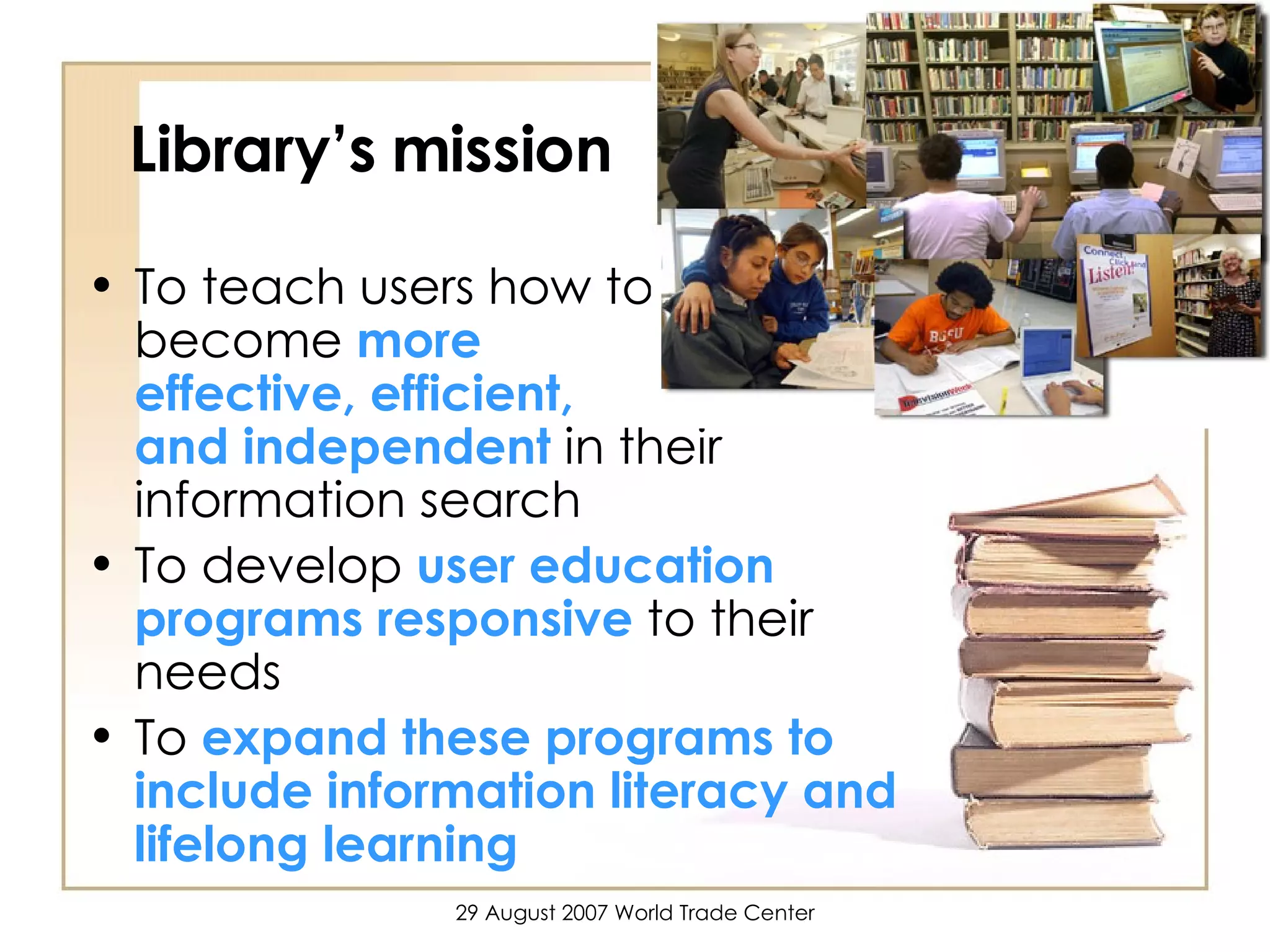
Library’s mission To teach users how to  become  more  effective, efficient,  and independent  in their information search To develop  user education programs responsive  to their needs To  expand these programs to include information literacy and lifelong learning
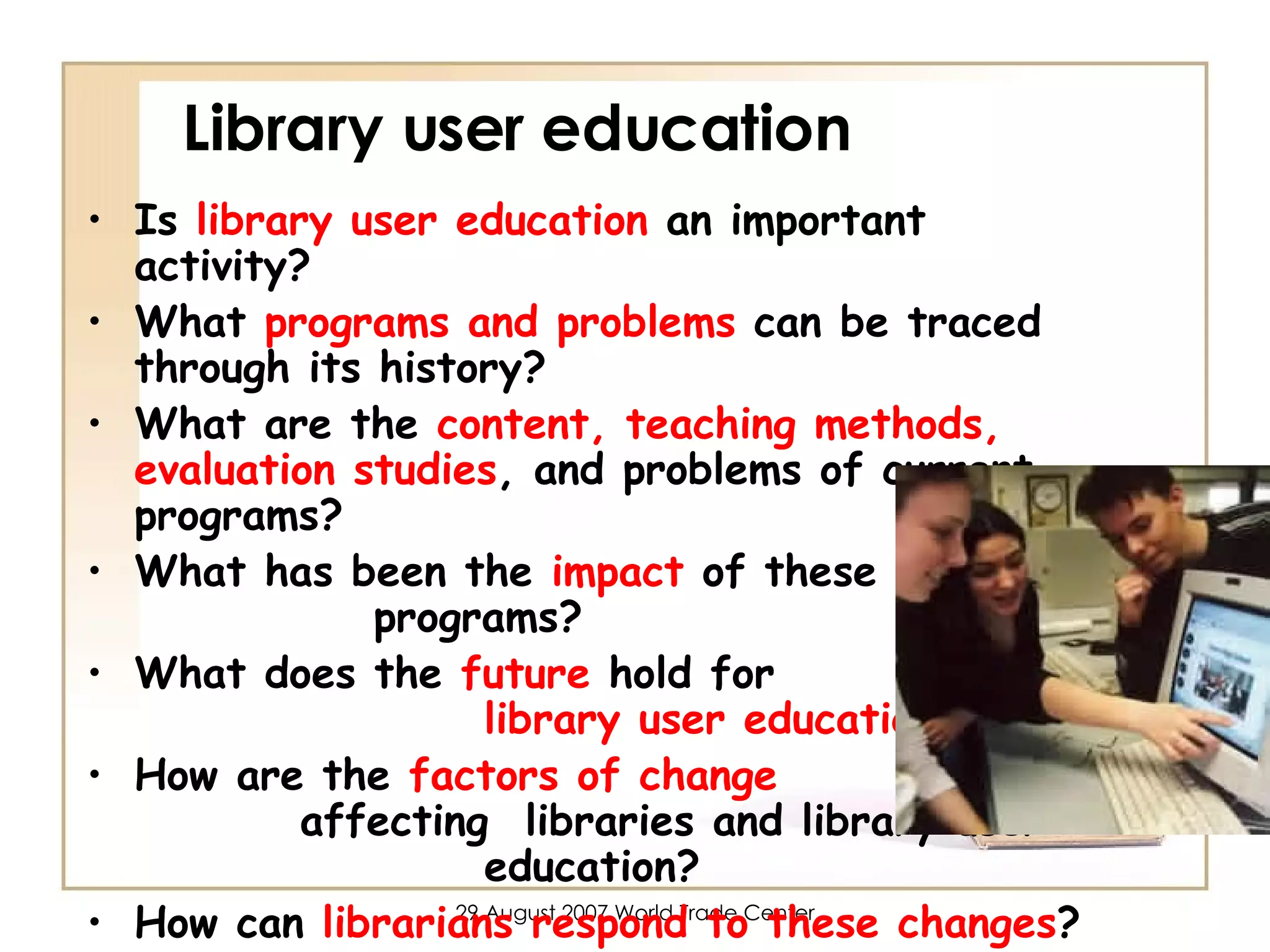
Library user education Is  library user education  an important activity?  What  programs and problems  can be traced through its history?  What are the  content, teaching methods, evaluation studies , and problems of current programs?  What has been the  impact  of these  programs?  What does the  future  hold for  library user education ?  How are the  factors of change   affecting  libraries and library user  education?  How can  librarians respond to these changes ?
User education   defined … user education   simply means educating the library patron, whether student, staff, or member of the public, on how to use the library and its services.  should include any effort or program   which will  guide and instruct   existing  and potential users  in the  recognition and formulation  of their information needs, in  the effective and efficient use  of information services and  their assessment .
History of user education 1700s    evidence indicates German universities gave library instruction in the form of lectures 1820s early rise and rapid decline of library instruction also in the form of lectures 1900s   basic skills at freshmen level 1940-1970s  focused on access skills and biblio-  graphic tools; problem solving was  introduced
History of user education 1980s    integration of library instruction into the library profession and higher education; expansion of user education to information literacy 1990s development of online catalogs and databases, and increased use of Internet drastically changed instruction sessions 2000s     use   of multimedia aids, online  tutorials, modular teaching methods,  and heightened focus on information  literacy
Current Status What is being taught and which teaching methods and systems have been implemented in programs?   What do evaluation studies show about the effectiveness of library user education?  What are some problems  common to these programs?
Current Methods Lecture method Seminar, tutorials, and demonstration Guided tour Audiovisual method Computer-aided programmed instruction Individual instruction at the  Reference desk Course-related instruction Web-based instruction
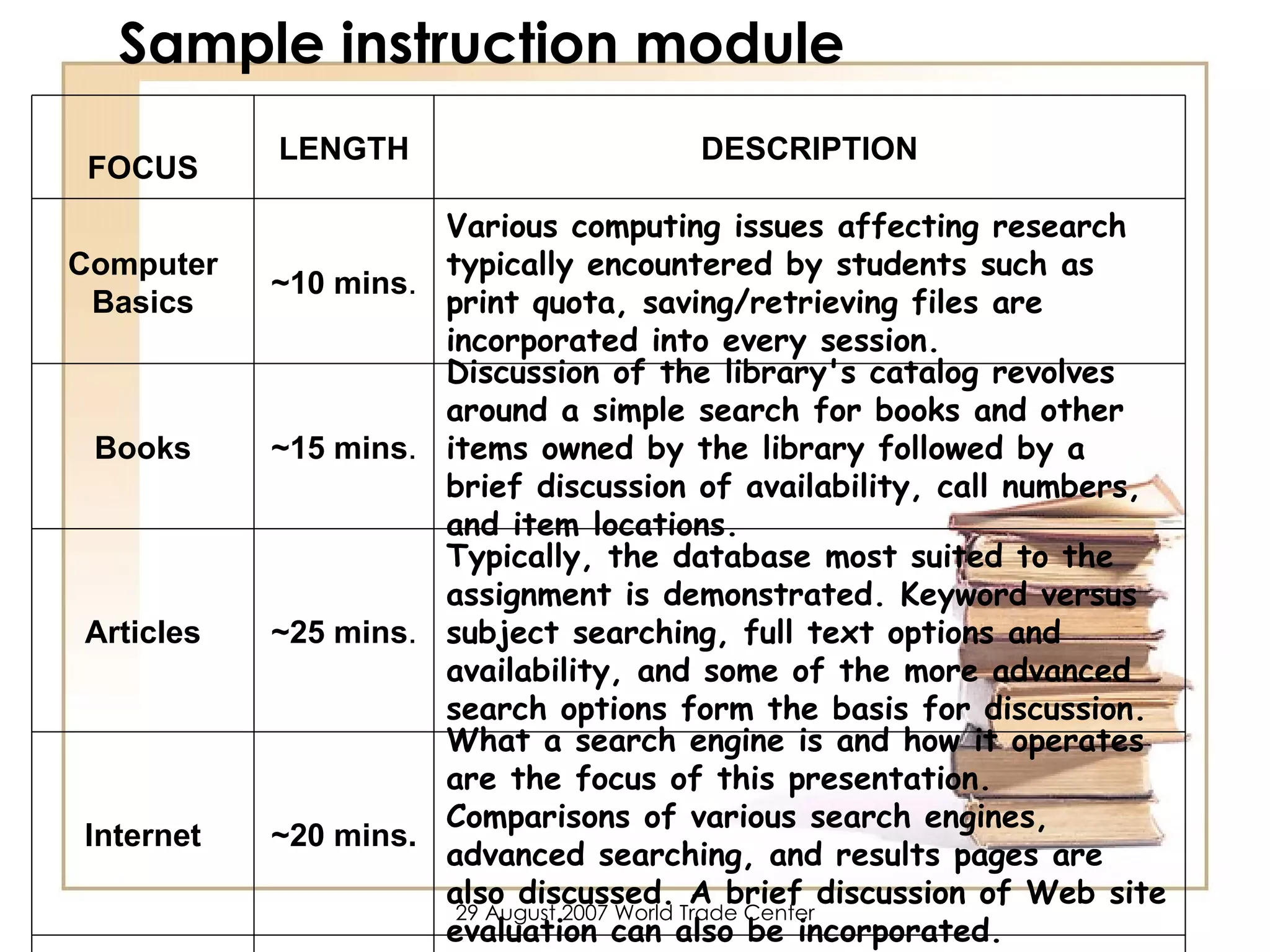
Sample instruction module What a search engine is and how it operates are the focus of this presentation. Comparisons of various search engines, advanced searching, and results pages are also discussed. A brief discussion of Web site evaluation can also be incorporated. ~20 mins. Internet Typically, the database most suited to the assignment is demonstrated. Keyword versus subject searching, full text options and availability, and some of the more advanced search options form the basis for discussion. ~25 mins . Articles Discussion of the library's catalog revolves around a simple search for books and other items owned by the library followed by a brief discussion of availability, call numbers, and item locations. ~15 mins . Books Various computing issues affecting research typically encountered by students such as print quota, saving/retrieving files are incorporated into every session.  ~10 mins . Computer Basics DESCRIPTION LENGTH FOCUS
Levels of user education at the beginning of every academic year or semester ... applicable to all those who are using the library for the first time, e.g. Library orientation and library tour  subject oriented instruction for undergraduates at a stage when they are admitted to a special branch or subject of their choice or at the time of  project work.  Literature search training ...  provided at the beginning of  their research work.
Other Levels of User Education Undergraduate Level   a general introduction to the geography of the university library, as well as some useful information about the library catalog, reference sources, etc.  Post-graduate Level   In addition to the above  information, instruction on  classification system, biblio-  graphies available, library  services offered, etc.
Other Levels of User Education  Research Scholar Level   detailed info about literature search, compilation of bibliographies for their projects, technical writing, giving footnotes, etc.  Faculty Level   to conduct fruitful research and  enable faculty to teach,  they  need to know the steps in literature  search, information retrieval,  technical writings, interlibrary  loans, relevant library services, etc.
Evaluation of library instruction Formative evaluation   to measure the effectiveness of instruction for guidance on how to improve the program Summative evaluation   to measure the effect of library instruction on the students and their performance Most evaluation studies done since the 1970s fall into one of three methods:  opinion surveys,  knowledge testing ,  and   library use observation.
Common Problems lack of student motivation or faculty cooperation generic instruction session trivializes information gathering course-related instruction is simply oral bibliography audiovisual does not hold users' interest computer-assisted instruction  is  very time intensive to  produce   Instruction is not integrated into  the curriculum
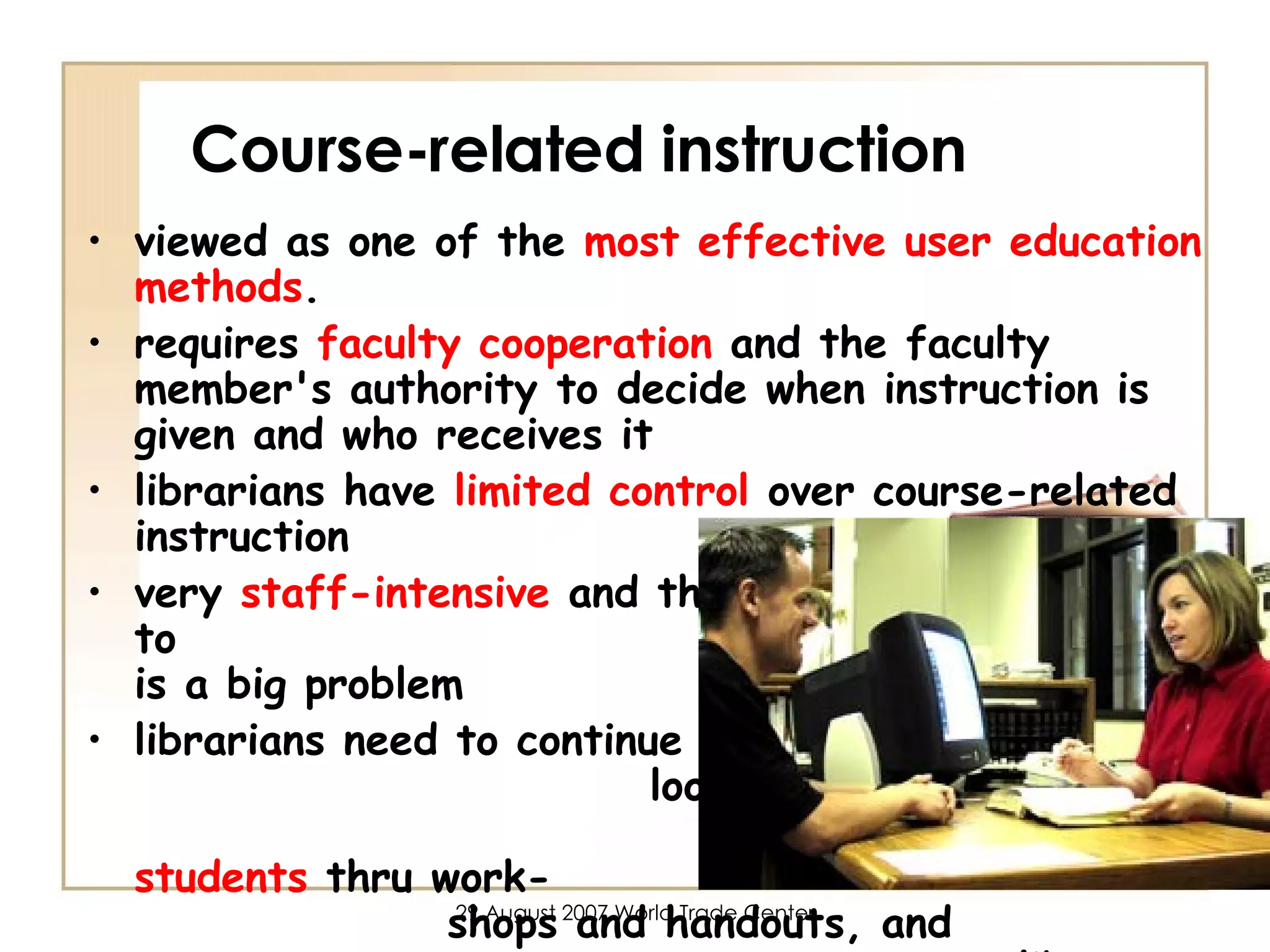
Course-related instruction viewed as one of the  most effective user education methods .  requires  faculty cooperation  and the faculty member's authority to decide when instruction is given and who receives it librarians have  limited control  over course-related instruction very  staff-intensive  and the high ratio of students to  librarians is a big problem librarians need to continue to  look for  additional ways of  reaching students  thru work-  shops and handouts, and  library assignment  consultations
Information literacy now the avowed  objective  of most library user education program is an  expansion of instruction  as to objectives, materials, and methods has  evolved in the way that instruction  evolved from library orientation into bibliographic instruction encompasses the entire world of information seeking  to prepare people to pursue the concept of lifelong learning extends its objectives to teaching information-seeking skills  to all ages and at all times prepares people  to use information effectively  in any situation
Information literacy   defined… Information literacy may be defined as  the ability to access and evaluate information effectively  for problem solving and decision making.  Information literate people know  how to be lifelong learners in an information society . They recognize  when information is needed  and have the  ability to locate, evaluate and use  effectively the information needed Information literate people are those  who  have learned how to learn . They know  how to learn because they know how  information is organized, how to  find it, how to use information in  such a way that others can  learn from them.
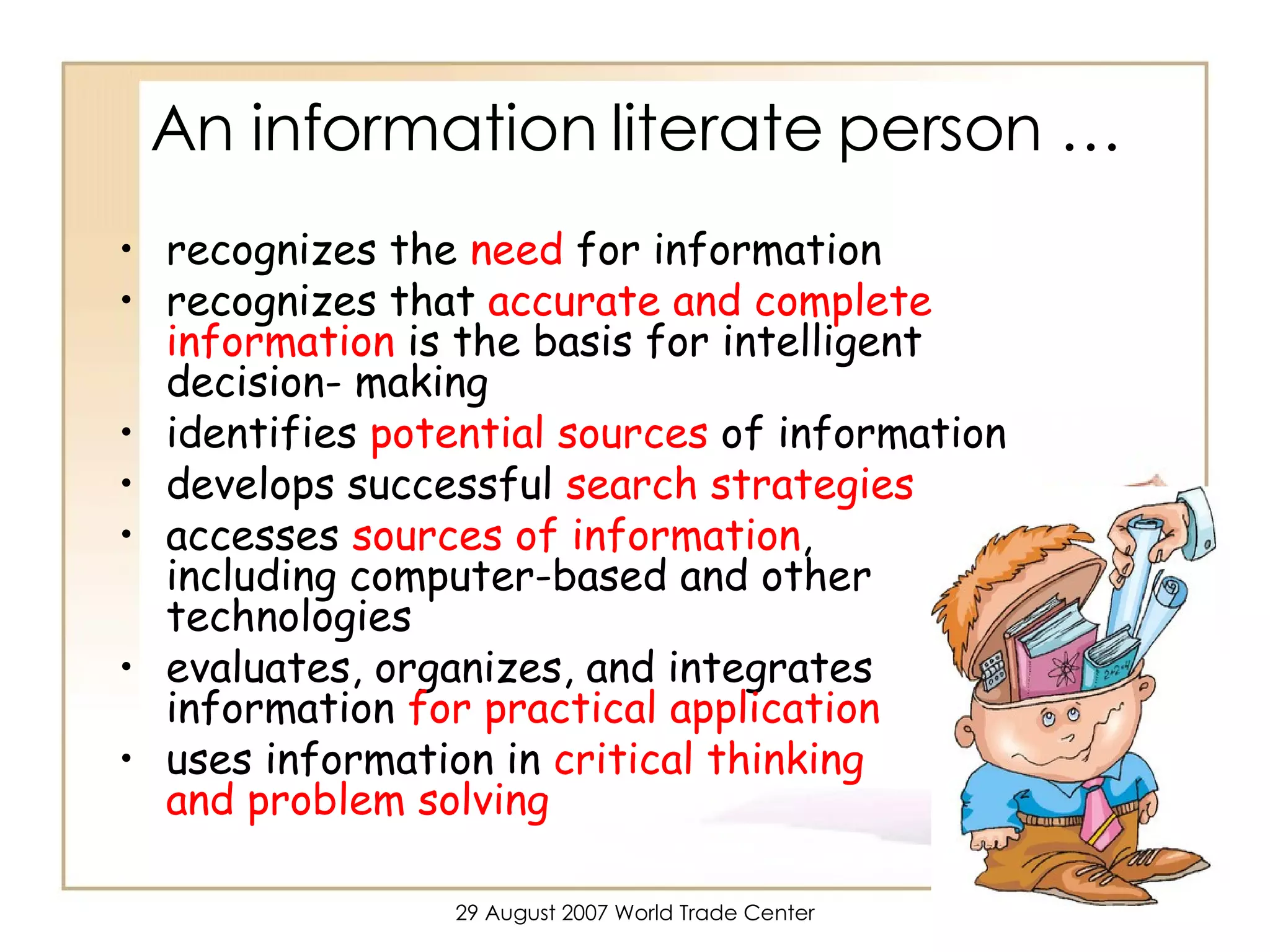
An information literate person …  recognizes the  need  for information recognizes that  accurate and complete information  is the basis for intelligent decision- making identifies  potential sources  of information develops successful  search strategies accesses  sources of information ,  including computer-based and other technologies evaluates, organizes, and integrates information  for practical application uses information in  critical thinking  and problem solving
Innovative strategies librarians should become proactive in teaching information skills; they also must learn to teach an expanded library user education program will include teaching the structure of information, use of new electronic formats, and applying critical thinking to information librarians will have to maximize the use of technology to teach more skills to greater numbers of users more complex expert systems will be developed  to help users with in-depth use of complex abstracting and indexing services   emphasis will be on problem-solving and on obtaining and accessing information rather  than on ownership user instruction will need to provide students  and faculty with basic, intermediate, and  advanced guidance in the use of the library
Innovative strategies As to methods, instruction should employ short modules that allow self-directed study with more emphasis on instructional content and less on the media used, e.g.  online modules  and  online tutorials The system should be one that  users are comfortable in using  and gives them a sense of control over it. Users should receive guidance on which  resources are best for their needs , and  basic instruction on search technique , and should feel assured that the system is not difficult and is evolving toward a more efficient, effective,  and easy-to-use system.
Innovative strategies Staff responsible for the future management of the user education program, will need to liaise closely with all academic areas, groups and individual users to ensure that it meets the increasingly diverse needs of users.  The program must reflect the varied levels of skills of those users.   Library user education should become an integral part, formal if possible, of the curriculum of the University.  It must be monitored and evaluated to ensure it is relevant to users’ needs.   Those responsible for user education will be expected to appraise and implement national and international developments, if they are appropriate to local needs.
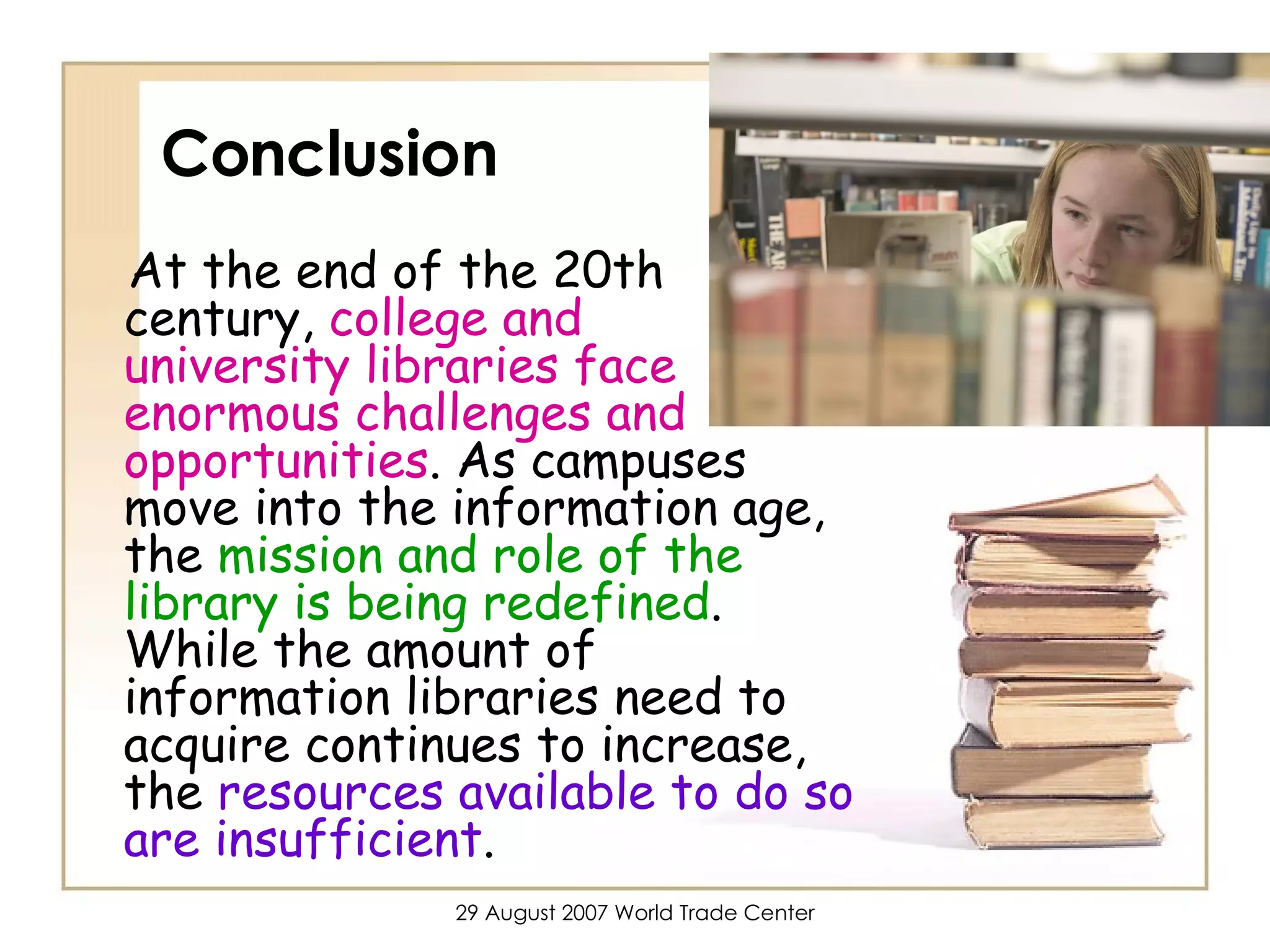
Conclusion At the end of the 20th century,  college and  university libraries face enormous challenges and opportunities . As campuses move into the information age, the  mission and role of the library is being redefined . While the amount of information libraries need to acquire continues to increase, the  resources available to do so are insufficient .
Conclusion The  growing universe  of  print-based publications  and digital documents on the one hand, and the  declining universe of library budgets  on the other, can be handled confidently by adopting certain strategies, such as by developing  critical thinking skills , as well as promoting  information literacy  at large.  In the near future, users should expect  timely access  to quality information.
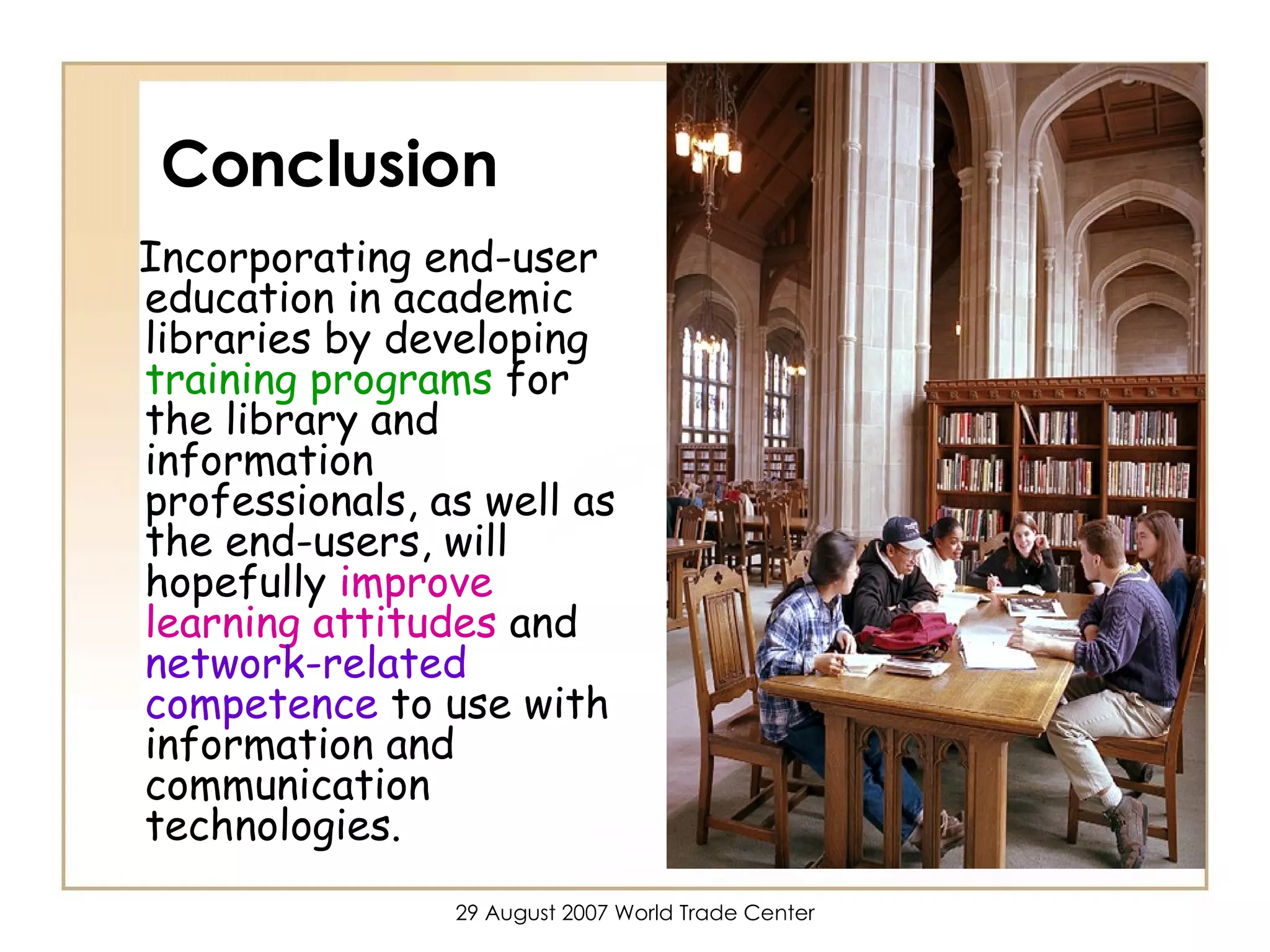
Conclusion Incorporating end-user education in academic libraries by developing  training programs  for the library and information professionals, as well as the end-users, will hopefully  improve learning attitudes  and  network-related competence  to use with information and communication technologies.
 

User education and information literacy - Innovative strategies and practices

  • 1.
    User Education and Information Literacy : Current Practices and Innovative Strategies Fe Angela M. Verzosa by
  • 2.
    Overview Developments incomputers, microelectronics, and communication technologies Gone are the days of stand-alone libraries Traditional libraries were dominated by print publications and access to these resources were done manually The paradigm shift now is from stand-alone libraries to library and information networks, available via the Internet Automated, digital, and virtual libraries as well as networked data, specialized networks, and library networks are now in place Multimedia and the Internet have further made the job of library and information professionals more challenging
  • 3.
    Overview growing recognitionof the importance of life-long and individualized learning a new enthusiasm for research library instruction and bibliographic control and automation has emerged bibliographic instruction, also called library use instruction, or user education, has grown over the years from a simple area of interest to a complex area of study instruction librarians have begun to examine the complexities of search strategies, the differing information needs of novices and experts, and the organization of knowledge in various fields in order to better serve their patrons all these contribute to the emergence of an important role for the librarian, that of the teacher
  • 4.
    Library’s mission Toteach users how to become more effective, efficient, and independent in their information search To develop user education programs responsive to their needs To expand these programs to include information literacy and lifelong learning
  • 5.
    Library user educationIs library user education an important activity? What programs and problems can be traced through its history? What are the content, teaching methods, evaluation studies , and problems of current programs? What has been the impact of these programs? What does the future hold for library user education ? How are the factors of change affecting libraries and library user education? How can librarians respond to these changes ?
  • 6.
    User education defined … user education simply means educating the library patron, whether student, staff, or member of the public, on how to use the library and its services. should include any effort or program which will guide and instruct existing and potential users in the recognition and formulation of their information needs, in the effective and efficient use of information services and their assessment .
  • 7.
    History of usereducation 1700s evidence indicates German universities gave library instruction in the form of lectures 1820s early rise and rapid decline of library instruction also in the form of lectures 1900s basic skills at freshmen level 1940-1970s focused on access skills and biblio- graphic tools; problem solving was introduced
  • 8.
    History of usereducation 1980s integration of library instruction into the library profession and higher education; expansion of user education to information literacy 1990s development of online catalogs and databases, and increased use of Internet drastically changed instruction sessions 2000s use of multimedia aids, online tutorials, modular teaching methods, and heightened focus on information literacy
  • 9.
    Current Status Whatis being taught and which teaching methods and systems have been implemented in programs? What do evaluation studies show about the effectiveness of library user education? What are some problems common to these programs?
  • 10.
    Current Methods Lecturemethod Seminar, tutorials, and demonstration Guided tour Audiovisual method Computer-aided programmed instruction Individual instruction at the Reference desk Course-related instruction Web-based instruction
  • 11.
    Sample instruction moduleWhat a search engine is and how it operates are the focus of this presentation. Comparisons of various search engines, advanced searching, and results pages are also discussed. A brief discussion of Web site evaluation can also be incorporated. ~20 mins. Internet Typically, the database most suited to the assignment is demonstrated. Keyword versus subject searching, full text options and availability, and some of the more advanced search options form the basis for discussion. ~25 mins . Articles Discussion of the library's catalog revolves around a simple search for books and other items owned by the library followed by a brief discussion of availability, call numbers, and item locations. ~15 mins . Books Various computing issues affecting research typically encountered by students such as print quota, saving/retrieving files are incorporated into every session. ~10 mins . Computer Basics DESCRIPTION LENGTH FOCUS
  • 12.
    Levels of usereducation at the beginning of every academic year or semester ... applicable to all those who are using the library for the first time, e.g. Library orientation and library tour subject oriented instruction for undergraduates at a stage when they are admitted to a special branch or subject of their choice or at the time of project work. Literature search training ... provided at the beginning of their research work.
  • 13.
    Other Levels ofUser Education Undergraduate Level a general introduction to the geography of the university library, as well as some useful information about the library catalog, reference sources, etc. Post-graduate Level In addition to the above information, instruction on classification system, biblio- graphies available, library services offered, etc.
  • 14.
    Other Levels ofUser Education Research Scholar Level detailed info about literature search, compilation of bibliographies for their projects, technical writing, giving footnotes, etc. Faculty Level to conduct fruitful research and enable faculty to teach, they need to know the steps in literature search, information retrieval, technical writings, interlibrary loans, relevant library services, etc.
  • 15.
    Evaluation of libraryinstruction Formative evaluation to measure the effectiveness of instruction for guidance on how to improve the program Summative evaluation to measure the effect of library instruction on the students and their performance Most evaluation studies done since the 1970s fall into one of three methods: opinion surveys, knowledge testing , and library use observation.
  • 16.
    Common Problems lackof student motivation or faculty cooperation generic instruction session trivializes information gathering course-related instruction is simply oral bibliography audiovisual does not hold users' interest computer-assisted instruction is very time intensive to produce Instruction is not integrated into the curriculum
  • 17.
    Course-related instruction viewedas one of the most effective user education methods . requires faculty cooperation and the faculty member's authority to decide when instruction is given and who receives it librarians have limited control over course-related instruction very staff-intensive and the high ratio of students to librarians is a big problem librarians need to continue to look for additional ways of reaching students thru work- shops and handouts, and library assignment consultations
  • 18.
    Information literacy nowthe avowed objective of most library user education program is an expansion of instruction as to objectives, materials, and methods has evolved in the way that instruction evolved from library orientation into bibliographic instruction encompasses the entire world of information seeking to prepare people to pursue the concept of lifelong learning extends its objectives to teaching information-seeking skills to all ages and at all times prepares people to use information effectively in any situation
  • 19.
    Information literacy defined… Information literacy may be defined as the ability to access and evaluate information effectively for problem solving and decision making. Information literate people know how to be lifelong learners in an information society . They recognize when information is needed and have the ability to locate, evaluate and use effectively the information needed Information literate people are those who have learned how to learn . They know how to learn because they know how information is organized, how to find it, how to use information in such a way that others can learn from them.
  • 20.
    An information literateperson … recognizes the need for information recognizes that accurate and complete information is the basis for intelligent decision- making identifies potential sources of information develops successful search strategies accesses sources of information , including computer-based and other technologies evaluates, organizes, and integrates information for practical application uses information in critical thinking and problem solving
  • 21.
    Innovative strategies librariansshould become proactive in teaching information skills; they also must learn to teach an expanded library user education program will include teaching the structure of information, use of new electronic formats, and applying critical thinking to information librarians will have to maximize the use of technology to teach more skills to greater numbers of users more complex expert systems will be developed to help users with in-depth use of complex abstracting and indexing services emphasis will be on problem-solving and on obtaining and accessing information rather than on ownership user instruction will need to provide students and faculty with basic, intermediate, and advanced guidance in the use of the library
  • 22.
    Innovative strategies Asto methods, instruction should employ short modules that allow self-directed study with more emphasis on instructional content and less on the media used, e.g. online modules and online tutorials The system should be one that users are comfortable in using and gives them a sense of control over it. Users should receive guidance on which resources are best for their needs , and basic instruction on search technique , and should feel assured that the system is not difficult and is evolving toward a more efficient, effective, and easy-to-use system.
  • 23.
    Innovative strategies Staffresponsible for the future management of the user education program, will need to liaise closely with all academic areas, groups and individual users to ensure that it meets the increasingly diverse needs of users. The program must reflect the varied levels of skills of those users. Library user education should become an integral part, formal if possible, of the curriculum of the University. It must be monitored and evaluated to ensure it is relevant to users’ needs. Those responsible for user education will be expected to appraise and implement national and international developments, if they are appropriate to local needs.
  • 24.
    Conclusion At theend of the 20th century, college and university libraries face enormous challenges and opportunities . As campuses move into the information age, the mission and role of the library is being redefined . While the amount of information libraries need to acquire continues to increase, the resources available to do so are insufficient .
  • 25.
    Conclusion The growing universe of  print-based publications and digital documents on the one hand, and the declining universe of library budgets on the other, can be handled confidently by adopting certain strategies, such as by developing critical thinking skills , as well as promoting information literacy at large. In the near future, users should expect timely access to quality information.
  • 26.
    Conclusion Incorporating end-usereducation in academic libraries by developing training programs for the library and information professionals, as well as the end-users, will hopefully improve learning attitudes and network-related competence to use with information and communication technologies.
  • 27.