Anwarul Islam. PhD
anwarpulak@gmail.com
Library 2.0
Definitions
Library 2.0 = Web 2.0 tools + Library services

Library 2.0 describes a subset of library services
  designed to meet user needs caused by the
  direct and peripheral effects of Web 2.0
  services …. (Habib, 2006: p.24).
Web 2.0
The term Web 2.0 is associated with web
  applications that facilitate participatory
  information sharing, interoperability, user-
  centered design, and collaboration on the
  World Wide Web. (Web 2.0 –Wikipedia, 2011)
Examples of Web 2.0 include social networking
  sites, blogs, wikis, video sharing sites, hosted
  services, web applications, mashups and
  folksonomies.
Web 1.0 vs Web 2.0
Web 2.0 vs Library 2.0
                 Web 2.0                   Library 2.0
Tim O’Reilly               librarycrunch.com

web as platform            user participation

read/write                 user-centred services

perpetual beta             radical trust
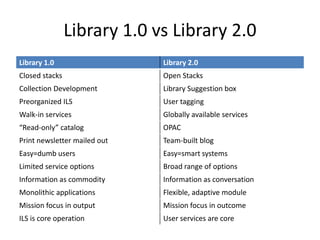
Library 1.0 vs Library 2.0
Library 1.0                   Library 2.0
Closed stacks                 Open Stacks
Collection Development        Library Suggestion box
Preorganized ILS              User tagging
Walk-in services              Globally available services
“Read-only” catalog           OPAC
Print newsletter mailed out   Team-built blog
Easy=dumb users               Easy=smart systems
Limited service options       Broad range of options
Information as commodity      Information as conversation
Monolithic applications       Flexible, adaptive module
Mission focus in output       Mission focus in outcome
ILS is core operation         User services are core
Library (the taxonomy)
               •   Traditional
               •   Hybrid
   On          •   Digital/Virtual
collections    •   Poly-media


               •   Public
               •   Academic
   On          •   Special
 service       •   National
Kindle
                                      (an e-reader)

                                                              Developer            Amazon.com
The     fourth    generation
Kindle, Kindle Touch and                                      Manufacturer         Foxconn

Kindle Touch 3G can display                                   Product family       Kindle
Kindle (AZW), TXT, PDF,
unprotected MOBI, and PRC                                     Type                 E-book reader
files natively. HTML, DOC,
                                                              Release date         November 19, 2007
DOCX, JPEG, GIF, PNG, and
BMP are usable through                                        Introductory price   $399
conversion.
                                                              Operating system     Linux 2.6.26


                               A third generation Kindle (now known as
                                  "Kindle Keyboard") in graphite color
RSS
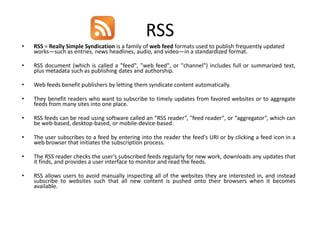
•   RSS = Really Simple Syndication is a family of web feed formats used to publish frequently updated
    works—such as entries, news headlines, audio, and video—in a standardized format.

•   RSS document (which is called a "feed", "web feed", or "channel") includes full or summarized text,
    plus metadata such as publishing dates and authorship.

•   Web feeds benefit publishers by letting them syndicate content automatically.

•   They benefit readers who want to subscribe to timely updates from favored websites or to aggregate
    feeds from many sites into one place.

•   RSS feeds can be read using software called an “RSS reader”, "feed reader", or “aggregator”, which can
    be web-based, desktop-based, or mobile-device-based.

•   The user subscribes to a feed by entering into the reader the feed's URI or by clicking a feed icon in a
    web browser that initiates the subscription process.

•   The RSS reader checks the user's subscribed feeds regularly for new work, downloads any updates that
    it finds, and provides a user interface to monitor and read the feeds.

•   RSS allows users to avoid manually inspecting all of the websites they are interested in, and instead
    subscribe to websites such that all new content is pushed onto their browsers when it becomes
    available.
RSS History & Variants
The RSS formats were preceded by several attempts at web syndication that did
   not achieve widespread popularity. The basic idea of restructuring
   information about websites goes back to as early as 1995, when Ramanathan
   V. Guha and other in Apple Computer’s Advanced Technology Group
   developed the Meta Content Framework.

There are several different versions of RSS-

     –   RSS 0.90
     –   RSS 0.91
     –   RSS 0.92
     –   RSS 1.0
     –   RSS 1.1
     –   RSS2.01
What are the benefits to having an RSS feed?

RSS is beneficial to both publishers and website visitors. To keep things simple I have
   listed just a few of the benefits for both publishers and website visitors.
   RSS benefits for publishers:
   1. Reaching new audiences through syndication
   2. Improved search engine optimization
   3. Easier and less expensive vehicle for communication than email.
   4. Additional way to communicate with customers or potential customers.
   RSS benefits for website visitors:
   1. Website visitors do not have to release personal information in order to
   subscribe to an RSS feed.
   2. 100% opt-in, users control the content they wish to receive.
   3. Faster method for scanning content (saves time)
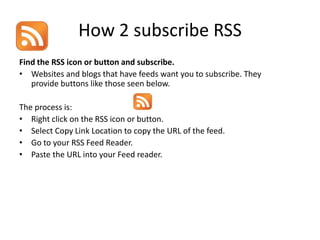
How 2 subscribe RSS
Find the RSS icon or button and subscribe.
• Websites and blogs that have feeds want you to subscribe. They
   provide buttons like those seen below.

The process is:
• Right click on the RSS icon or button.
• Select Copy Link Location to copy the URL of the feed.
• Go to your RSS Feed Reader.
• Paste the URL into your Feed reader.
RSS symbols


http://rss-tutorial.com/rss-how-to-subscribe-to-feeds.htm
RSS for Libraries
• http://www.loc.gov/rss/
• http://www.cincinnatilibrary.org/feeds/
• http://www.computer.org/portal/web/csdl/dlrss
• http://library.mcmaster.ca/php/blog.php?display=full
  &id=94
• www.library.auckland.ac.nz/rss/
Free e-books


http://www.gutenberg.org/
                            http://www.e-book.com.au/freebooks.htm


                                              www.ebookee.org
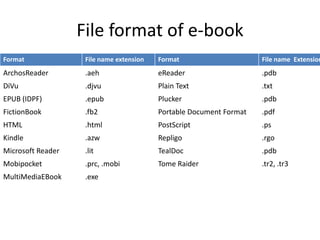
File format of e-book
Format              File name extension   Format                     File name Extension
ArchosReader        .aeh                  eReader                    .pdb
DiVu                .djvu                 Plain Text                 .txt
EPUB (IDPF)         .epub                 Plucker                    .pdb
FictionBook         .fb2                  Portable Document Format   .pdf
HTML                .html                 PostScript                 .ps
Kindle              .azw                  Repligo                    .rgo
Microsoft Reader    .lit                  TealDoc                    .pdb
Mobipocket          .prc, .mobi           Tome Raider                .tr2, .tr3
MultiMediaEBook     .exe
Library 2.0 concept model
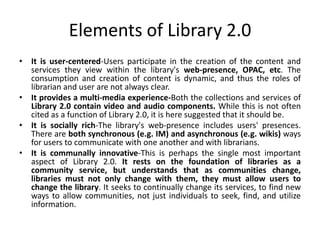
Elements of Library 2.0
• It is user-centered-Users participate in the creation of the content and
  services they view within the library's web-presence, OPAC, etc. The
  consumption and creation of content is dynamic, and thus the roles of
  librarian and user are not always clear.
• It provides a multi-media experience-Both the collections and services of
  Library 2.0 contain video and audio components. While this is not often
  cited as a function of Library 2.0, it is here suggested that it should be.
• It is socially rich-The library's web-presence includes users' presences.
  There are both synchronous (e.g. IM) and asynchronous (e.g. wikis) ways
  for users to communicate with one another and with librarians.
• It is communally innovative-This is perhaps the single most important
  aspect of Library 2.0. It rests on the foundation of libraries as a
  community service, but understands that as communities change,
  libraries must not only change with them, they must allow users to
  change the library. It seeks to continually change its services, to find new
  ways to allow communities, not just individuals to seek, find, and utilize
  information.
Ward Cunningham

                     Wiki

A wiki is a website which allows its users to add,
  modify, or delete its content via a web
  browser using a simplified markup language
  or a rich-text editor. Wikis are powered
  by wiki software. Most are created
  collaboratively.
Wikipedia

Wikipedia is a free, collaboratively edited and multilingual                     Internet
encyclopedia supported by the non-profit Wikimedia Foundation.

•22 million articles (over 3.9 million in English alone) have been written collaboratively
by volunteers around the world.
•It has about 100,000 regularly active contributors.
•As of June 2012, there are editions of Wikipedia in 285 languages.
• 365 million readers worldwide.

Wikipedia was launched in January 2001 by Jimmy Wales and Larry Sanger. Sanger
coined the name Wikipedia, which is a portmanteau of wiki (a type of collaborative
website, from the Hawaiian word wiki, meaning "quick") and encyclopedia.
Wikis
• Bangla Wikipedia
http://bn.wikipedia.org/wiki/Wikipedia
• Bangla Wiki Books
http://bn.wikisource.org

• LIS Wiki
http://liswiki.org/wiki/Main_Page
Ask a librarian
IR Open Source Software
Dspace

    A software platform developed and used at MIT that enables institutions to capture and describe digital works
    using a submission workflow module. The system enables these works to be archived and distributed over the
    web through a search and retrieval system.
Fedora
    A software platform that provides a robust foundation for an array of innovative solutions including open-access
    publishing, scholarly communication, e-science, digital libraries, archives, education, and more. Using a standards-
    based, service-oriented architecture, the Fedora platform provides an extensible framework of service
    components to support features such as OAI-PMH, search engine integration, fine-grained access control, content
    versioning and integrity checking, dynamic views of digital objects and formal semantic relationships among them.
GNU EPrints Archive Software

      A software platform developed at the University of Southampton which creates online archives that can be "full-
      text" searched with enhanced searching for names and dates.
IR+
      IR+ is an institutional repository software project. It is a fully featured digital repository management solution that
      is easy for users to understand and manage. Its goals are to meet the needs of any organization that needs to
      author, publish and preserve digital information.

OCLC Research Software
    A list of open source software developed by the Online Computer Library Center (OCLC) to build a repository and
    harvest data according to OAI-PMH standards.
Open Source LMS
KOHA (OPAC)


http://koha-community.org/demo/
KOHA (Staff Interface)
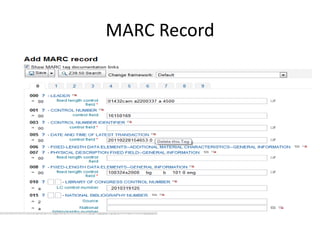
MARC Record
MARC 21
SMS for Reference Services
•   Google SMS
•   Altarama's Reference by SMS
•   AIM Hack: Your users can:
     –   Send a message to 246246 (AIMAIM)
     –   Enter the text "send [library's AIM address] [question]" (without quotations or brackets)
            •   For example:
            •   send anytownlibrarychat what are yr hours?
     –   From that point on, send and receive messages as you normally would. (Your patron doesn't need to use the account prefix, etc.
         for each message during the session)
     –   Standard messaging rates will apply
•   Text a Librarian, Powered by Mosio - Text Message (SMS) Reference Services. Accessible on over 260 million US
    mobile phones using a mobile, cell phone carrier approved technologies. Used by single branch libraries or multi-
    library cooperatives.
•   LibraryH3lp Twilio SMS Gateway - Patrons text a phone number, not a short code/keyword combination. US phone
    numbers only; international texts can be received and sent. Text messages can be flexibly routed and transferred
    among librarians.
•   LibraryH3lp Android SMS Gateway - Library provides the Google Android phone and creates a gateway using
    LibraryH3lp. Patrons text a phone number, not a short code/keyword combination. Text messages can be flexibly
    routed and transferred among librarians.
•   LibraryH3lp Google Voice Gateway - Library obtains a Google Voice account and phone number. Patrons text a
    phone number, not a short code/keyword combination. Librarian respond via IM as with other LibraryH3lp
    questions.
•   Upside Wireless is an SMS gateway company used by UCLA Libraries
•   Twilio Provides US phone numbers and APIs for developers to use in creating their own applications. Libraries with
    programming resources available could roll their own SMS service.
Mobile Enhanced Library services


  http://www.slideshare.net/tsierra/opportuniti
  es-for-mobile-enhanced-library-services-and-    http://m.lib.ncsu.edu/
  collections
31

Library 2.0

  • 1.
  • 2.
    Library 2.0 Definitions Library 2.0= Web 2.0 tools + Library services Library 2.0 describes a subset of library services designed to meet user needs caused by the direct and peripheral effects of Web 2.0 services …. (Habib, 2006: p.24).
  • 3.
    Web 2.0 The termWeb 2.0 is associated with web applications that facilitate participatory information sharing, interoperability, user- centered design, and collaboration on the World Wide Web. (Web 2.0 –Wikipedia, 2011) Examples of Web 2.0 include social networking sites, blogs, wikis, video sharing sites, hosted services, web applications, mashups and folksonomies.
  • 4.
    Web 1.0 vsWeb 2.0
  • 5.
    Web 2.0 vsLibrary 2.0 Web 2.0 Library 2.0 Tim O’Reilly librarycrunch.com web as platform user participation read/write user-centred services perpetual beta radical trust
  • 6.
    Library 1.0 vsLibrary 2.0 Library 1.0 Library 2.0 Closed stacks Open Stacks Collection Development Library Suggestion box Preorganized ILS User tagging Walk-in services Globally available services “Read-only” catalog OPAC Print newsletter mailed out Team-built blog Easy=dumb users Easy=smart systems Limited service options Broad range of options Information as commodity Information as conversation Monolithic applications Flexible, adaptive module Mission focus in output Mission focus in outcome ILS is core operation User services are core
  • 7.
    Library (the taxonomy) • Traditional • Hybrid On • Digital/Virtual collections • Poly-media • Public • Academic On • Special service • National
  • 8.
    Kindle (an e-reader) Developer Amazon.com The fourth generation Kindle, Kindle Touch and Manufacturer Foxconn Kindle Touch 3G can display Product family Kindle Kindle (AZW), TXT, PDF, unprotected MOBI, and PRC Type E-book reader files natively. HTML, DOC, Release date November 19, 2007 DOCX, JPEG, GIF, PNG, and BMP are usable through Introductory price $399 conversion. Operating system Linux 2.6.26 A third generation Kindle (now known as "Kindle Keyboard") in graphite color
  • 9.
    RSS • RSS = Really Simple Syndication is a family of web feed formats used to publish frequently updated works—such as entries, news headlines, audio, and video—in a standardized format. • RSS document (which is called a "feed", "web feed", or "channel") includes full or summarized text, plus metadata such as publishing dates and authorship. • Web feeds benefit publishers by letting them syndicate content automatically. • They benefit readers who want to subscribe to timely updates from favored websites or to aggregate feeds from many sites into one place. • RSS feeds can be read using software called an “RSS reader”, "feed reader", or “aggregator”, which can be web-based, desktop-based, or mobile-device-based. • The user subscribes to a feed by entering into the reader the feed's URI or by clicking a feed icon in a web browser that initiates the subscription process. • The RSS reader checks the user's subscribed feeds regularly for new work, downloads any updates that it finds, and provides a user interface to monitor and read the feeds. • RSS allows users to avoid manually inspecting all of the websites they are interested in, and instead subscribe to websites such that all new content is pushed onto their browsers when it becomes available.
  • 10.
    RSS History &Variants The RSS formats were preceded by several attempts at web syndication that did not achieve widespread popularity. The basic idea of restructuring information about websites goes back to as early as 1995, when Ramanathan V. Guha and other in Apple Computer’s Advanced Technology Group developed the Meta Content Framework. There are several different versions of RSS- – RSS 0.90 – RSS 0.91 – RSS 0.92 – RSS 1.0 – RSS 1.1 – RSS2.01
  • 11.
    What are thebenefits to having an RSS feed? RSS is beneficial to both publishers and website visitors. To keep things simple I have listed just a few of the benefits for both publishers and website visitors. RSS benefits for publishers: 1. Reaching new audiences through syndication 2. Improved search engine optimization 3. Easier and less expensive vehicle for communication than email. 4. Additional way to communicate with customers or potential customers. RSS benefits for website visitors: 1. Website visitors do not have to release personal information in order to subscribe to an RSS feed. 2. 100% opt-in, users control the content they wish to receive. 3. Faster method for scanning content (saves time)
  • 12.
    How 2 subscribeRSS Find the RSS icon or button and subscribe. • Websites and blogs that have feeds want you to subscribe. They provide buttons like those seen below. The process is: • Right click on the RSS icon or button. • Select Copy Link Location to copy the URL of the feed. • Go to your RSS Feed Reader. • Paste the URL into your Feed reader.
  • 13.
  • 14.
    RSS for Libraries •http://www.loc.gov/rss/ • http://www.cincinnatilibrary.org/feeds/ • http://www.computer.org/portal/web/csdl/dlrss • http://library.mcmaster.ca/php/blog.php?display=full &id=94 • www.library.auckland.ac.nz/rss/
  • 15.
    Free e-books http://www.gutenberg.org/ http://www.e-book.com.au/freebooks.htm www.ebookee.org
  • 16.
    File format ofe-book Format File name extension Format File name Extension ArchosReader .aeh eReader .pdb DiVu .djvu Plain Text .txt EPUB (IDPF) .epub Plucker .pdb FictionBook .fb2 Portable Document Format .pdf HTML .html PostScript .ps Kindle .azw Repligo .rgo Microsoft Reader .lit TealDoc .pdb Mobipocket .prc, .mobi Tome Raider .tr2, .tr3 MultiMediaEBook .exe
  • 17.
  • 18.
    Elements of Library2.0 • It is user-centered-Users participate in the creation of the content and services they view within the library's web-presence, OPAC, etc. The consumption and creation of content is dynamic, and thus the roles of librarian and user are not always clear. • It provides a multi-media experience-Both the collections and services of Library 2.0 contain video and audio components. While this is not often cited as a function of Library 2.0, it is here suggested that it should be. • It is socially rich-The library's web-presence includes users' presences. There are both synchronous (e.g. IM) and asynchronous (e.g. wikis) ways for users to communicate with one another and with librarians. • It is communally innovative-This is perhaps the single most important aspect of Library 2.0. It rests on the foundation of libraries as a community service, but understands that as communities change, libraries must not only change with them, they must allow users to change the library. It seeks to continually change its services, to find new ways to allow communities, not just individuals to seek, find, and utilize information.
  • 19.
    Ward Cunningham Wiki A wiki is a website which allows its users to add, modify, or delete its content via a web browser using a simplified markup language or a rich-text editor. Wikis are powered by wiki software. Most are created collaboratively.
  • 20.
    Wikipedia Wikipedia is afree, collaboratively edited and multilingual Internet encyclopedia supported by the non-profit Wikimedia Foundation. •22 million articles (over 3.9 million in English alone) have been written collaboratively by volunteers around the world. •It has about 100,000 regularly active contributors. •As of June 2012, there are editions of Wikipedia in 285 languages. • 365 million readers worldwide. Wikipedia was launched in January 2001 by Jimmy Wales and Larry Sanger. Sanger coined the name Wikipedia, which is a portmanteau of wiki (a type of collaborative website, from the Hawaiian word wiki, meaning "quick") and encyclopedia.
  • 21.
    Wikis • Bangla Wikipedia http://bn.wikipedia.org/wiki/Wikipedia •Bangla Wiki Books http://bn.wikisource.org • LIS Wiki http://liswiki.org/wiki/Main_Page
  • 22.
  • 23.
    IR Open SourceSoftware Dspace A software platform developed and used at MIT that enables institutions to capture and describe digital works using a submission workflow module. The system enables these works to be archived and distributed over the web through a search and retrieval system. Fedora A software platform that provides a robust foundation for an array of innovative solutions including open-access publishing, scholarly communication, e-science, digital libraries, archives, education, and more. Using a standards- based, service-oriented architecture, the Fedora platform provides an extensible framework of service components to support features such as OAI-PMH, search engine integration, fine-grained access control, content versioning and integrity checking, dynamic views of digital objects and formal semantic relationships among them. GNU EPrints Archive Software A software platform developed at the University of Southampton which creates online archives that can be "full- text" searched with enhanced searching for names and dates. IR+ IR+ is an institutional repository software project. It is a fully featured digital repository management solution that is easy for users to understand and manage. Its goals are to meet the needs of any organization that needs to author, publish and preserve digital information. OCLC Research Software A list of open source software developed by the Online Computer Library Center (OCLC) to build a repository and harvest data according to OAI-PMH standards.
  • 24.
  • 25.
  • 26.
  • 27.
  • 28.
  • 29.
    SMS for ReferenceServices • Google SMS • Altarama's Reference by SMS • AIM Hack: Your users can: – Send a message to 246246 (AIMAIM) – Enter the text "send [library's AIM address] [question]" (without quotations or brackets) • For example: • send anytownlibrarychat what are yr hours? – From that point on, send and receive messages as you normally would. (Your patron doesn't need to use the account prefix, etc. for each message during the session) – Standard messaging rates will apply • Text a Librarian, Powered by Mosio - Text Message (SMS) Reference Services. Accessible on over 260 million US mobile phones using a mobile, cell phone carrier approved technologies. Used by single branch libraries or multi- library cooperatives. • LibraryH3lp Twilio SMS Gateway - Patrons text a phone number, not a short code/keyword combination. US phone numbers only; international texts can be received and sent. Text messages can be flexibly routed and transferred among librarians. • LibraryH3lp Android SMS Gateway - Library provides the Google Android phone and creates a gateway using LibraryH3lp. Patrons text a phone number, not a short code/keyword combination. Text messages can be flexibly routed and transferred among librarians. • LibraryH3lp Google Voice Gateway - Library obtains a Google Voice account and phone number. Patrons text a phone number, not a short code/keyword combination. Librarian respond via IM as with other LibraryH3lp questions. • Upside Wireless is an SMS gateway company used by UCLA Libraries • Twilio Provides US phone numbers and APIs for developers to use in creating their own applications. Libraries with programming resources available could roll their own SMS service.
  • 30.
    Mobile Enhanced Libraryservices http://www.slideshare.net/tsierra/opportuniti es-for-mobile-enhanced-library-services-and- http://m.lib.ncsu.edu/ collections
  • 31.

Editor's Notes

  • #4 Mashup: A mashup novel, or mashup book (also mash-up), is a work of fiction which combines a pre-existing text, often a classic work of fiction,...Folksonomy: The activity of sorting information into categories derived from the consensus of the information users.