Kankana Baishya
Assistant Librarian
National Law University and Judicial Academy, Assam
Guwahati-781007
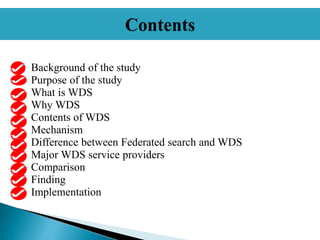
Background of the study
Purpose of the study
What is WDS
Why WDS
Contents of WDS
Mechanism
Difference between Federated search and WDS
Major WDS service providers
Comparison
Finding
Implementation
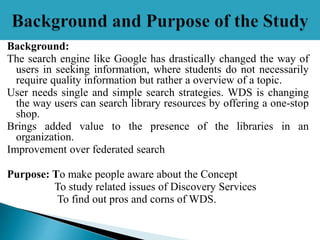
Background:
The search engine like Google has drastically changed the way of
users in seeking information, where students do not necessarily
require quality information but rather a overview of a topic.
User needs single and simple search strategies. WDS is changing
the way users can search library resources by offering a one-stop
shop.
Brings added value to the presence of the libraries in an
organization.
Improvement over federated search
Purpose: To make people aware about the Concept
To study related issues of Discovery Services
To find out pros and corns of WDS.
Web scale discovery service is a single point of entry into a
library’s collections
Feature:
 Unified platform to search all the resources including licensed,
open and local collections
 Google like single search box
 Single results list for all collections
 Relevancy ranking across entire results
 Connections to full text
 Infrastructure, processing and indexing are maintained
remotely by the vendor
 Increases exposure of the resources
 Less Labour intensive
 Time Saving
 Single search strategy
 Single interface to quality resources
 Increases the usage statistics of the databases
 Reduces Training sessions
 Digital Collection
 E Books
 E Database (Open Access, Free or subscribed)
 Locally developed contents(online catalogue, the
institutional repositories and its own full text
subscribed electronic content,
 Content from locally developed and hosted database
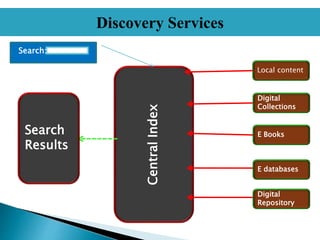
 Web-scale discovery: A preharvested central index featured with discovery layer
providing a single search across a library’s entire local, open access, and
subscription collections.
 Central index:
Meta data index
a technology that hyperlinks to the full text of the content subscribed by the
libraries implementing these solutions.
One of the significant features discrete to web scale discovery content is its ability
to index the local collection of
 Discovery layer: The user interfaces and search system for discovering,
displaying, and interacting with the content in library systems
 Library Optimization:. The search interface provides multiple searching
strategies, allowing the user to refine on number of filters such as subjects covered,
peer reviewed content, full text and orients it to only library owned content. The
relevancy algorithm and ranking of results is weighed on factors such as,
keywords matching with subject and title of the content, peer review, currency and
surrogates of local print content.
Search:
CentralIndex
Local content
Discovery Services
Search
Results
Digital
Collections
E Books
E databases
Digital
Repository
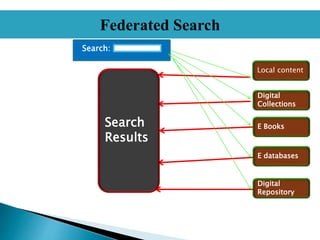
Search:
Local content
Federated Search
Search
Results
Digital
Collections
E Books
E databases
Digital
Repository
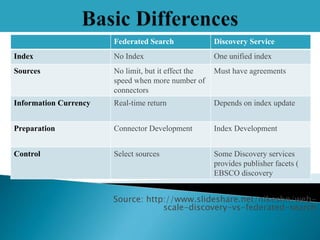
Source: http://www.slideshare.net/nikeshn/web-
scale-discovery-vs-federated-search
Federated Search Discovery Service
Index No Index One unified index
Sources No limit, but it effect the
speed when more number of
connectors
Must have agreements
Information Currency Real-time return Depends on index update
Preparation Connector Development Index Development
Control Select sources Some Discovery services
provides publisher facets (
EBSCO discovery
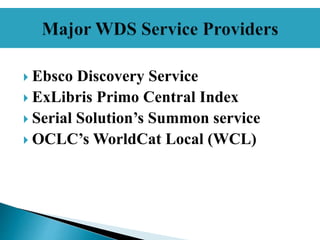
 Ebsco Discovery Service
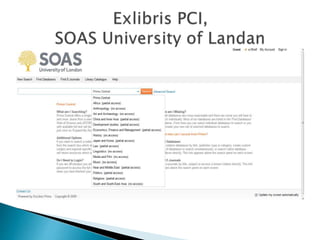
 ExLibris Primo Central Index
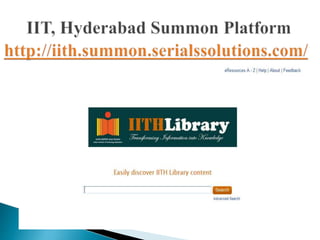
 Serial Solution’s Summon service
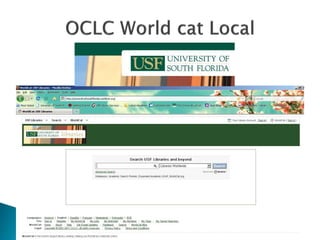
 OCLC’s WorldCat Local (WCL)
 Ebsco has started the EDS sevice in 2008
 Released publicly in 2010
 Ex Libris Ltd. Has started Primo in 2005
 Primo Central Index released officially in mid
2010
 In 2004 Serial Solutions became a division of
Proquest
 The Summon® WDS Service was initiated by
the Serial Solution in July, 2009
 OCLC released initial version of World Cat Local in
November, 2007
 OCLC brought out the discovery platform in 2009
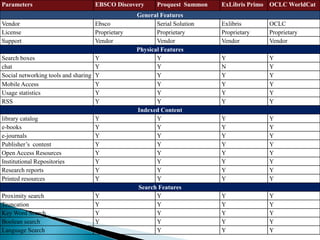
Parameters EBSCO Discovery Proquest Summon ExLibris Primo OCLC WorldCat
General Features
Vendor Ebsco Serial Solution Exlibris OCLC
License Proprietary Proprietary Proprietary Proprietary
Support Vendor Vendor Vendor Vendor
Physical Features
Search boxes Y Y Y Y
chat Y Y N Y
Social networking tools and sharing Y Y Y Y
Mobile Access Y Y Y Y
Usage statistics Y Y Y Y
RSS Y Y Y Y
Indexed Content
library catalog Y Y Y Y
e-books Y Y Y Y
e-journals Y Y Y Y
Publisher’s content Y Y Y Y
Open Access Resources Y Y Y Y
Institutional Repositories Y Y Y Y
Research reports Y Y Y Y
Printed resources Y Y Y Y
Search Features
Proximity search Y Y Y Y
Truncation Y Y Y Y
Key Word Search Y Y Y Y
Boolean search Y Y Y Y
Language Search Y Y Y Y
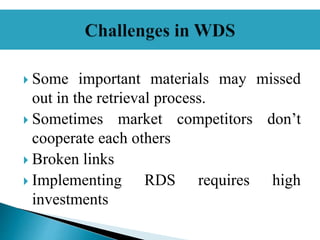
 Some important materials may missed
out in the retrieval process.
 Sometimes market competitors don’t
cooperate each others
 Broken links
 Implementing RDS requires high
investments
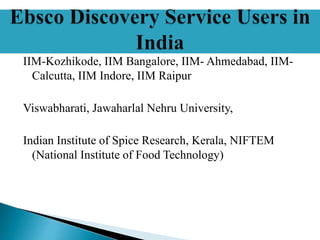
IIM-Kozhikode, IIM Bangalore, IIM- Ahmedabad, IIM-
Calcutta, IIM Indore, IIM Raipur
Viswabharati, Jawaharlal Nehru University,
Indian Institute of Spice Research, Kerala, NIFTEM
(National Institute of Food Technology)
 IIT, Hyderabad
 IIM, Ahmedabad
A discussion was posted in LIS
Links(http://lislinks.com/forum/topics/be
st-web-scale-discovery-
service#comments) asking the best WDS
Service. And accordingly many has
suggested to go for Ebsco Discovery
Service (EDS ).
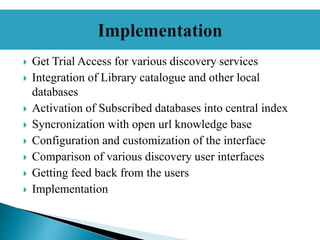
 Get Trial Access for various discovery services
 Integration of Library catalogue and other local
databases
 Activation of Subscribed databases into central index
 Syncronization with open url knowledge base
 Configuration and customization of the interface
 Comparison of various discovery user interfaces
 Getting feed back from the users
 Implementation
Have a Good day

Web scale discovery service

  • 1.
    Kankana Baishya Assistant Librarian NationalLaw University and Judicial Academy, Assam Guwahati-781007
  • 2.
    Background of thestudy Purpose of the study What is WDS Why WDS Contents of WDS Mechanism Difference between Federated search and WDS Major WDS service providers Comparison Finding Implementation
  • 3.
    Background: The search enginelike Google has drastically changed the way of users in seeking information, where students do not necessarily require quality information but rather a overview of a topic. User needs single and simple search strategies. WDS is changing the way users can search library resources by offering a one-stop shop. Brings added value to the presence of the libraries in an organization. Improvement over federated search Purpose: To make people aware about the Concept To study related issues of Discovery Services To find out pros and corns of WDS.
  • 4.
    Web scale discoveryservice is a single point of entry into a library’s collections Feature:  Unified platform to search all the resources including licensed, open and local collections  Google like single search box  Single results list for all collections  Relevancy ranking across entire results  Connections to full text  Infrastructure, processing and indexing are maintained remotely by the vendor
  • 5.
     Increases exposureof the resources  Less Labour intensive  Time Saving  Single search strategy  Single interface to quality resources  Increases the usage statistics of the databases  Reduces Training sessions
  • 6.
     Digital Collection E Books  E Database (Open Access, Free or subscribed)  Locally developed contents(online catalogue, the institutional repositories and its own full text subscribed electronic content,  Content from locally developed and hosted database
  • 7.
     Web-scale discovery:A preharvested central index featured with discovery layer providing a single search across a library’s entire local, open access, and subscription collections.  Central index: Meta data index a technology that hyperlinks to the full text of the content subscribed by the libraries implementing these solutions. One of the significant features discrete to web scale discovery content is its ability to index the local collection of  Discovery layer: The user interfaces and search system for discovering, displaying, and interacting with the content in library systems  Library Optimization:. The search interface provides multiple searching strategies, allowing the user to refine on number of filters such as subjects covered, peer reviewed content, full text and orients it to only library owned content. The relevancy algorithm and ranking of results is weighed on factors such as, keywords matching with subject and title of the content, peer review, currency and surrogates of local print content.
  • 8.
  • 9.
  • 10.
    Source: http://www.slideshare.net/nikeshn/web- scale-discovery-vs-federated-search Federated SearchDiscovery Service Index No Index One unified index Sources No limit, but it effect the speed when more number of connectors Must have agreements Information Currency Real-time return Depends on index update Preparation Connector Development Index Development Control Select sources Some Discovery services provides publisher facets ( EBSCO discovery
  • 11.
     Ebsco DiscoveryService  ExLibris Primo Central Index  Serial Solution’s Summon service  OCLC’s WorldCat Local (WCL)
  • 12.
     Ebsco hasstarted the EDS sevice in 2008  Released publicly in 2010
  • 13.
     Ex LibrisLtd. Has started Primo in 2005  Primo Central Index released officially in mid 2010
  • 14.
     In 2004Serial Solutions became a division of Proquest  The Summon® WDS Service was initiated by the Serial Solution in July, 2009
  • 15.
     OCLC releasedinitial version of World Cat Local in November, 2007  OCLC brought out the discovery platform in 2009
  • 16.
    Parameters EBSCO DiscoveryProquest Summon ExLibris Primo OCLC WorldCat General Features Vendor Ebsco Serial Solution Exlibris OCLC License Proprietary Proprietary Proprietary Proprietary Support Vendor Vendor Vendor Vendor Physical Features Search boxes Y Y Y Y chat Y Y N Y Social networking tools and sharing Y Y Y Y Mobile Access Y Y Y Y Usage statistics Y Y Y Y RSS Y Y Y Y Indexed Content library catalog Y Y Y Y e-books Y Y Y Y e-journals Y Y Y Y Publisher’s content Y Y Y Y Open Access Resources Y Y Y Y Institutional Repositories Y Y Y Y Research reports Y Y Y Y Printed resources Y Y Y Y Search Features Proximity search Y Y Y Y Truncation Y Y Y Y Key Word Search Y Y Y Y Boolean search Y Y Y Y Language Search Y Y Y Y
  • 17.
     Some importantmaterials may missed out in the retrieval process.  Sometimes market competitors don’t cooperate each others  Broken links  Implementing RDS requires high investments
  • 18.
    IIM-Kozhikode, IIM Bangalore,IIM- Ahmedabad, IIM- Calcutta, IIM Indore, IIM Raipur Viswabharati, Jawaharlal Nehru University, Indian Institute of Spice Research, Kerala, NIFTEM (National Institute of Food Technology)
  • 20.
     IIT, Hyderabad IIM, Ahmedabad
  • 24.
    A discussion wasposted in LIS Links(http://lislinks.com/forum/topics/be st-web-scale-discovery- service#comments) asking the best WDS Service. And accordingly many has suggested to go for Ebsco Discovery Service (EDS ).
  • 25.
     Get TrialAccess for various discovery services  Integration of Library catalogue and other local databases  Activation of Subscribed databases into central index  Syncronization with open url knowledge base  Configuration and customization of the interface  Comparison of various discovery user interfaces  Getting feed back from the users  Implementation
  • 26.

Editor's Notes

  • #8 Central index: Web scale discovery services have a central index which compiles metadata from various publishers and content providers at the back end. Along with a discovery or search interface which retrieves results from this backend index and, a technology that hyperlinks to the full text of the content subscribed by the libraries implementing these solutions. One of the significant features discrete to web scale discovery content is its ability to index the local collection of libraries such as the online catalogue, the institutional repositories and its own full text subscribed electronic content. These disparate objects are merged into a central index and provide real time information retrieved from multiple sources which include data from newspapers, book reviews, journals, magazines, e-books, databases, indexing and abstracting services and many more.
  • #13 EDS contains information from as many as 70,000 publishers and other providers who make available hundreds of millions of records from hundreds of thousands of journals, magazines, books, and other content sources
  • #14 Provide library users with a single solution for the discovery and delivery of all local and remote articles, books, open access collections, and digital content
  • #15 It’s the service that is based on the creation of a single record optimized for discovery, bringing together rich metadata and full text from multiple sources to make an item more discoverable
  • #16 Using WorldCat Discovery provides access to more than 2,000 collections, representing 285 of the world's top publishers, such as ProQuest, EBSCO *, Gale and Elsevier. Full text for more than 8+ million open-access content items from HathiTrust, OAIster and GoogleBooks are available, along with 15 million e-books from Overdrive, eBrary, MyiLibrary and others