INTEGRATING  INFORMATION LITERACY  THROUGHOUT THE CURRICULUM Julie Cavender Manager, Library Development & Services Jones e-global library
What we will cover today What is information literacy Why is it important Who needs it Where to start How to integrate with the curriculum
WHAT IS IT? Information Literacy
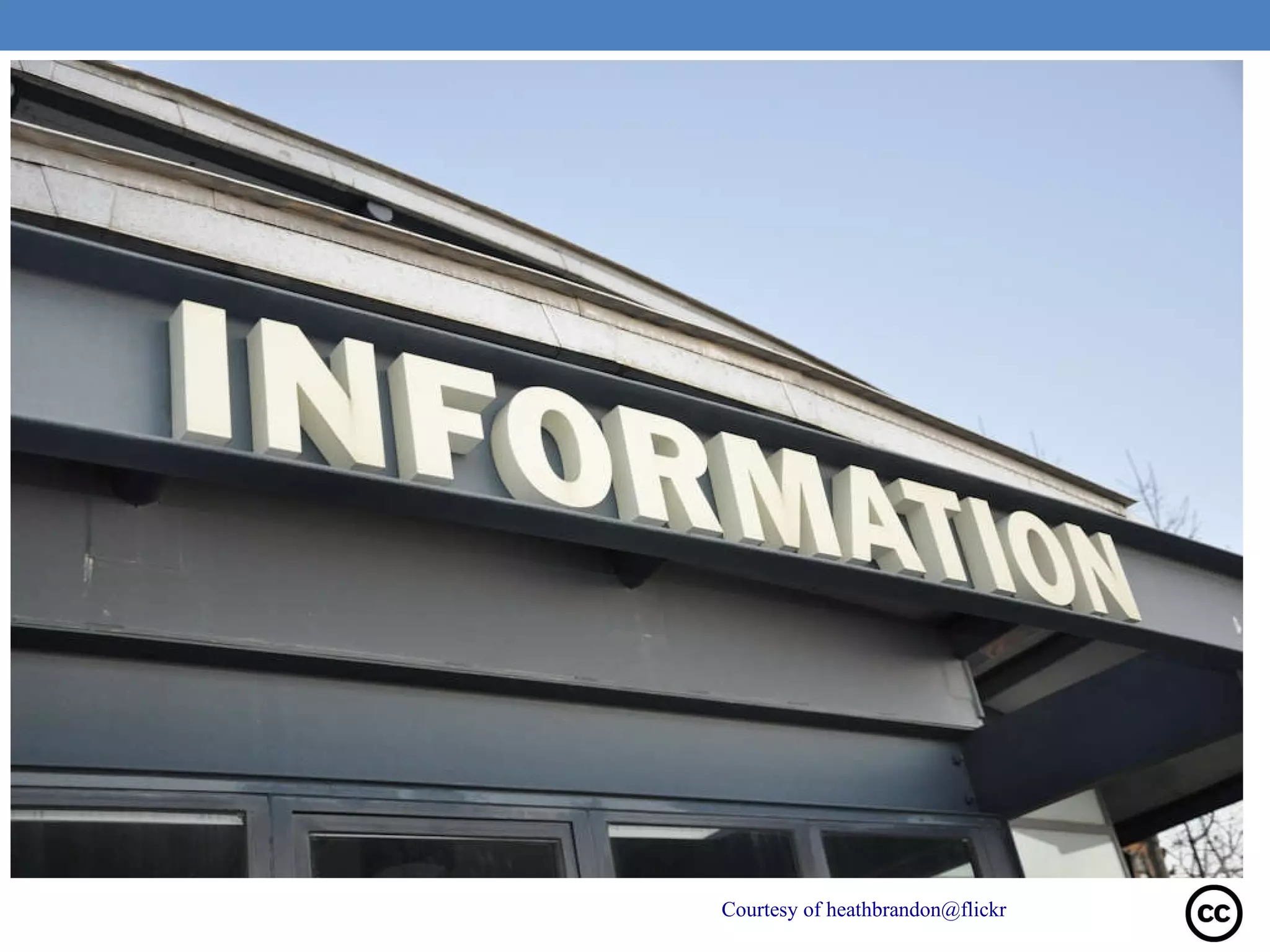
Courtesy of heathbrandon@flickr
 
 
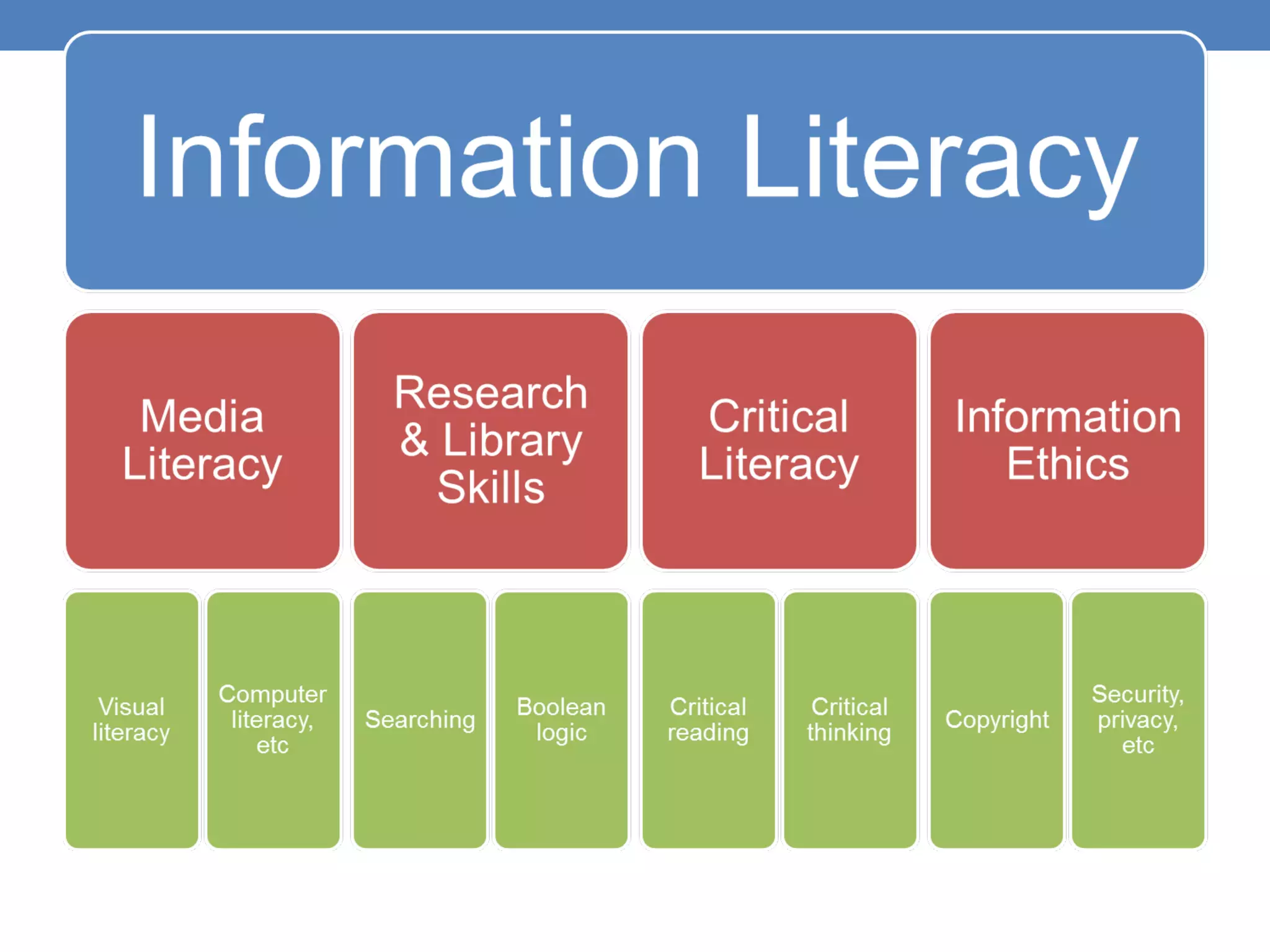
Information literacy is a set of abilities requiring individuals to “recognize when information is needed and have the ability to locate, evaluate, and use effectively the needed information.”
 
WHY IS IT IMPORTANT? Information Literacy
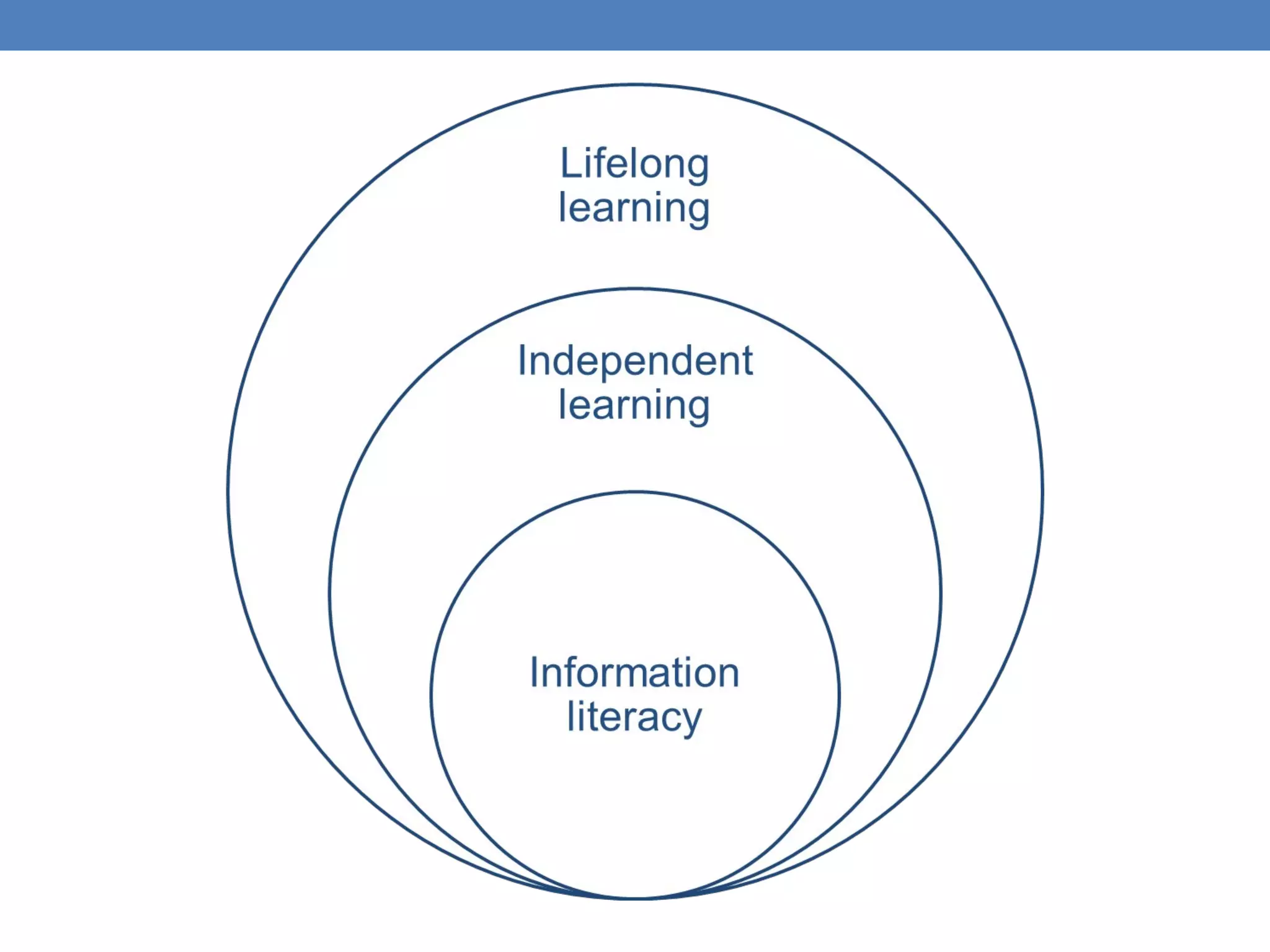
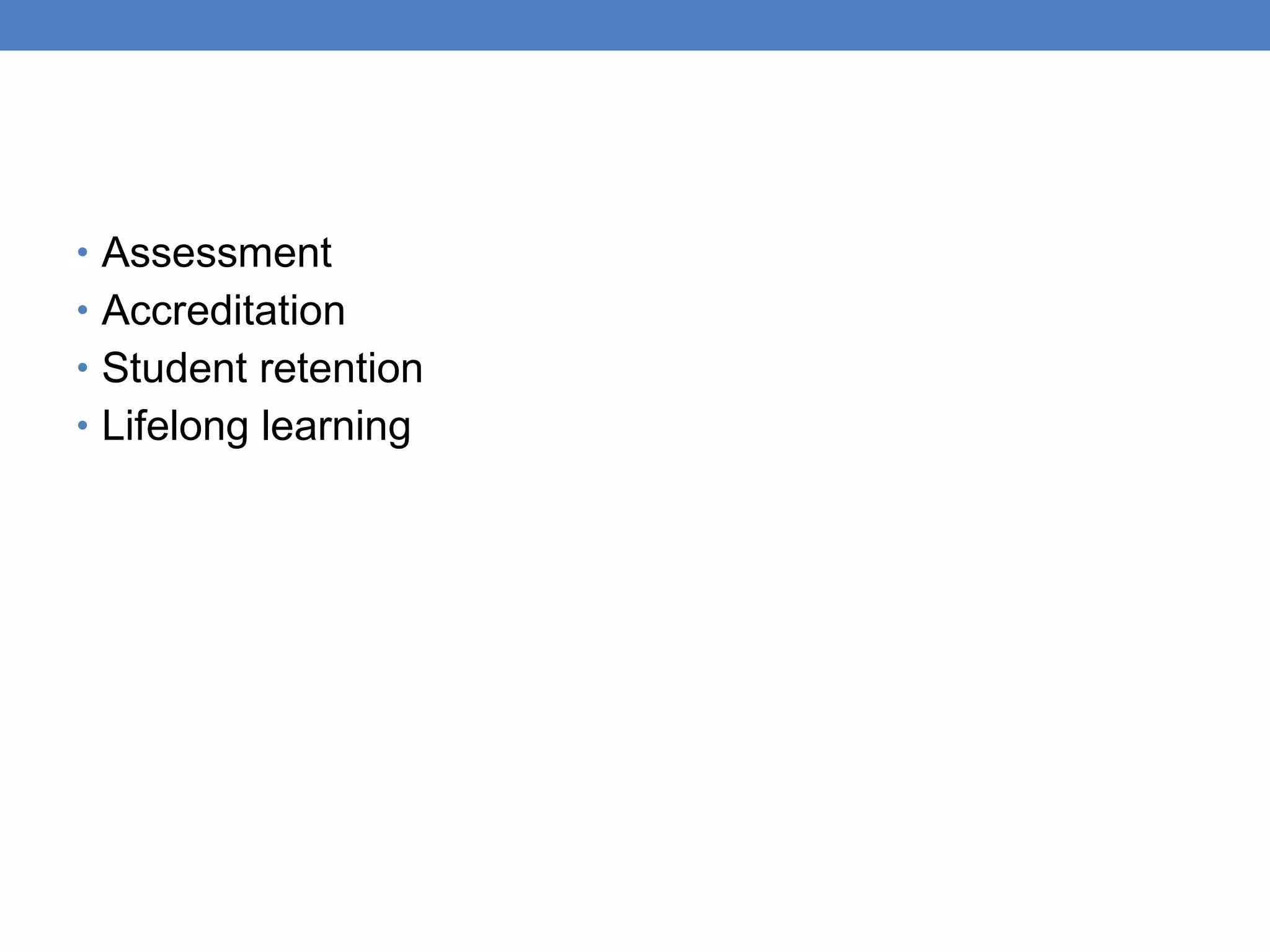
Assessment Accreditation Student retention Lifelong learning
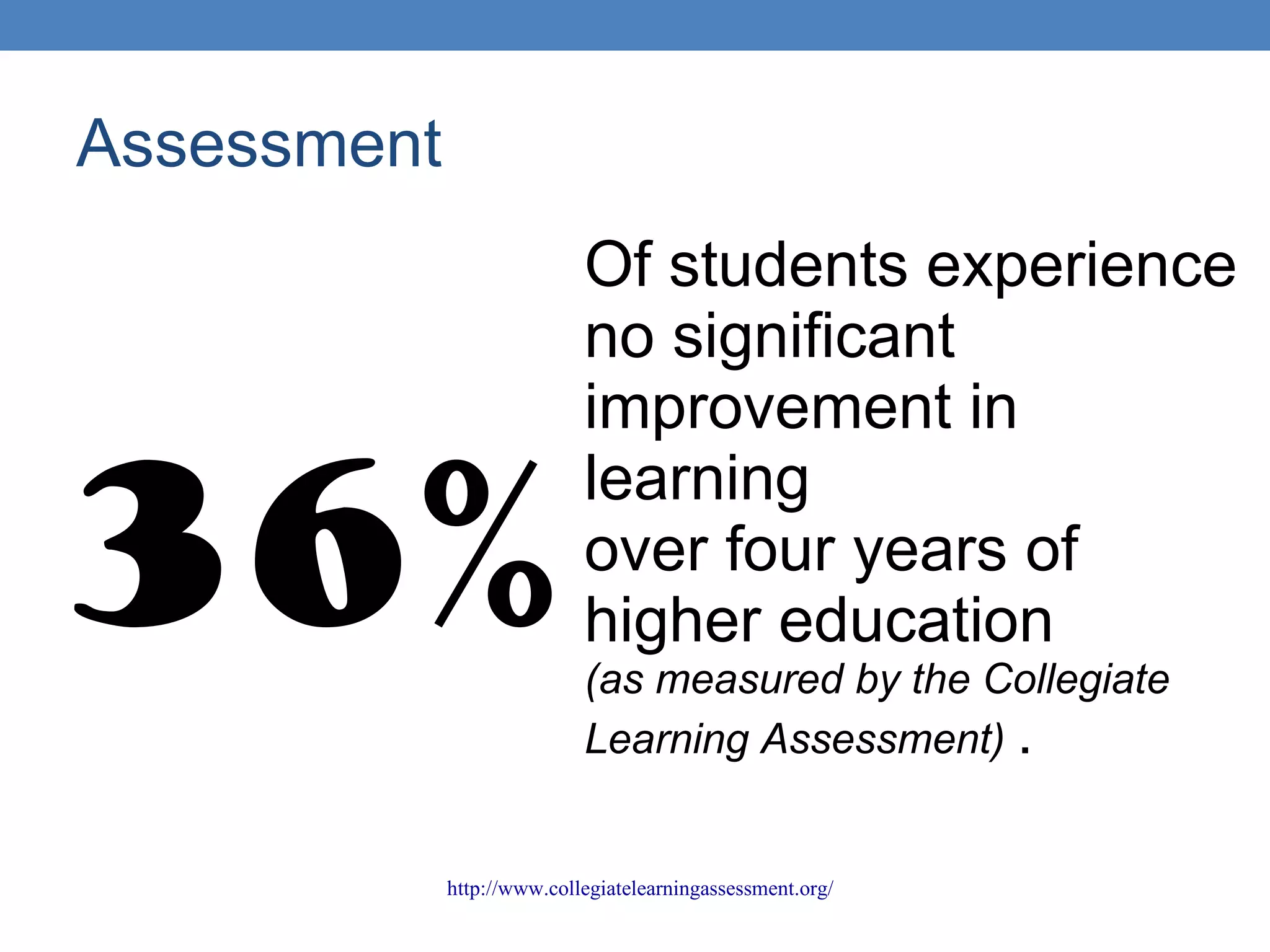
Assessment 36% Of students experience no significant improvement in learning over four years of higher education (as measured by the Collegiate Learning Assessment)  . http://www.collegiatelearningassessment.org/
Accreditation "[Baccalaureate programs] also ensure the development of core learning abilities and competencies including, but not limited to, college-level written and oral communication; college-level quantitative skills; information literacy; and the habit of critical analysis of data and argument." WASC Standard 2.2a of “Teaching and Learning”
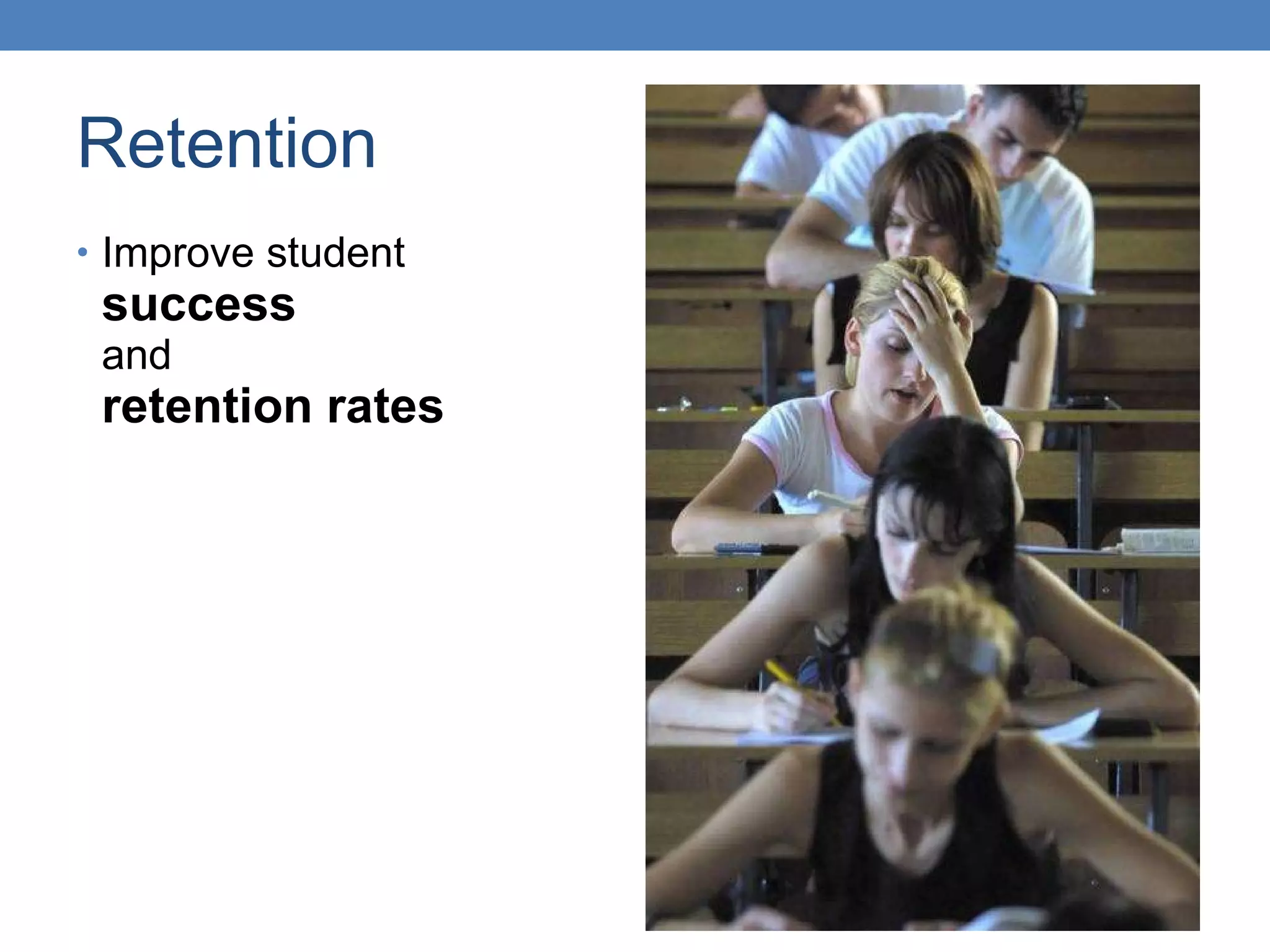
Retention Improve student  success   and  retention rates
 
WHO NEEDS IT? Information Literacy
 
WHERE DO I START? Information Literacy
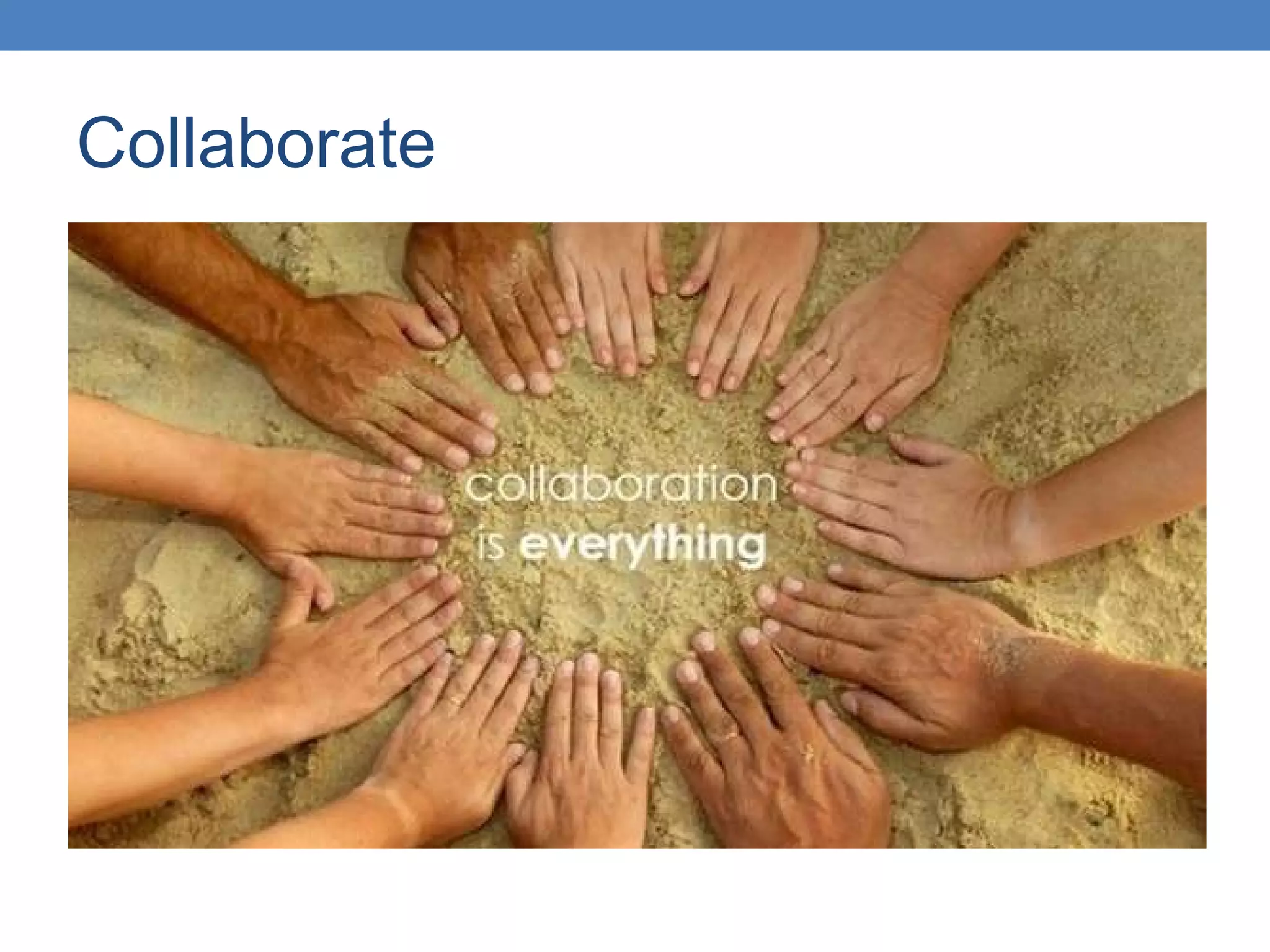
Collaborate
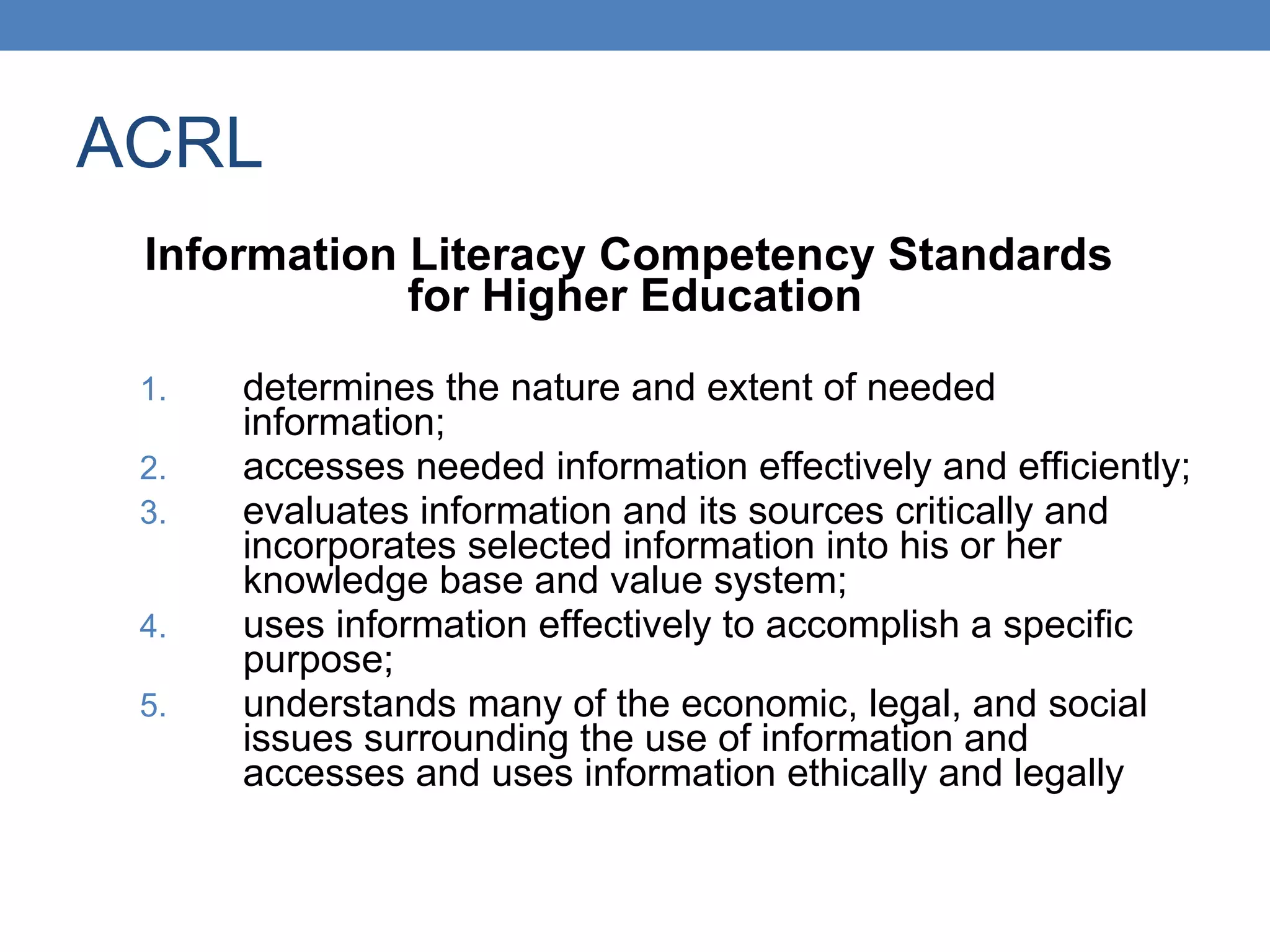
ACRL Information Literacy Competency Standards  for Higher Education determines the nature and extent of needed information; accesses needed information effectively and efficiently; evaluates information and its sources critically and incorporates selected information into his or her knowledge base and value system; uses information effectively to accomplish a specific purpose; understands many of the economic, legal, and social issues surrounding the use of information and accesses and uses information ethically and legally
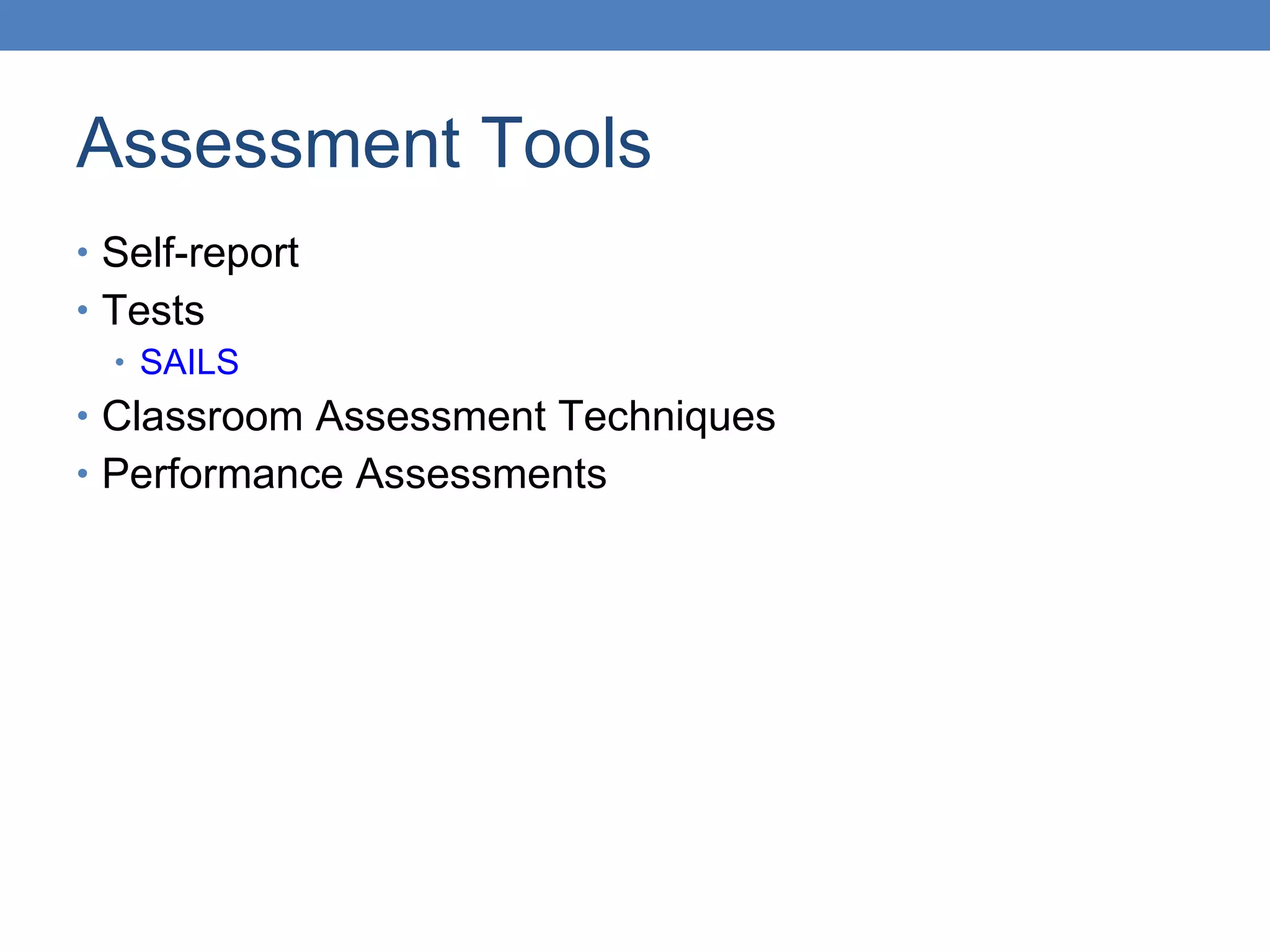
Assessment Tools Self-report Tests SAILS Classroom Assessment Techniques Performance Assessments
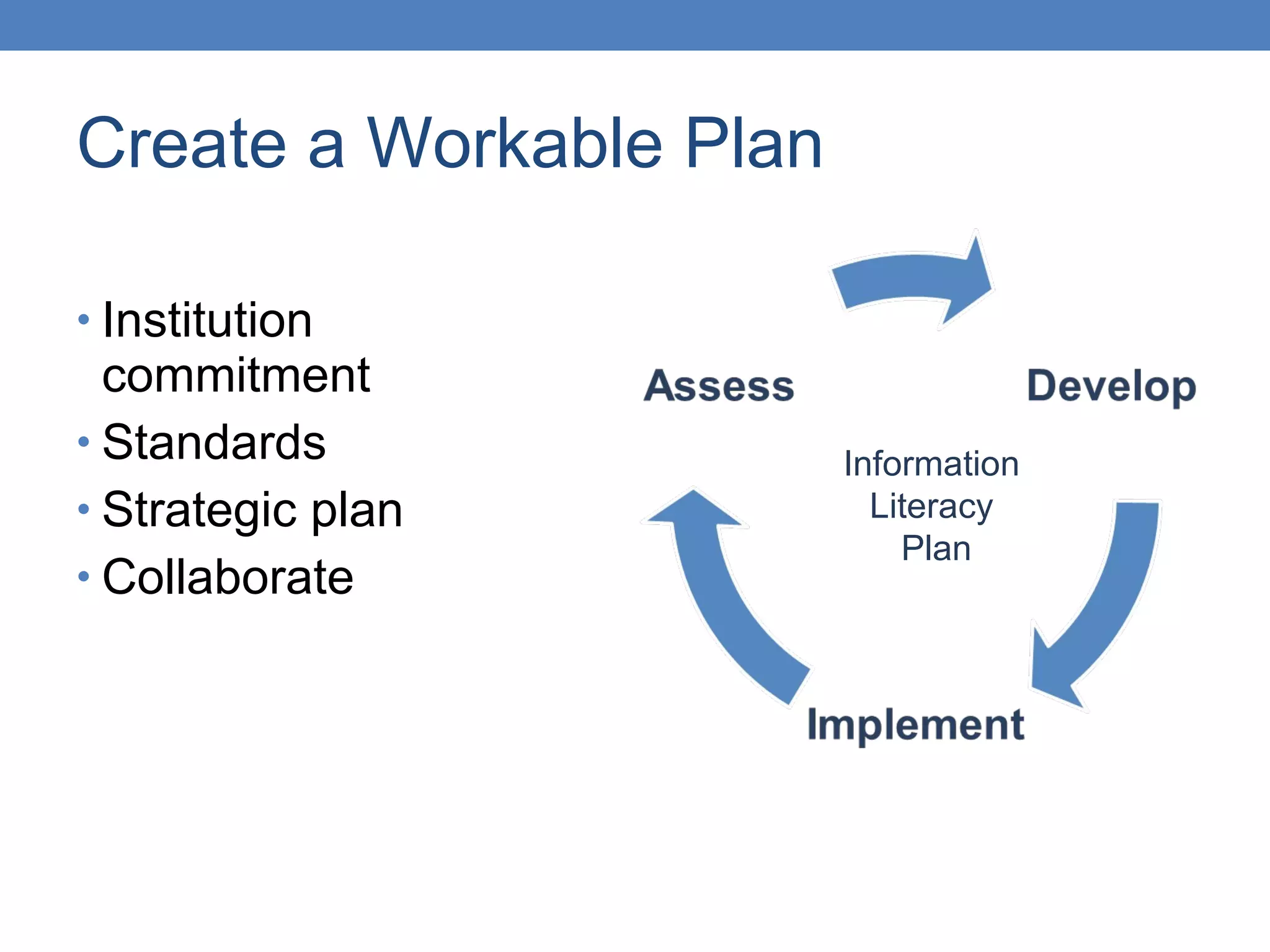
Create a Workable Plan Institution commitment Standards Strategic plan Collaborate Information  Literacy  Plan
 
HOW TO INTEGRATE WITH CURRICULUM Information Literacy
First Steps Tips Clear focus on information literacy standard for every activity Work on standards one by one  Promote IL activity Work in teams Be clear about IL objectives
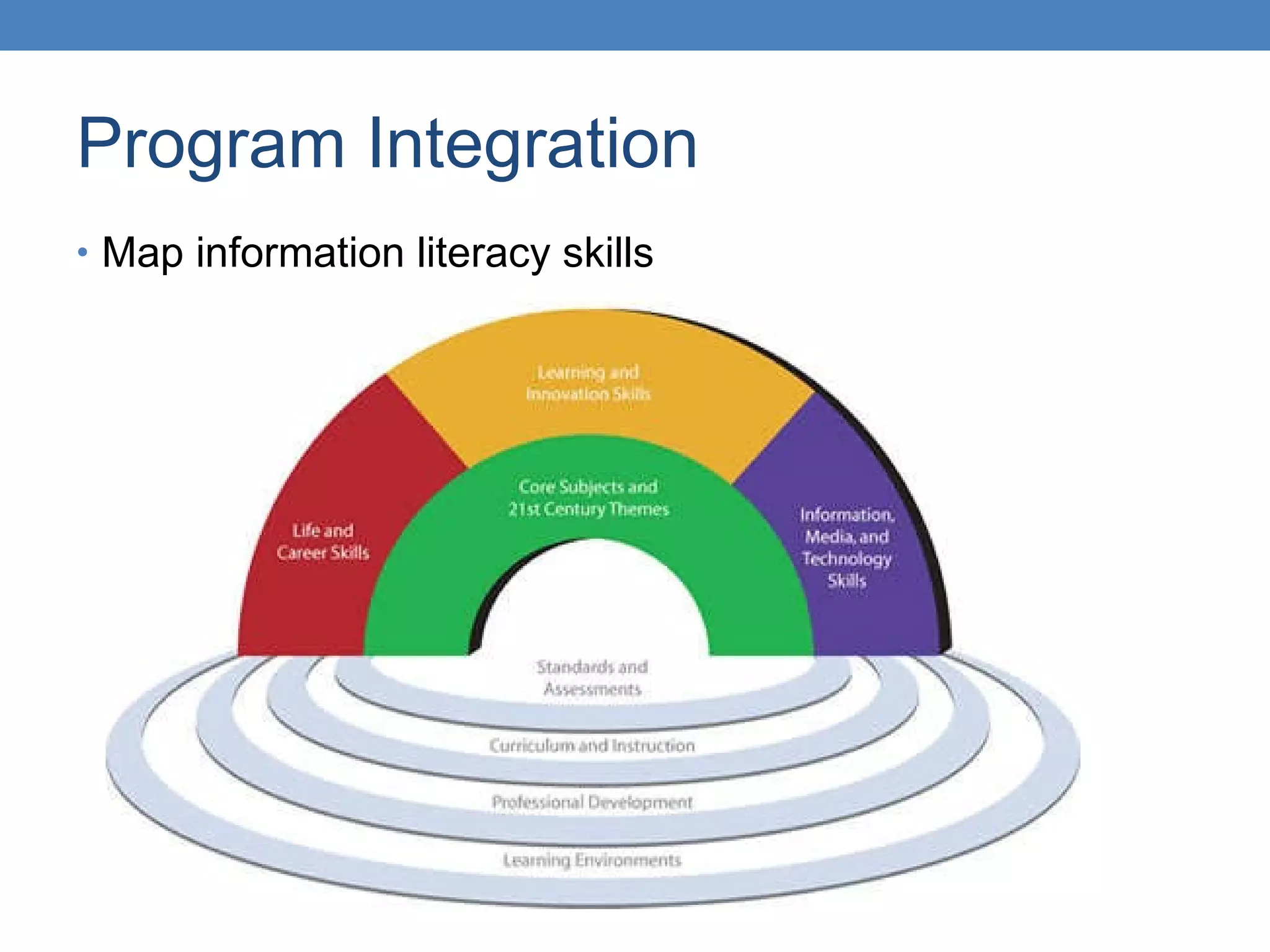
Program Integration Map information literacy skills
Learning Outcomes ACRL Sample criteria Level of reading Use of information to support point of view Citing and referencing Critical evaluation
Problem-Based Learning Annotated bibliographies Documenting search and retrieval process Find and critically evaluate opposing positions on a topic Contact a librarian
Online Environment Quizzes Discussion boards and chat Collaborative work Guides to resources Tutorials
USEFUL TOOLS Information Literacy
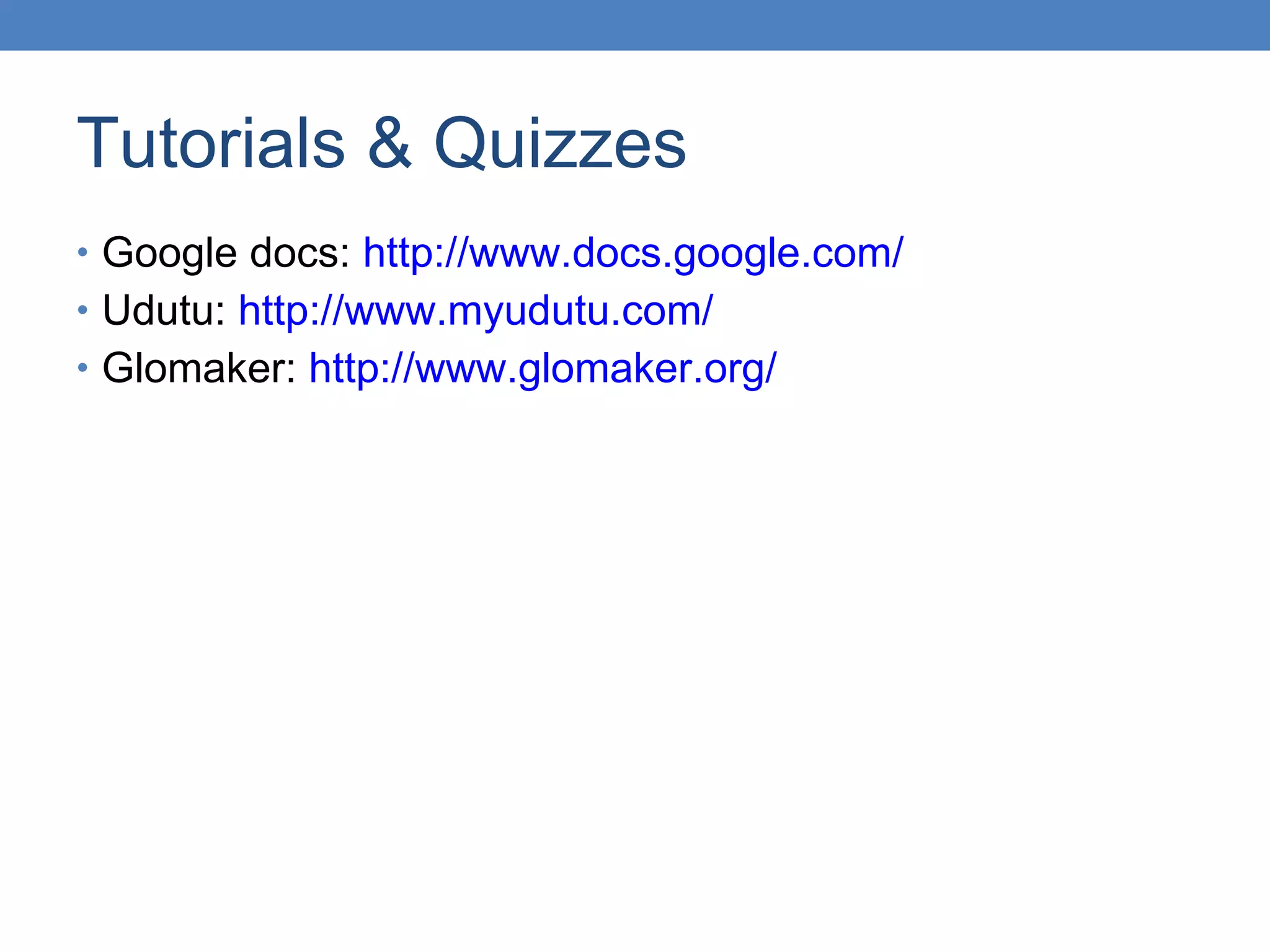
Tutorials & Quizzes Google docs:  http://www.docs.google.com/ Udutu:  http://www.myudutu.com/ Glomaker:  http://www.glomaker.org/
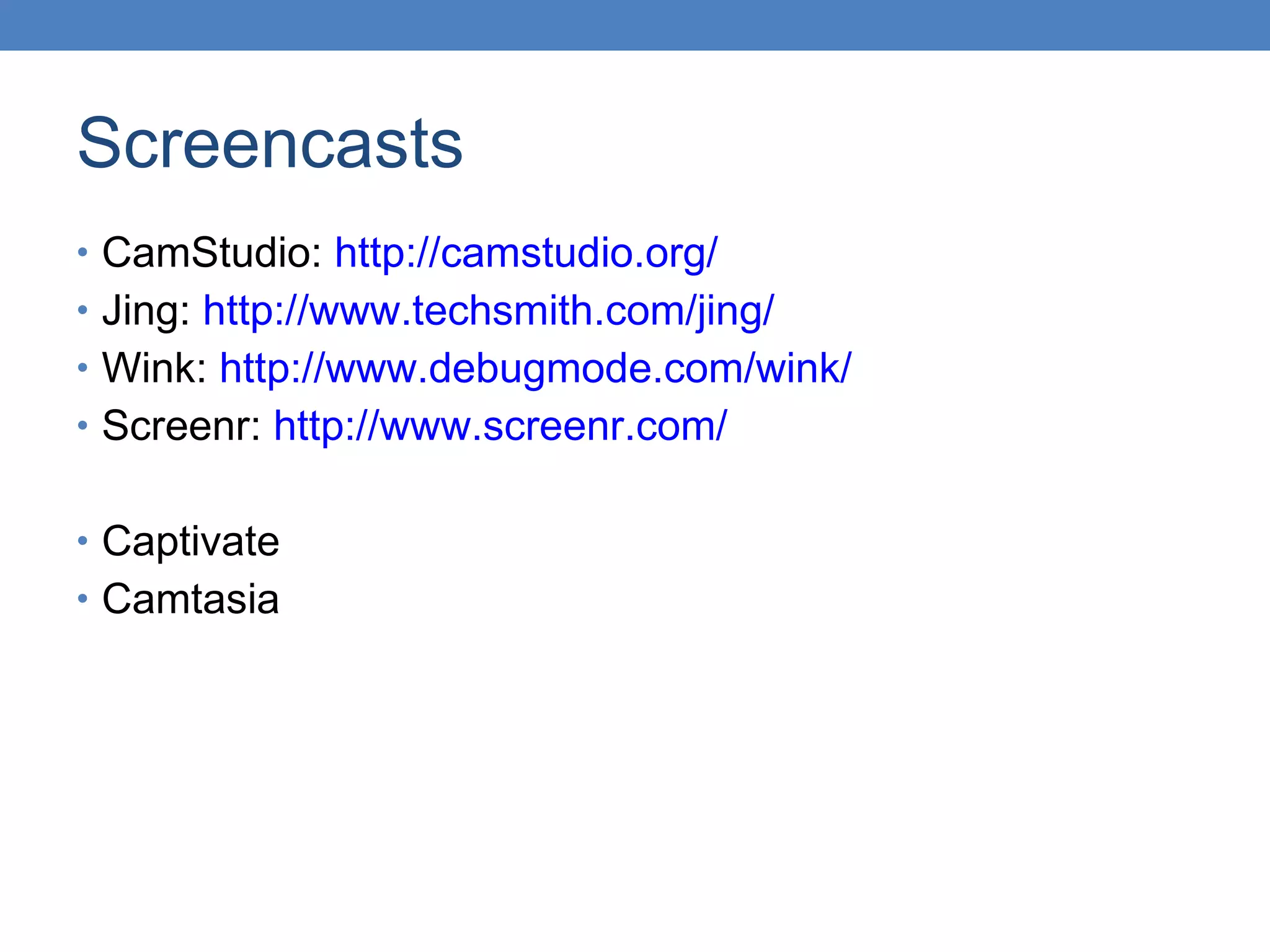
Screencasts CamStudio:  http://camstudio.org/ Jing:  http://www.techsmith.com/jing/ Wink:  http://www.debugmode.com/wink/ Screenr:  http://www.screenr.com/ Captivate Camtasia
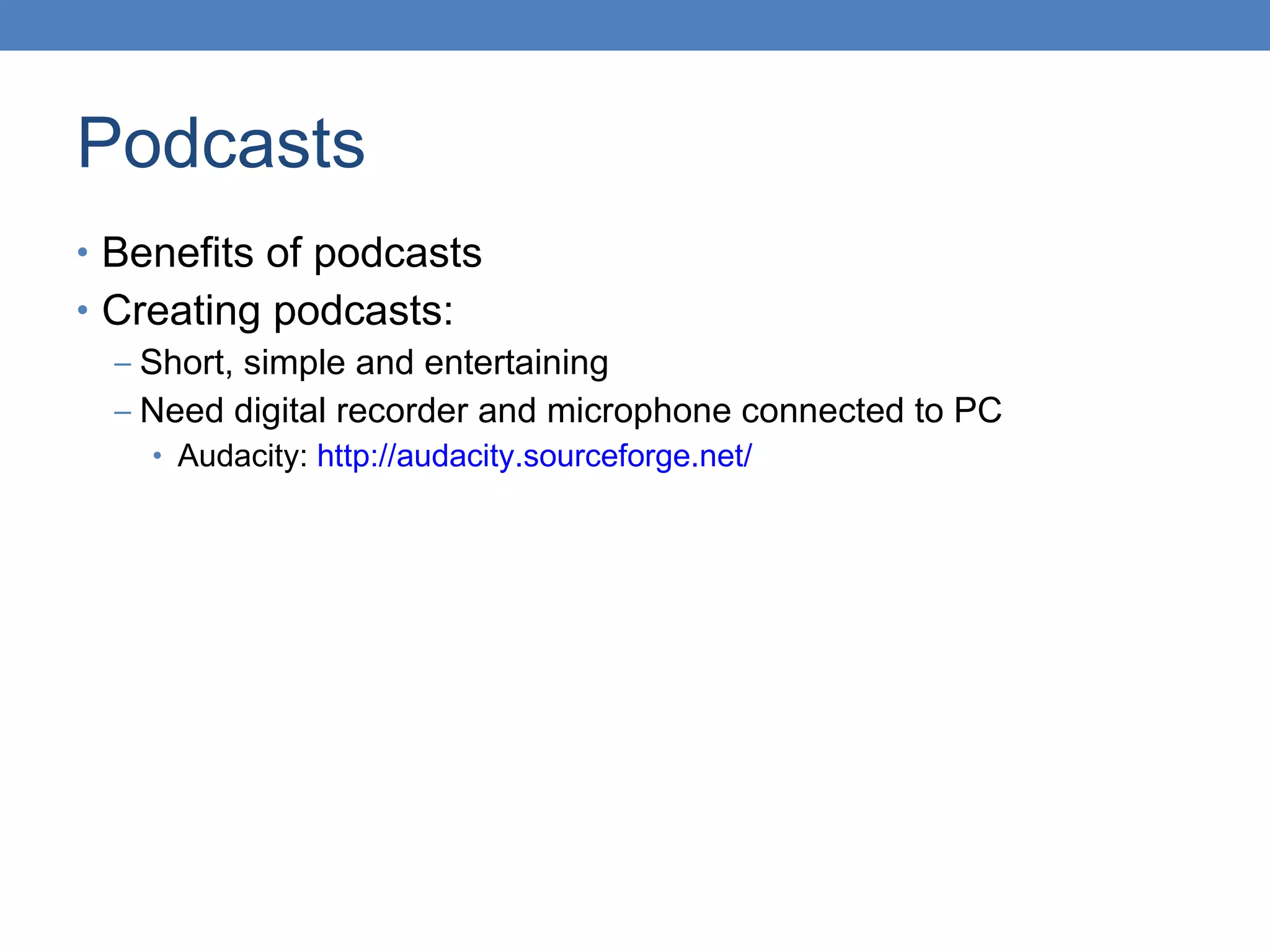
Podcasts Benefits of podcasts Creating podcasts: Short, simple and entertaining Need digital recorder and microphone connected to PC Audacity:  http://audacity.sourceforge.net/
Videos/Movies YouTube Talk to your librarian Enlist experts to create videos Create your own!
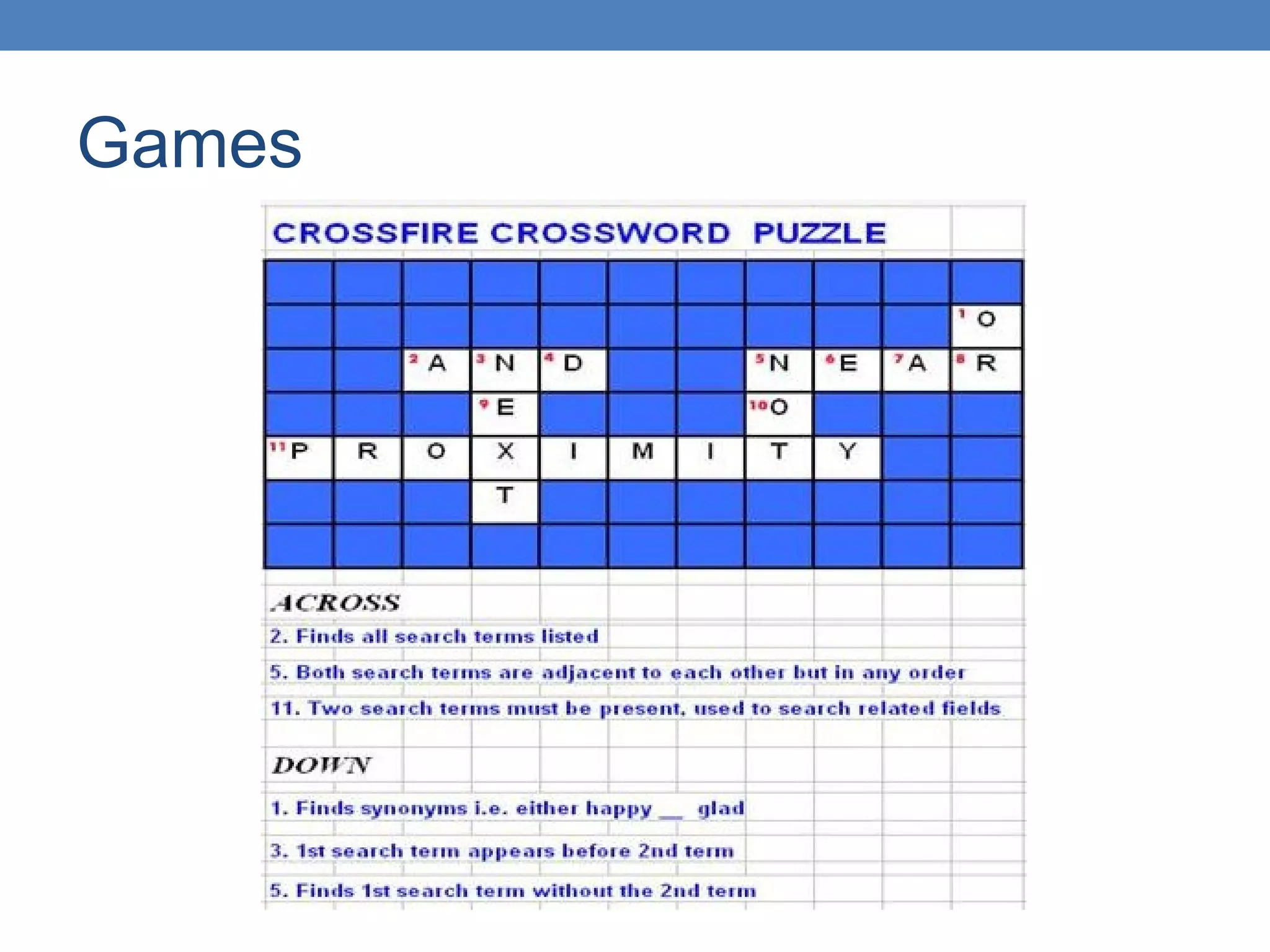
Games
 
Social Bookmarking Delicious:  http://del.icio.us/   Diigo:  http://www.diigo.com/ Comprehensive list found here:  http://www.philb.com/iwantto/web2pagebookmarking.htm
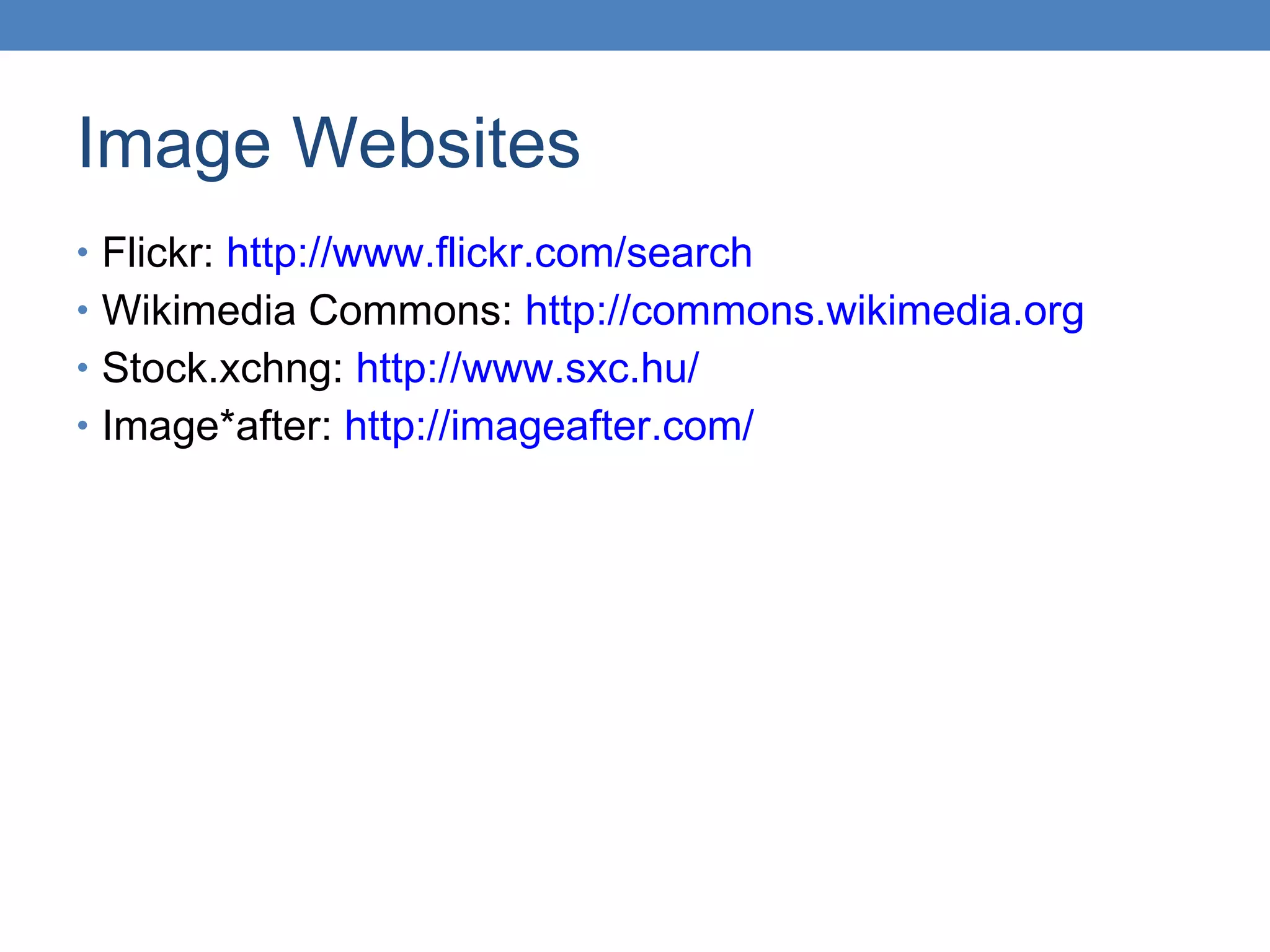
Image Websites Flickr:  http://www.flickr.com/search Wikimedia Commons:  http://commons.wikimedia.org Stock.xchng:  http://www.sxc.hu/ Image*after:  http://imageafter.com/
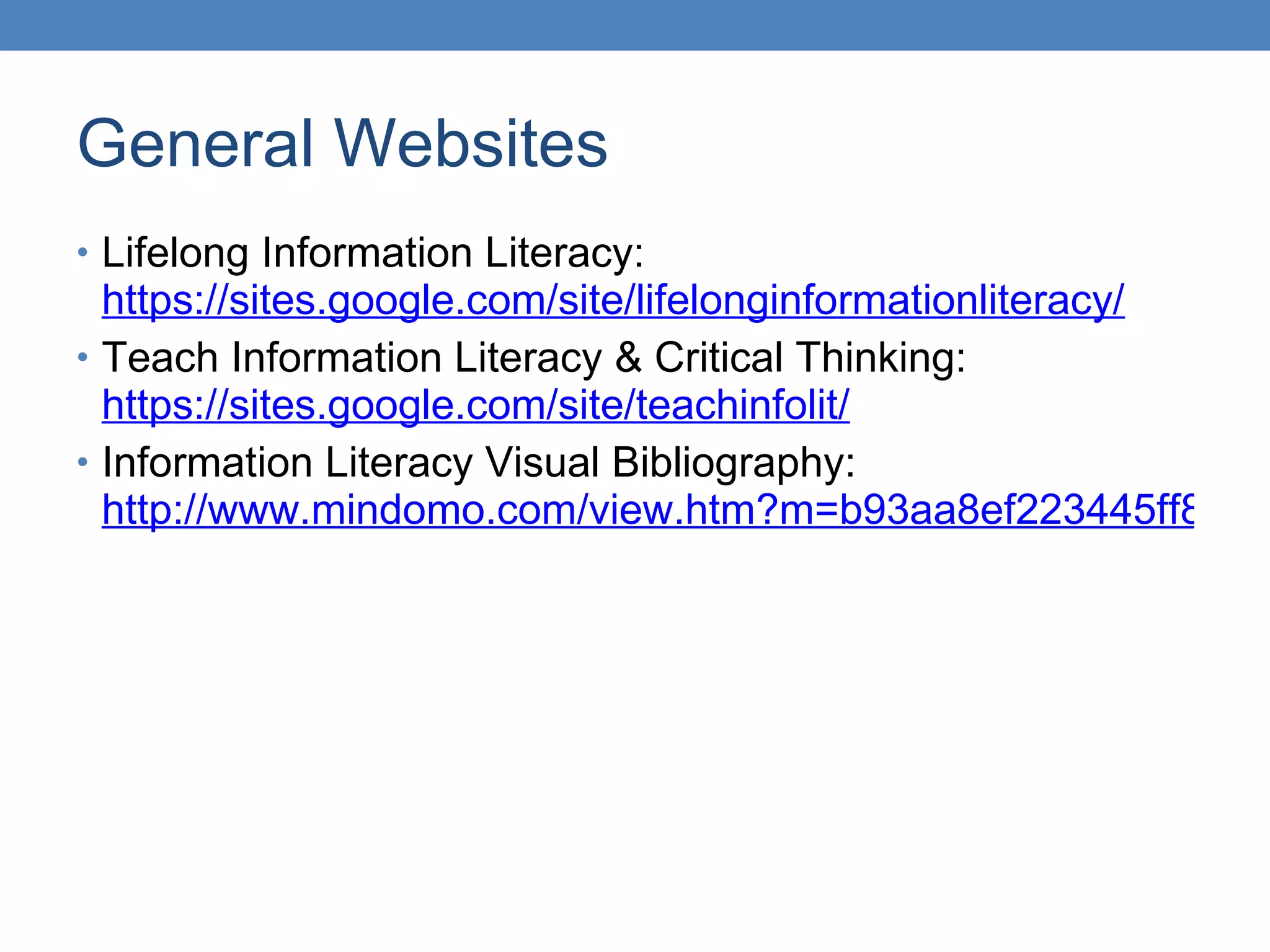
General Websites Lifelong Information Literacy:  https://sites.google.com/site/lifelonginformationliteracy/ Teach Information Literacy & Critical Thinking:  https://sites.google.com/site/teachinfolit/ Information Literacy Visual Bibliography:  http://www.mindomo.com/view.htm?m=b93aa8ef223445ff8919191fbc3ed23c
IDEAS FOR ASSIGNMENTS Information Literacy
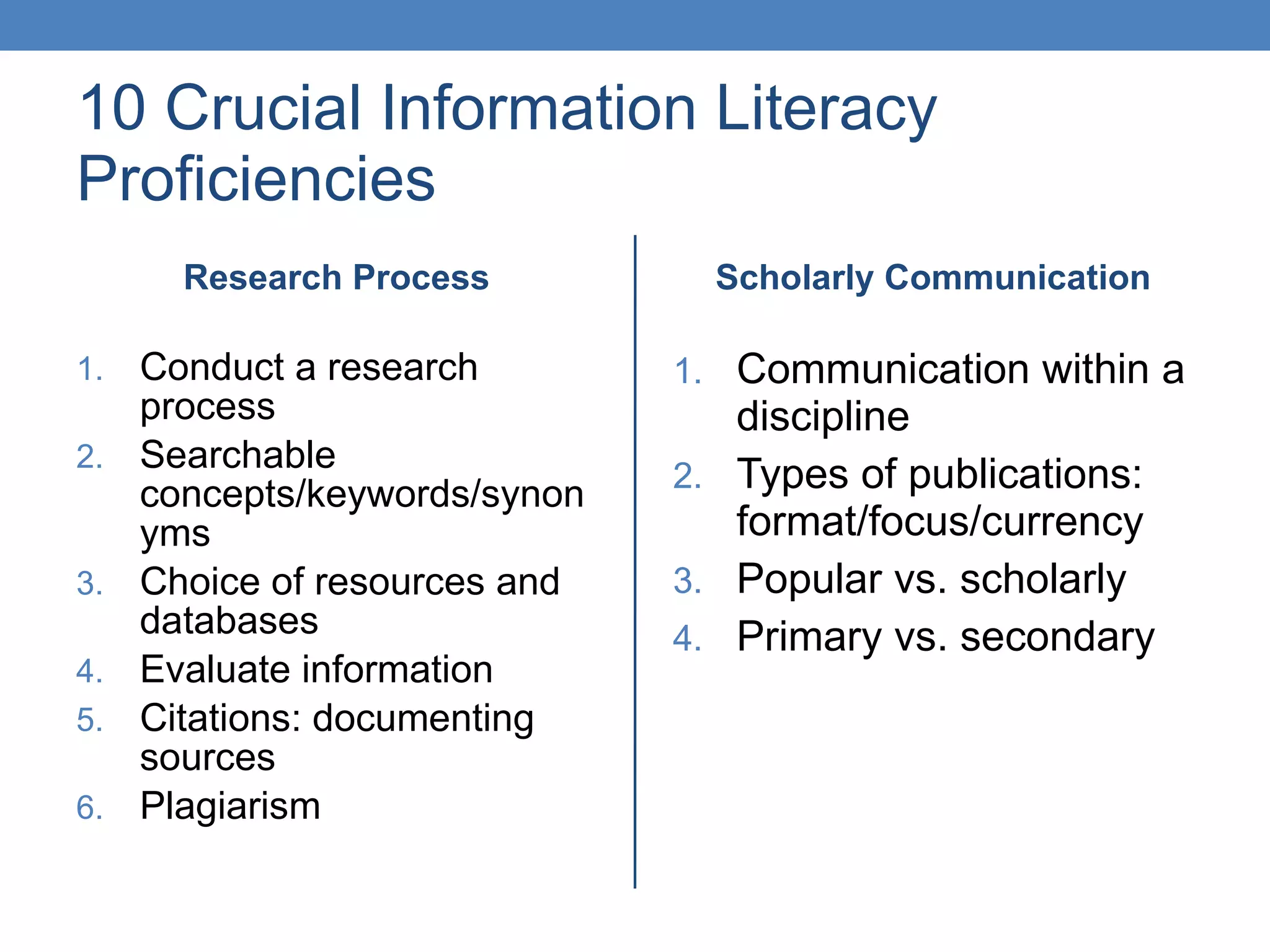
10 Crucial Information Literacy Proficiencies Research Process Conduct a research process Searchable concepts/keywords/synonyms Choice of resources and databases Evaluate information Citations: documenting sources Plagiarism Scholarly Communication Communication within a discipline Types of publications: format/focus/currency Popular vs. scholarly Primary vs. secondary
Research Strategy Log topic changes and evolution of research  State the question/research problem; consider kinds of information sources needed to answer
Searchable Concepts Describe topics in a few sentences; “diagram” research statement Demonstrate Boolean operators Ask students to keep a research log
Choose resources/databases State resources used to find information  Consult two reference sources ; note other uses for the tool Conduct a search for the same topic in two different databases and compare/contrast the results
Evaluate Information Small groups examine texts/websites and evaluate them Evaluate Web Resources Use examples of various criteria and an opportunity to “Test your own critical thinking.”
Citations: Documenting Sources Provide copies of a variety of sources; identify parts needed to create a citation Turn in citations in the proper format with early drafts of papers; require a bibliography early on with citations in the proper format
Plagiarism Give students excerpts from books/articles; practice paraphrasing, quoting, and properly citing the material. Provide both acceptable and unacceptable paraphrases. How do they differ?
Communication in Discipline Write brief outline of ordering, production and dissemination of research might shape the development of new knowledge.
Types of Publications Compare and contrast treatment of a specific topic/question/issue in a book and in an article. Contemporary account of historic event Identify a topic for which the majority of published information would be in article form Apply the flow of information discussion above to a given event/trend/theory
Popular vs. Scholarly Identify and compare a scholarly and popular article  Give students several scholarly articles and ask them to identify the common features among the articles. Provide students with a variety of resources and have them make arguments about whether, and why, they would classify each as being scholarly.
Primary vs. Secondary Provide research questions/theses; make a list of the kinds of primary resource materials scholars might seek Evaluate a primary source Consider a particular source, the circumstances under which it might be considered a primary source or a secondary source Review past writing and discuss whether these materials would be considered primary or secondary sources, and under what circumstances.
Top Tips for Successful Integration Contact your librarian Engage support Work with staff Consider how LMS can help students Always be explicit
“ Information literacy empowers people in all walks of life to seek, evaluate, use and create information effectively to achieve their personal, social, occupational and educational goals. It is a basic human right in a digital world and promotes social inclusion in all nations."
HOW DO I LEARN MORE ABOUT IT? Information Literacy
References Academic Literacy: A Statement of Competencies Expected of Students Entering California’s Public Colleges and Universities, 2002, < http://www.universityofcalifornia.edu/senate/reports/acadlit.pdf >. Accessed 7 October 2011. ACRL | Information Literacy Competency Standards for Higher Education, < http://www.ala.org/ala/mgrps/divs/acrl/standards/informationliteracycompetency.cfm >. Accessed 3 October 2011.
Contact Me Julie Cavender [email_address] 303.784.8370 | Cell: 303.562.6072 LinkedIn:  http://www.linkedin.com/in/juliecavender Twitter: @Global_Library Thank you!

CAPPS 2011 Integrating Information Literacy in the Curriculum

  • 1.
    INTEGRATING INFORMATIONLITERACY THROUGHOUT THE CURRICULUM Julie Cavender Manager, Library Development & Services Jones e-global library
  • 2.
    What we willcover today What is information literacy Why is it important Who needs it Where to start How to integrate with the curriculum
  • 3.
    WHAT IS IT?Information Literacy
  • 4.
  • 5.
  • 6.
  • 7.
    Information literacy isa set of abilities requiring individuals to “recognize when information is needed and have the ability to locate, evaluate, and use effectively the needed information.”
  • 8.
  • 9.
    WHY IS ITIMPORTANT? Information Literacy
  • 10.
    Assessment Accreditation Studentretention Lifelong learning
  • 11.
    Assessment 36% Ofstudents experience no significant improvement in learning over four years of higher education (as measured by the Collegiate Learning Assessment) . http://www.collegiatelearningassessment.org/
  • 12.
    Accreditation &quot;[Baccalaureate programs]also ensure the development of core learning abilities and competencies including, but not limited to, college-level written and oral communication; college-level quantitative skills; information literacy; and the habit of critical analysis of data and argument.&quot; WASC Standard 2.2a of “Teaching and Learning”
  • 13.
    Retention Improve student success and retention rates
  • 14.
  • 15.
    WHO NEEDS IT?Information Literacy
  • 16.
  • 17.
    WHERE DO ISTART? Information Literacy
  • 18.
  • 19.
    ACRL Information LiteracyCompetency Standards for Higher Education determines the nature and extent of needed information; accesses needed information effectively and efficiently; evaluates information and its sources critically and incorporates selected information into his or her knowledge base and value system; uses information effectively to accomplish a specific purpose; understands many of the economic, legal, and social issues surrounding the use of information and accesses and uses information ethically and legally
  • 20.
    Assessment Tools Self-reportTests SAILS Classroom Assessment Techniques Performance Assessments
  • 21.
    Create a WorkablePlan Institution commitment Standards Strategic plan Collaborate Information Literacy Plan
  • 22.
  • 23.
    HOW TO INTEGRATEWITH CURRICULUM Information Literacy
  • 24.
    First Steps TipsClear focus on information literacy standard for every activity Work on standards one by one Promote IL activity Work in teams Be clear about IL objectives
  • 25.
    Program Integration Mapinformation literacy skills
  • 26.
    Learning Outcomes ACRLSample criteria Level of reading Use of information to support point of view Citing and referencing Critical evaluation
  • 27.
    Problem-Based Learning Annotatedbibliographies Documenting search and retrieval process Find and critically evaluate opposing positions on a topic Contact a librarian
  • 28.
    Online Environment QuizzesDiscussion boards and chat Collaborative work Guides to resources Tutorials
  • 29.
  • 30.
    Tutorials & QuizzesGoogle docs: http://www.docs.google.com/ Udutu: http://www.myudutu.com/ Glomaker: http://www.glomaker.org/
  • 31.
    Screencasts CamStudio: http://camstudio.org/ Jing: http://www.techsmith.com/jing/ Wink: http://www.debugmode.com/wink/ Screenr: http://www.screenr.com/ Captivate Camtasia
  • 32.
    Podcasts Benefits ofpodcasts Creating podcasts: Short, simple and entertaining Need digital recorder and microphone connected to PC Audacity: http://audacity.sourceforge.net/
  • 33.
    Videos/Movies YouTube Talkto your librarian Enlist experts to create videos Create your own!
  • 34.
  • 35.
  • 36.
    Social Bookmarking Delicious: http://del.icio.us/ Diigo: http://www.diigo.com/ Comprehensive list found here: http://www.philb.com/iwantto/web2pagebookmarking.htm
  • 37.
    Image Websites Flickr: http://www.flickr.com/search Wikimedia Commons: http://commons.wikimedia.org Stock.xchng: http://www.sxc.hu/ Image*after: http://imageafter.com/
  • 38.
    General Websites LifelongInformation Literacy: https://sites.google.com/site/lifelonginformationliteracy/ Teach Information Literacy & Critical Thinking: https://sites.google.com/site/teachinfolit/ Information Literacy Visual Bibliography: http://www.mindomo.com/view.htm?m=b93aa8ef223445ff8919191fbc3ed23c
  • 39.
    IDEAS FOR ASSIGNMENTSInformation Literacy
  • 40.
    10 Crucial InformationLiteracy Proficiencies Research Process Conduct a research process Searchable concepts/keywords/synonyms Choice of resources and databases Evaluate information Citations: documenting sources Plagiarism Scholarly Communication Communication within a discipline Types of publications: format/focus/currency Popular vs. scholarly Primary vs. secondary
  • 41.
    Research Strategy Logtopic changes and evolution of research State the question/research problem; consider kinds of information sources needed to answer
  • 42.
    Searchable Concepts Describetopics in a few sentences; “diagram” research statement Demonstrate Boolean operators Ask students to keep a research log
  • 43.
    Choose resources/databases Stateresources used to find information Consult two reference sources ; note other uses for the tool Conduct a search for the same topic in two different databases and compare/contrast the results
  • 44.
    Evaluate Information Smallgroups examine texts/websites and evaluate them Evaluate Web Resources Use examples of various criteria and an opportunity to “Test your own critical thinking.”
  • 45.
    Citations: Documenting SourcesProvide copies of a variety of sources; identify parts needed to create a citation Turn in citations in the proper format with early drafts of papers; require a bibliography early on with citations in the proper format
  • 46.
    Plagiarism Give studentsexcerpts from books/articles; practice paraphrasing, quoting, and properly citing the material. Provide both acceptable and unacceptable paraphrases. How do they differ?
  • 47.
    Communication in DisciplineWrite brief outline of ordering, production and dissemination of research might shape the development of new knowledge.
  • 48.
    Types of PublicationsCompare and contrast treatment of a specific topic/question/issue in a book and in an article. Contemporary account of historic event Identify a topic for which the majority of published information would be in article form Apply the flow of information discussion above to a given event/trend/theory
  • 49.
    Popular vs. ScholarlyIdentify and compare a scholarly and popular article Give students several scholarly articles and ask them to identify the common features among the articles. Provide students with a variety of resources and have them make arguments about whether, and why, they would classify each as being scholarly.
  • 50.
    Primary vs. SecondaryProvide research questions/theses; make a list of the kinds of primary resource materials scholars might seek Evaluate a primary source Consider a particular source, the circumstances under which it might be considered a primary source or a secondary source Review past writing and discuss whether these materials would be considered primary or secondary sources, and under what circumstances.
  • 51.
    Top Tips forSuccessful Integration Contact your librarian Engage support Work with staff Consider how LMS can help students Always be explicit
  • 52.
    “ Information literacyempowers people in all walks of life to seek, evaluate, use and create information effectively to achieve their personal, social, occupational and educational goals. It is a basic human right in a digital world and promotes social inclusion in all nations.&quot;
  • 53.
    HOW DO ILEARN MORE ABOUT IT? Information Literacy
  • 54.
    References Academic Literacy:A Statement of Competencies Expected of Students Entering California’s Public Colleges and Universities, 2002, < http://www.universityofcalifornia.edu/senate/reports/acadlit.pdf >. Accessed 7 October 2011. ACRL | Information Literacy Competency Standards for Higher Education, < http://www.ala.org/ala/mgrps/divs/acrl/standards/informationliteracycompetency.cfm >. Accessed 3 October 2011.
  • 55.
    Contact Me JulieCavender [email_address] 303.784.8370 | Cell: 303.562.6072 LinkedIn:  http://www.linkedin.com/in/juliecavender Twitter: @Global_Library Thank you!