
Dr. Nihar K. Patra
University Librarian
Nalanda University, Rajgir
Email: patranihar@gmail.com
 Introduction
 From Electronic Resource to Electronic Resource
Management
 Lifecycle of Electronic Resource Management
 Electronic Resource Management System and its Best
Practices
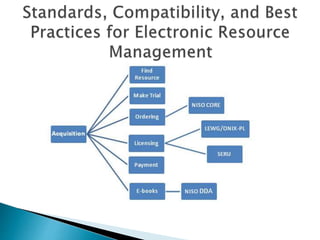
 Standards, Compatibility, and Best Practices for Electronic
Resource Management
 Electronic Resource Management Systems: Pros and cons
 Electronic Resources: A Bird’s-eye view
◦ Online Catalogue: Machine readable catalogue in the mid 1960
◦ Machine Readable Cataloguing: MARC, MARC 21
◦ Shared Catalogue: Ohio College Library Centre (OCLC)
◦ Online Public Access Catalogue: Ohio State University in 1975
◦ Web-based Catalogue
◦ Database
◦ Bibliographic Database
◦ CD-ROM Database
◦ Online Database
◦ Web-based databases
◦ Electronic Journals
◦ Electronic Books
◦ Institutional Repository
◦ Emerging Types of E-resources: Blogs Wikis etc
 Evaluation of Resource Management
◦ Study made by Mr Jewell in 2001 stated that many libraries
started developing local software to manage e-resources
◦ Workshop held in May 2002 in Chicago cosponsored by
National Information Standards Organization (NISO) and
Digital Library Federation (DLF) discussed standards related
to issues of ERMS
◦ This led formation to the formation of DLFs Electronic
Resource Management Initiative (ERMI) in October 2002
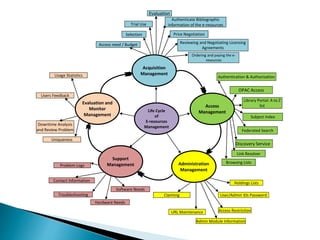
Usage Statistics
Users Feedback
Downtime Analysis
and Review Problem
Uniqueness
Problem Logs
Contact Information
Troubleshooting
Hardware Needs
Software Needs
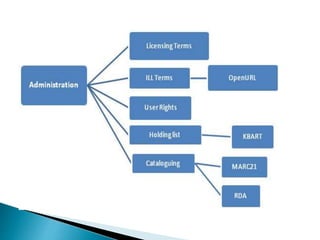
Holdings Lists
User/Admin IDs Password
Access Restriction
Admin Module Information
URL Maintenance
Claiming
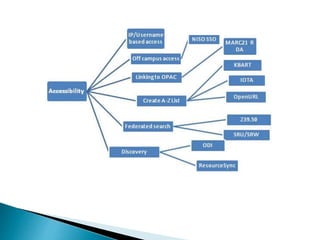
Authentication & Authorization
OPAC Access
Library Portal: A to Z
list
Federated Search
Discovery Service
Link Resolver
Life Cycle
of
E-resources
Management
Acquisition
Management
Access
Management
Administration
Management
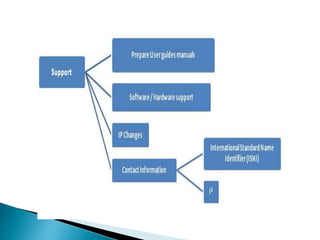
Support
Management
Evaluation and
Monitor
Management
Selection
Trial Use
Evaluation
Authenticate Bibliographic
information of the e-resources
Price Negotiation
Reviewing and Negotiating Licensing
Agreements
Ordering and paying the e-
resources
Access need / Budget
Subject Index
Browsing Lists
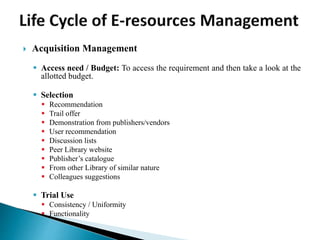
 Acquisition Management
 Access need / Budget: To access the requirement and then take a look at the
allotted budget.
 Selection
 Recommendation
 Trail offer
 Demonstration from publishers/vendors
 User recommendation
 Discussion lists
 Peer Library website
 Publisher’s catalogue
 From other Library of similar nature
 Colleagues suggestions
 Trial Use
 Consistency / Uniformity
 Functionality
Evaluation
• Content
• Updates
• Quality – reputation of publisher as well as intellectual level
• Indexing Up-gradation
• Authority – scholarly or not
• Accessibility
• Cost factor
• Technical support
• Licensing agreement
Authenticate Bibliographic information of the e-resources
• Verify coverage, content provider of the product, frequency of updates
and cost
Price Negotiation
• Product type: aggregator/full text database
• Product available through yearly subscription, one-time
purchase or multi-year deals with fixed price caps
• Rental models
• Print + electronic deal
• Institution size
• Number of uses
• Price of consortia deal
• Price for journal package deal
• Evidence Based Acquisition
• Patron-Driving Acquisition
Reviewing and Negotiating Licensing Agreements
• Authorized users and sites: Permits multiple users to access e-resources at
the same time from different geographical locations
• Archiving policy and perpetual access: Allow access to paid e-resources
even after termination of an agreement.
• Institutional / self archiving: Allow author and the institution to upload
their publications to IR in preprint or postprint format
• Copyright and fair use: Allow users to view, download, and print
materials. Permission for interlibrary loan, electronic course reserve,
distance education etc
• Usage statistics
• Liability for unauthorized use: Library to monitor unauthorized users
• Cost
Reviewing and Negotiating Licensing Agreements
• Technical Consideration
• Indemnification
• Terms of payment and termination
• Governing law: Any dispute should be settled within the
geographical limits of the institute
 Ordering and paying the e-resources
 Access Management
• Authentication & Authorization: Authenticate the authorized users
(Application Programming Interface (API) and Lightweight Directory
Access protocol (LDAP).
• OPAC Access
• Library Portal: A to Z list
• Federated Search
• Discovery Service
• Link Resolver
• Subject Index
• Browsing Lists
 Administration Management
• Knowledge Base / Holdings Lists
• User/Admin IDs Password
• Access Restriction
• Admin Module Information
• URL Maintenance
• Claiming:
 Support Management
• Problem Logs: To address logging problem with resources as well as
content provider.
• Contact Information
• Troubleshooting: A set of troubleshooting guidelines should be available
in the system.
• Hardware / Software Needs
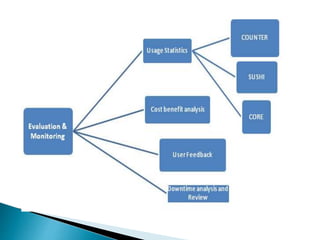
 Evaluation and Monitor Management
• Usage Statistics: Counting Online Usage of Networked Electronic
Resources (COUNTER) and Standardized Usage Statistics Harvesting
Initiative (SUSHI)
• Uniqueness: Comparing duplication in various formats or overlapping in
full-text resources
• Downtime Analysis and Review Problem
• Users Feedback
1. Innovative Interface’ Innovative ERM
2. TDNet’ TDNet ERM Solutions
3. Ex Libris’Alma
4. OCLC’ Web-share License Manager
5. Serials Solutions’ 360 Resource Manager
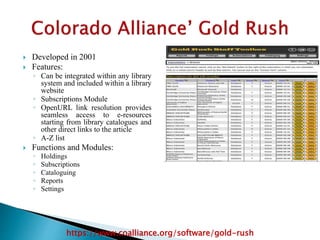
6. Colorado Alliance’ Gold Rush
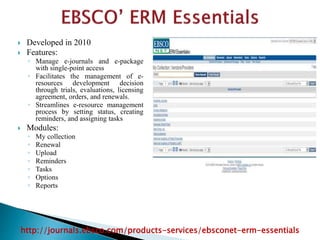
7. EBSCO’ ERM Essentials
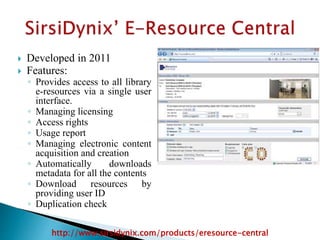
8. SirsiDynix’ E-Resource Central
9. Priory Solution’ Research Monitor
10. University of Notre Dame’ CORAL
11. SemperTool’ Digital Library Suite
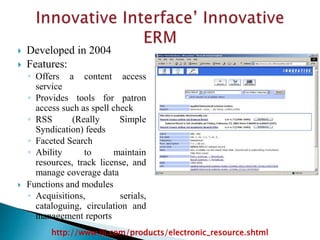
 Developed in 2004
 Features:
◦ Offers a content access
service
◦ Provides tools for patron
access such as spell check
◦ RSS (Really Simple
Syndication) feeds
◦ Faceted Search
◦ Ability to maintain
resources, track license, and
manage coverage data
 Functions and modules
◦ Acquisitions, serials,
cataloguing, circulation and
management reports
http://www.iii.com/products/electronic_resource.shtml
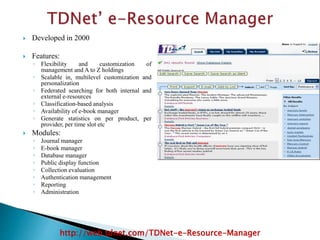
 Developed in 2000
 Features:
◦ Flexibility and customization of
management and A to Z holdings
◦ Scalable in, multilevel customization and
personalization
◦ Federated searching for both internal and
external e-resources
◦ Classification-based analysis
◦ Availability of e-book manager
◦ Generate statistics on per product, per
provider, per time slot etc
 Modules:
◦ Journal manager
◦ E-book manager
◦ Database manager
◦ Public display function
◦ Collection evaluation
◦ Authentication management
◦ Reporting
◦ Administration
http://web.tdnet.com/TDNet-e-Resource-Manager
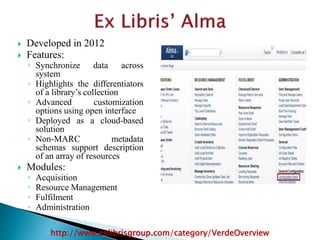
 Developed in 2012
 Features:
◦ Synchronize data across
system
◦ Highlights the differentiators
of a library’s collection
◦ Advanced customization
options using open interface
◦ Deployed as a cloud-based
solution
◦ Non-MARC metadata
schemas support description
of an array of resources
 Modules:
◦ Acquisition
◦ Resource Management
◦ Fulfilment
◦ Administration
http://www.exlibrisgroup.com/category/VerdeOverview
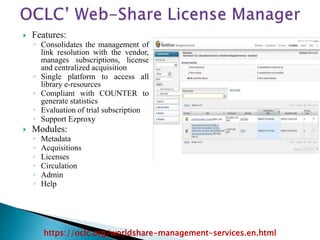
 Features:
◦ Consolidates the management of
link resolution with the vendor,
manages subscriptions, license
and centralized acquisition
◦ Single platform to access all
library e-resources
◦ Compliant with COUNTER to
generate statistics
◦ Evaluation of trial subscription
◦ Support Ezproxy
 Modules:
◦ Metadata
◦ Acquisitions
◦ Licenses
◦ Circulation
◦ Admin
◦ Help
https://oclc.org/worldshare-management-services.en.html
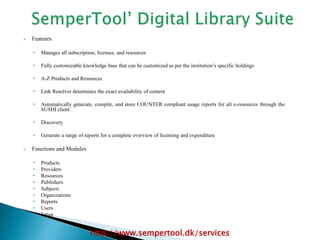
 Features
• Manages all subscription, licenses, and resources
• Fully customizable knowledge base that can be customized as per the institution’s specific holdings
• A-Z Products and Resources
• Link Resolver determines the exact availability of content
• Automatically generate, compile, and store COUNTER compliant usage reports for all e-resources through the
SUSHI client.
• Discovery
• Generate a range of reports for a complete overview of licensing and expenditure
 Functions and Modules
• Products
• Providers
• Resources
• Publishers
• Subjects
• Organizations
• Reports
• Users
• Setup
http://www.sempertool.dk/services
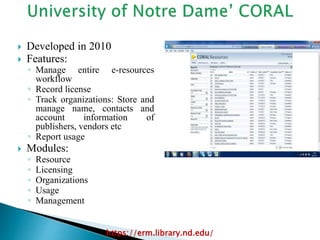
 Developed in 2010
 Features:
◦ Manage entire e-resources
workflow
◦ Record license
◦ Track organizations: Store and
manage name, contacts and
account information of
publishers, vendors etc
◦ Report usage
 Modules:
◦ Resource
◦ Licensing
◦ Organizations
◦ Usage
◦ Management
https://erm.library.nd.edu/
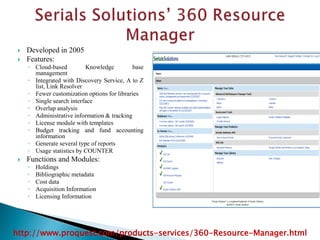
 Developed in 2005
 Features:
◦ Cloud-based Knowledge base
management
◦ Integrated with Discovery Service, A to Z
list, Link Resolver
◦ Fewer customization options for libraries
◦ Single search interface
◦ Overlap analysis
◦ Administrative information & tracking
◦ License module with templates
◦ Budget tracking and fund accounting
information
◦ Generate several type of reports
◦ Usage statistics by COUNTER
 Functions and Modules:
◦ Holdings
◦ Bibliographic metadata
◦ Cost data
◦ Acquisition Information
◦ Licensing Information
http://www.proquest.com/products-services/360-Resource-Manager.html
 Developed in 2001
 Features:
◦ Can be integrated within any library
system and included within a library
website
◦ Subscriptions Module
◦ OpenURL link resolution provides
seamless access to e-resources
starting from library catalogues and
other direct links to the article
◦ A-Z list
 Functions and Modules:
◦ Holdings
◦ Subscriptions
◦ Cataloguing
◦ Reports
◦ Settings
https://www.coalliance.org/software/gold-rush
 Developed in 2010
 Features:
◦ Manage e-journals and e-package
with single-point access
◦ Facilitates the management of e-
resources development decision
through trials, evaluations, licensing
agreement, orders, and renewals.
◦ Streamlines e-resource management
process by setting status, creating
reminders, and assigning tasks
 Modules:
◦ My collection
◦ Renewal
◦ Upload
◦ Reminders
◦ Tasks
◦ Options
◦ Reports
http://journals.ebsco.com/products-services/ebsconet-erm-essentials
 Developed in 2011
 Features:
◦ Provides access to all library
e-resources via a single user
interface.
◦ Managing licensing
◦ Access rights
◦ Usage report
◦ Managing electronic content
acquisition and creation
◦ Automatically downloads
metadata for all the contents
◦ Download resources by
providing user ID
◦ Duplication check
http://www.sirsidynix.com/products/eresource-central
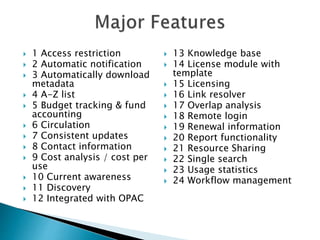
 1 Access restriction
 2 Automatic notification
 3 Automatically download
metadata
 4 A-Z list
 5 Budget tracking & fund
accounting
 6 Circulation
 7 Consistent updates
 8 Contact information
 9 Cost analysis / cost per
use
 10 Current awareness
 11 Discovery
 12 Integrated with OPAC
 13 Knowledge base
 14 License module with
template
 15 Licensing
 16 Link resolver
 17 Overlap analysis
 18 Remote login
 19 Renewal information
 20 Report functionality
 21 Resource Sharing
 22 Single search
 23 Usage statistics
 24 Workflow management
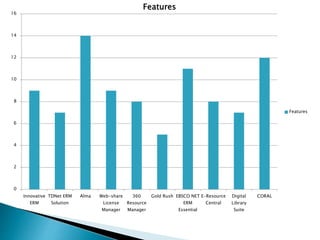
0
2
4
6
8
10
12
14
16
Innovative
ERM
TDNet ERM
Solution
Alma Web-share
License
Manager
360
Resource
Manager
Gold Rush EBSCO NET
ERM
Essential
E-Resource
Central
Digital
Library
Suite
CORAL
Features
Features
This will be very handy tool in making right choice & decision for selecting ERMS for
efficient management of e-resources
Advantages
 Effectively manage the life cycle of e-resources starting from evaluation, selection, and
acquisition through renewal/review and cancellation
 Ability to maintain resources, track licenses, and manage coverage data and A-Z
holdings etc.
 Assistance in managing e-journals with no duplication of effort
 Easily analyze cost, usage, and licensing information
 Libraries can quickly analyze actual expenditure vs. budget
 Allows users to simultaneously search multiple databases and receive combined results
 Negotiation license with content provider, evaluation of trial
subscriptions, centralized acquisition, budgeting and ordering.
 E-mail alerts remind before the licenses are up for renewal with a
custom time period.
 Includes acquisitions information, contacts, account information
and access information.
 Access verification and technical access management includes
notification of URL changes and to publisher for IP changes
 Facilitate A-to-Z database search, MARC record of each title and
direct to article OpenURL resolving
 Many more…
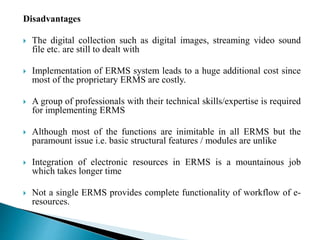
Disadvantages
 The digital collection such as digital images, streaming video sound
file etc. are still to dealt with
 Implementation of ERMS system leads to a huge additional cost since
most of the proprietary ERMS are costly.
 A group of professionals with their technical skills/expertise is required
for implementing ERMS
 Although most of the functions are inimitable in all ERMS but the
paramount issue i.e. basic structural features / modules are unlike
 Integration of electronic resources in ERMS is a mountainous job
which takes longer time
 Not a single ERMS provides complete functionality of workflow of e-
resources.
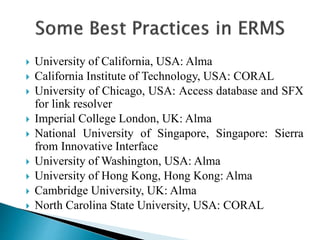
 University of California, USA: Alma
 California Institute of Technology, USA: CORAL
 University of Chicago, USA: Access database and SFX
for link resolver
 Imperial College London, UK: Alma
 National University of Singapore, Singapore: Sierra
from Innovative Interface
 University of Washington, USA: Alma
 University of Hong Kong, Hong Kong: Alma
 Cambridge University, UK: Alma
 North Carolina State University, USA: CORAL
Queries may be sent at : patranihar@gmail.com

Electronic Resource Management in the library

  • 1.
    Dr. Nihar K.Patra University Librarian Nalanda University, Rajgir Email: patranihar@gmail.com
  • 2.
     Introduction  FromElectronic Resource to Electronic Resource Management  Lifecycle of Electronic Resource Management  Electronic Resource Management System and its Best Practices  Standards, Compatibility, and Best Practices for Electronic Resource Management  Electronic Resource Management Systems: Pros and cons
  • 3.
     Electronic Resources:A Bird’s-eye view ◦ Online Catalogue: Machine readable catalogue in the mid 1960 ◦ Machine Readable Cataloguing: MARC, MARC 21 ◦ Shared Catalogue: Ohio College Library Centre (OCLC) ◦ Online Public Access Catalogue: Ohio State University in 1975 ◦ Web-based Catalogue ◦ Database ◦ Bibliographic Database ◦ CD-ROM Database ◦ Online Database ◦ Web-based databases ◦ Electronic Journals ◦ Electronic Books ◦ Institutional Repository ◦ Emerging Types of E-resources: Blogs Wikis etc
  • 4.
     Evaluation ofResource Management ◦ Study made by Mr Jewell in 2001 stated that many libraries started developing local software to manage e-resources ◦ Workshop held in May 2002 in Chicago cosponsored by National Information Standards Organization (NISO) and Digital Library Federation (DLF) discussed standards related to issues of ERMS ◦ This led formation to the formation of DLFs Electronic Resource Management Initiative (ERMI) in October 2002
  • 6.
    Usage Statistics Users Feedback DowntimeAnalysis and Review Problem Uniqueness Problem Logs Contact Information Troubleshooting Hardware Needs Software Needs Holdings Lists User/Admin IDs Password Access Restriction Admin Module Information URL Maintenance Claiming Authentication & Authorization OPAC Access Library Portal: A to Z list Federated Search Discovery Service Link Resolver Life Cycle of E-resources Management Acquisition Management Access Management Administration Management Support Management Evaluation and Monitor Management Selection Trial Use Evaluation Authenticate Bibliographic information of the e-resources Price Negotiation Reviewing and Negotiating Licensing Agreements Ordering and paying the e- resources Access need / Budget Subject Index Browsing Lists
  • 7.
     Acquisition Management Access need / Budget: To access the requirement and then take a look at the allotted budget.  Selection  Recommendation  Trail offer  Demonstration from publishers/vendors  User recommendation  Discussion lists  Peer Library website  Publisher’s catalogue  From other Library of similar nature  Colleagues suggestions  Trial Use  Consistency / Uniformity  Functionality
  • 8.
    Evaluation • Content • Updates •Quality – reputation of publisher as well as intellectual level • Indexing Up-gradation • Authority – scholarly or not • Accessibility • Cost factor • Technical support • Licensing agreement Authenticate Bibliographic information of the e-resources • Verify coverage, content provider of the product, frequency of updates and cost
  • 9.
    Price Negotiation • Producttype: aggregator/full text database • Product available through yearly subscription, one-time purchase or multi-year deals with fixed price caps • Rental models • Print + electronic deal • Institution size • Number of uses • Price of consortia deal • Price for journal package deal • Evidence Based Acquisition • Patron-Driving Acquisition
  • 10.
    Reviewing and NegotiatingLicensing Agreements • Authorized users and sites: Permits multiple users to access e-resources at the same time from different geographical locations • Archiving policy and perpetual access: Allow access to paid e-resources even after termination of an agreement. • Institutional / self archiving: Allow author and the institution to upload their publications to IR in preprint or postprint format • Copyright and fair use: Allow users to view, download, and print materials. Permission for interlibrary loan, electronic course reserve, distance education etc • Usage statistics • Liability for unauthorized use: Library to monitor unauthorized users • Cost
  • 11.
    Reviewing and NegotiatingLicensing Agreements • Technical Consideration • Indemnification • Terms of payment and termination • Governing law: Any dispute should be settled within the geographical limits of the institute  Ordering and paying the e-resources
  • 12.
     Access Management •Authentication & Authorization: Authenticate the authorized users (Application Programming Interface (API) and Lightweight Directory Access protocol (LDAP). • OPAC Access • Library Portal: A to Z list • Federated Search • Discovery Service • Link Resolver • Subject Index • Browsing Lists
  • 13.
     Administration Management •Knowledge Base / Holdings Lists • User/Admin IDs Password • Access Restriction • Admin Module Information • URL Maintenance • Claiming:
  • 14.
     Support Management •Problem Logs: To address logging problem with resources as well as content provider. • Contact Information • Troubleshooting: A set of troubleshooting guidelines should be available in the system. • Hardware / Software Needs
  • 15.
     Evaluation andMonitor Management • Usage Statistics: Counting Online Usage of Networked Electronic Resources (COUNTER) and Standardized Usage Statistics Harvesting Initiative (SUSHI) • Uniqueness: Comparing duplication in various formats or overlapping in full-text resources • Downtime Analysis and Review Problem • Users Feedback
  • 16.
    1. Innovative Interface’Innovative ERM 2. TDNet’ TDNet ERM Solutions 3. Ex Libris’Alma 4. OCLC’ Web-share License Manager 5. Serials Solutions’ 360 Resource Manager 6. Colorado Alliance’ Gold Rush 7. EBSCO’ ERM Essentials 8. SirsiDynix’ E-Resource Central 9. Priory Solution’ Research Monitor 10. University of Notre Dame’ CORAL 11. SemperTool’ Digital Library Suite
  • 17.
     Developed in2004  Features: ◦ Offers a content access service ◦ Provides tools for patron access such as spell check ◦ RSS (Really Simple Syndication) feeds ◦ Faceted Search ◦ Ability to maintain resources, track license, and manage coverage data  Functions and modules ◦ Acquisitions, serials, cataloguing, circulation and management reports http://www.iii.com/products/electronic_resource.shtml
  • 18.
     Developed in2000  Features: ◦ Flexibility and customization of management and A to Z holdings ◦ Scalable in, multilevel customization and personalization ◦ Federated searching for both internal and external e-resources ◦ Classification-based analysis ◦ Availability of e-book manager ◦ Generate statistics on per product, per provider, per time slot etc  Modules: ◦ Journal manager ◦ E-book manager ◦ Database manager ◦ Public display function ◦ Collection evaluation ◦ Authentication management ◦ Reporting ◦ Administration http://web.tdnet.com/TDNet-e-Resource-Manager
  • 19.
     Developed in2012  Features: ◦ Synchronize data across system ◦ Highlights the differentiators of a library’s collection ◦ Advanced customization options using open interface ◦ Deployed as a cloud-based solution ◦ Non-MARC metadata schemas support description of an array of resources  Modules: ◦ Acquisition ◦ Resource Management ◦ Fulfilment ◦ Administration http://www.exlibrisgroup.com/category/VerdeOverview
  • 20.
     Features: ◦ Consolidatesthe management of link resolution with the vendor, manages subscriptions, license and centralized acquisition ◦ Single platform to access all library e-resources ◦ Compliant with COUNTER to generate statistics ◦ Evaluation of trial subscription ◦ Support Ezproxy  Modules: ◦ Metadata ◦ Acquisitions ◦ Licenses ◦ Circulation ◦ Admin ◦ Help https://oclc.org/worldshare-management-services.en.html
  • 21.
     Features • Managesall subscription, licenses, and resources • Fully customizable knowledge base that can be customized as per the institution’s specific holdings • A-Z Products and Resources • Link Resolver determines the exact availability of content • Automatically generate, compile, and store COUNTER compliant usage reports for all e-resources through the SUSHI client. • Discovery • Generate a range of reports for a complete overview of licensing and expenditure  Functions and Modules • Products • Providers • Resources • Publishers • Subjects • Organizations • Reports • Users • Setup http://www.sempertool.dk/services
  • 22.
     Developed in2010  Features: ◦ Manage entire e-resources workflow ◦ Record license ◦ Track organizations: Store and manage name, contacts and account information of publishers, vendors etc ◦ Report usage  Modules: ◦ Resource ◦ Licensing ◦ Organizations ◦ Usage ◦ Management https://erm.library.nd.edu/
  • 23.
     Developed in2005  Features: ◦ Cloud-based Knowledge base management ◦ Integrated with Discovery Service, A to Z list, Link Resolver ◦ Fewer customization options for libraries ◦ Single search interface ◦ Overlap analysis ◦ Administrative information & tracking ◦ License module with templates ◦ Budget tracking and fund accounting information ◦ Generate several type of reports ◦ Usage statistics by COUNTER  Functions and Modules: ◦ Holdings ◦ Bibliographic metadata ◦ Cost data ◦ Acquisition Information ◦ Licensing Information http://www.proquest.com/products-services/360-Resource-Manager.html
  • 24.
     Developed in2001  Features: ◦ Can be integrated within any library system and included within a library website ◦ Subscriptions Module ◦ OpenURL link resolution provides seamless access to e-resources starting from library catalogues and other direct links to the article ◦ A-Z list  Functions and Modules: ◦ Holdings ◦ Subscriptions ◦ Cataloguing ◦ Reports ◦ Settings https://www.coalliance.org/software/gold-rush
  • 25.
     Developed in2010  Features: ◦ Manage e-journals and e-package with single-point access ◦ Facilitates the management of e- resources development decision through trials, evaluations, licensing agreement, orders, and renewals. ◦ Streamlines e-resource management process by setting status, creating reminders, and assigning tasks  Modules: ◦ My collection ◦ Renewal ◦ Upload ◦ Reminders ◦ Tasks ◦ Options ◦ Reports http://journals.ebsco.com/products-services/ebsconet-erm-essentials
  • 26.
     Developed in2011  Features: ◦ Provides access to all library e-resources via a single user interface. ◦ Managing licensing ◦ Access rights ◦ Usage report ◦ Managing electronic content acquisition and creation ◦ Automatically downloads metadata for all the contents ◦ Download resources by providing user ID ◦ Duplication check http://www.sirsidynix.com/products/eresource-central
  • 27.
     1 Accessrestriction  2 Automatic notification  3 Automatically download metadata  4 A-Z list  5 Budget tracking & fund accounting  6 Circulation  7 Consistent updates  8 Contact information  9 Cost analysis / cost per use  10 Current awareness  11 Discovery  12 Integrated with OPAC  13 Knowledge base  14 License module with template  15 Licensing  16 Link resolver  17 Overlap analysis  18 Remote login  19 Renewal information  20 Report functionality  21 Resource Sharing  22 Single search  23 Usage statistics  24 Workflow management
  • 28.
    0 2 4 6 8 10 12 14 16 Innovative ERM TDNet ERM Solution Alma Web-share License Manager 360 Resource Manager GoldRush EBSCO NET ERM Essential E-Resource Central Digital Library Suite CORAL Features Features
  • 34.
    This will bevery handy tool in making right choice & decision for selecting ERMS for efficient management of e-resources Advantages  Effectively manage the life cycle of e-resources starting from evaluation, selection, and acquisition through renewal/review and cancellation  Ability to maintain resources, track licenses, and manage coverage data and A-Z holdings etc.  Assistance in managing e-journals with no duplication of effort  Easily analyze cost, usage, and licensing information  Libraries can quickly analyze actual expenditure vs. budget  Allows users to simultaneously search multiple databases and receive combined results
  • 35.
     Negotiation licensewith content provider, evaluation of trial subscriptions, centralized acquisition, budgeting and ordering.  E-mail alerts remind before the licenses are up for renewal with a custom time period.  Includes acquisitions information, contacts, account information and access information.  Access verification and technical access management includes notification of URL changes and to publisher for IP changes  Facilitate A-to-Z database search, MARC record of each title and direct to article OpenURL resolving  Many more…
  • 36.
    Disadvantages  The digitalcollection such as digital images, streaming video sound file etc. are still to dealt with  Implementation of ERMS system leads to a huge additional cost since most of the proprietary ERMS are costly.  A group of professionals with their technical skills/expertise is required for implementing ERMS  Although most of the functions are inimitable in all ERMS but the paramount issue i.e. basic structural features / modules are unlike  Integration of electronic resources in ERMS is a mountainous job which takes longer time  Not a single ERMS provides complete functionality of workflow of e- resources.
  • 37.
     University ofCalifornia, USA: Alma  California Institute of Technology, USA: CORAL  University of Chicago, USA: Access database and SFX for link resolver  Imperial College London, UK: Alma  National University of Singapore, Singapore: Sierra from Innovative Interface  University of Washington, USA: Alma  University of Hong Kong, Hong Kong: Alma  Cambridge University, UK: Alma  North Carolina State University, USA: CORAL
  • 38.
    Queries may besent at : patranihar@gmail.com