What is a Collections Development Policy?And why do I need one?Sarah WilkieMay 2010
AgendaNames and definitionsRole and purposeContext: making the linksEthicsRisk and how to manage itPolicy and practiceWho is your audience?
What’s in a name?Library Stock PolicyStock Management PolicyLibraries Stock StrategyStock Policy Document
Definition of a Collections Development policy“Collection Development is the process of planning and acquiring a balanced collection of library materials in many formats”[NAG Template for a Model Collection Development Policy for Public Libraries]
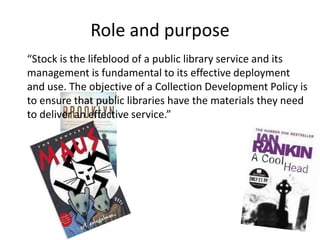
Role and purpose“Stock is the lifeblood of a public library service and its management is fundamental to its effective deployment and use. The objective of a Collection Development Policy is to ensure that public libraries have the materials they need to deliver an effective service.”
Making the links - 1To other library service policies, strategies and plans: Business plan Community engagement strategy Reader development strategy Marketing strategy Events programme
Making the links - 2To wider authority objectives: LAAs Every Child Matters Crime Prevention strategy Cultural strategy Strategy for Older People Integration & Community Cohesion Strategy
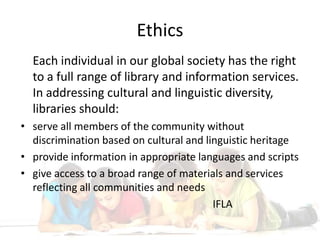
EthicsEach individual in our global society has the right to a full range of library and information services.   In addressing cultural and linguistic diversity, libraries should:serve all members of the community without discrimination based on cultural and linguistic heritageprovide information in appropriate languages and scriptsgive access to a broad range of materials and services reflecting all communities and needs							IFLA
Managing the risks“In the interests of intellectual freedom, material should not be rejected solely because it is considered controversial. A good library should encompass controversial issues and different perspectives in the interests of democracy and discovery.”MLA Guidelines on Controversial Stock
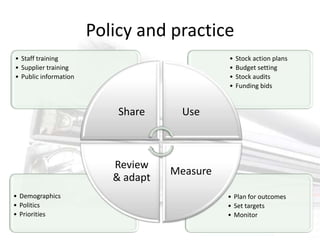
Policy and practice
Who is your audience?StaffColleaguesHead of serviceElected MembersThe publicSuppliersCouncil decision makersOther council departmentsConsortium membersPartners
Any questions

Collection Development policies

  • 1.
    What is aCollections Development Policy?And why do I need one?Sarah WilkieMay 2010
  • 2.
    AgendaNames and definitionsRoleand purposeContext: making the linksEthicsRisk and how to manage itPolicy and practiceWho is your audience?
  • 3.
    What’s in aname?Library Stock PolicyStock Management PolicyLibraries Stock StrategyStock Policy Document
  • 4.
    Definition of aCollections Development policy“Collection Development is the process of planning and acquiring a balanced collection of library materials in many formats”[NAG Template for a Model Collection Development Policy for Public Libraries]
  • 5.
    Role and purpose“Stockis the lifeblood of a public library service and its management is fundamental to its effective deployment and use. The objective of a Collection Development Policy is to ensure that public libraries have the materials they need to deliver an effective service.”
  • 6.
    Making the links- 1To other library service policies, strategies and plans: Business plan Community engagement strategy Reader development strategy Marketing strategy Events programme
  • 7.
    Making the links- 2To wider authority objectives: LAAs Every Child Matters Crime Prevention strategy Cultural strategy Strategy for Older People Integration & Community Cohesion Strategy
  • 8.
    EthicsEach individual inour global society has the right to a full range of library and information services. In addressing cultural and linguistic diversity, libraries should:serve all members of the community without discrimination based on cultural and linguistic heritageprovide information in appropriate languages and scriptsgive access to a broad range of materials and services reflecting all communities and needs IFLA
  • 9.
    Managing the risks“Inthe interests of intellectual freedom, material should not be rejected solely because it is considered controversial. A good library should encompass controversial issues and different perspectives in the interests of democracy and discovery.”MLA Guidelines on Controversial Stock
  • 10.
  • 11.
    Who is youraudience?StaffColleaguesHead of serviceElected MembersThe publicSuppliersCouncil decision makersOther council departmentsConsortium membersPartners
  • 12.