Information Literacy  for the Information Literate Ruth A Pagell Wuhan TTT October 2008
Module Objectives This module will : Help you understand the importance of strategic planning for course planning Provide tips for  developing an IL class for your institution Reinforce the importance of information literacy for the information literate to contribute to learning and national development
Why Consider “Information Literacy”  for the Information Literate? Globalization of economies Globalization of education Tools of business Competitive intelligence Life long learning Raising the level of literacy for all
What is Information Literacy for your    Institutions? What’s in the name information literacy for the information literate? Orientation Training Bibliographic instruction Instruction Research skills Evaluation, analysis Understanding of copyright and plagiarism
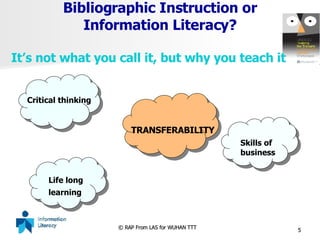
Bibliographic Instruction or Information Literacy? It’s not what you call it, but why you teach it TRANSFERABILITY Critical thinking Skills of business Life long learning
Enterprise Wide  Orientation Target Audience: For new learners For new staff at all levels For new researchers/faculty/decision makers Levels of Contact: Email – personal, mass customization, mass mailing Participate in organization’s orientation Follow up with individual invitation
Training / Instruction From general introduction to research literacy  for undergraduates Academic Writing Introduction to Legal Research How to search XYZ database Advanced web searching Using bibliographic software BBA Research  Certificate  Program
7 Factors  for Developing an IL Course Understand your learners and their literacy needs Set course objectives Prepare course outline Determine teaching methods Create course materials Design assessment tools Plan for marketing your course
Understand Your Learners and   Their Literacy Needs a.  What is information literacy for your  organization’s staff? b.  What is information literacy for your learners?  c.  What do your learners already know and how can you find out?
1 a: Information Literacy for Library Staff  Map Learning to Competencies Competence is the ability to perform a set of tasks  successfully or efficiently to a required  standard of performance , based on  behaviors ,  skills  and underlying  knowledge
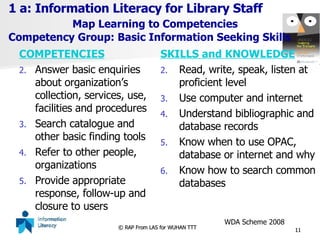
1 a: Information Literacy for Library Staff  Map Learning to Competencies Competency Group:  Basic Information Seeking Skills COMPETENCIES Answer basic enquiries about organization’s collection, services, use, facilities and procedures Search catalogue and other basic finding tools  Refer to other people, organizations  Provide appropriate response, follow-up and closure to users SKILLS and KNOWLEDGE Read, write, speak, listen at proficient level Use computer and internet  Understand bibliographic and database records Know when to use OPAC, database or internet and why Know how to search common databases WDA Scheme 2008
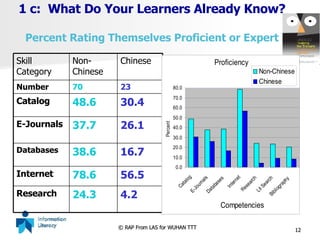
1 c:  What Do Your Learners Already Know? Percent Rating Themselves Proficient or Expert 23 70 Number 4.2 24.3 Research 56.5 78.6 Internet 16.7 38.6 Databases 26.1 37.7 E-Journals 30.4 48.6 Catalog Chinese Non-Chinese Skill Category
2. Set Course Objectives a.  Are your objectives in line with the learner’s needs? b.  What should your learners know at the end of the course?  c.  Are the objectives clear, specific and measurable? d.  Are you able to map content to objectives?
What are the key takeaways? How much time do you need? How much time will you get? What are the skill dependencies? Who else should you include in planning?   3. From Objectives  To Course Outline
4. Select Teaching Method Map methods to content and learners   Lecture Show and tell Role Play Hands – on Discussion  Small group Virtual  Passive Interactive On your own time
4. Select Teaching Methods What competencies and skills does your literacy trainer need? What is more important? Being a good trainer Being an expert in what is being taught What is more effective? Using an internal trainer Outsourcing your training
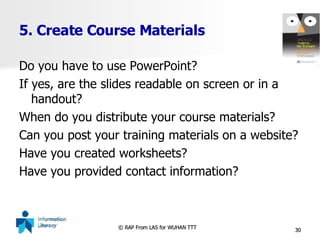
5 Create course materials What form will the course material take? PowerPoint Paper Web pages Hand outs Activity sheets Readings Do you need to clear copyright or seek permission? Contact vendors for access rights?
6.  Design assessment tools How will you assess your learners? Administer pre and post tests Provide exercises Create a case study How will you evaluate your course? Ask questions to help you improve the course Solicit key learning points and have learners share
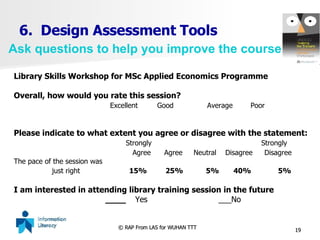
6.  Design Assessment Tools Ask questions to help you improve the course Library Skills Workshop for MSc Applied Economics Programme Overall, how would you rate this session? Excellent  Good  Average  Poor   Please indicate to what extent you agree or disagree with the statement: Strongly  Strongly Agree  Agree  Neutral  Disagree   Disagree The pace of the session was just right   15%  25%  5%  40%  5%   I am interested in attending library training session in the future  ____  Yes  ___No
Plan for Marketing your Course Factors affecting attendance Is the course compulsory? For credit? Do you have a champion or sponsor? Who initiated the course?  You or your institution? What do you call your course?   Is their a charge for the course?   Are you providing food? Is the course in a convenient location?
7.  Plan For Marketing your Course For user learners How do you get their attention? Where do your learners get events information? What incentive can you offer for taking the course? How do learners want you to contact them? For staff learners Is the course part of their professional development?  Will the course help their salary or promotion?
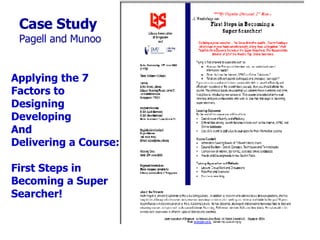
Case Study Pagell and Munoo Applying the 7  Factors to Designing Developing And Delivering a Course: First Steps in Becoming a Super Searcher!
About the Course First Steps in Becoming a Super Searcher! Sponsor: Library Association of Singapore  (LAS) Professional Development Committee Target audience: Para-professionals and entry level librarians Duration: 1 day course Size limit per class:20 based on need for hands-on Number of sessions conducted: 2 Trainers: 2 trainers from an academic library Cost course:  Fee, based on organization’s LAS membership
Understand Your Learners And Their   Literacy Needs Pre-course Information Gathering Dear Ms. Learner: Thank you for signing up for our course…. To help customize the course please tell us: 1.  Your job title and roles What you hope to learn from the course
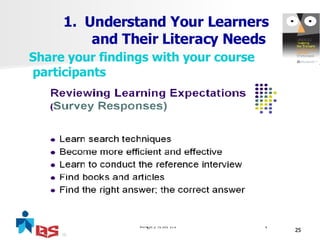
Understand Your Learners  and Their Literacy Needs Share your findings with your course participants
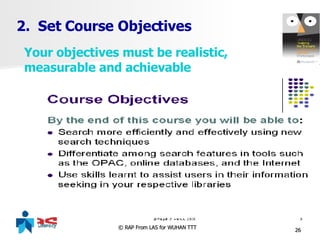
2.  Set Course Objectives Your objectives must be realistic,  measurable and achievable
3 Prepare Course Outline Program Outline 9-9:30 Welcome and Objectives 9:30-10:30 Understanding Users and their Information Needs 10:45-12:30  Search Concepts and Techniques  1:30- 3:15  Hands-on Case Study 3:30-4:15  Case Study Results 4:15-4:45  What’s New  4:45 – 5  Q & A   Chunk the content; leave time for questions
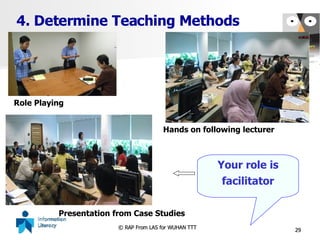
4.  Match Teaching Methods to Content Training Approaches Lecture; Group-work; Discussion Role Playing  Hands-on searching The Reference Interview: Role Play Person A:  Information specialist Person B:  Information seeker Person C: Scribe
4. Determine Teaching Methods Your role is facilitator Role Playing Hands on following lecturer Presentation from Case Studies
5. Create Course Materials Do you have to use PowerPoint? If yes, are the slides readable on screen or in a handout? When do you distribute your course materials? Can you post your training materials on a website? Have you created worksheets? Have you provided contact information?
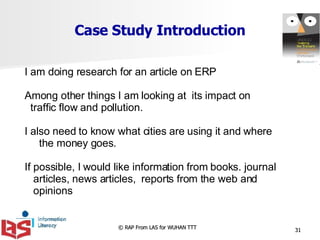
Case Study Introduction I am doing research for an article on ERP Among other things I am looking at  its impact on  traffic flow and pollution. I also need to know what cities are using it and where the money goes. If possible, I would like information from books. journal articles, news articles,  reports from the web and opinions
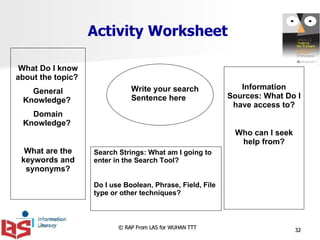
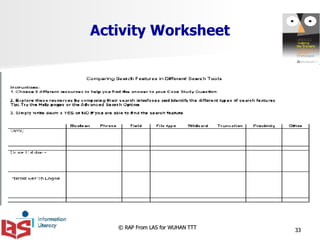
Activity Worksheet   What Do I know about the topic?  General Knowledge?  Domain Knowledge?  What are the keywords and synonyms? Information Sources: What Do I have access to? Who can I seek help from? Search Strings: What am I going to enter in the Search Tool? Do I use Boolean, Phrase, Field, File type or other techniques? Write your search Sentence here
Activity Worksheet
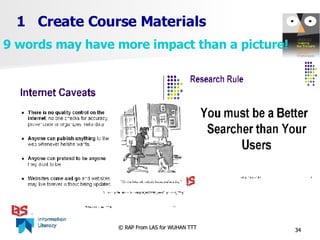
Create Course Materials 9 words may have more impact than a picture!
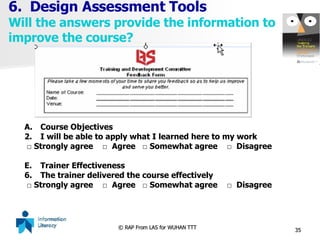
6.  Design Assessment Tools Will the answers provide the information to improve the course? Course Objectives I will be able to apply what I learned here to my work  □  Strongly agree  □  Agree  □ Somewhat agree  □  Disagree Trainer Effectiveness The trainer delivered the course effectively □  Strongly agree  □  Agree  □ Somewhat agree  □  Disagree
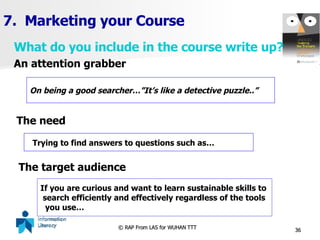
7.  Marketing your Course What do you include in the course write up? An attention grabber On being a good searcher…”It’s like a detective puzzle..”  The need   Trying to find answers to questions such as… The target audience If you are curious and want to learn sustainable skills to  search efficiently and effectively regardless of the tools  you use…
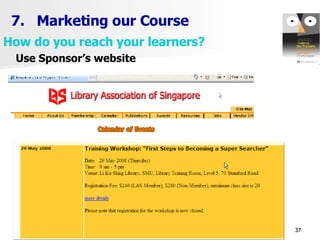
7.  Marketing our Course How do you reach your learners? Use Sponsor’s website
7.  Marketing our Course Other marketing channels Contact their bosses Use your website Involve all committee members For re-run, word of mouth
Training the Trainers Be a champion of IL yourself Advocate IL to key stakeholders 3-Rs: Reflect, Review, Revise  Write about and share teachings and learning with others  Keep up to date with trends and developments DO NOT FOCUS ON WHAT CANNOT BE DONE SEE WHERE YOU HAVE CONTROL
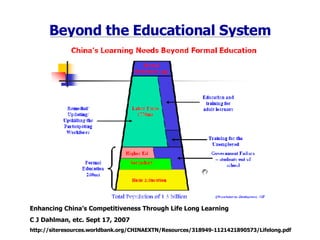
Beyond the Educational System Enhancing China’s Competitiveness Through Life Long Learning C J Dahlman, etc. Sept 17, 2007  http://siteresources.worldbank.org/CHINAEXTN/Resources/318949-1121421890573/Lifelong.pdf
Beyond Basics Graduate Students Researchers, Engineers and Scientists Medical Profession Government Officials Business People Lawyers
Trends and Developments:   Surveys Aims of the Study: Are young people, the ‘Google generation’, searching for and researching content in new ways and whether this is likely to shape their future behavior as mature researchers? Whether or not new ways of researching content will prove to be any different from the ways that existing researchers and scholars carry out their work? To inform and stimulate discussion about the future of libraries in the internet era Information Behaviour of the researcher of the future, 11 January 2008 University College of London, (2008, January, 8). A Ciber Briefing Paper. Retrieved May 25, 2008, from Information behaviour of the reseacher of the future Web site: http://www.jisc.ac.uk/media/documents/programmes/reppres/gg_final_keynote_11012008.pdf
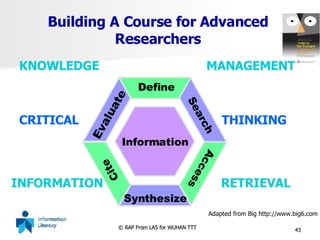
Building A Course for Advanced  Researchers  KNOWLEDGE  MANAGEMENT CRITICAL  THINKING  Adapted from Big http://www.big6.com INFORMATION  RETRIEVAL Define Synthesize Information Cite Access Evaluate Search
Thank You Discussion Questions and Answers Contact Details: [email_address] With input from Rajen Munoo  [email_address]

Pagell Wuhan

  • 1.
    Information Literacy for the Information Literate Ruth A Pagell Wuhan TTT October 2008
  • 2.
    Module Objectives Thismodule will : Help you understand the importance of strategic planning for course planning Provide tips for developing an IL class for your institution Reinforce the importance of information literacy for the information literate to contribute to learning and national development
  • 3.
    Why Consider “InformationLiteracy” for the Information Literate? Globalization of economies Globalization of education Tools of business Competitive intelligence Life long learning Raising the level of literacy for all
  • 4.
    What is InformationLiteracy for your Institutions? What’s in the name information literacy for the information literate? Orientation Training Bibliographic instruction Instruction Research skills Evaluation, analysis Understanding of copyright and plagiarism
  • 5.
    Bibliographic Instruction orInformation Literacy? It’s not what you call it, but why you teach it TRANSFERABILITY Critical thinking Skills of business Life long learning
  • 6.
    Enterprise Wide Orientation Target Audience: For new learners For new staff at all levels For new researchers/faculty/decision makers Levels of Contact: Email – personal, mass customization, mass mailing Participate in organization’s orientation Follow up with individual invitation
  • 7.
    Training / InstructionFrom general introduction to research literacy for undergraduates Academic Writing Introduction to Legal Research How to search XYZ database Advanced web searching Using bibliographic software BBA Research Certificate Program
  • 8.
    7 Factors for Developing an IL Course Understand your learners and their literacy needs Set course objectives Prepare course outline Determine teaching methods Create course materials Design assessment tools Plan for marketing your course
  • 9.
    Understand Your Learnersand Their Literacy Needs a. What is information literacy for your organization’s staff? b. What is information literacy for your learners? c. What do your learners already know and how can you find out?
  • 10.
    1 a: InformationLiteracy for Library Staff Map Learning to Competencies Competence is the ability to perform a set of tasks successfully or efficiently to a required standard of performance , based on behaviors , skills and underlying knowledge
  • 11.
    1 a: InformationLiteracy for Library Staff Map Learning to Competencies Competency Group: Basic Information Seeking Skills COMPETENCIES Answer basic enquiries about organization’s collection, services, use, facilities and procedures Search catalogue and other basic finding tools Refer to other people, organizations Provide appropriate response, follow-up and closure to users SKILLS and KNOWLEDGE Read, write, speak, listen at proficient level Use computer and internet Understand bibliographic and database records Know when to use OPAC, database or internet and why Know how to search common databases WDA Scheme 2008
  • 12.
    1 c: What Do Your Learners Already Know? Percent Rating Themselves Proficient or Expert 23 70 Number 4.2 24.3 Research 56.5 78.6 Internet 16.7 38.6 Databases 26.1 37.7 E-Journals 30.4 48.6 Catalog Chinese Non-Chinese Skill Category
  • 13.
    2. Set CourseObjectives a. Are your objectives in line with the learner’s needs? b. What should your learners know at the end of the course? c. Are the objectives clear, specific and measurable? d. Are you able to map content to objectives?
  • 14.
    What are thekey takeaways? How much time do you need? How much time will you get? What are the skill dependencies? Who else should you include in planning? 3. From Objectives To Course Outline
  • 15.
    4. Select TeachingMethod Map methods to content and learners Lecture Show and tell Role Play Hands – on Discussion Small group Virtual Passive Interactive On your own time
  • 16.
    4. Select TeachingMethods What competencies and skills does your literacy trainer need? What is more important? Being a good trainer Being an expert in what is being taught What is more effective? Using an internal trainer Outsourcing your training
  • 17.
    5 Create coursematerials What form will the course material take? PowerPoint Paper Web pages Hand outs Activity sheets Readings Do you need to clear copyright or seek permission? Contact vendors for access rights?
  • 18.
    6. Designassessment tools How will you assess your learners? Administer pre and post tests Provide exercises Create a case study How will you evaluate your course? Ask questions to help you improve the course Solicit key learning points and have learners share
  • 19.
    6. DesignAssessment Tools Ask questions to help you improve the course Library Skills Workshop for MSc Applied Economics Programme Overall, how would you rate this session? Excellent Good Average Poor Please indicate to what extent you agree or disagree with the statement: Strongly Strongly Agree Agree Neutral Disagree Disagree The pace of the session was just right 15% 25% 5% 40% 5% I am interested in attending library training session in the future ____ Yes ___No
  • 20.
    Plan for Marketingyour Course Factors affecting attendance Is the course compulsory? For credit? Do you have a champion or sponsor? Who initiated the course? You or your institution? What do you call your course? Is their a charge for the course? Are you providing food? Is the course in a convenient location?
  • 21.
    7. PlanFor Marketing your Course For user learners How do you get their attention? Where do your learners get events information? What incentive can you offer for taking the course? How do learners want you to contact them? For staff learners Is the course part of their professional development? Will the course help their salary or promotion?
  • 22.
    Case Study Pagelland Munoo Applying the 7 Factors to Designing Developing And Delivering a Course: First Steps in Becoming a Super Searcher!
  • 23.
    About the CourseFirst Steps in Becoming a Super Searcher! Sponsor: Library Association of Singapore (LAS) Professional Development Committee Target audience: Para-professionals and entry level librarians Duration: 1 day course Size limit per class:20 based on need for hands-on Number of sessions conducted: 2 Trainers: 2 trainers from an academic library Cost course: Fee, based on organization’s LAS membership
  • 24.
    Understand Your LearnersAnd Their Literacy Needs Pre-course Information Gathering Dear Ms. Learner: Thank you for signing up for our course…. To help customize the course please tell us: 1. Your job title and roles What you hope to learn from the course
  • 25.
    Understand Your Learners and Their Literacy Needs Share your findings with your course participants
  • 26.
    2. SetCourse Objectives Your objectives must be realistic, measurable and achievable
  • 27.
    3 Prepare CourseOutline Program Outline 9-9:30 Welcome and Objectives 9:30-10:30 Understanding Users and their Information Needs 10:45-12:30 Search Concepts and Techniques 1:30- 3:15 Hands-on Case Study 3:30-4:15 Case Study Results 4:15-4:45 What’s New 4:45 – 5 Q & A Chunk the content; leave time for questions
  • 28.
    4. MatchTeaching Methods to Content Training Approaches Lecture; Group-work; Discussion Role Playing Hands-on searching The Reference Interview: Role Play Person A: Information specialist Person B: Information seeker Person C: Scribe
  • 29.
    4. Determine TeachingMethods Your role is facilitator Role Playing Hands on following lecturer Presentation from Case Studies
  • 30.
    5. Create CourseMaterials Do you have to use PowerPoint? If yes, are the slides readable on screen or in a handout? When do you distribute your course materials? Can you post your training materials on a website? Have you created worksheets? Have you provided contact information?
  • 31.
    Case Study IntroductionI am doing research for an article on ERP Among other things I am looking at its impact on traffic flow and pollution. I also need to know what cities are using it and where the money goes. If possible, I would like information from books. journal articles, news articles, reports from the web and opinions
  • 32.
    Activity Worksheet What Do I know about the topic? General Knowledge? Domain Knowledge? What are the keywords and synonyms? Information Sources: What Do I have access to? Who can I seek help from? Search Strings: What am I going to enter in the Search Tool? Do I use Boolean, Phrase, Field, File type or other techniques? Write your search Sentence here
  • 33.
  • 34.
    Create Course Materials9 words may have more impact than a picture!
  • 35.
    6. DesignAssessment Tools Will the answers provide the information to improve the course? Course Objectives I will be able to apply what I learned here to my work □ Strongly agree □ Agree □ Somewhat agree □ Disagree Trainer Effectiveness The trainer delivered the course effectively □ Strongly agree □ Agree □ Somewhat agree □ Disagree
  • 36.
    7. Marketingyour Course What do you include in the course write up? An attention grabber On being a good searcher…”It’s like a detective puzzle..” The need Trying to find answers to questions such as… The target audience If you are curious and want to learn sustainable skills to search efficiently and effectively regardless of the tools you use…
  • 37.
    7. Marketingour Course How do you reach your learners? Use Sponsor’s website
  • 38.
    7. Marketingour Course Other marketing channels Contact their bosses Use your website Involve all committee members For re-run, word of mouth
  • 39.
    Training the TrainersBe a champion of IL yourself Advocate IL to key stakeholders 3-Rs: Reflect, Review, Revise Write about and share teachings and learning with others Keep up to date with trends and developments DO NOT FOCUS ON WHAT CANNOT BE DONE SEE WHERE YOU HAVE CONTROL
  • 40.
    Beyond the EducationalSystem Enhancing China’s Competitiveness Through Life Long Learning C J Dahlman, etc. Sept 17, 2007 http://siteresources.worldbank.org/CHINAEXTN/Resources/318949-1121421890573/Lifelong.pdf
  • 41.
    Beyond Basics GraduateStudents Researchers, Engineers and Scientists Medical Profession Government Officials Business People Lawyers
  • 42.
    Trends and Developments: Surveys Aims of the Study: Are young people, the ‘Google generation’, searching for and researching content in new ways and whether this is likely to shape their future behavior as mature researchers? Whether or not new ways of researching content will prove to be any different from the ways that existing researchers and scholars carry out their work? To inform and stimulate discussion about the future of libraries in the internet era Information Behaviour of the researcher of the future, 11 January 2008 University College of London, (2008, January, 8). A Ciber Briefing Paper. Retrieved May 25, 2008, from Information behaviour of the reseacher of the future Web site: http://www.jisc.ac.uk/media/documents/programmes/reppres/gg_final_keynote_11012008.pdf
  • 43.
    Building A Coursefor Advanced Researchers KNOWLEDGE MANAGEMENT CRITICAL THINKING Adapted from Big http://www.big6.com INFORMATION RETRIEVAL Define Synthesize Information Cite Access Evaluate Search
  • 44.
    Thank You DiscussionQuestions and Answers Contact Details: [email_address] With input from Rajen Munoo [email_address]