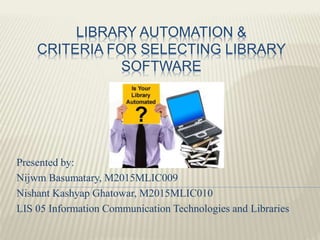
LIBRARY AUTOMATION &
CRITERIA FOR SELECTING LIBRARY
SOFTWARE
Presented by:
Nijwm Basumatary, M2015MLIC009
Nishant Kashyap Ghatowar, M2015MLIC010
LIS 05 Information Communication Technologies and Libraries
CONTENT
• Library Automation
• Development of Library Automation
• Special features of Library Automation
• Need for Library Automation
• Objectives of Library Automation
• Basic Requirements of Library Automation
• Advantages of Library Automation
• Disadvantages of Library Automation
• Library Automation: The steps
• Criteria for selecting Library Software
LIBRARY AUTOMATION
• Automation is a process of using the machineries for
easily working and saving the human power and time.
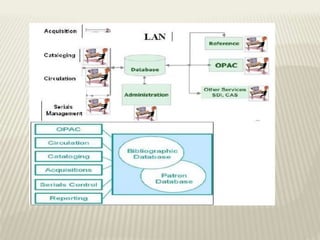
• Library automation is the general term for information
and communications technologies (ICT) that are used
to replace manual systems in the library.
• The main purpose of library automation is to free the
librarians and library staff and to allow them to
contribute more meaningfully to spread of knowledge
and Information.
DEVELOPMENT OF LIBRARY
AUTOMATION
• 1930s Punch card for circulation (IBM)
• 1950 Info & Docu. Center America
• 1961 Invention of IC by Rober Noyce (Intel) and
Jack Kerby (Texas)
• 1961 KWIC H. P. Luhan IBM
• 1966 MARC-I and in 1968 it was converted in
MARC-II by Henriette Avram
• 1965 Indian Science Abstract: author index by
INSDOC
• 1970s Many library networks establish in India
SPECIAL FEATURES OF LIBRARY
AUTOMATION
• It is an electronics based activity which is carried out by
human beings
• It is helpful to providing library services
• Standardization in library work
• Accuracy in work
• Speedily communication of information
• Avoid duplication in the library work
• Trained staff
• Availability of information
• It is a time saving system
• User friendly system
• Networking
NEED FOR LIBRARY AUTOMATION
• Obtain increased operational efficiencies,
• Relieve professional staff from clerical chores
so that they are available for user-oriented
services,
• Improve the quality, speed and effectiveness of
services,
• Improve access to remote users and other
stakeholders, e.g., the general public,
• Improve access to resources on other networks
and systems, including the Web,
NEED FOR LIBRARY AUTOMATION
• Provide new services not hitherto possible,
• Improve the management of their physical and financial
resources,
• Facilitate wider access to information for their clients,
• Facilitate wider dissemination of their information
products and services,
• Enable their participation in resource-sharing library
networks, and
• Enable rapid communication with other libraries (including
outreach libraries) and professional peers.
OBJECTIVES OF LIBRARY
AUTOMATION
• Speedily disposal of library work
• Establishment of a well storage & retrieval system
• Time and human power saving with qualitative services
• Suitability for library cooperation & coordination
development
• Simplicity in library management to meet the objectives
• Proper use of human resources
• Development of the new library services
• Preparation of reports and correspondence
• Suitability for resource sharing and networking
• Development of human resources
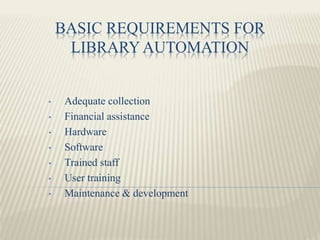
BASIC REQUIREMENTS FOR
LIBRARY AUTOMATION
• Adequate collection
• Financial assistance
• Hardware
• Software
• Trained staff
• User training
• Maintenance & development
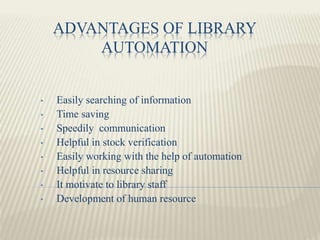
ADVANTAGES OF LIBRARY
AUTOMATION
• Easily searching of information
• Time saving
• Speedily communication
• Helpful in stock verification
• Easily working with the help of automation
• Helpful in resource sharing
• It motivate to library staff
• Development of human resource
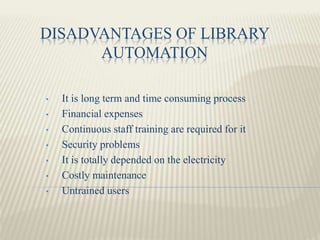
DISADVANTAGES OF LIBRARY
AUTOMATION
• It is long term and time consuming process
• Financial expenses
• Continuous staff training are required for it
• Security problems
• It is totally depended on the electricity
• Costly maintenance
• Untrained users
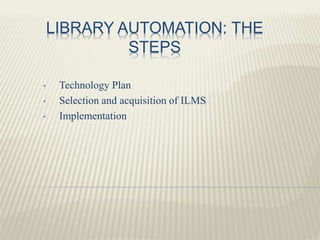
LIBRARY AUTOMATION: THE
STEPS
• Technology Plan
• Selection and acquisition of ILMS
• Implementation
CRITERIA FOR SELECTING LIBRARY
SOFTWARE
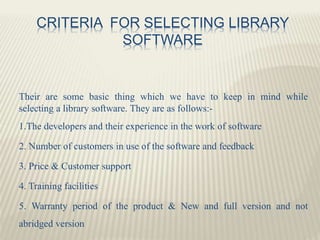
Their are some basic thing which we have to keep in mind while
selecting a library software. They are as follows:-
1.The developers and their experience in the work of software
2. Number of customers in use of the software and feedback
3. Price & Customer support
4. Training facilities
5. Warranty period of the product & New and full version and not
abridged version
CRITERIA FOR SELECTING LIBRARY
SOFTWARE
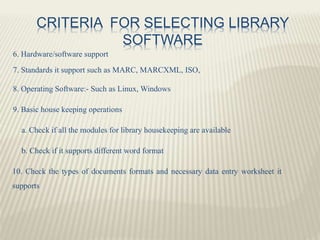
6. Hardware/software support
7. Standards it support such as MARC, MARCXML, ISO,
8. Operating Software:- Such as Linux, Windows
9. Basic house keeping operations
a. Check if all the modules for library housekeeping are available
b. Check if it supports different word format
10. Check the types of documents formats and necessary data entry worksheet it
supports
CRITERIA FOR SELECTING LIBRARY
SOFTWARE
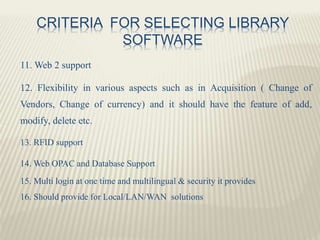
11. Web 2 support
12. Flexibility in various aspects such as in Acquisition ( Change of
Vendors, Change of currency) and it should have the feature of add,
modify, delete etc.
13. RFID support
14. Web OPAC and Database Support
15. Multi login at one time and multilingual & security it provides
16. Should provide for Local/LAN/WAN solutions
REFERENCES
Association, T. M. L. (1986). Library Automation. Madras Library Association.
Clayton, M. (1987). Managing Library Automation. Gower Pub. Co.
Kumar, P. S. G. (1987). Computerization of Indian Libraries. B.R. Publishing
Corporation.
Nair, R. R. (1992). Computer Application to Library and Information Services. Ess
Ess Publication.
Riaz, M. (1991). Library Automation : An Introductory Text. EBSCO Subscription
Services.
Singh, S. P. (1975). Automation in Libraries. Metropolitan Book Co.
Sharma, S. K. P. (1995). Fundamentals of Library Automation. Ess Ess Publication.
Haravu, L. J. (2005). Library Automation. Allied Publishers.
SAFECode_Software_Integrity_Controls0610.pdf. (n.d.). Retrieved September 15,
2015, from
http://www.safecode.org/publication/SAFECode_Software_Integrity_Controls0610.p
df
SOUL. (n.d.). Retrieved September 15, 2015, from http://www.inflibnet.ac.in/soul/
Library Automation & Criteria for selection Library Software

Library Automation & Criteria for selection Library Software

  • 1.
    LIBRARY AUTOMATION & CRITERIAFOR SELECTING LIBRARY SOFTWARE Presented by: Nijwm Basumatary, M2015MLIC009 Nishant Kashyap Ghatowar, M2015MLIC010 LIS 05 Information Communication Technologies and Libraries
  • 2.
    CONTENT • Library Automation •Development of Library Automation • Special features of Library Automation • Need for Library Automation • Objectives of Library Automation • Basic Requirements of Library Automation • Advantages of Library Automation • Disadvantages of Library Automation • Library Automation: The steps • Criteria for selecting Library Software
  • 3.
    LIBRARY AUTOMATION • Automationis a process of using the machineries for easily working and saving the human power and time. • Library automation is the general term for information and communications technologies (ICT) that are used to replace manual systems in the library. • The main purpose of library automation is to free the librarians and library staff and to allow them to contribute more meaningfully to spread of knowledge and Information.
  • 4.
    DEVELOPMENT OF LIBRARY AUTOMATION •1930s Punch card for circulation (IBM) • 1950 Info & Docu. Center America • 1961 Invention of IC by Rober Noyce (Intel) and Jack Kerby (Texas) • 1961 KWIC H. P. Luhan IBM • 1966 MARC-I and in 1968 it was converted in MARC-II by Henriette Avram • 1965 Indian Science Abstract: author index by INSDOC • 1970s Many library networks establish in India
  • 5.
    SPECIAL FEATURES OFLIBRARY AUTOMATION • It is an electronics based activity which is carried out by human beings • It is helpful to providing library services • Standardization in library work • Accuracy in work • Speedily communication of information • Avoid duplication in the library work • Trained staff • Availability of information • It is a time saving system • User friendly system • Networking
  • 6.
    NEED FOR LIBRARYAUTOMATION • Obtain increased operational efficiencies, • Relieve professional staff from clerical chores so that they are available for user-oriented services, • Improve the quality, speed and effectiveness of services, • Improve access to remote users and other stakeholders, e.g., the general public, • Improve access to resources on other networks and systems, including the Web,
  • 7.
    NEED FOR LIBRARYAUTOMATION • Provide new services not hitherto possible, • Improve the management of their physical and financial resources, • Facilitate wider access to information for their clients, • Facilitate wider dissemination of their information products and services, • Enable their participation in resource-sharing library networks, and • Enable rapid communication with other libraries (including outreach libraries) and professional peers.
  • 8.
    OBJECTIVES OF LIBRARY AUTOMATION •Speedily disposal of library work • Establishment of a well storage & retrieval system • Time and human power saving with qualitative services • Suitability for library cooperation & coordination development • Simplicity in library management to meet the objectives • Proper use of human resources • Development of the new library services • Preparation of reports and correspondence • Suitability for resource sharing and networking • Development of human resources
  • 9.
    BASIC REQUIREMENTS FOR LIBRARYAUTOMATION • Adequate collection • Financial assistance • Hardware • Software • Trained staff • User training • Maintenance & development
  • 10.
    ADVANTAGES OF LIBRARY AUTOMATION •Easily searching of information • Time saving • Speedily communication • Helpful in stock verification • Easily working with the help of automation • Helpful in resource sharing • It motivate to library staff • Development of human resource
  • 11.
    DISADVANTAGES OF LIBRARY AUTOMATION •It is long term and time consuming process • Financial expenses • Continuous staff training are required for it • Security problems • It is totally depended on the electricity • Costly maintenance • Untrained users
  • 12.
    LIBRARY AUTOMATION: THE STEPS •Technology Plan • Selection and acquisition of ILMS • Implementation
  • 14.
    CRITERIA FOR SELECTINGLIBRARY SOFTWARE Their are some basic thing which we have to keep in mind while selecting a library software. They are as follows:- 1.The developers and their experience in the work of software 2. Number of customers in use of the software and feedback 3. Price & Customer support 4. Training facilities 5. Warranty period of the product & New and full version and not abridged version
  • 15.
    CRITERIA FOR SELECTINGLIBRARY SOFTWARE 6. Hardware/software support 7. Standards it support such as MARC, MARCXML, ISO, 8. Operating Software:- Such as Linux, Windows 9. Basic house keeping operations a. Check if all the modules for library housekeeping are available b. Check if it supports different word format 10. Check the types of documents formats and necessary data entry worksheet it supports
  • 16.
    CRITERIA FOR SELECTINGLIBRARY SOFTWARE 11. Web 2 support 12. Flexibility in various aspects such as in Acquisition ( Change of Vendors, Change of currency) and it should have the feature of add, modify, delete etc. 13. RFID support 14. Web OPAC and Database Support 15. Multi login at one time and multilingual & security it provides 16. Should provide for Local/LAN/WAN solutions
  • 17.
    REFERENCES Association, T. M.L. (1986). Library Automation. Madras Library Association. Clayton, M. (1987). Managing Library Automation. Gower Pub. Co. Kumar, P. S. G. (1987). Computerization of Indian Libraries. B.R. Publishing Corporation. Nair, R. R. (1992). Computer Application to Library and Information Services. Ess Ess Publication. Riaz, M. (1991). Library Automation : An Introductory Text. EBSCO Subscription Services. Singh, S. P. (1975). Automation in Libraries. Metropolitan Book Co. Sharma, S. K. P. (1995). Fundamentals of Library Automation. Ess Ess Publication. Haravu, L. J. (2005). Library Automation. Allied Publishers. SAFECode_Software_Integrity_Controls0610.pdf. (n.d.). Retrieved September 15, 2015, from http://www.safecode.org/publication/SAFECode_Software_Integrity_Controls0610.p df SOUL. (n.d.). Retrieved September 15, 2015, from http://www.inflibnet.ac.in/soul/