By: Dian Arya
 Alphonse F.Trezza: library network is a formal
organization among libraries for cooperation and
sharing of resources, in which the group as a
whole is organized into subgroups with the
exception that most of the needs of a library will be
satisfied within the subgroups of which is its
member
 Raynard C. Swank: library network is a concept
that includes the development of cooperative
systems of libraries on geographical, subject, or
other lines, each with somekind of centre that not
only coordinates the internal activities of the
system but also serves as the system’s outlet to and
inlet from the centres of other systems
 Susan Martin: library network is a group of
individuals or organizations that are
interconnected. The linking must include a
communications mechanism, and many
networks exist for the express purpose of
facilitating certain types of communication
among their members. … in achieving better
sharing of resources consisting of bibliographic
information and of collections- and better
service to the patrons
 Library networking is meant to promote and
facilitate sharing of the resources available within
a group of libraries in order to provide maximum
information to users, to lower operational costs
and also to make optimum use of resources
 In order to do so, it is necessary to create
bibliographic tools, like union catalogues and
union lists based on the resources available in the
participating libraries and these tools have to be in
turn used for resource sharing and reference
purposes
 Rationalization of acquisitions needs to be
undertaken
 Interlibrary loan services should grow and may be
interlinked with the search of the union catalogues.
Delivery of documents should be fast, either
electronically, through fax or through courier or
mail
 The libraries selected to join a network should be
willing partners, ready to buy hardware, etc., and
should be willing to send professional staff for
training. They should be willing to pool
bibliographic records to the central host of the
network besides adhering to other network
obligations
 In-house functions like acquisition,
cataloguing, classification, serials control,
circulation, SDI, current awareness service, etc.,
should be undertaken by the individual
libraries. The network software may or may
not support these operations of the libraries in
the beginning but eventually the network
software should not only be able to create
union catalogues or full-text databases, but also
get integrated with the in-house operations
 The network should be able to recommend to
participating libraries the of hardware they
need for their in-house functions and for
networking purposes. Hardware should be
selected considering the number of comes the
participating libraries can generate within the
next 3-5 years. The hardware at the central host
will have to be upgraded regularly depending
upon the speed with which participating
libraries generate records and the network
pools them into the central host
 All libraries should follow a standard format
(MARC or Dublin Core), AACR II, standard
thesaurus like LC Subject Headings, etc,
uniformly.
 E-mail and internet facilities should be
available with the libraries and they should be
able to access international databases,
preferably individually or through the network
host to begin with.
 Although efforts, should be made to have one
classification scheme in all participating
libraries but use of different class numbers
should not become a hurdle as search requests
are mostly by authors, titles, editors and subject
descriptors.
 The earliest aims of networks was resource
sharing – that is, the use of distant computing
resources by means of the network, but the
aims and objectives of successful library
network vary according to the changing
scenario and varying priorities.
 It increases the availability and accessability of
resources
 Resource sharing helps in building specialised
collection and all participating libraries need
not duplicate the procurement of similar
material
 Resource sharing advocates that the reading
material of one library should be made
available to the clients of other librariess, thus
exposing the reading materials to a wider
group of users.
 To promote co-operative activities like
acquisition, exchange, storage, binding,
training, reference and documentation services,
interlibrary loans etc.
 To eliminate record duplication
 To prepare union catalogue
 To rationalise the collection development
 To obtain improved bibliographic control
 To enhance the efficacy of exchange agreement
 To achieve a regular document delivery system
 To promote the exchange of information with
other cooperative networks
 To create authority files
 To extend service to a wider user community
and to promote programme for increased use
of library resources
 To assisst member libraries in selection,
purchase, catalogue and processing of library
materials
 To stimulate the improvement of library
facilities and services
 To co-operate in the development of library
personnel
 To provide, resources beyond the reach of
individual libraries
 To achieve economies in the use of resources,
human and material
 To facilitate sharing of material among
members of the group
 To provide cost effective information storage
and maintenance
 To enable the optimum utilization of existing
library information system
 To provide current awareness services with
minimum delay
 To give access to information resources within
the state and other states
 To evolve a state standard for information
handling
 Provision of document transmission facility
 Providing remote access to one’s own online
public access catalogue (OPAC) and enabling
access to other remote OPACs
 Access to commercial bibliographic record
databases and interconnection between
bibliographic record creation utilities
 Support for inter-library loan services
 Providing access to users to external
information sources such as databases,
electronic journals, news, etc.
 Linking library issue systems fo support of
reciprocal borrowing arrangements between
institutions
 Use of electronic mail, news and mailing lists
for informal or formal professional
communication
 Provision of local networked information
services
 Private: usually owned by some corporation or
other entity that confines access and use of
network services to its staff
 Cooperative: refers to networks that are
supported and managed by their users
 Integrated Services Digital Network: a public
network providing end-to-end digital
connectivity which is capable of supporting a
range of digital devices and service, both voice
and non-voice, on the same basis.
 Local Area Network (LAN)
LAN connects a large number of different types of
equipment, including computer terminals, fax,
telex, CD-ROM players, etc. on single site.
There are baseband that is they carry only
digital computer data, and broadband can
carry video and voice signals as well data.
 Metropolitan Area Network (MAN)
MAN cover specific metropolitan area and
provide to them all the services.
 Wide Area Network (WAN)
These are private networks linking equipment at
several different sites and have much in
common with conventional large scale data
network
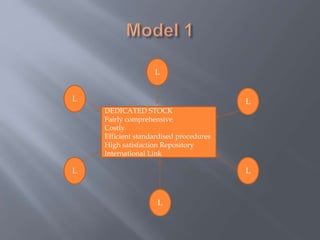
 Model 1, shows a very simple cooperative
arrangement which is costly but can provide an
effective international link as it provides only
one main node percountry. Each individual
library uses a national central library facility
L
L
L
L
L
L
DEDICATED STOCK
Fairly comprehensive
Costly
Efficient standardised procedures
High satisfaction Repository
International Link

Library Networks

  • 1.
  • 2.
     Alphonse F.Trezza:library network is a formal organization among libraries for cooperation and sharing of resources, in which the group as a whole is organized into subgroups with the exception that most of the needs of a library will be satisfied within the subgroups of which is its member  Raynard C. Swank: library network is a concept that includes the development of cooperative systems of libraries on geographical, subject, or other lines, each with somekind of centre that not only coordinates the internal activities of the system but also serves as the system’s outlet to and inlet from the centres of other systems
  • 3.
     Susan Martin:library network is a group of individuals or organizations that are interconnected. The linking must include a communications mechanism, and many networks exist for the express purpose of facilitating certain types of communication among their members. … in achieving better sharing of resources consisting of bibliographic information and of collections- and better service to the patrons
  • 4.
     Library networkingis meant to promote and facilitate sharing of the resources available within a group of libraries in order to provide maximum information to users, to lower operational costs and also to make optimum use of resources  In order to do so, it is necessary to create bibliographic tools, like union catalogues and union lists based on the resources available in the participating libraries and these tools have to be in turn used for resource sharing and reference purposes
  • 5.
     Rationalization ofacquisitions needs to be undertaken  Interlibrary loan services should grow and may be interlinked with the search of the union catalogues. Delivery of documents should be fast, either electronically, through fax or through courier or mail  The libraries selected to join a network should be willing partners, ready to buy hardware, etc., and should be willing to send professional staff for training. They should be willing to pool bibliographic records to the central host of the network besides adhering to other network obligations
  • 6.
     In-house functionslike acquisition, cataloguing, classification, serials control, circulation, SDI, current awareness service, etc., should be undertaken by the individual libraries. The network software may or may not support these operations of the libraries in the beginning but eventually the network software should not only be able to create union catalogues or full-text databases, but also get integrated with the in-house operations
  • 7.
     The networkshould be able to recommend to participating libraries the of hardware they need for their in-house functions and for networking purposes. Hardware should be selected considering the number of comes the participating libraries can generate within the next 3-5 years. The hardware at the central host will have to be upgraded regularly depending upon the speed with which participating libraries generate records and the network pools them into the central host
  • 8.
     All librariesshould follow a standard format (MARC or Dublin Core), AACR II, standard thesaurus like LC Subject Headings, etc, uniformly.  E-mail and internet facilities should be available with the libraries and they should be able to access international databases, preferably individually or through the network host to begin with.
  • 9.
     Although efforts,should be made to have one classification scheme in all participating libraries but use of different class numbers should not become a hurdle as search requests are mostly by authors, titles, editors and subject descriptors.
  • 10.
     The earliestaims of networks was resource sharing – that is, the use of distant computing resources by means of the network, but the aims and objectives of successful library network vary according to the changing scenario and varying priorities.
  • 11.
     It increasesthe availability and accessability of resources  Resource sharing helps in building specialised collection and all participating libraries need not duplicate the procurement of similar material  Resource sharing advocates that the reading material of one library should be made available to the clients of other librariess, thus exposing the reading materials to a wider group of users.
  • 12.
     To promoteco-operative activities like acquisition, exchange, storage, binding, training, reference and documentation services, interlibrary loans etc.  To eliminate record duplication  To prepare union catalogue  To rationalise the collection development  To obtain improved bibliographic control  To enhance the efficacy of exchange agreement  To achieve a regular document delivery system
  • 13.
     To promotethe exchange of information with other cooperative networks  To create authority files  To extend service to a wider user community and to promote programme for increased use of library resources  To assisst member libraries in selection, purchase, catalogue and processing of library materials  To stimulate the improvement of library facilities and services
  • 14.
     To co-operatein the development of library personnel  To provide, resources beyond the reach of individual libraries  To achieve economies in the use of resources, human and material  To facilitate sharing of material among members of the group  To provide cost effective information storage and maintenance
  • 15.
     To enablethe optimum utilization of existing library information system  To provide current awareness services with minimum delay  To give access to information resources within the state and other states  To evolve a state standard for information handling  Provision of document transmission facility
  • 16.
     Providing remoteaccess to one’s own online public access catalogue (OPAC) and enabling access to other remote OPACs  Access to commercial bibliographic record databases and interconnection between bibliographic record creation utilities  Support for inter-library loan services  Providing access to users to external information sources such as databases, electronic journals, news, etc.
  • 17.
     Linking libraryissue systems fo support of reciprocal borrowing arrangements between institutions  Use of electronic mail, news and mailing lists for informal or formal professional communication  Provision of local networked information services
  • 18.
     Private: usuallyowned by some corporation or other entity that confines access and use of network services to its staff  Cooperative: refers to networks that are supported and managed by their users  Integrated Services Digital Network: a public network providing end-to-end digital connectivity which is capable of supporting a range of digital devices and service, both voice and non-voice, on the same basis.
  • 19.
     Local AreaNetwork (LAN) LAN connects a large number of different types of equipment, including computer terminals, fax, telex, CD-ROM players, etc. on single site. There are baseband that is they carry only digital computer data, and broadband can carry video and voice signals as well data.
  • 20.
     Metropolitan AreaNetwork (MAN) MAN cover specific metropolitan area and provide to them all the services.  Wide Area Network (WAN) These are private networks linking equipment at several different sites and have much in common with conventional large scale data network
  • 21.
     Model 1,shows a very simple cooperative arrangement which is costly but can provide an effective international link as it provides only one main node percountry. Each individual library uses a national central library facility
  • 22.
    L L L L L L DEDICATED STOCK Fairly comprehensive Costly Efficientstandardised procedures High satisfaction Repository International Link