Introduction to Library
 Instruction in the ULS

         Robin Kear, MLIS
   Nazarbayev University Library
            April 2012
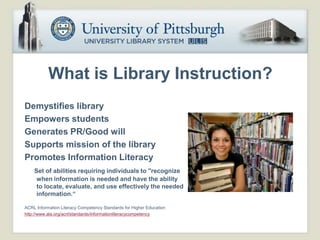
What is Library Instruction?
Demystifies library
Empowers students
Generates PR/Good will
Supports mission of the library
Promotes Information Literacy
    Set of abilities requiring individuals to "recognize
     when information is needed and have the ability
     to locate, evaluate, and use effectively the needed
     information.“

ACRL Information Literacy Competency Standards for Higher Education
http://www.ala.org/acrl/standards/informationliteracycompetency
Bibliographic Instruction vs.
    Information Literacy
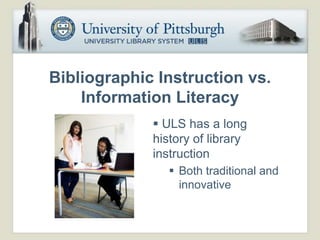
              ULS has a long
             history of library
             instruction
                 Both traditional and
                  innovative
Bibliographic Instruction vs.
           Information Literacy
 “Information literacy involves mastery over a complex set of
  concepts and skills and their interplay…knowledge of library
  skills is an integral part of information literacy… serving as
  tools for realizing its higher goals.”

    Sharma, Shikha. “From Chaos to Clarity.” Journal of Academic
     Librarianship 33.1 (Jan. 2007): 127-35.
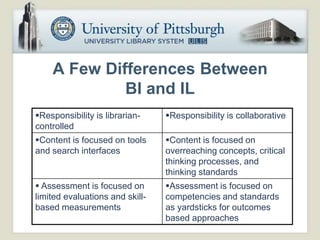
A Few Differences Between
             BI and IL
Responsibility is librarian-    Responsibility is collaborative
controlled
Content is focused on tools     Content is focused on
and search interfaces            overreaching concepts, critical
                                 thinking processes, and
                                 thinking standards
 Assessment is focused on       Assessment is focused on
limited evaluations and skill-   competencies and standards
based measurements               as yardsticks for outcomes
                                 based approaches
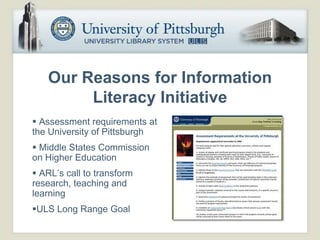
Our Reasons for Information
        Literacy Initiative
 Assessment requirements at
the University of Pittsburgh
 Middle States Commission
on Higher Education
 ARL’s call to transform
research, teaching and
learning
ULS Long Range Goal
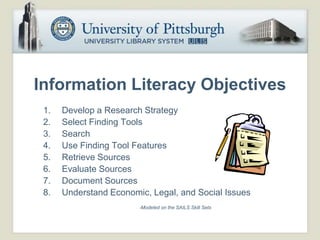
Information Literacy Objectives
 1.   Develop a Research Strategy
 2.   Select Finding Tools
 3.   Search
 4.   Use Finding Tool Features
 5.   Retrieve Sources
 6.   Evaluate Sources
 7.   Document Sources
 8.   Understand Economic, Legal, and Social Issues
                        -Modeled on the SAILS Skill Sets
Role of ULS In
Information Literacy Assessment
                 Online information literacy
                test
                 45 questions dealing with a
                range of information seeking
                skills
                 Benchmark freshman IL
                skills
                 Assess senior class skills
The Goal: Better IL Integration at
   the Course/Program Level
Embed into the research
process of the course or
program
Collaborate with the
instructor(s) or program
director(s)
Always tie instruction to the
assignment
Various, Simultaneous
            IL Components
 One-shot classes as library/searching orientations
 One-on-one instruction
 Embedded librarians
 Classroom integrated tools
 Integrated discipline/IL goals and rubrics
 Curriculum mapping
Embedded Librarian

Integral part of the
  whole
Part of the online
  classroom
  environment
ENGLIT 0500: Intro to Critical Reading

 Collaboration with a Pitt English Professor
 Tiered assignment
 I teach just before the annotated bibliography
  is due
 Part of their CourseWeb
 Review annotated bibliographies
Levels for Courseware Tools
Macro Level Library Courseware
  Involvement, entails working with the developers
  and programmers of courseware to integrating into
  the software a generic, global library presence.

Micro Level Library Courseware
  Involvement, involves individual librarians teaming
  up with faculty as consultants to participate in
  developing a customized library instruction and
  resource component for the courseware enhanced
  courses.
Ideas for Courseware
 Create downloadable items that can be
  imported into online courses
 Remind faculty of virtual reference desks and
  library web presence
 Offer to create and embed discipline specific
  IL rubrics
 “Librarian Role”
The Reality
The research process is more difficult with
information abundance:

    •Technology issues now complicate
    research concepts further
    •Too many information choices, not enough
    orientation
The Assignment

    Write a 5-7 page paper on
    the topic of your choice.
    Use scholarly sources.
    Due the last day of the
    semester.
Things students feel…
Anxiety
Annoyance
Stress
Overwhelmed
Fear
Confusion
Excitement
Dread
Uncertainty
Things students say…
   “I have no idea [about the dates or details of my topic].”
   I can’t find this article in the catalog.
   This magazine isn’t online so I can’t get it.
   There is not enough on my topic, I have to change it.
   I don’t know what a primary or secondary source is.
   My professor said to use scholarly sources…what are those?
   Am I cheating if I use someone else’s bibliography?
(Mary George, Admissions of Another Sort)
Things students do…
 Procrastinate (80% of Head &Elison’s 86 students
  procrastinate on 80% of their research assignments)
 Spend 3 hours on research, 2 hours
  writing
 Go to Wikipedia for context and to pre-
  search (8 out of 11)
 Go to the Internet or databases for
  sources
 Do “good enough” research to get by
The Result
   Papers aren’t as good as
   they could be
   Research is associated
   with negativity
   Hard for library to fulfill
   requests (reference and
   collection related) when
   students procrastinate
Goal: Better Research Assignments

 Process over Product
 Tiered Paper Approach
 Suggest Alternatives to the 5-7 Pages
     Annotated bibliography
     Literature review
     Bibliographic essay
     Evaluate and edit a Wikipedia entry
     Grant or research proposal
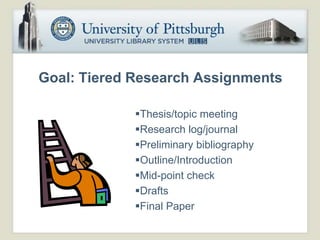
Goal: Tiered Research Assignments

             Thesis/topic meeting
             Research log/journal
             Preliminary bibliography
             Outline/Introduction
             Mid-point check
             Drafts
             Final Paper
Goal: Embed Smaller Research
            Components
   Explain Citations
   Explain Source Types
   Suggest Disciplinary Sources
   Explain Terminology (primary vs. secondary)
   Explain Information Cycle
Things students need…
 Collaboration between faculty and librarians
 Collaboration between academic departments and
  libraries
 Connection between research-paper process and
  everyday life research
 Context:
  background, vocabulary, expectation, gathering
  resources
 Librarian as informational coach
 Frequent explanations of research (IL) concepts
  across courses and years from faculty and librarians
The Result: Ubiquity

 Research is not disconnected from
  the classroom
 Research is not an outside skill
 Research skills are necessary for all
  their work
LibGuide Companions
 Information Literacy
  Fundamentals
   http://pitt.libguides.com/infolit

 Information Literacy Tools
   http://pitt.libguides.com/infolittools
Any Questions?

Robin kear introduction to library instruction

  • 1.
    Introduction to Library Instruction in the ULS Robin Kear, MLIS Nazarbayev University Library April 2012
  • 2.
    What is LibraryInstruction? Demystifies library Empowers students Generates PR/Good will Supports mission of the library Promotes Information Literacy Set of abilities requiring individuals to "recognize when information is needed and have the ability to locate, evaluate, and use effectively the needed information.“ ACRL Information Literacy Competency Standards for Higher Education http://www.ala.org/acrl/standards/informationliteracycompetency
  • 3.
    Bibliographic Instruction vs. Information Literacy  ULS has a long history of library instruction  Both traditional and innovative
  • 4.
    Bibliographic Instruction vs. Information Literacy  “Information literacy involves mastery over a complex set of concepts and skills and their interplay…knowledge of library skills is an integral part of information literacy… serving as tools for realizing its higher goals.”  Sharma, Shikha. “From Chaos to Clarity.” Journal of Academic Librarianship 33.1 (Jan. 2007): 127-35.
  • 5.
    A Few DifferencesBetween BI and IL Responsibility is librarian- Responsibility is collaborative controlled Content is focused on tools Content is focused on and search interfaces overreaching concepts, critical thinking processes, and thinking standards  Assessment is focused on Assessment is focused on limited evaluations and skill- competencies and standards based measurements as yardsticks for outcomes based approaches
  • 6.
    Our Reasons forInformation Literacy Initiative  Assessment requirements at the University of Pittsburgh  Middle States Commission on Higher Education  ARL’s call to transform research, teaching and learning ULS Long Range Goal
  • 7.
    Information Literacy Objectives 1. Develop a Research Strategy 2. Select Finding Tools 3. Search 4. Use Finding Tool Features 5. Retrieve Sources 6. Evaluate Sources 7. Document Sources 8. Understand Economic, Legal, and Social Issues -Modeled on the SAILS Skill Sets
  • 8.
    Role of ULSIn Information Literacy Assessment  Online information literacy test  45 questions dealing with a range of information seeking skills  Benchmark freshman IL skills  Assess senior class skills
  • 9.
    The Goal: BetterIL Integration at the Course/Program Level Embed into the research process of the course or program Collaborate with the instructor(s) or program director(s) Always tie instruction to the assignment
  • 10.
    Various, Simultaneous IL Components  One-shot classes as library/searching orientations  One-on-one instruction  Embedded librarians  Classroom integrated tools  Integrated discipline/IL goals and rubrics  Curriculum mapping
  • 11.
    Embedded Librarian Integral partof the whole Part of the online classroom environment
  • 12.
    ENGLIT 0500: Introto Critical Reading  Collaboration with a Pitt English Professor  Tiered assignment  I teach just before the annotated bibliography is due  Part of their CourseWeb  Review annotated bibliographies
  • 13.
    Levels for CoursewareTools Macro Level Library Courseware Involvement, entails working with the developers and programmers of courseware to integrating into the software a generic, global library presence. Micro Level Library Courseware Involvement, involves individual librarians teaming up with faculty as consultants to participate in developing a customized library instruction and resource component for the courseware enhanced courses.
  • 14.
    Ideas for Courseware Create downloadable items that can be imported into online courses  Remind faculty of virtual reference desks and library web presence  Offer to create and embed discipline specific IL rubrics  “Librarian Role”
  • 15.
    The Reality The researchprocess is more difficult with information abundance: •Technology issues now complicate research concepts further •Too many information choices, not enough orientation
  • 16.
    The Assignment Write a 5-7 page paper on the topic of your choice. Use scholarly sources. Due the last day of the semester.
  • 17.
  • 18.
    Things students say…  “I have no idea [about the dates or details of my topic].”  I can’t find this article in the catalog.  This magazine isn’t online so I can’t get it.  There is not enough on my topic, I have to change it.  I don’t know what a primary or secondary source is.  My professor said to use scholarly sources…what are those?  Am I cheating if I use someone else’s bibliography? (Mary George, Admissions of Another Sort)
  • 19.
    Things students do… Procrastinate (80% of Head &Elison’s 86 students procrastinate on 80% of their research assignments)  Spend 3 hours on research, 2 hours writing  Go to Wikipedia for context and to pre- search (8 out of 11)  Go to the Internet or databases for sources  Do “good enough” research to get by
  • 20.
    The Result Papers aren’t as good as they could be Research is associated with negativity Hard for library to fulfill requests (reference and collection related) when students procrastinate
  • 21.
    Goal: Better ResearchAssignments  Process over Product  Tiered Paper Approach  Suggest Alternatives to the 5-7 Pages  Annotated bibliography  Literature review  Bibliographic essay  Evaluate and edit a Wikipedia entry  Grant or research proposal
  • 22.
    Goal: Tiered ResearchAssignments Thesis/topic meeting Research log/journal Preliminary bibliography Outline/Introduction Mid-point check Drafts Final Paper
  • 23.
    Goal: Embed SmallerResearch Components  Explain Citations  Explain Source Types  Suggest Disciplinary Sources  Explain Terminology (primary vs. secondary)  Explain Information Cycle
  • 24.
    Things students need… Collaboration between faculty and librarians  Collaboration between academic departments and libraries  Connection between research-paper process and everyday life research  Context: background, vocabulary, expectation, gathering resources  Librarian as informational coach  Frequent explanations of research (IL) concepts across courses and years from faculty and librarians
  • 25.
    The Result: Ubiquity Research is not disconnected from the classroom  Research is not an outside skill  Research skills are necessary for all their work
  • 26.
    LibGuide Companions  InformationLiteracy Fundamentals  http://pitt.libguides.com/infolit  Information Literacy Tools  http://pitt.libguides.com/infolittools
  • 27.