Conceptions of GIS: Implications for Information Literacy Maryam Nazari Maryam Nazari, University of Sheffield Information Literacy Research Centre Summer Event,  Department of Information Studies, University of Sheffield 13 th  of August 2008
Outline  An overview of my study Methodological approach The conceptions of GIS Implications for information literacy  Maryam Nazari, University of Sheffield
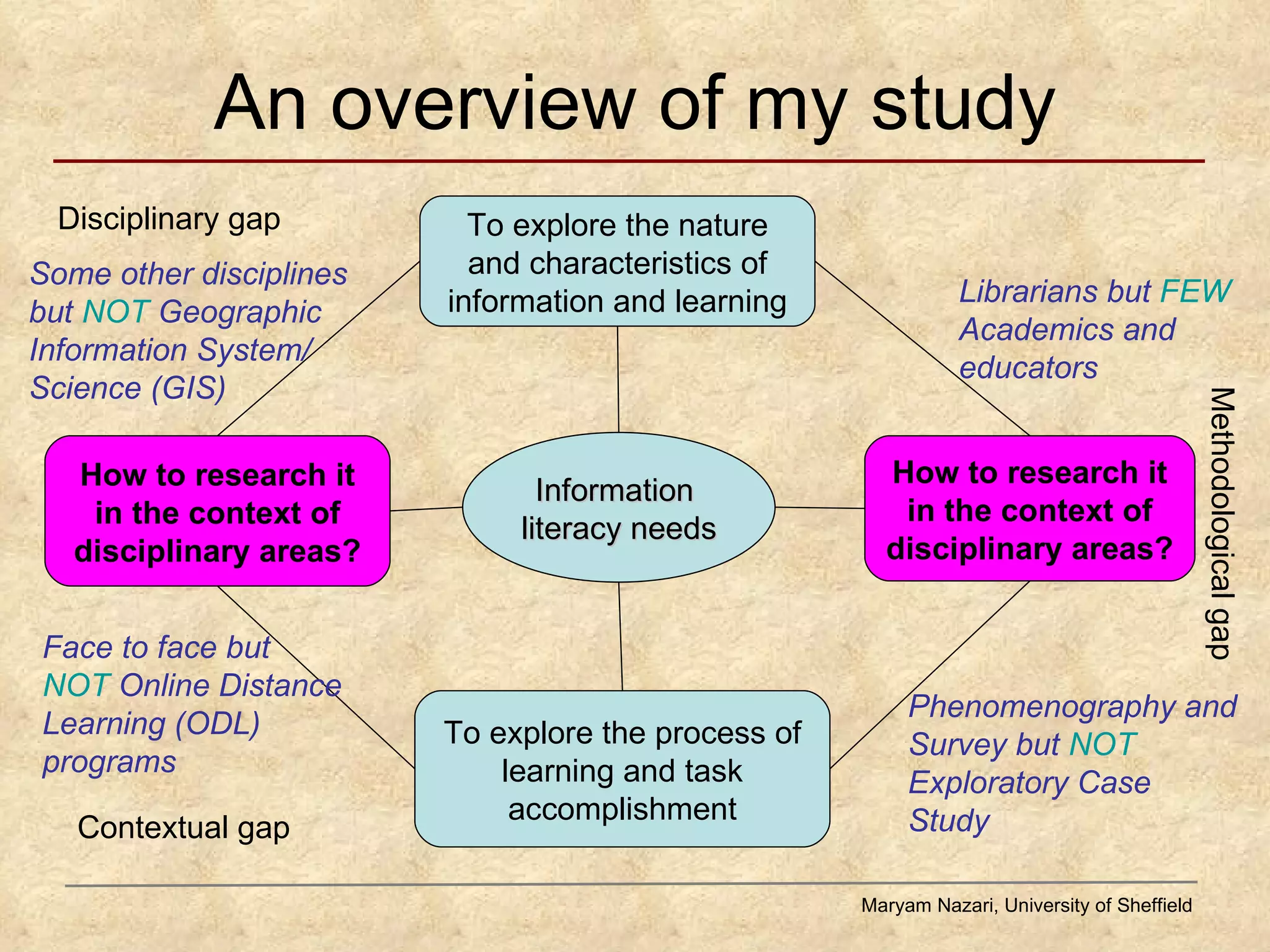
An overview of my study Maryam Nazari, University of Sheffield Information  literacy needs How to research it in the context of disciplinary areas? How to research it in the context of disciplinary areas? To explore the process of learning and task accomplishment To explore the nature and characteristics of information and learning Some other disciplines but  NOT  Geographic Information System/ Science (GIS) Phenomenography and Survey but  NOT  Exploratory Case Study Librarians but  FEW  Academics and educators  Face to face but  NOT  Online Distance Learning (ODL) programs Disciplinary gap Contextual gap Methodological gap
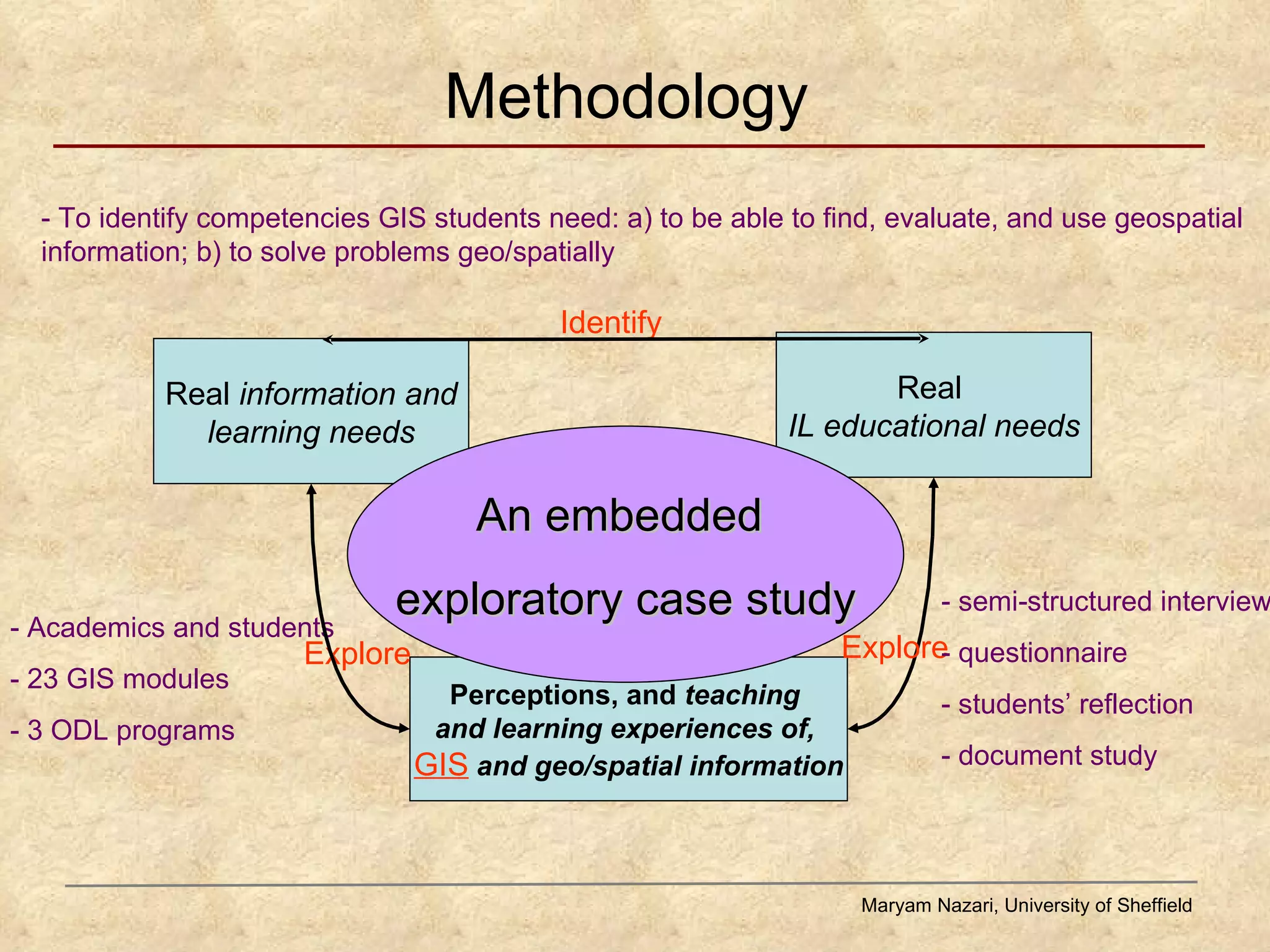
Methodology   Maryam Nazari, University of Sheffield Real  information and learning needs Perceptions, and  teaching  and learning experiences of,  GIS  and geo/spatial information Real  IL educational needs An embedded  exploratory case study Identify   Explore   - Academics and students  - 23 GIS modules - 3 ODL programs - semi-structured interview - questionnaire  - students’ reflection - document study - To identify competencies GIS students need: a) to be able to find, evaluate, and use geospatial information; b) to solve problems geo/spatially Explore
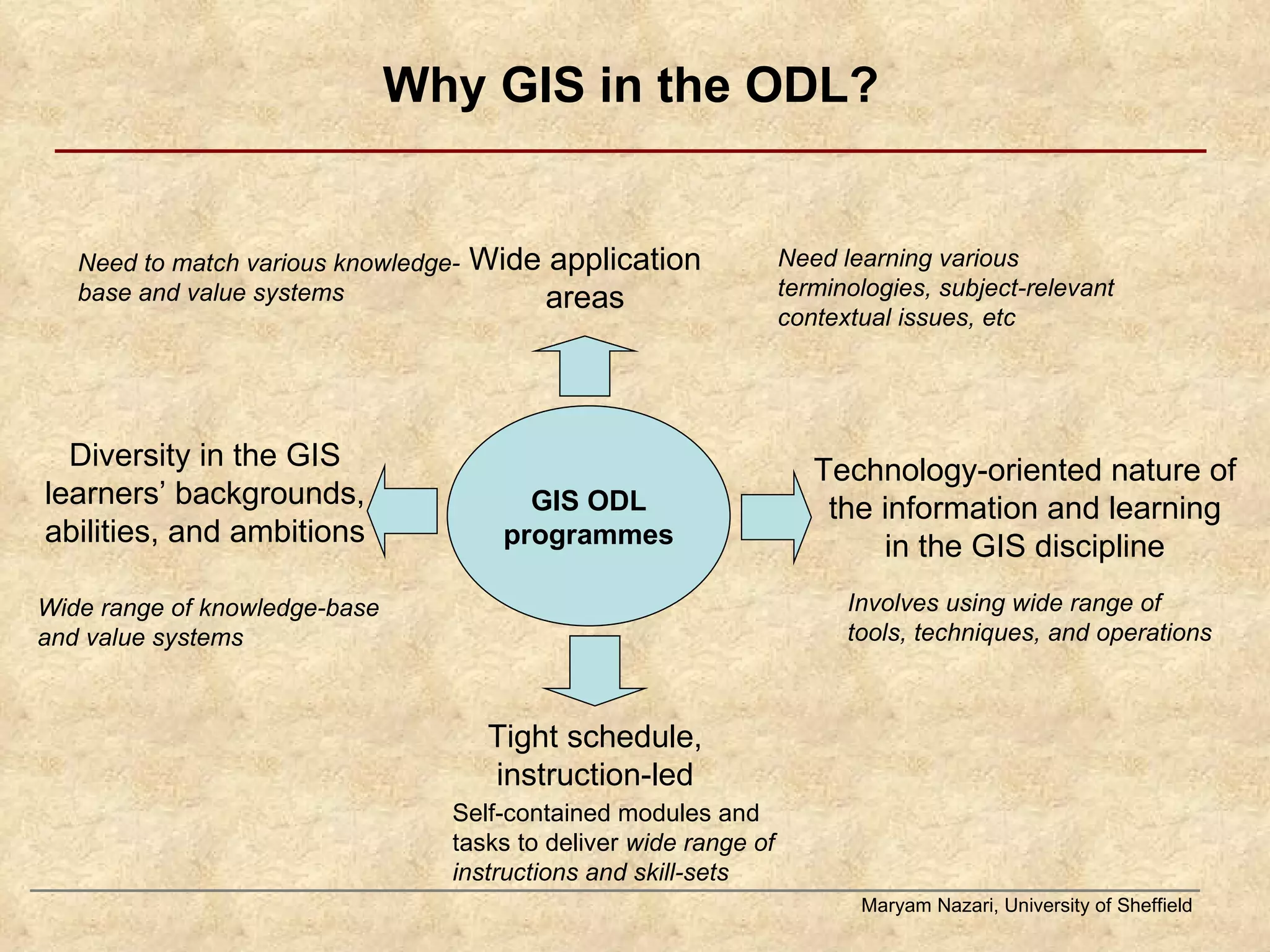
Why GIS in the ODL? Maryam Nazari, University of Sheffield GIS ODL programmes Diversity in the GIS learners’ backgrounds, abilities, and ambitions Wide application areas Technology-oriented nature of the information and learning in the GIS discipline Tight schedule, instruction-led Involves using wide range of tools, techniques, and operations Self-contained modules and tasks to deliver  wide range of instructions and skill-sets Need learning various terminologies, subject-relevant contextual issues, etc Wide range of knowledge-base and value systems Need to match various knowledge-base and value systems
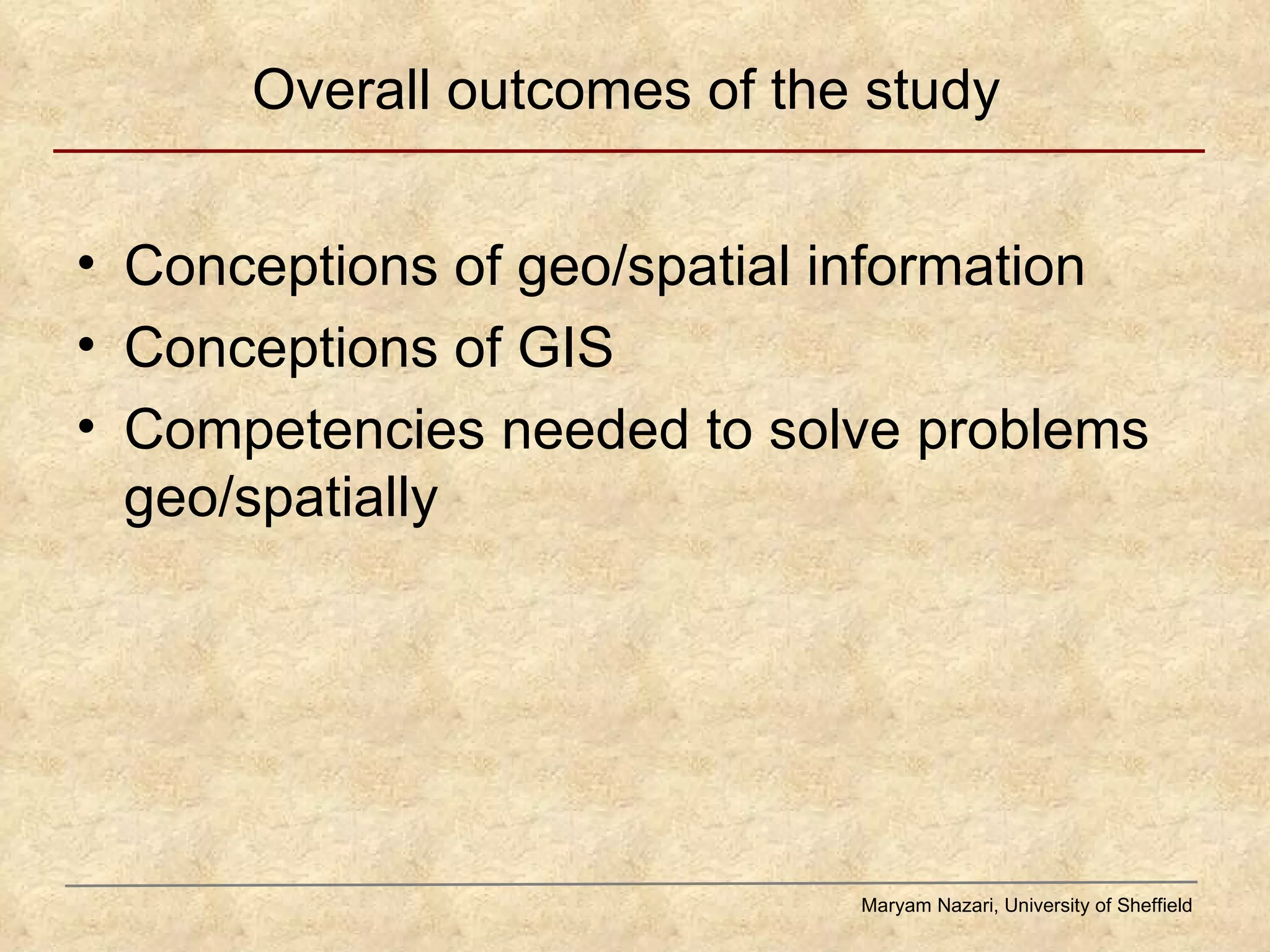
Overall outcomes of the study Conceptions of geo/spatial information Conceptions of GIS Competencies needed to solve problems geo/spatially Maryam Nazari, University of Sheffield
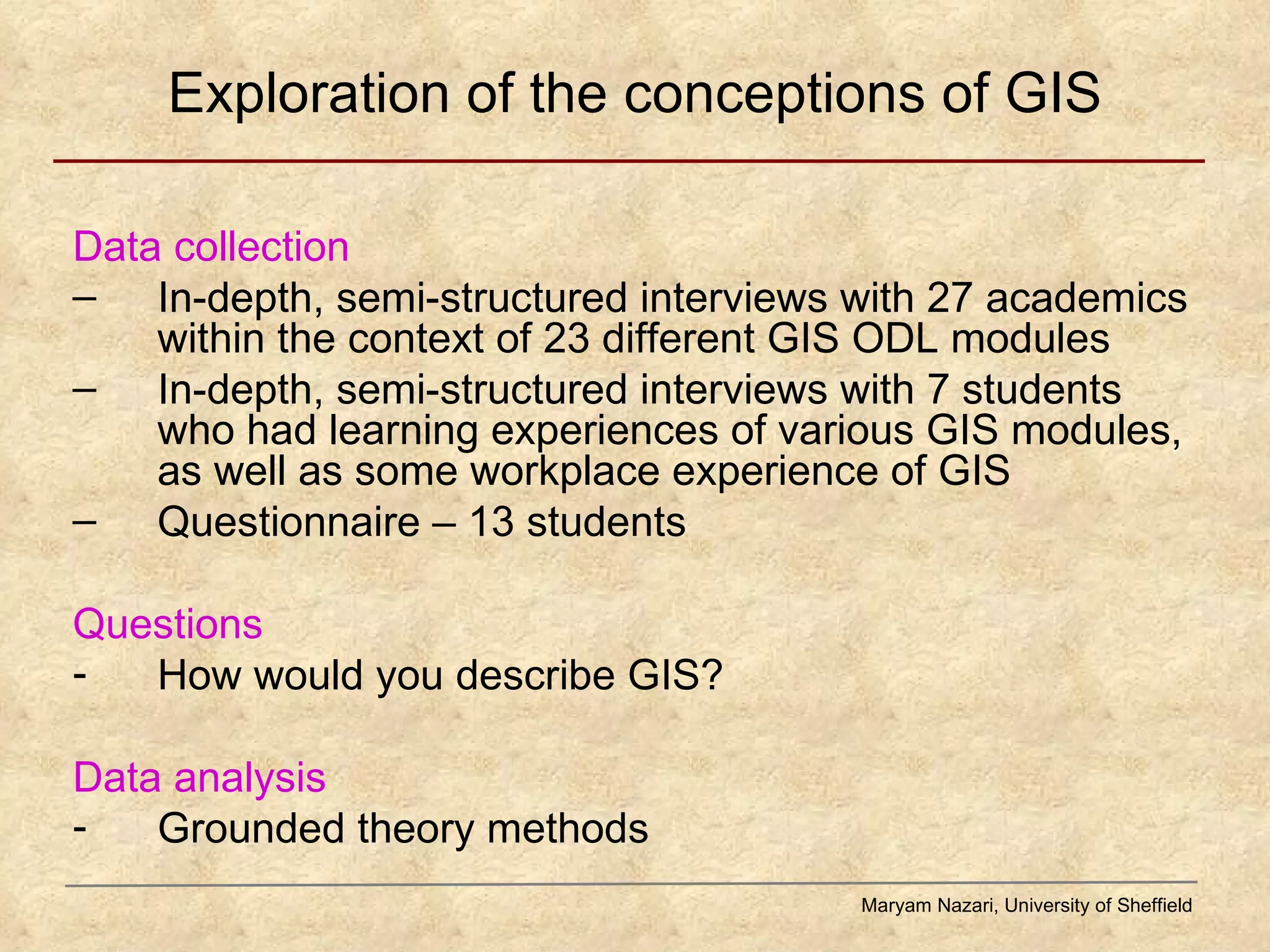
Exploration of the conceptions of GIS Data collection In-depth, semi-structured interviews with 27 academics within the context of 23 different GIS ODL modules In-depth, semi-structured interviews with 7 students who had learning experiences of various GIS modules, as well as some workplace experience of GIS Questionnaire – 13 students Questions How would you describe GIS?  Data analysis Grounded theory methods Maryam Nazari, University of Sheffield
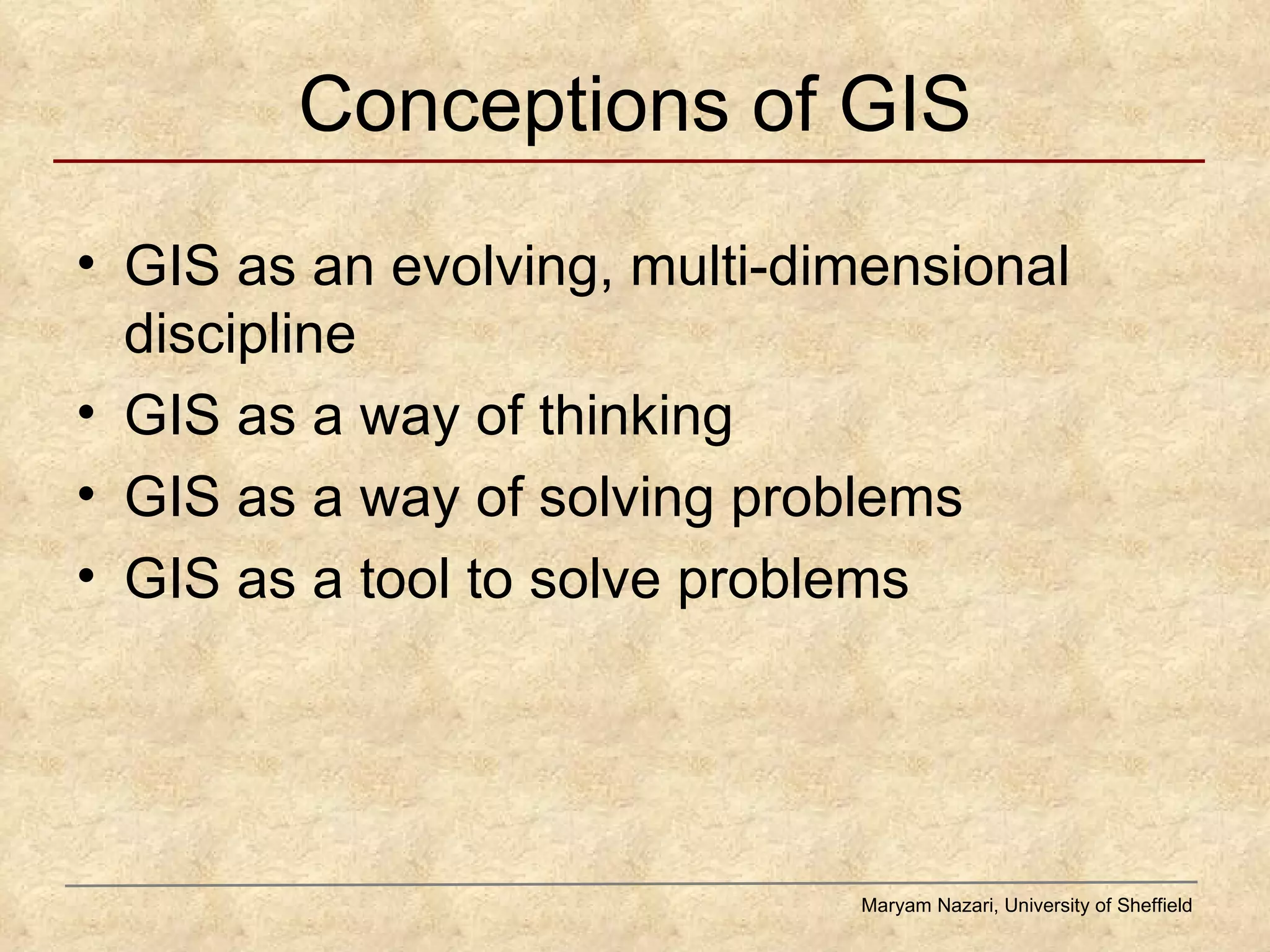
Conceptions of GIS GIS as an evolving, multi-dimensional discipline GIS as a way of thinking GIS as a way of solving problems GIS as a tool to solve problems Maryam Nazari, University of Sheffield
1- GIS as an evolving, multidimensional discipline Maryam Nazari, University of Sheffield Science Technology Applications Tool/ software Geo/spatial information Geography [and other subjects and disciplines] Geo/spatial information Applications Tool/ software: generic and subject-relevant Evolving techniques and operations Evolving principles, terminologies, methodologies
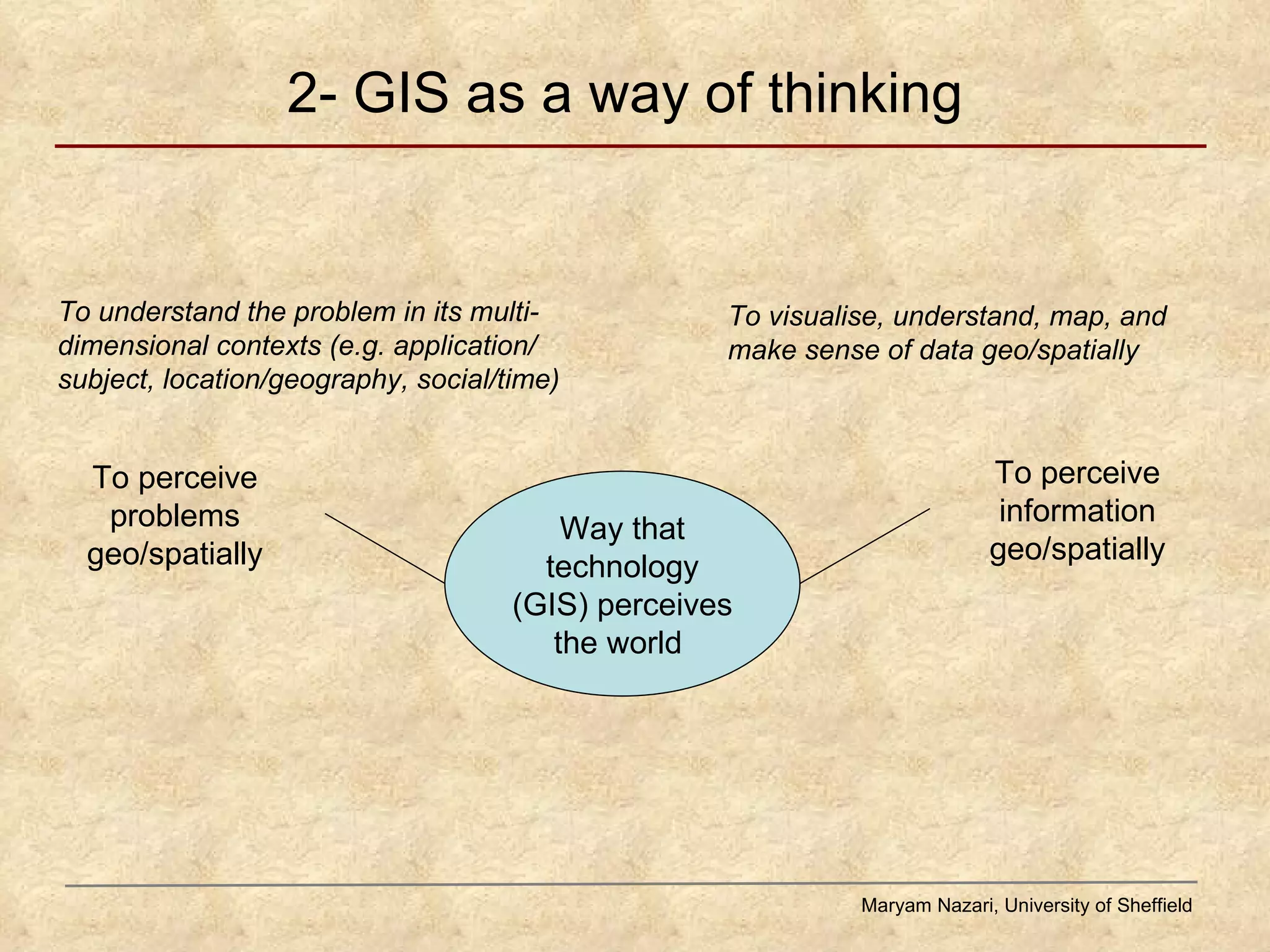
2- GIS as a way of thinking Maryam Nazari, University of Sheffield Way that technology (GIS) perceives the world  To perceive problems geo/spatially To perceive information geo/spatially To visualise, understand, map, and make sense of data geo/spatially To understand the problem in its multi-dimensional contexts (e.g. application/ subject, location/geography, social/time)
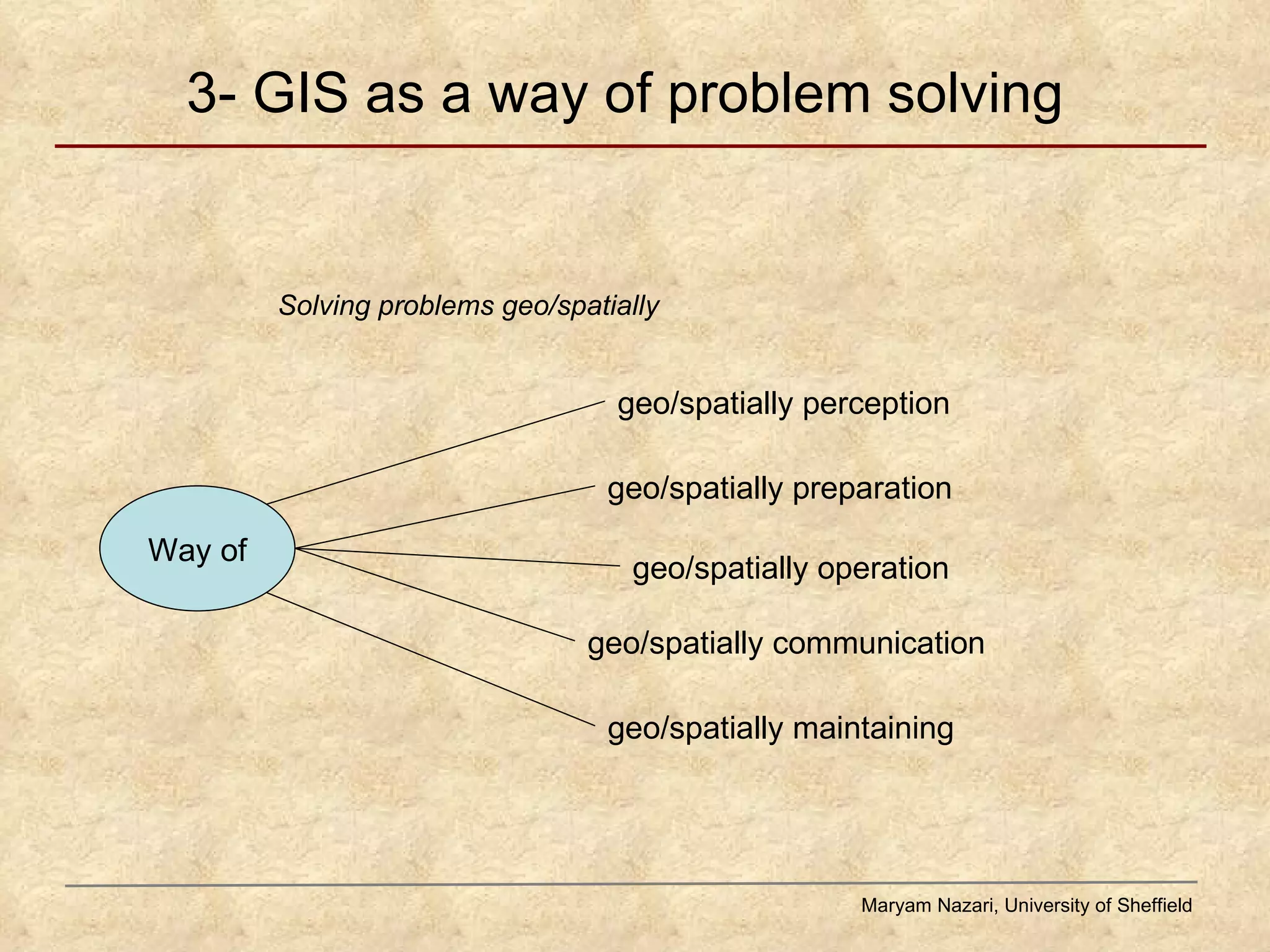
3- GIS as a way of problem solving Maryam Nazari, University of Sheffield Way of geo/spatially perception Solving problems geo/spatially geo/spatially preparation geo/spatially operation geo/spatially communication geo/spatially maintaining
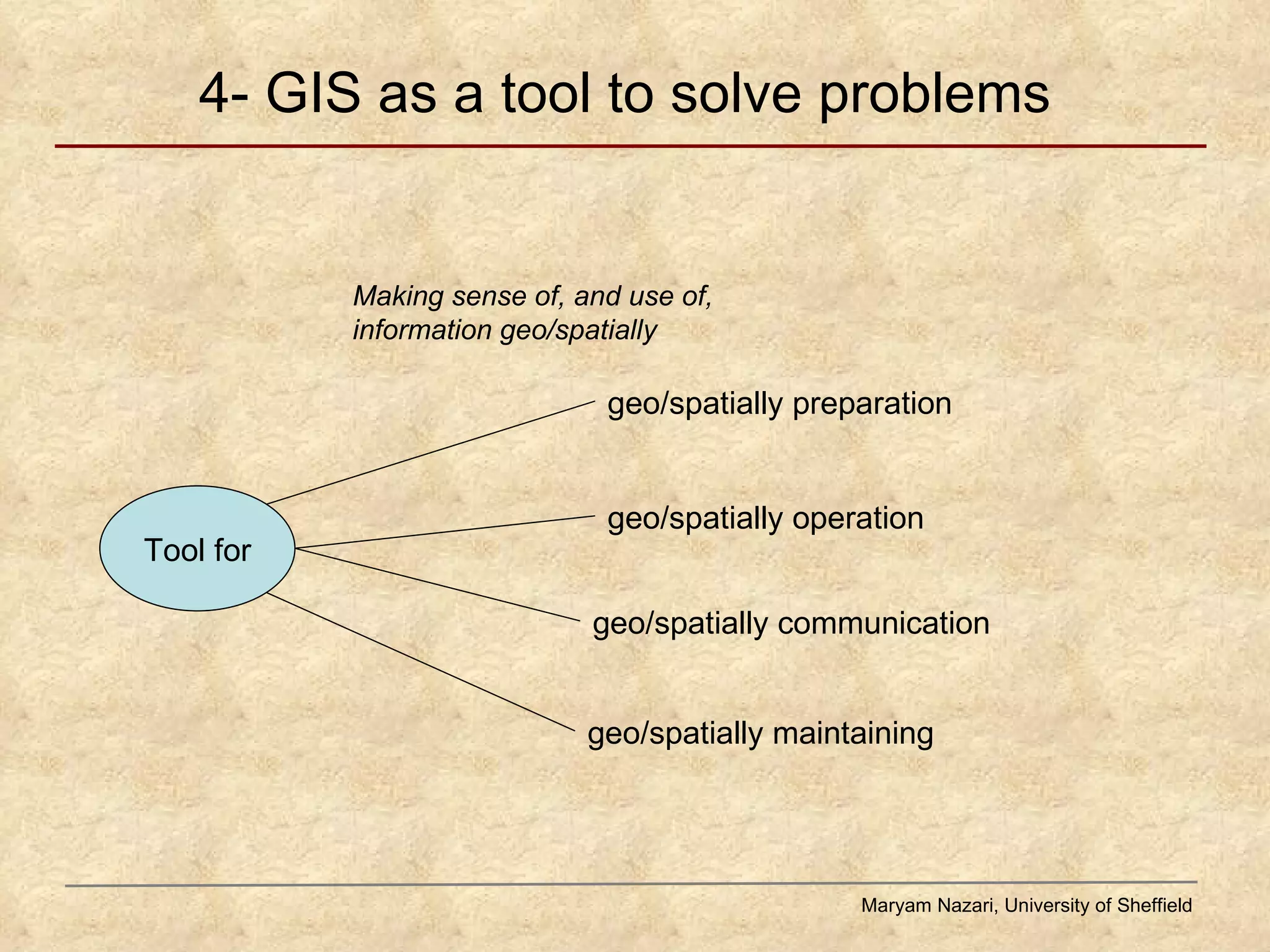
4- GIS as a tool to solve problems Maryam Nazari, University of Sheffield Tool for geo/spatially preparation Making sense of, and use of, information geo/spatially geo/spatially operation geo/spatially communication geo/spatially maintaining
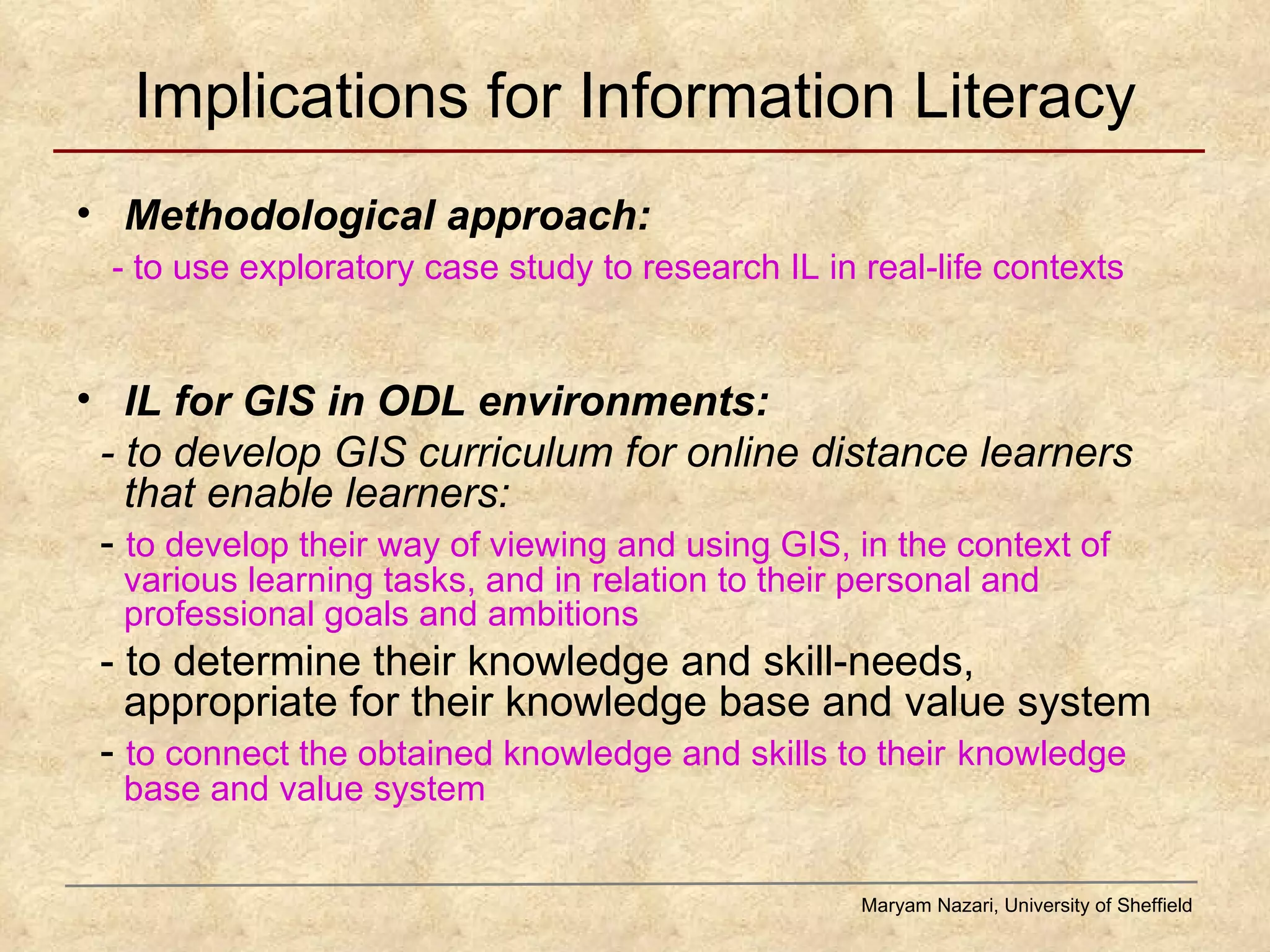
Implications for Information Literacy Methodological approach:  - to use exploratory case study to research IL in real-life contexts IL for GIS in ODL environments:  - to develop GIS curriculum for online distance learners that enable learners: -  to develop their way of viewing and using GIS, in the context of various learning tasks, and in relation to their personal and professional goals and ambitions - to determine their knowledge and skill-needs, appropriate for their knowledge base and value system -  to connect the obtained knowledge and skills to their   knowledge base and value system Maryam Nazari, University of Sheffield
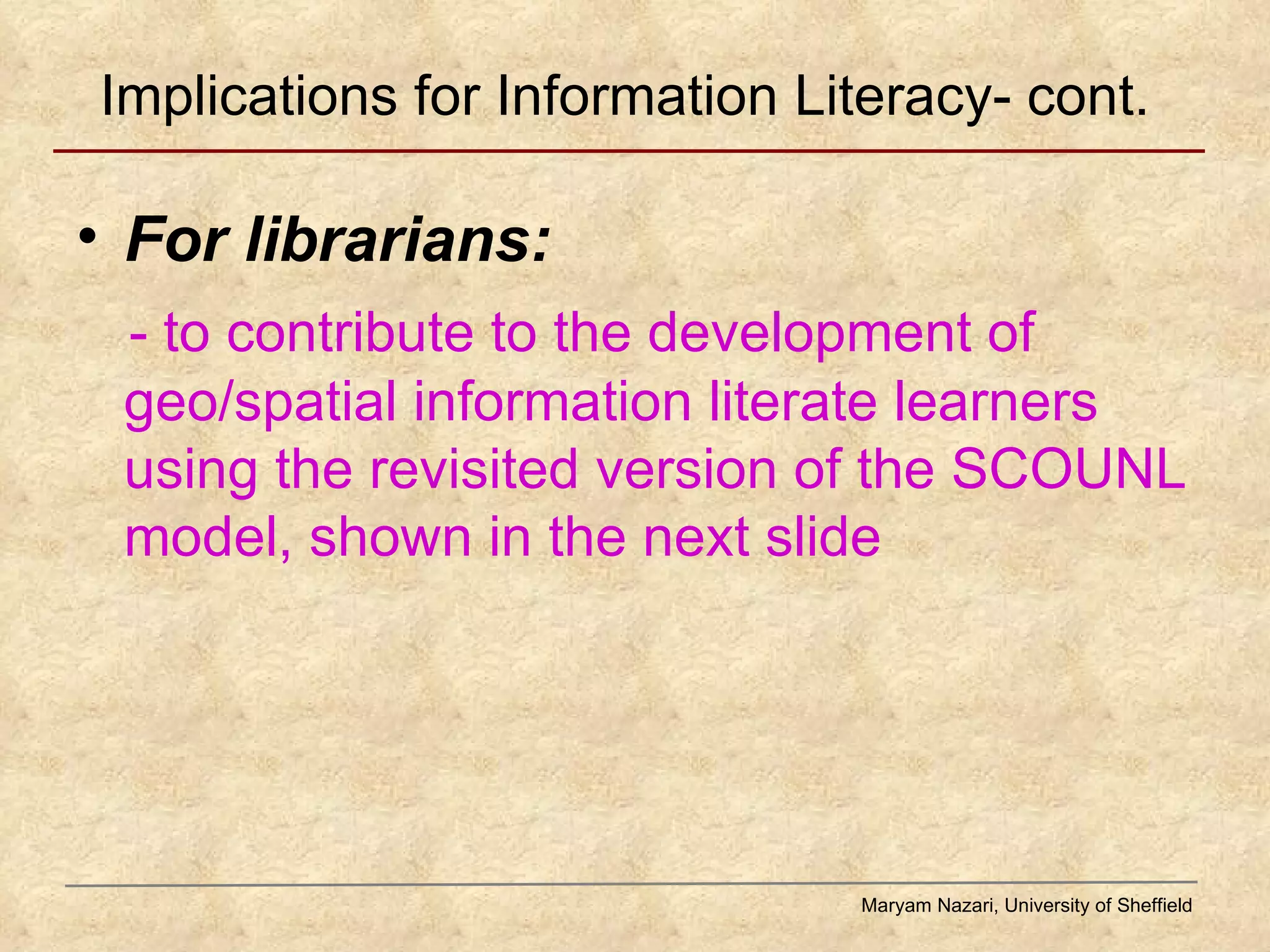
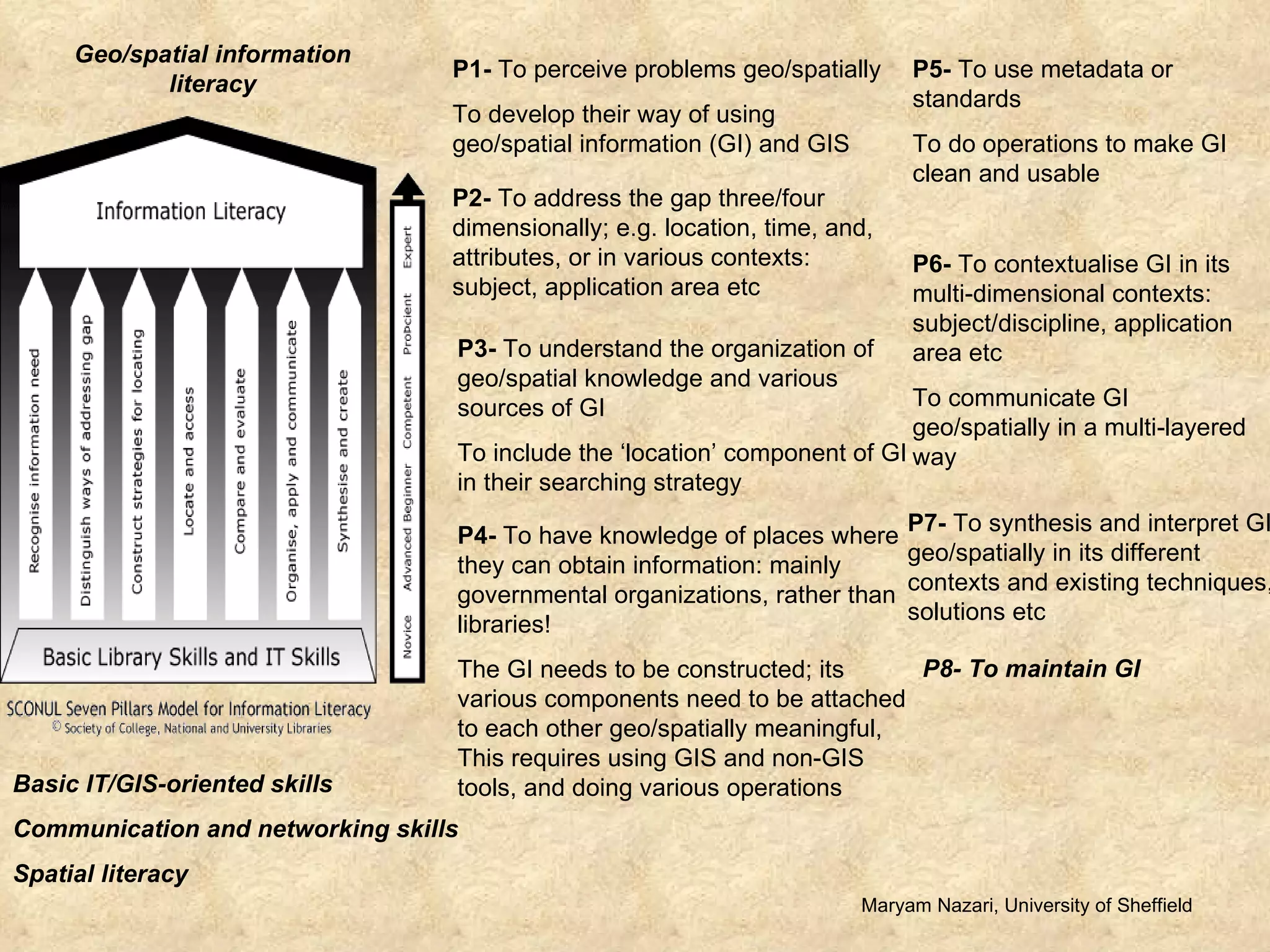
Implications for Information Literacy- cont. For librarians:  - to contribute to the development of geo/spatial information literate learners using the revisited version of the SCOUNL model, shown in the next slide  Maryam Nazari, University of Sheffield
Maryam Nazari, University of Sheffield P1-  To perceive problems geo/spatially To develop their way of using geo/spatial information (GI) and GIS P2-  To address the gap three/four dimensionally; e.g. location, time, and, attributes, or in various contexts: subject, application area etc P3-  To understand the organization of geo/spatial knowledge and various sources of GI To include the ‘location’ component of GI in their searching strategy P4-  To have knowledge of places where they can obtain information: mainly governmental organizations, rather than libraries! The GI needs to be constructed; its various components need to be attached to each other geo/spatially meaningful, This requires using GIS and non-GIS tools, and doing various operations P5-  To use metadata or standards To do operations to make GI clean and usable P6-  To contextualise GI in its multi-dimensional contexts: subject/discipline, application area etc To communicate GI geo/spatially in a multi-layered way P7-  To synthesis and interpret GI geo/spatially in its different contexts and existing techniques, solutions etc Basic IT/GIS-oriented skills Communication and networking skills Spatial literacy  Geo/spatial information literacy P8- To maintain GI

Conceptions of GIS: implications for information literacy

  • 1.
    Conceptions of GIS:Implications for Information Literacy Maryam Nazari Maryam Nazari, University of Sheffield Information Literacy Research Centre Summer Event, Department of Information Studies, University of Sheffield 13 th of August 2008
  • 2.
    Outline Anoverview of my study Methodological approach The conceptions of GIS Implications for information literacy Maryam Nazari, University of Sheffield
  • 3.
    An overview ofmy study Maryam Nazari, University of Sheffield Information literacy needs How to research it in the context of disciplinary areas? How to research it in the context of disciplinary areas? To explore the process of learning and task accomplishment To explore the nature and characteristics of information and learning Some other disciplines but NOT Geographic Information System/ Science (GIS) Phenomenography and Survey but NOT Exploratory Case Study Librarians but FEW Academics and educators Face to face but NOT Online Distance Learning (ODL) programs Disciplinary gap Contextual gap Methodological gap
  • 4.
    Methodology Maryam Nazari, University of Sheffield Real information and learning needs Perceptions, and teaching and learning experiences of, GIS and geo/spatial information Real IL educational needs An embedded exploratory case study Identify Explore - Academics and students - 23 GIS modules - 3 ODL programs - semi-structured interview - questionnaire - students’ reflection - document study - To identify competencies GIS students need: a) to be able to find, evaluate, and use geospatial information; b) to solve problems geo/spatially Explore
  • 5.
    Why GIS inthe ODL? Maryam Nazari, University of Sheffield GIS ODL programmes Diversity in the GIS learners’ backgrounds, abilities, and ambitions Wide application areas Technology-oriented nature of the information and learning in the GIS discipline Tight schedule, instruction-led Involves using wide range of tools, techniques, and operations Self-contained modules and tasks to deliver wide range of instructions and skill-sets Need learning various terminologies, subject-relevant contextual issues, etc Wide range of knowledge-base and value systems Need to match various knowledge-base and value systems
  • 6.
    Overall outcomes ofthe study Conceptions of geo/spatial information Conceptions of GIS Competencies needed to solve problems geo/spatially Maryam Nazari, University of Sheffield
  • 7.
    Exploration of theconceptions of GIS Data collection In-depth, semi-structured interviews with 27 academics within the context of 23 different GIS ODL modules In-depth, semi-structured interviews with 7 students who had learning experiences of various GIS modules, as well as some workplace experience of GIS Questionnaire – 13 students Questions How would you describe GIS? Data analysis Grounded theory methods Maryam Nazari, University of Sheffield
  • 8.
    Conceptions of GISGIS as an evolving, multi-dimensional discipline GIS as a way of thinking GIS as a way of solving problems GIS as a tool to solve problems Maryam Nazari, University of Sheffield
  • 9.
    1- GIS asan evolving, multidimensional discipline Maryam Nazari, University of Sheffield Science Technology Applications Tool/ software Geo/spatial information Geography [and other subjects and disciplines] Geo/spatial information Applications Tool/ software: generic and subject-relevant Evolving techniques and operations Evolving principles, terminologies, methodologies
  • 10.
    2- GIS asa way of thinking Maryam Nazari, University of Sheffield Way that technology (GIS) perceives the world To perceive problems geo/spatially To perceive information geo/spatially To visualise, understand, map, and make sense of data geo/spatially To understand the problem in its multi-dimensional contexts (e.g. application/ subject, location/geography, social/time)
  • 11.
    3- GIS asa way of problem solving Maryam Nazari, University of Sheffield Way of geo/spatially perception Solving problems geo/spatially geo/spatially preparation geo/spatially operation geo/spatially communication geo/spatially maintaining
  • 12.
    4- GIS asa tool to solve problems Maryam Nazari, University of Sheffield Tool for geo/spatially preparation Making sense of, and use of, information geo/spatially geo/spatially operation geo/spatially communication geo/spatially maintaining
  • 13.
    Implications for InformationLiteracy Methodological approach: - to use exploratory case study to research IL in real-life contexts IL for GIS in ODL environments: - to develop GIS curriculum for online distance learners that enable learners: - to develop their way of viewing and using GIS, in the context of various learning tasks, and in relation to their personal and professional goals and ambitions - to determine their knowledge and skill-needs, appropriate for their knowledge base and value system - to connect the obtained knowledge and skills to their knowledge base and value system Maryam Nazari, University of Sheffield
  • 14.
    Implications for InformationLiteracy- cont. For librarians: - to contribute to the development of geo/spatial information literate learners using the revisited version of the SCOUNL model, shown in the next slide Maryam Nazari, University of Sheffield
  • 15.
    Maryam Nazari, Universityof Sheffield P1- To perceive problems geo/spatially To develop their way of using geo/spatial information (GI) and GIS P2- To address the gap three/four dimensionally; e.g. location, time, and, attributes, or in various contexts: subject, application area etc P3- To understand the organization of geo/spatial knowledge and various sources of GI To include the ‘location’ component of GI in their searching strategy P4- To have knowledge of places where they can obtain information: mainly governmental organizations, rather than libraries! The GI needs to be constructed; its various components need to be attached to each other geo/spatially meaningful, This requires using GIS and non-GIS tools, and doing various operations P5- To use metadata or standards To do operations to make GI clean and usable P6- To contextualise GI in its multi-dimensional contexts: subject/discipline, application area etc To communicate GI geo/spatially in a multi-layered way P7- To synthesis and interpret GI geo/spatially in its different contexts and existing techniques, solutions etc Basic IT/GIS-oriented skills Communication and networking skills Spatial literacy Geo/spatial information literacy P8- To maintain GI