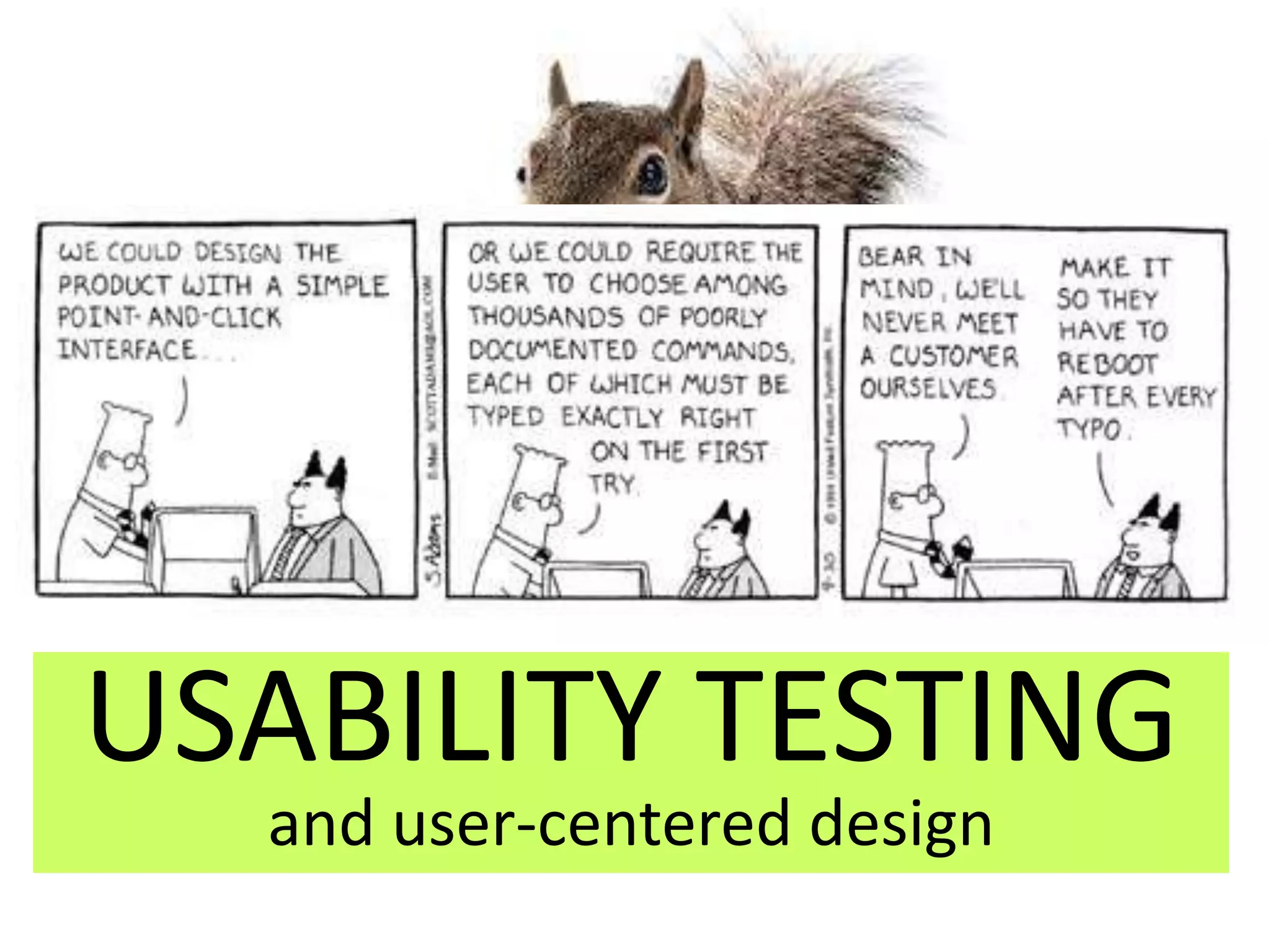
USABILITY TESTING 
and user-centered design
USER-CENTERED DESIGN: 
a rhetorically based 
philosophy of design that 
considers end users’ needs, 
wants, and constraints in all 
stages of the design process. 
(Wikipedia) 
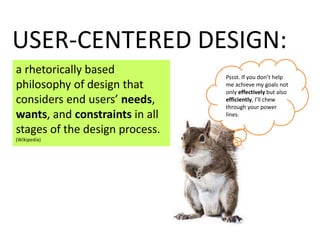
Pssst. If you don’t help 
me achieve my goals not 
only effectively but also 
efficiently, I’ll chew 
through your power 
lines.
examples of 
especially 
well-designed 
products? 
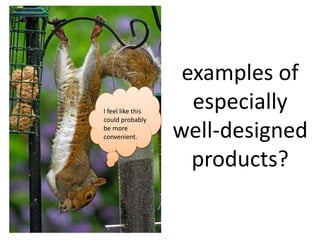
I feel like this 
could probably 
be more 
convenient.
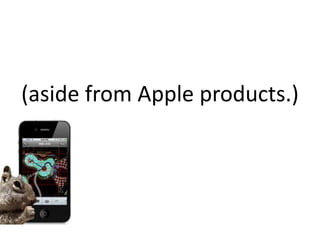
(aside from Apple products.)
Usability testing is a way to 
find out whether the 
assumptions used in the 
design process were correct.
To be usable, a product should be… 
Easy to learn. 
Easy to remember. 
Efficient. 
Satisfying 
(enjoyable to use). 
Error free.
What would be difficult about doing 
usability testing for software and/or 
websites?
Types of Usability Tests 
1. Lab-based testing. 
1.Web-based testing. 
1. Cognitive walkthrough. (Acting as the user, an 
evaluator does a set of tasks and records his/her 
experience.) **this is the type of testing you’ll be 
doing for this project.
STEPS for a Cognitive Walkthrough 
Usability Test
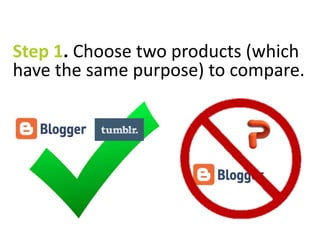
Step 1. Choose two products (which 
have the same purpose) to compare.
Step 2. Identify typical users of the 
project (level of knowledge, reasons 
for use, etc.).
Step 3. Decide the tasks that will 
comprise the test: 
 at least 10 tasks. 
 not too simple. 
 do things your identified user 
would do.
EXAMPLE: What kinds of tasks could a user 
do with word processing software (e.g. 
Microsoft Word)?
Step 3 (cont). Consider the following 
when designing tasks to test products: 
 Affordances of product. 
 Constraints of product. 
 Ease of use. 
 Aesthetics. 
 Visibility/functionality. 
 Feedback (is product responsive?). 
 Mapping (do you know where you are in a given 
process?). 
 Time taken to complete tasks.
Step 4. Decide on equipment and 
location where you will complete the 
tasks (must be consistent for both 
products).
Step 5. Decide on criteria and rating scale.
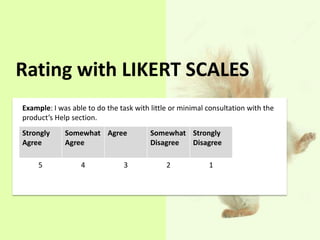
Rating with LIKERT SCALES 
Example: I was able to do the task with little or minimal consultation with the 
product’s Help section. 
Strongly 
Agree 
Somewhat 
Agree 
Agree Somewhat 
Disagree 
Strongly 
Disagree 
5 4 3 2 1
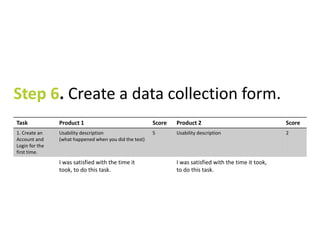
Step 6. Create a data collection form. 
Task Product 1 Score Product 2 Score 
1. Create an 
Usability description 
5 Usability description 2 
Account and 
(what happened when you did the test) 
Login for the 
first time. 
I was satisfied with the time it 
took, to do this task. 
I was satisfied with the time it took, 
to do this task.
Step 7. Do the test.
Step 8.Write up the results (white 
paper).
HOORAY!!!

Usability Testing and User-Centered Design

  • 1.
    USABILITY TESTING anduser-centered design
  • 2.
    USER-CENTERED DESIGN: arhetorically based philosophy of design that considers end users’ needs, wants, and constraints in all stages of the design process. (Wikipedia) Pssst. If you don’t help me achieve my goals not only effectively but also efficiently, I’ll chew through your power lines.
  • 3.
    examples of especially well-designed products? I feel like this could probably be more convenient.
  • 4.
  • 5.
    Usability testing isa way to find out whether the assumptions used in the design process were correct.
  • 6.
    To be usable,a product should be… Easy to learn. Easy to remember. Efficient. Satisfying (enjoyable to use). Error free.
  • 7.
    What would bedifficult about doing usability testing for software and/or websites?
  • 8.
    Types of UsabilityTests 1. Lab-based testing. 1.Web-based testing. 1. Cognitive walkthrough. (Acting as the user, an evaluator does a set of tasks and records his/her experience.) **this is the type of testing you’ll be doing for this project.
  • 9.
    STEPS for aCognitive Walkthrough Usability Test
  • 10.
    Step 1. Choosetwo products (which have the same purpose) to compare.
  • 11.
    Step 2. Identifytypical users of the project (level of knowledge, reasons for use, etc.).
  • 12.
    Step 3. Decidethe tasks that will comprise the test:  at least 10 tasks.  not too simple.  do things your identified user would do.
  • 13.
    EXAMPLE: What kindsof tasks could a user do with word processing software (e.g. Microsoft Word)?
  • 14.
    Step 3 (cont).Consider the following when designing tasks to test products:  Affordances of product.  Constraints of product.  Ease of use.  Aesthetics.  Visibility/functionality.  Feedback (is product responsive?).  Mapping (do you know where you are in a given process?).  Time taken to complete tasks.
  • 15.
    Step 4. Decideon equipment and location where you will complete the tasks (must be consistent for both products).
  • 16.
    Step 5. Decideon criteria and rating scale.
  • 17.
    Rating with LIKERTSCALES Example: I was able to do the task with little or minimal consultation with the product’s Help section. Strongly Agree Somewhat Agree Agree Somewhat Disagree Strongly Disagree 5 4 3 2 1
  • 18.
    Step 6. Createa data collection form. Task Product 1 Score Product 2 Score 1. Create an Usability description 5 Usability description 2 Account and (what happened when you did the test) Login for the first time. I was satisfied with the time it took, to do this task. I was satisfied with the time it took, to do this task.
  • 19.
    Step 7. Dothe test.
  • 20.
    Step 8.Write upthe results (white paper).
  • 21.