INTRODUCTION
 A prototype model suggests that before development of the actual
software a working prototype should be build first
 A prototype is a toy implementation of the system.
 It allows limited performance version of the eventual software to
be delivered to the early stage of the development process.
 The customer provides suggestion and improvements on the
prototype.
INTRODUCTION
 After a prototype is built, it is delivered to the
customer for the evaluation.
 It helps the customer determine how the feature
will function in the final software.
 It is a very useful technique to obtain accurate
requirements of the system.
FLOWCHART OF PROTOTYPE
MODELRequirement analysis
quick
design
Customer
evaluation of
prototype
Refine requirements
according to the
customer suggestion
Design
Implement
& Unit
testing
Integratio
n and
system
Test
Operati
on
&Mainta
in
Not accepted
Accepted
Implement
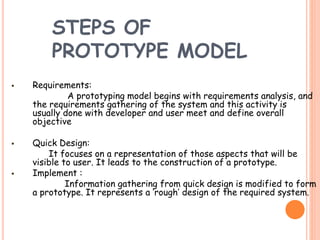
STEPS OF
PROTOTYPE MODEL
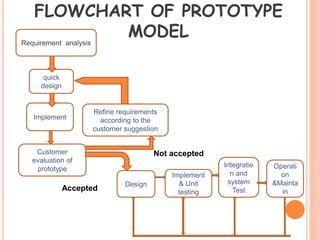
 Requirements:
A prototyping model begins with requirements analysis, and
the requirements gathering of the system and this activity is
usually done with developer and user meet and define overall
objective
 Quick Design:
It focuses on a representation of those aspects that will be
visible to user. It leads to the construction of a prototype.
 Implement :
Information gathering from quick design is modified to form
a prototype. It represents a ’rough’ design of the required system.
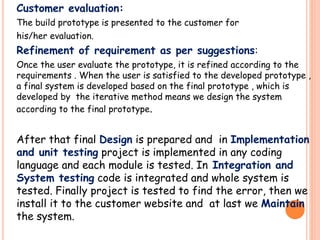
Customer evaluation:
The build prototype is presented to the customer for
his/her evaluation.
Refinement of requirement as per suggestions:
Once the user evaluate the prototype, it is refined according to the
requirements . When the user is satisfied to the developed prototype ,
a final system is developed based on the final prototype , which is
developed by the iterative method means we design the system
according to the final prototype.
After that final Design is prepared and in Implementation
and unit testing project is implemented in any coding
language and each module is tested. In Integration and
System testing code is integrated and whole system is
tested. Finally project is tested to find the error, then we
install it to the customer website and at last we Maintain
the system.
ADVANTAGES
 Provides better understandability of the
customers needs.
 It helps to critically examine the technical
issues
Used for development of large project
 It reduces risk of failure.
DISADVANTAGES
 It is a never ending process.
 Prototype has to be discarded , so some might
argue that the cost involved is higher.
 It is time consuming model.
The developer often makes implementation
compromise in order to get a prototype model
working quickly.
Prototype model 130714101556-phpapp02

Prototype model 130714101556-phpapp02

  • 1.
    INTRODUCTION  A prototypemodel suggests that before development of the actual software a working prototype should be build first  A prototype is a toy implementation of the system.  It allows limited performance version of the eventual software to be delivered to the early stage of the development process.  The customer provides suggestion and improvements on the prototype.
  • 2.
    INTRODUCTION  After aprototype is built, it is delivered to the customer for the evaluation.  It helps the customer determine how the feature will function in the final software.  It is a very useful technique to obtain accurate requirements of the system.
  • 3.
    FLOWCHART OF PROTOTYPE MODELRequirementanalysis quick design Customer evaluation of prototype Refine requirements according to the customer suggestion Design Implement & Unit testing Integratio n and system Test Operati on &Mainta in Not accepted Accepted Implement
  • 4.
    STEPS OF PROTOTYPE MODEL Requirements: A prototyping model begins with requirements analysis, and the requirements gathering of the system and this activity is usually done with developer and user meet and define overall objective  Quick Design: It focuses on a representation of those aspects that will be visible to user. It leads to the construction of a prototype.  Implement : Information gathering from quick design is modified to form a prototype. It represents a ’rough’ design of the required system.
  • 5.
    Customer evaluation: The buildprototype is presented to the customer for his/her evaluation. Refinement of requirement as per suggestions: Once the user evaluate the prototype, it is refined according to the requirements . When the user is satisfied to the developed prototype , a final system is developed based on the final prototype , which is developed by the iterative method means we design the system according to the final prototype. After that final Design is prepared and in Implementation and unit testing project is implemented in any coding language and each module is tested. In Integration and System testing code is integrated and whole system is tested. Finally project is tested to find the error, then we install it to the customer website and at last we Maintain the system.
  • 6.
    ADVANTAGES  Provides betterunderstandability of the customers needs.  It helps to critically examine the technical issues Used for development of large project  It reduces risk of failure.
  • 7.
    DISADVANTAGES  It isa never ending process.  Prototype has to be discarded , so some might argue that the cost involved is higher.  It is time consuming model. The developer often makes implementation compromise in order to get a prototype model working quickly.