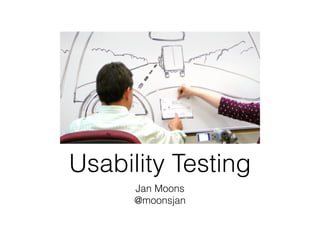
Usability Testing
      Jan Moons
      @moonsjan
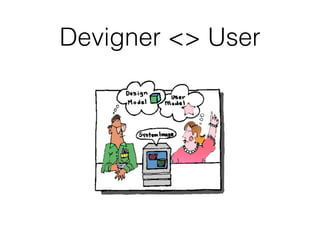
The Problem of
    Unusable Products

• Focus on machine and underlying system

• Not on the person who will use the system
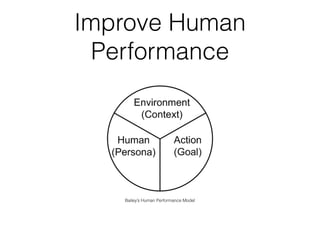
Improve Human
  Performance


   Bailey’s Human Performance Model
Devigner <> User
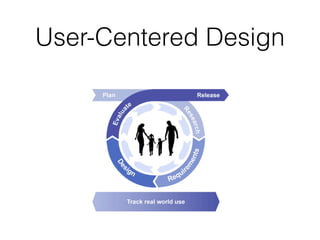
User-Centered Design
Usability Testing


• Technique used in User-Centered Design
  to evaluate the usability of the “product” by
  testing it on potential users
Aim of Usability Testing


• Measuring the usability of the “product”
Measuring Usability

• Effectiveness

• Efficiency

• Satisfaction
Not Usability Testing
• Focus Groups:

 • Small group of people

 • React to designs and ideas

 • Sampling of user’s opinions and feelings

 • Users’ want and needs analysis

• Don’t tell whether people can use the product!
Usability Test
• Watch users

• Performing tasks

• With sketches, prototypes or application

• Note down their problems

• Make recommendations

• Again!
Usual Suspects

• Facilitator

• Participant, i.e. potential users

• Observers / Note takers
Example Usability Test
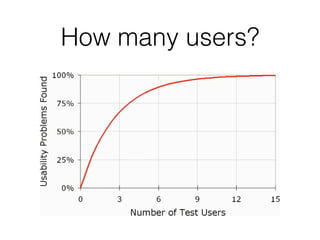
How many users?
R.I.T.E.
• More rounds of small scale (3-4 users) usability tests:

  • In the first round of tests most of the significant
    problems are encountered

  • Fix these problems!!!

  • In the second round most probably a new set of
    problems will be uncovered

  • Etc.
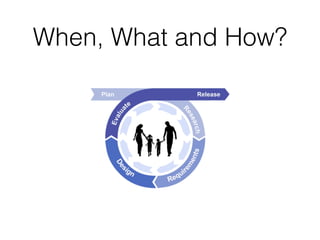
When, What and How?
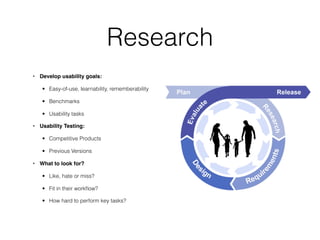
Research
• Develop usability goals:

   • Easy-of-use, learnability, rememberability

   • Benchmarks

   • Usability tasks

• Usability Testing:

   • Competitive Products

   • Previous Versions

• What to look for?

   • Like, hate or miss?

   • Fit in their workflow?

   • How hard to perform key tasks?
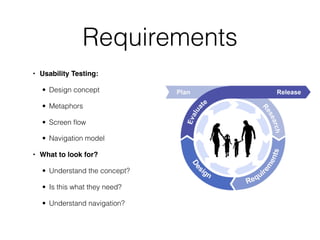
Requirements
• Usability Testing:

  • Design concept

  • Metaphors

  • Screen flow

  • Navigation model

• What to look for?

  • Understand the concept?

  • Is this what they need?

  • Understand navigation?
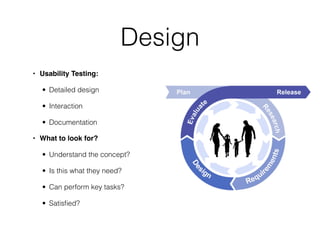
Design
• Usability Testing:

  • Detailed design

  • Interaction

  • Documentation

• What to look for?

  • Understand the concept?

  • Is this what they need?

  • Can perform key tasks?

  • Satisfied?
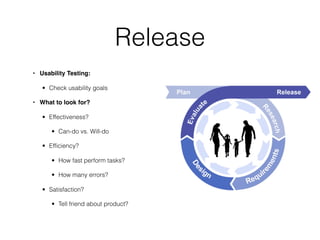
Release
• Usability Testing:

   • Check usability goals

• What to look for?

   • Effectiveness?

      • Can-do vs. Will-do

   • Efficiency?

      • How fast perform tasks?

      • How many errors?

   • Satisfaction?

      • Tell friend about product?
www.uxpro.be
 @uxprobe
Real-World Usability
• Real users

• Real tasks

• Real environments


• They use the system because they need it!
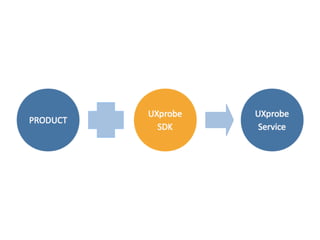
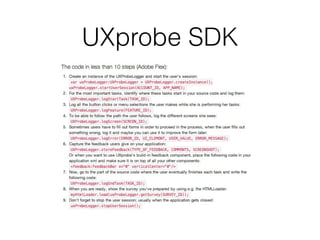
UXprobe SDK
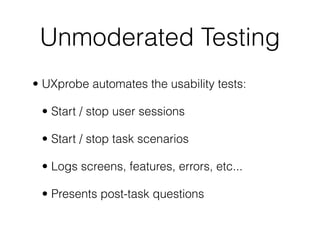
Unmoderated Testing
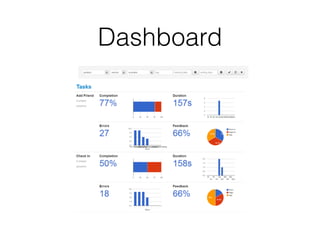
• UXprobe automates the usability tests:

 • Start / stop user sessions

 • Start / stop task scenarios

 • Logs screens, features, errors, etc...

 • Presents post-task questions
Dashboard
Benefits of UXprobe

• Real users, real tasks in real environments

• Quantitative data

• Statistical confidence

• Costs spread over large set of participants
Thank you!
 jan.moons@uxpro.be
      @uxprobe

Usability Testing

Editor's Notes

  • #2 \n
  • #3 Engineers are more comfortable with the scientific issues associated with systems\n\nNot rewarded for interpersonal &amp;#x201C;people&amp;#x201D; skills but for their ability to solve technical problems\n
  • #4 Engineers and programmers traditionally placed the emphasis on the Action part\nMuch less on the human and environment parts\nRelationship between these parts have also been neglected\n
  • #5 Methods and techniques are needed to help designers change the way they view and design products =&gt; User-Centered Design (UCD)\n
  • #6 &amp;#x2018;User-Centered Design (UCD) is a user interface design process that focuses on usability goals, user characteristics, environments, tasks and workflow in the design of an interface. The UCD process is an iterative process, where design and evaluation steps are built in from the first stage of projects, through implementation .&amp;#x2019; - Shawn Lawton Henry - Accessibility in UCD process\n\n
  • #7 Product can be: sketch, low / high-fidelity prototype, mockup, actual application\n
  • #8 \n
  • #9 Effectiveness/accurate: How many mistakes did people make? (And were they fatal or recoverable with the right information?)\n\nEfficiency: How much time, and how many steps, are required for people to complete basic tasks?\n\nSatisfaction: How does the person feel about the tasks completed? Is the person confident, stressed? Would the user recommend this system to a friend?\n
  • #10 \n
  • #11 \n
  • #12 \n
  • #13 \n
  • #14 Source: Jakob Nielsen &amp; Tom Landauer\nTesting 5 users will tend to uncover 85% of usability problems\nSerious case of diminishing returns for testing additional users\n
  • #15 RITE = Rapid Iterative Testing and Evaluation\n
  • #16 &amp;#x2018;User-Centered Design (UCD) is a user interface design process that focuses on usability goals, user characteristics, environments, tasks and workflow in the design of an interface. The UCD process is an iterative process, where design and evaluation steps are built in from the first stage of projects, through implementation .&amp;#x2019; - Shawn Lawton Henry - Accessibility in UCD process\n\n
  • #17 \n
  • #18 \n
  • #19 \n
  • #20 \n
  • #21 \n
  • #22 \n
  • #23 \n
  • #24 \n
  • #25 No need for an experienced data logger\nWho knows when a task starts and when a task is completed or not\nMeasures task completion\nData logger is a distraction to the participant\n
  • #26 The researcher later analyzes the data collected by the tool and reports the results.\n
  • #27 \n
  • #28 \n