Chapter 25 Section 1 
• Explain how new types of stores and 
marketing changed American life. 
• Analyze the ways in which Americans 
developed a mass culture. 
• Describe the new forms of popular 
entertainment in the late 1800s. 
The Cold War Begins 
Section 3 
Social and Cultural Trends 
Objectives
Chapter 25 Section 1 
The CoSldo Wciaalr aBnedg iCnsultural Trends 
Section 3 
Terms and People 
• Mark Twain – a satirical novelist who wrote 
about American life in the late 1800s 
• Gilded Age – term coined by Mark Twain to 
describe the post-Reconstruction era which was 
characterized by a façade of prosperity 
• conspicuous consumerism – purchasing of 
goods and services to impress others 
• mass culture – similar consumption patterns as 
a result of the spread of transportation, 
communication, and advertising
Chapter 25 Section 1 
Terms and People (continued) 
The CoSldo Wciaalr aBnedg iCnsultural Trends 
Section 3 
• Joseph Pulitzer – an immigrant who became a 
publisher of sensationalistic newspapers 
• William Randolph Hearst – a competitor of 
Pulitzer’s who also published sensationalistic 
newspapers 
• Horatio Alger – a novelist who wrote about 
characters who succeeded through hard work 
• vaudeville – type of show, including dancing, 
singing, and comedy sketches, that became 
popular in the late 19th century
Chapter 25 Section 1 
The CoSldo Wciaalr aBnedg iCnsultural Trends 
Section 3 
What luxuries did cities offer to the 
middle class? 
1. During the last part of the 19th century, a 
new middle class lifestyle gained popularity and 
influence in America. 
Though some disliked the values of this era, 
the shared American culture created then 
would persist for the next century.
Chapter 25 Section 1 
The CoSldo Wciaalr aBnedg iCnsultural Trends 
Section 3 
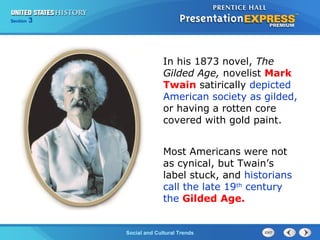
In his 1873 novel, The 
Gilded Age, novelist Mark 
Twain satirically depicted 
American society as gilded, 
or having a rotten core 
covered with gold paint. 
Most Americans were not 
as cynical, but Twain’s 
label stuck, and historians 
call the late 19th century 
the Gilded Age.
Chapter 25 Section 1 
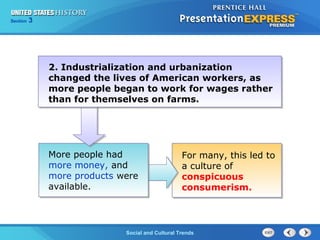
2. Industrialization and urbanization 
changed the lives of American workers, as 
more people began to work for wages rather 
than for themselves on farms. 
The CoSldo Wciaalr aBnedg iCnsultural Trends 
Section 3 
For many, this led to 
a culture of 
conspicuous 
consumerism. 
More people had 
more money, and 
more products were 
available.
Chapter 25 Section 1 
The CoSldo Wciaalr aBnedg iCnsultural Trends 
Section 3 
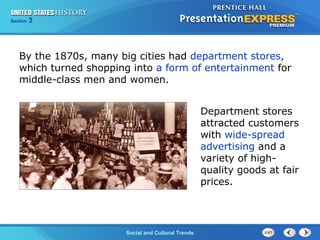
By the 1870s, many big cities had department stores, 
which turned shopping into a form of entertainment for 
middle-class men and women. 
Department stores 
attracted customers 
with wide-spread 
advertising and a 
variety of high-quality 
goods at fair 
prices.
Chapter 25 Section 1 
People began to 
measure success 
by what they could 
buy, and they 
equated purchasing 
power with a 
higher standard of 
living. 
In this period, the 
cost of living 
decreased because 
manufactured 
products and new 
technology cost less. 
The CoSldo Wciaalr aBnedg iCnsultural Trends 
Section 3 
Better sanitation and medical care 
contributed to a longer life expectancy.
Chapter 25 Section 1 
The CoSldo Wciaalr aBnedg iCnsultural Trends 
Section 3 
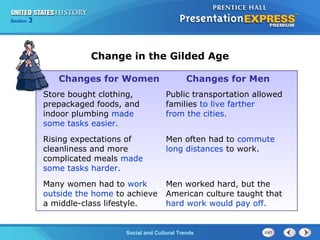
Change in the Gilded Age 
Changes for Women Changes for Men 
Store bought clothing, 
prepackaged foods, and 
indoor plumbing made 
some tasks easier. 
Public transportation allowed 
families to live farther 
from the cities. 
Rising expectations of 
cleanliness and more 
complicated meals made 
some tasks harder. 
Men often had to commute 
long distances to work. 
Many women had to work 
outside the home to achieve 
a middle-class lifestyle. 
Men worked hard, but the 
American culture taught that 
hard work would pay off.
Chapter 25 Section 1 
The CoSldo Wciaalr aBnedg iCnsultural Trends 
Section 3 
3. One of the effects of the spread of 
transportation, communication, and 
advertising was that Americans became 
more alike in their consumption patterns. 
• Rich and poor wore the same clothing styles. 
• People bought the same kinds of products. 
• This phenomenon is known as mass culture.
Chapter 25 Section 1 
The CoSldo Wciaalr aBnedg iCnsultural Trends 
Section 3 
The newspapers of the Gilded Age both 
reflected and helped create mass culture. 
Between 1870 and 
1900, the number 
of newspapers 
increased from 
about 600 to more 
than 1,600. 
Ethnic and special-interest 
publishers 
catered to the array 
of urban dwellers, 
especially immigrants.
Chapter 25 Section 1 
The CoSldo Wciaalr aBnedg iCnsultural Trends 
Section 3 
Joseph 
Pulitzer 
believed that 
the job of a 
newspaper was 
to inform people 
and to stir up 
controversy. His 
papers were 
sensationalistic. 
The 
sensationalistic 
newspapers of 
William 
Randolph 
Hearst 
competed with 
Pulitzer’s papers 
for readers.
Chapter 25 Section 1 
The CoSldo Wciaalr aBnedg iCnsultural Trends 
Section 3 
During the Gilded Age, literature and art 
that explored harsh realities was popular. 
• Stephen Crane wrote about New York slums. 
• Horatio Alger wrote about characters who 
succeeded through hard work. 
• Robert Henri and others developed a style of 
painting known as the Ashcan School, which 
depicted the squalor of New York slums.
Chapter 25 Section 1 
The CoSldo Wciaalr aBnedg iCnsultural Trends 
Section 3 
4. Public education expanded rapidly, as grade-school 
education became compulsory, more teenagers began 
attending high schools, and kindergartens opened. 
As a result, the 
literacy rate 
climbed to nearly 
90 percent by 
1900.
Chapter 25 Section 1 
The CoSldo Wciaalr aBnedg iCnsultural Trends 
Section 3 
Schools began to do a better job of 
preparing people for careers. 
• Schools taught skills that workers needed in 
budding industries. 
• Teachers attended training schools, and 
reformers such as John Dewey introduced new 
teaching methods. 
• Universities began to provide specialized 
training for urban careers such as social work.
Chapter 25 Section 1 
The CoSldo Wciaalr aBnedg iCnsultural Trends 
Section 3 
Education for All 
Immigrants 
• Schools taught immigrants English and 
helped Americanize them. 
Women 
• A few careers were open to women. 
• There was an upsurge in women’s 
colleges, and many state universities 
began to accept women. 
African 
Americans 
• Limited access to white institutions led 
to a growth in schools and colleges for 
African Americans.
Chapter 25 Section 1 
The CoSldo Wciaalr aBnedg iCnsultural Trends 
Section 3 
During the Gilded Age, new kinds of 
entertainment emerged. 
Amusement 
Parks 
• Coney Island and similar parks offered roller 
coasters and other rides. 
Outdoor 
Events 
• Buffalo Bill’s Wild West Show toured America. 
• Chautauquas offered storytelling, bands, singers, 
and lectures on politics and morals. 
Fun in 
the City 
• Vaudeville shows were a mixture of musical 
drama, songs, and comedy. 
• Nickelodeons introduced motion pictures. 
• Ragtime bands played in music halls.
Chapter 25 Section 1 
The CoSldo Wciaalr aBnedg iCnsultural Trends 
Section 3 
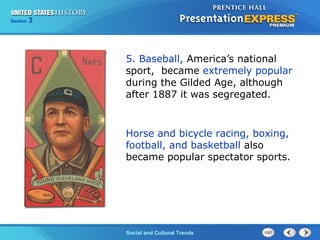
5. Baseball, America’s national 
sport, became extremely popular 
during the Gilded Age, although 
after 1887 it was segregated. 
Horse and bicycle racing, boxing, 
football, and basketball also 
became popular spectator sports.
Chapter 25 Section 1 
The CoSldo Wciaalr aBnedg iCnsultural Trends 
Section 3 
Section Review 
QuickTake Quiz Know It, Show It Quiz

US History Ch. 5 Section 3 Notes

  • 1.
    Chapter 25 Section1 • Explain how new types of stores and marketing changed American life. • Analyze the ways in which Americans developed a mass culture. • Describe the new forms of popular entertainment in the late 1800s. The Cold War Begins Section 3 Social and Cultural Trends Objectives
  • 2.
    Chapter 25 Section1 The CoSldo Wciaalr aBnedg iCnsultural Trends Section 3 Terms and People • Mark Twain – a satirical novelist who wrote about American life in the late 1800s • Gilded Age – term coined by Mark Twain to describe the post-Reconstruction era which was characterized by a façade of prosperity • conspicuous consumerism – purchasing of goods and services to impress others • mass culture – similar consumption patterns as a result of the spread of transportation, communication, and advertising
  • 3.
    Chapter 25 Section1 Terms and People (continued) The CoSldo Wciaalr aBnedg iCnsultural Trends Section 3 • Joseph Pulitzer – an immigrant who became a publisher of sensationalistic newspapers • William Randolph Hearst – a competitor of Pulitzer’s who also published sensationalistic newspapers • Horatio Alger – a novelist who wrote about characters who succeeded through hard work • vaudeville – type of show, including dancing, singing, and comedy sketches, that became popular in the late 19th century
  • 4.
    Chapter 25 Section1 The CoSldo Wciaalr aBnedg iCnsultural Trends Section 3 What luxuries did cities offer to the middle class? 1. During the last part of the 19th century, a new middle class lifestyle gained popularity and influence in America. Though some disliked the values of this era, the shared American culture created then would persist for the next century.
  • 5.
    Chapter 25 Section1 The CoSldo Wciaalr aBnedg iCnsultural Trends Section 3 In his 1873 novel, The Gilded Age, novelist Mark Twain satirically depicted American society as gilded, or having a rotten core covered with gold paint. Most Americans were not as cynical, but Twain’s label stuck, and historians call the late 19th century the Gilded Age.
  • 6.
    Chapter 25 Section1 2. Industrialization and urbanization changed the lives of American workers, as more people began to work for wages rather than for themselves on farms. The CoSldo Wciaalr aBnedg iCnsultural Trends Section 3 For many, this led to a culture of conspicuous consumerism. More people had more money, and more products were available.
  • 7.
    Chapter 25 Section1 The CoSldo Wciaalr aBnedg iCnsultural Trends Section 3 By the 1870s, many big cities had department stores, which turned shopping into a form of entertainment for middle-class men and women. Department stores attracted customers with wide-spread advertising and a variety of high-quality goods at fair prices.
  • 8.
    Chapter 25 Section1 People began to measure success by what they could buy, and they equated purchasing power with a higher standard of living. In this period, the cost of living decreased because manufactured products and new technology cost less. The CoSldo Wciaalr aBnedg iCnsultural Trends Section 3 Better sanitation and medical care contributed to a longer life expectancy.
  • 9.
    Chapter 25 Section1 The CoSldo Wciaalr aBnedg iCnsultural Trends Section 3 Change in the Gilded Age Changes for Women Changes for Men Store bought clothing, prepackaged foods, and indoor plumbing made some tasks easier. Public transportation allowed families to live farther from the cities. Rising expectations of cleanliness and more complicated meals made some tasks harder. Men often had to commute long distances to work. Many women had to work outside the home to achieve a middle-class lifestyle. Men worked hard, but the American culture taught that hard work would pay off.
  • 10.
    Chapter 25 Section1 The CoSldo Wciaalr aBnedg iCnsultural Trends Section 3 3. One of the effects of the spread of transportation, communication, and advertising was that Americans became more alike in their consumption patterns. • Rich and poor wore the same clothing styles. • People bought the same kinds of products. • This phenomenon is known as mass culture.
  • 11.
    Chapter 25 Section1 The CoSldo Wciaalr aBnedg iCnsultural Trends Section 3 The newspapers of the Gilded Age both reflected and helped create mass culture. Between 1870 and 1900, the number of newspapers increased from about 600 to more than 1,600. Ethnic and special-interest publishers catered to the array of urban dwellers, especially immigrants.
  • 12.
    Chapter 25 Section1 The CoSldo Wciaalr aBnedg iCnsultural Trends Section 3 Joseph Pulitzer believed that the job of a newspaper was to inform people and to stir up controversy. His papers were sensationalistic. The sensationalistic newspapers of William Randolph Hearst competed with Pulitzer’s papers for readers.
  • 13.
    Chapter 25 Section1 The CoSldo Wciaalr aBnedg iCnsultural Trends Section 3 During the Gilded Age, literature and art that explored harsh realities was popular. • Stephen Crane wrote about New York slums. • Horatio Alger wrote about characters who succeeded through hard work. • Robert Henri and others developed a style of painting known as the Ashcan School, which depicted the squalor of New York slums.
  • 14.
    Chapter 25 Section1 The CoSldo Wciaalr aBnedg iCnsultural Trends Section 3 4. Public education expanded rapidly, as grade-school education became compulsory, more teenagers began attending high schools, and kindergartens opened. As a result, the literacy rate climbed to nearly 90 percent by 1900.
  • 15.
    Chapter 25 Section1 The CoSldo Wciaalr aBnedg iCnsultural Trends Section 3 Schools began to do a better job of preparing people for careers. • Schools taught skills that workers needed in budding industries. • Teachers attended training schools, and reformers such as John Dewey introduced new teaching methods. • Universities began to provide specialized training for urban careers such as social work.
  • 16.
    Chapter 25 Section1 The CoSldo Wciaalr aBnedg iCnsultural Trends Section 3 Education for All Immigrants • Schools taught immigrants English and helped Americanize them. Women • A few careers were open to women. • There was an upsurge in women’s colleges, and many state universities began to accept women. African Americans • Limited access to white institutions led to a growth in schools and colleges for African Americans.
  • 17.
    Chapter 25 Section1 The CoSldo Wciaalr aBnedg iCnsultural Trends Section 3 During the Gilded Age, new kinds of entertainment emerged. Amusement Parks • Coney Island and similar parks offered roller coasters and other rides. Outdoor Events • Buffalo Bill’s Wild West Show toured America. • Chautauquas offered storytelling, bands, singers, and lectures on politics and morals. Fun in the City • Vaudeville shows were a mixture of musical drama, songs, and comedy. • Nickelodeons introduced motion pictures. • Ragtime bands played in music halls.
  • 18.
    Chapter 25 Section1 The CoSldo Wciaalr aBnedg iCnsultural Trends Section 3 5. Baseball, America’s national sport, became extremely popular during the Gilded Age, although after 1887 it was segregated. Horse and bicycle racing, boxing, football, and basketball also became popular spectator sports.
  • 19.
    Chapter 25 Section1 The CoSldo Wciaalr aBnedg iCnsultural Trends Section 3 Section Review QuickTake Quiz Know It, Show It Quiz