Section

2

Objectives
• Explain the causes of the Spanish-American
War.
• Identify the major battles of the war.
• Describe the consequences of the war,
including the debate over imperialism.

The Spanish-American War
Section

2

Terms and People
•

José Martí – Cuban patriot who launched a war
for independence from Spain in 1895

•

William Randolph Hearst – owner of the New
York Journal who, along with Joseph Pulitzer of the
New York World, started the Yellow Press

•

Yellow Press – sensationalized and exaggerated
reporting on Spanish atrocities in Cuba

•

jingoism – aggressive nationalism

•

George Dewey – commodore of the U.S. squadron
that destroyed the Spanish fleet in Manila Bay
The Spanish-American War
Section

2

Terms and People

(continued)

•

Emilio Aguinaldo – leader of Filipino
nationalists who defeated the Spanish Army

•

Rough Riders – volunteer cavalry unit
assembled by Theodore Roosevelt, famous for
their 1898 charge at San Juan Hill

•

Treaty of Paris – ended the Spanish-American
War and included U.S. acquisition of Puerto Rico
and the purchase of the Philippines

The Spanish-American War
Section

2

What were the causes and effects of
the Spanish-American War?
1. American economic interests, the
growth of a national imperialist spirit, and
an aggressive Yellow Press brought the
United States to the brink of war in 1898.
The United States acquired colonies and
became a world power as a result of the
Spanish-American War.

The Spanish-American War
Section

2

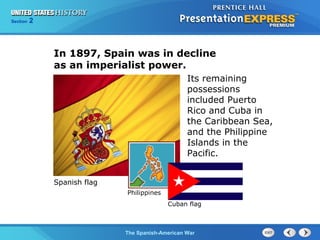
In 1897, Spain was in decline
as an imperialist power.
Its remaining
possessions
included Puerto
Rico and Cuba in
the Caribbean Sea,
and the Philippine
Islands in the
Pacific.
Spanish flag
Philippines
Cuban flag

The Spanish-American War
Section

2

In 1895, Cuban patriot José Martí launched
a war for independence from Spain.

Spanish General
Valeriano Weyler
was brutal in his
attempts to stop
Martí’s guerrilla
attacks.

Tens of
thousands of
rural farmers
died of disease
and starvation
in concentration
camps.

The Spanish-American War

The sympathetic
Yellow Press
published
emotional
headlines in the
U.S. about Spanish
atrocities.
Section

2

American emotions were inflamed by Joseph
Pulitzer’s New York World and William
Randolph Hearst’s New York Journal.

In response, President McKinley
warned Spain to make peace and
sent the battleship Maine to
Havana harbor to protect American
citizens.
2. When Hearst published a letter stolen from the
Spanish ambassador that insulted President McKinley,
American jingoism rose to a fever pitch.

The Spanish-American War
Section

2

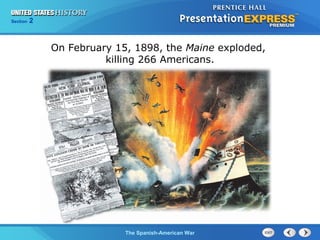
On February 15, 1898, the Maine exploded,
killing 266 Americans.

The Spanish-American War
Section

2

The Yellow Press demanded war. Headlines
screamed, “Remember the Maine!”
A naval board of inquiry blamed a mine
for the explosion.

In response, Spain
agreed to American
demands, including
an end to the
concentration camps.

The Spanish-American War

Despite Spanish
concessions,
President McKinley
sought permission
to use force.
Section

2

In April 1898, following a heated debate,
Congress agreed to McKinley’s request.
Critics charged
that the real goal
was an American
take-over of Cuba.

As a result, the Teller
Amendment was
added, stipulating
that the U.S. would
not annex Cuba.

The U.S. Navy was sent to blockade Cuban ports.
President McKinley called for 100,000 volunteers.

The Spanish-American War
Section

2

3. In response to the American actions,
Spain declared war on the U.S. The war
began with U.S. victories in the Philippines.
Commodore George Dewey
surprised and easily defeated
a Spanish fleet at Manila
Bay.
Rather than surrender to the
Filipino independence
fighters led by Emilio
Aguinaldo, Spanish troops
surrendered to U.S. forces.

The Spanish-American War
Section

2

• Guantanamo Bay was
captured.

4. U.S. troops
easily defeated
the Spanish in
Cuba.

• Theodore Roosevelt’s
Rough Riders, and two
regiments of African
American soldiers, stormed
San Juan Hill.
• A Spanish fleet was
destroyed at Santiago.
• Spanish troops surrendered
in Cuba and on the island of
Puerto Rico.

The Spanish-American War
Section

2

In the Treaty
of Paris, Spain
gave up control
of Cuba, Puerto
Rico, and
Guam.

• Spain sold the
Philippines to the
U.S. for $20 million.
• Guam and Puerto
Rico became
American territories.
• Under the Teller
Amendment, Cuba
could not be
annexed by the
United States.

The Spanish-American War
Section

2

5. While Secretary of State John Hay called it a
“splendid little war” debate soon arose over
the Philippines and U.S. imperialism.

• Critics like William
Jennings Bryan and
Mark Twain attacked
imperialism as
against American
principles.

• President McKinley
argued that the U.S.
had a responsibility
to “uplift and civilize”
the Filipino people.
However, the U.S.
brutally suppressed a
Filipino rebellion.

The Spanish-American War
Section

2

In February 1899, the U.S. Senate ratified the
Treaty of Paris by just one vote.
In the
election of
1900
McKinley
faced Bryan
for the
Presidency.

McKinley chose
Theodore
Roosevelt, “the
hero of San
Juan Hill” as
his running
mate.

McKinley and
Roosevelt
won easily.

The United States now had an empire and a
new stature in world affairs.
The Spanish-American War
Section

2

Section Review
QuickTake Quiz

Know It, Show It Quiz

The Spanish-American War

US History Ch. 9 Section 3 Notes

  • 1.
    Section 2 Objectives • Explain thecauses of the Spanish-American War. • Identify the major battles of the war. • Describe the consequences of the war, including the debate over imperialism. The Spanish-American War
  • 2.
    Section 2 Terms and People • JoséMartí – Cuban patriot who launched a war for independence from Spain in 1895 • William Randolph Hearst – owner of the New York Journal who, along with Joseph Pulitzer of the New York World, started the Yellow Press • Yellow Press – sensationalized and exaggerated reporting on Spanish atrocities in Cuba • jingoism – aggressive nationalism • George Dewey – commodore of the U.S. squadron that destroyed the Spanish fleet in Manila Bay The Spanish-American War
  • 3.
    Section 2 Terms and People (continued) • EmilioAguinaldo – leader of Filipino nationalists who defeated the Spanish Army • Rough Riders – volunteer cavalry unit assembled by Theodore Roosevelt, famous for their 1898 charge at San Juan Hill • Treaty of Paris – ended the Spanish-American War and included U.S. acquisition of Puerto Rico and the purchase of the Philippines The Spanish-American War
  • 4.
    Section 2 What were thecauses and effects of the Spanish-American War? 1. American economic interests, the growth of a national imperialist spirit, and an aggressive Yellow Press brought the United States to the brink of war in 1898. The United States acquired colonies and became a world power as a result of the Spanish-American War. The Spanish-American War
  • 5.
    Section 2 In 1897, Spainwas in decline as an imperialist power. Its remaining possessions included Puerto Rico and Cuba in the Caribbean Sea, and the Philippine Islands in the Pacific. Spanish flag Philippines Cuban flag The Spanish-American War
  • 6.
    Section 2 In 1895, Cubanpatriot José Martí launched a war for independence from Spain. Spanish General Valeriano Weyler was brutal in his attempts to stop Martí’s guerrilla attacks. Tens of thousands of rural farmers died of disease and starvation in concentration camps. The Spanish-American War The sympathetic Yellow Press published emotional headlines in the U.S. about Spanish atrocities.
  • 7.
    Section 2 American emotions wereinflamed by Joseph Pulitzer’s New York World and William Randolph Hearst’s New York Journal. In response, President McKinley warned Spain to make peace and sent the battleship Maine to Havana harbor to protect American citizens. 2. When Hearst published a letter stolen from the Spanish ambassador that insulted President McKinley, American jingoism rose to a fever pitch. The Spanish-American War
  • 8.
    Section 2 On February 15,1898, the Maine exploded, killing 266 Americans. The Spanish-American War
  • 9.
    Section 2 The Yellow Pressdemanded war. Headlines screamed, “Remember the Maine!” A naval board of inquiry blamed a mine for the explosion. In response, Spain agreed to American demands, including an end to the concentration camps. The Spanish-American War Despite Spanish concessions, President McKinley sought permission to use force.
  • 10.
    Section 2 In April 1898,following a heated debate, Congress agreed to McKinley’s request. Critics charged that the real goal was an American take-over of Cuba. As a result, the Teller Amendment was added, stipulating that the U.S. would not annex Cuba. The U.S. Navy was sent to blockade Cuban ports. President McKinley called for 100,000 volunteers. The Spanish-American War
  • 11.
    Section 2 3. In responseto the American actions, Spain declared war on the U.S. The war began with U.S. victories in the Philippines. Commodore George Dewey surprised and easily defeated a Spanish fleet at Manila Bay. Rather than surrender to the Filipino independence fighters led by Emilio Aguinaldo, Spanish troops surrendered to U.S. forces. The Spanish-American War
  • 12.
    Section 2 • Guantanamo Baywas captured. 4. U.S. troops easily defeated the Spanish in Cuba. • Theodore Roosevelt’s Rough Riders, and two regiments of African American soldiers, stormed San Juan Hill. • A Spanish fleet was destroyed at Santiago. • Spanish troops surrendered in Cuba and on the island of Puerto Rico. The Spanish-American War
  • 13.
    Section 2 In the Treaty ofParis, Spain gave up control of Cuba, Puerto Rico, and Guam. • Spain sold the Philippines to the U.S. for $20 million. • Guam and Puerto Rico became American territories. • Under the Teller Amendment, Cuba could not be annexed by the United States. The Spanish-American War
  • 14.
    Section 2 5. While Secretaryof State John Hay called it a “splendid little war” debate soon arose over the Philippines and U.S. imperialism. • Critics like William Jennings Bryan and Mark Twain attacked imperialism as against American principles. • President McKinley argued that the U.S. had a responsibility to “uplift and civilize” the Filipino people. However, the U.S. brutally suppressed a Filipino rebellion. The Spanish-American War
  • 15.
    Section 2 In February 1899,the U.S. Senate ratified the Treaty of Paris by just one vote. In the election of 1900 McKinley faced Bryan for the Presidency. McKinley chose Theodore Roosevelt, “the hero of San Juan Hill” as his running mate. McKinley and Roosevelt won easily. The United States now had an empire and a new stature in world affairs. The Spanish-American War
  • 16.
    Section 2 Section Review QuickTake Quiz KnowIt, Show It Quiz The Spanish-American War