The Cold War BeginsDissent and Discontent
Section 4
• Summarize the arguments made by critics
who rejected the culture of the fifties.
• Describe the causes and effects of urban and
rural poverty.
• Explain the problems that many minority
group members faced in the postwar era.
Objectives
The Cold War BeginsDissent and Discontent
Section 4
Terms and People
• beatniks − small group of writers and artists, in
the 1950s and early 1960s, who were critical of
American society
• inner city − the older, central part of a city with
crowded neighborhoods in which low-income,
usually minority, groups live
• urban renewal − government programs for
redevelopment of urban areas
• termination policy − ended all programs
monitored by the Bureau of Indian Affairs; ended
federal responsibility for the health and welfare of
Native Americans
The Cold War BeginsDissent and Discontent
Section 4
Why were some groups of Americans
dissatisfied with conditions in postwar
America?
1. “Hidden” poverty and discrimination
plagued some Americans, while others
criticized the conformity of middle-class life.
The discontents of the 1950s would manifest
the first signs of the dissent that would
dominate the 1960s.
The Cold War BeginsDissent and Discontent
Section 4
Some Americans believed that while material
conditions were better in the 1950s, the
quality of life had not improved.
• Many social critics complained about the
emphasis on conformity in 1950s America.
• They also criticized the power of advertising to
mold public tastes.
• The theme of alienation dominated a number of
popular books of the era.
The Cold War BeginsDissent and Discontent
Section 4
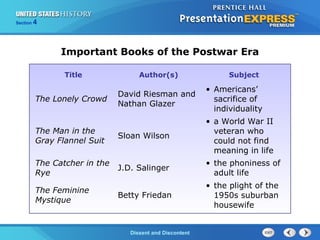
Important Books of the Postwar Era
Title Author(s) Subject
The Lonely Crowd
David Riesman and
Nathan Glazer
• Americans’
sacrifice of
individuality
The Man in the
Gray Flannel Suit
Sloan Wilson
• a World War II
veteran who
could not find
meaning in life
The Catcher in the
Rye
J.D. Salinger
• the phoniness of
adult life
The Feminine
Mystique
Betty Friedan
• the plight of the
1950s suburban
housewife
The Cold War BeginsDissent and Discontent
Section 4
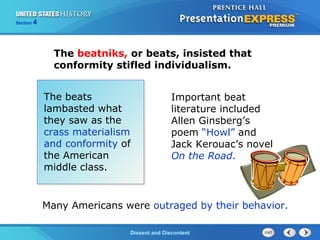
The beatniks, or beats, insisted that
conformity stifled individualism.
The beats
lambasted what
they saw as the
crass materialism
and conformity of
the American
middle class.
Important beat
literature included
Allen Ginsberg’s
poem “Howl” and
Jack Kerouac’s novel
On the Road.
Many Americans were outraged by their behavior.
The Cold War BeginsDissent and Discontent
Section 4
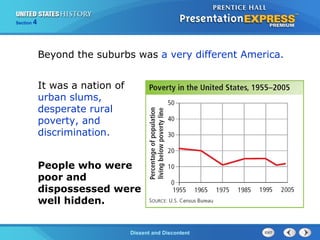
Beyond the suburbs was a very different America.
It was a nation of
urban slums,
desperate rural
poverty, and
discrimination.
People who were
poor and
dispossessed were
well hidden.
The Cold War BeginsDissent and Discontent
Section 4
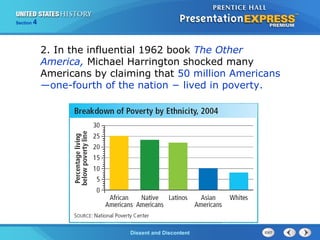
2. In the influential 1962 book The Other
America, Michael Harrington shocked many
Americans by claiming that 50 million Americans
—one-fourth of the nation − lived in poverty.
The Cold War BeginsDissent and Discontent
Section 4
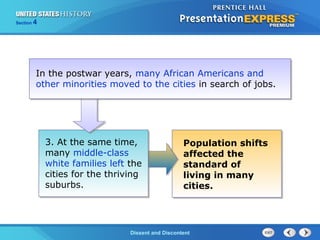
Population shifts
affected the
standard of
living in many
cities.
3. At the same time,
many middle-class
white families left the
cities for the thriving
suburbs.
In the postwar years, many African Americans and
other minorities moved to the cities in search of jobs.
The Cold War BeginsDissent and Discontent
Section 4
The loss of the middle class hurt cities
economically and politically.
• The middle class paid a large share of the taxes,
so without them, cities were poorer.
• When much of the middle class moved to the
suburbs, they took their congressional
representatives with them.
• City services declined with the loss of economic
and political power.
The Cold War BeginsDissent and Discontent
Section 4
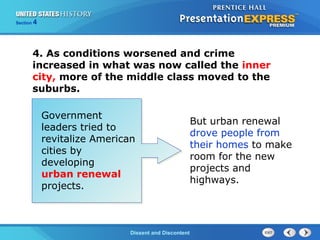
4. As conditions worsened and crime
increased in what was now called the inner
city, more of the middle class moved to the
suburbs.
Government
leaders tried to
revitalize American
cities by
developing
urban renewal
projects.
But urban renewal
drove people from
their homes to make
room for the new
projects and
highways.
The Cold War BeginsDissent and Discontent
Section 4
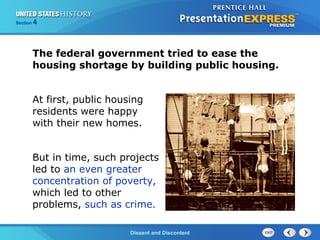
The federal government tried to ease the
housing shortage by building public housing.
At first, public housing
residents were happy
with their new homes.
But in time, such projects
led to an even greater
concentration of poverty,
which led to other
problems, such as crime.
The Cold War BeginsDissent and Discontent
Section 4
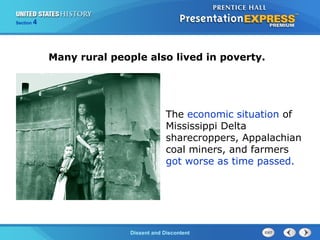
Many rural people also lived in poverty.
The economic situation of
Mississippi Delta
sharecroppers, Appalachian
coal miners, and farmers
got worse as time passed.
The Cold War BeginsDissent and Discontent
Section 4
Many farmers left rural
areas and moved to the
cities, while others
stayed behind, hoping for
economic improvement.
Small farm-owners
found it hard to
compete, and they
slipped into
poverty.
A major transformation in farming was
taking place, as corporations and large-farm
owners came to dominate farm production.
The Cold War BeginsDissent and Discontent
Section 4
African Americans and other minorities
faced housing and employment
discrimination in the urban north and west.
• Puerto Rican migrants to New York City were
grouped in inner city neighborhoods where
discrimination limited job opportunities.
• Because English was not their native language,
they had little political power and received little
help from city governments.
The Cold War BeginsDissent and Discontent
Section 4
By 1964, 3 million Mexicans had worked in the
United States under the bracero program, most
of them as farm laborers.
Many were
exploited and
cheated by their
employers, but
they did not
complain because
they feared
deportation.
One champion of
the rights of
Mexican migrant
workers, Ernesto
Galarza, joined the
effort to organize
unions for Mexican
farm laborers.
The Cold War BeginsDissent and Discontent
Section 4
5. In 1953, the federal government
enacted the termination policy, which
sought to end Native American tribal
government.
• The policy sought to relocate Native Americans to
cities and ended federal responsibility for them.
• Proponents of the policy argued that it would free
Native Americans to assimilate into U.S. society,
but in reality, it made conditions worse for them.
The Cold War BeginsDissent and Discontent
Section 4
Section Review
Know It, Show It QuizQuickTake Quiz

United States History Ch. 17 Section 4 Notes

  • 1.
    The Cold WarBeginsDissent and Discontent Section 4 • Summarize the arguments made by critics who rejected the culture of the fifties. • Describe the causes and effects of urban and rural poverty. • Explain the problems that many minority group members faced in the postwar era. Objectives
  • 2.
    The Cold WarBeginsDissent and Discontent Section 4 Terms and People • beatniks − small group of writers and artists, in the 1950s and early 1960s, who were critical of American society • inner city − the older, central part of a city with crowded neighborhoods in which low-income, usually minority, groups live • urban renewal − government programs for redevelopment of urban areas • termination policy − ended all programs monitored by the Bureau of Indian Affairs; ended federal responsibility for the health and welfare of Native Americans
  • 3.
    The Cold WarBeginsDissent and Discontent Section 4 Why were some groups of Americans dissatisfied with conditions in postwar America? 1. “Hidden” poverty and discrimination plagued some Americans, while others criticized the conformity of middle-class life. The discontents of the 1950s would manifest the first signs of the dissent that would dominate the 1960s.
  • 4.
    The Cold WarBeginsDissent and Discontent Section 4 Some Americans believed that while material conditions were better in the 1950s, the quality of life had not improved. • Many social critics complained about the emphasis on conformity in 1950s America. • They also criticized the power of advertising to mold public tastes. • The theme of alienation dominated a number of popular books of the era.
  • 5.
    The Cold WarBeginsDissent and Discontent Section 4 Important Books of the Postwar Era Title Author(s) Subject The Lonely Crowd David Riesman and Nathan Glazer • Americans’ sacrifice of individuality The Man in the Gray Flannel Suit Sloan Wilson • a World War II veteran who could not find meaning in life The Catcher in the Rye J.D. Salinger • the phoniness of adult life The Feminine Mystique Betty Friedan • the plight of the 1950s suburban housewife
  • 6.
    The Cold WarBeginsDissent and Discontent Section 4 The beatniks, or beats, insisted that conformity stifled individualism. The beats lambasted what they saw as the crass materialism and conformity of the American middle class. Important beat literature included Allen Ginsberg’s poem “Howl” and Jack Kerouac’s novel On the Road. Many Americans were outraged by their behavior.
  • 7.
    The Cold WarBeginsDissent and Discontent Section 4 Beyond the suburbs was a very different America. It was a nation of urban slums, desperate rural poverty, and discrimination. People who were poor and dispossessed were well hidden.
  • 8.
    The Cold WarBeginsDissent and Discontent Section 4 2. In the influential 1962 book The Other America, Michael Harrington shocked many Americans by claiming that 50 million Americans —one-fourth of the nation − lived in poverty.
  • 9.
    The Cold WarBeginsDissent and Discontent Section 4 Population shifts affected the standard of living in many cities. 3. At the same time, many middle-class white families left the cities for the thriving suburbs. In the postwar years, many African Americans and other minorities moved to the cities in search of jobs.
  • 10.
    The Cold WarBeginsDissent and Discontent Section 4 The loss of the middle class hurt cities economically and politically. • The middle class paid a large share of the taxes, so without them, cities were poorer. • When much of the middle class moved to the suburbs, they took their congressional representatives with them. • City services declined with the loss of economic and political power.
  • 11.
    The Cold WarBeginsDissent and Discontent Section 4 4. As conditions worsened and crime increased in what was now called the inner city, more of the middle class moved to the suburbs. Government leaders tried to revitalize American cities by developing urban renewal projects. But urban renewal drove people from their homes to make room for the new projects and highways.
  • 12.
    The Cold WarBeginsDissent and Discontent Section 4 The federal government tried to ease the housing shortage by building public housing. At first, public housing residents were happy with their new homes. But in time, such projects led to an even greater concentration of poverty, which led to other problems, such as crime.
  • 13.
    The Cold WarBeginsDissent and Discontent Section 4 Many rural people also lived in poverty. The economic situation of Mississippi Delta sharecroppers, Appalachian coal miners, and farmers got worse as time passed.
  • 14.
    The Cold WarBeginsDissent and Discontent Section 4 Many farmers left rural areas and moved to the cities, while others stayed behind, hoping for economic improvement. Small farm-owners found it hard to compete, and they slipped into poverty. A major transformation in farming was taking place, as corporations and large-farm owners came to dominate farm production.
  • 15.
    The Cold WarBeginsDissent and Discontent Section 4 African Americans and other minorities faced housing and employment discrimination in the urban north and west. • Puerto Rican migrants to New York City were grouped in inner city neighborhoods where discrimination limited job opportunities. • Because English was not their native language, they had little political power and received little help from city governments.
  • 16.
    The Cold WarBeginsDissent and Discontent Section 4 By 1964, 3 million Mexicans had worked in the United States under the bracero program, most of them as farm laborers. Many were exploited and cheated by their employers, but they did not complain because they feared deportation. One champion of the rights of Mexican migrant workers, Ernesto Galarza, joined the effort to organize unions for Mexican farm laborers.
  • 17.
    The Cold WarBeginsDissent and Discontent Section 4 5. In 1953, the federal government enacted the termination policy, which sought to end Native American tribal government. • The policy sought to relocate Native Americans to cities and ended federal responsibility for them. • Proponents of the policy argued that it would free Native Americans to assimilate into U.S. society, but in reality, it made conditions worse for them.
  • 18.
    The Cold WarBeginsDissent and Discontent Section 4 Section Review Know It, Show It QuizQuickTake Quiz