Chapter 25 Section 1
The Cold War BeginsMany Cultures Meet
Section 1
• Discuss the migration of the first people to the
Americas.
• Explain why Europeans wanted to develop a sea
route to India in the 1400s.
• Describe the importance of trade in West Africa.
• Identify the effects of Christopher Columbus’s
voyage to the Americas.
Objectives
Chapter 25 Section 1
The Cold War Begins
Section 1
Many Cultures Meet
Terms and People
• clans - extended family groups upon which most
Native American cultures were based
• Middle Passage - enslaved Africans’ transatlantic
journey to the Americas on a slave ship
• Christopher Columbus - Italian mariner sailing
for the Spanish who accidentally encountered the
Americas while traveling to the Indies in 1492
Chapter 25 Section 1
The Cold War Begins
Section 1
Many Cultures Meet
Terms and People (Continued)
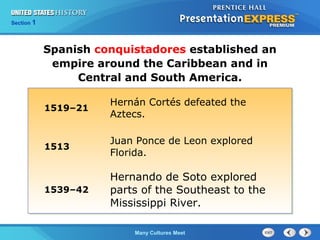
• conquistadors - Spanish explorers who
established an empire around the Caribbean and
throughout Central and South America
• Columbian Exchange - the exchange of plants,
animals, diseases, and ideas between Europe and
the Americas following Columbus’s journey
Chapter 25 Section 1
The Cold War Begins
Section 1
Many Cultures Meet
What were the causes and effects of
European arrival in the Americas?
1. Europe’s Age of Exploration began as a
search for an all-water route to Asia. In 1492,
Europeans began to explore the Americas.
The arrival of European settlers and enslaved
Africans brought traumatic changes to the
many complex Native American cultures.
Chapter 25 Section 1
The Cold War Begins
Section 1
Many Cultures Meet
• Some scientists believe they crossed a land bridge
over the Bering Strait.
• Others believe they came by boat along the Pacific
coast.
The first Americans migrated from Asia
between 40,000 and 15,000 years ago.
American Indians spread throughout the different
landscapes of North and South America.
Chapter 25 Section 1
The Cold War Begins
Section 1
Many Cultures Meet
They lived in extended family groups
called clans.
Clans identified with spirits of powerful
animals.
American Indians believed powerful
spiritual forces were part of nature.
2. Culturally diverse Native Americans
shared several characteristics:
1
2
3
Chapter 25 Section 1
The Cold War Begins
Section 1
Many Cultures Meet
Agriculture
led to the
growth of
civilizations.
• Indians of Central
Mexico cultivated
squash, corn, and
beans 3,500 years
ago.
• 3. Expanded food
supplies led to towns
and cities under
powerful chiefs.
Chapter 25 Section 1
The Cold War Begins
Section 1
Many Cultures Meet
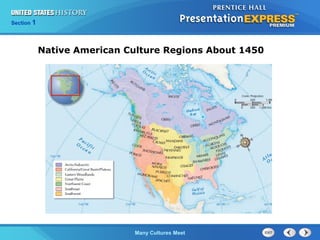
Native American Culture Regions About 1450
Chapter 25 Section 1
The Cold War Begins
Section 1
Many Cultures Meet
• Scientific advances and an increase in economic
wealth gave rise to voyages of exploration.
• Economic wealth led to voyages of exploration
as monarchs sought trade from Asia and Africa.
Between the 14th and 16th centuries,
Europe was changed by the Renaissance.
Chapter 25 Section 1
The Cold War Begins
Section 1
Many Cultures Meet
• They sought gold
and salt, and they
enslaved Africans.
• Between 1500 and
1800, 11 million
slaves crossed the
Atlantic, a trip
known as the
Middle Passage.
Portuguese
mariners rounded
the southern tip of
Africa and
eventually
reached India.
But on the way,
some mariners
stopped to trade
with West African
nations.
Chapter 25 Section 1
The Cold War Begins
Section 1
Many Cultures Meet
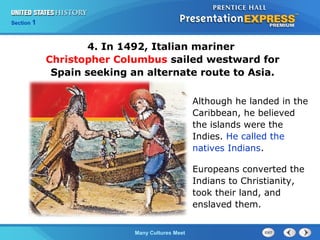
4. In 1492, Italian mariner
Christopher Columbus sailed westward for
Spain seeking an alternate route to Asia.
Although he landed in the
Caribbean, he believed
the islands were the
Indies. He called the
natives Indians.
Europeans converted the
Indians to Christianity,
took their land, and
enslaved them.
Chapter 25 Section 1
The Cold War Begins
Section 1
Many Cultures Meet
1519–21
Hernán Cortés defeated the
Aztecs.
1513
Juan Ponce de Leon explored
Florida.
1539–42
Hernando de Soto explored
parts of the Southeast to the
Mississippi River.
Spanish conquistadores established an
empire around the Caribbean and in
Central and South America.
Chapter 25 Section 1
The Cold War Begins
Section 1
Many Cultures Meet
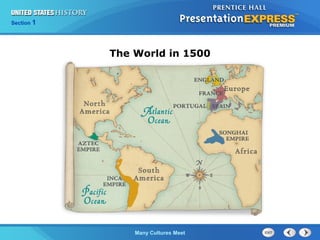
The World in 1500
Chapter 25 Section 1
The Cold War Begins
Section 1
Many Cultures Meet
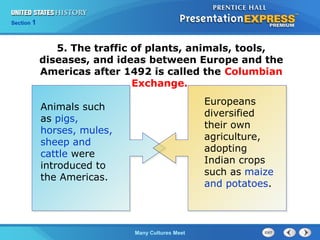
5. The traffic of plants, animals, tools,
diseases, and ideas between Europe and the
Americas after 1492 is called the Columbian
Exchange.
Animals such
as pigs,
horses, mules,
sheep and
cattle were
introduced to
the Americas.
Europeans
diversified
their own
agriculture,
adopting
Indian crops
such as maize
and potatoes.
Chapter 25 Section 1
The Cold War BeginsMany Cultures Meet
Section 1
Section Review
Know It, Show It QuizQuickTake Quiz

US History Ch. 1 Section 1 Notes

  • 1.
    Chapter 25 Section1 The Cold War BeginsMany Cultures Meet Section 1 • Discuss the migration of the first people to the Americas. • Explain why Europeans wanted to develop a sea route to India in the 1400s. • Describe the importance of trade in West Africa. • Identify the effects of Christopher Columbus’s voyage to the Americas. Objectives
  • 2.
    Chapter 25 Section1 The Cold War Begins Section 1 Many Cultures Meet Terms and People • clans - extended family groups upon which most Native American cultures were based • Middle Passage - enslaved Africans’ transatlantic journey to the Americas on a slave ship • Christopher Columbus - Italian mariner sailing for the Spanish who accidentally encountered the Americas while traveling to the Indies in 1492
  • 3.
    Chapter 25 Section1 The Cold War Begins Section 1 Many Cultures Meet Terms and People (Continued) • conquistadors - Spanish explorers who established an empire around the Caribbean and throughout Central and South America • Columbian Exchange - the exchange of plants, animals, diseases, and ideas between Europe and the Americas following Columbus’s journey
  • 4.
    Chapter 25 Section1 The Cold War Begins Section 1 Many Cultures Meet What were the causes and effects of European arrival in the Americas? 1. Europe’s Age of Exploration began as a search for an all-water route to Asia. In 1492, Europeans began to explore the Americas. The arrival of European settlers and enslaved Africans brought traumatic changes to the many complex Native American cultures.
  • 5.
    Chapter 25 Section1 The Cold War Begins Section 1 Many Cultures Meet • Some scientists believe they crossed a land bridge over the Bering Strait. • Others believe they came by boat along the Pacific coast. The first Americans migrated from Asia between 40,000 and 15,000 years ago. American Indians spread throughout the different landscapes of North and South America.
  • 6.
    Chapter 25 Section1 The Cold War Begins Section 1 Many Cultures Meet They lived in extended family groups called clans. Clans identified with spirits of powerful animals. American Indians believed powerful spiritual forces were part of nature. 2. Culturally diverse Native Americans shared several characteristics: 1 2 3
  • 7.
    Chapter 25 Section1 The Cold War Begins Section 1 Many Cultures Meet Agriculture led to the growth of civilizations. • Indians of Central Mexico cultivated squash, corn, and beans 3,500 years ago. • 3. Expanded food supplies led to towns and cities under powerful chiefs.
  • 8.
    Chapter 25 Section1 The Cold War Begins Section 1 Many Cultures Meet Native American Culture Regions About 1450
  • 9.
    Chapter 25 Section1 The Cold War Begins Section 1 Many Cultures Meet • Scientific advances and an increase in economic wealth gave rise to voyages of exploration. • Economic wealth led to voyages of exploration as monarchs sought trade from Asia and Africa. Between the 14th and 16th centuries, Europe was changed by the Renaissance.
  • 10.
    Chapter 25 Section1 The Cold War Begins Section 1 Many Cultures Meet • They sought gold and salt, and they enslaved Africans. • Between 1500 and 1800, 11 million slaves crossed the Atlantic, a trip known as the Middle Passage. Portuguese mariners rounded the southern tip of Africa and eventually reached India. But on the way, some mariners stopped to trade with West African nations.
  • 11.
    Chapter 25 Section1 The Cold War Begins Section 1 Many Cultures Meet 4. In 1492, Italian mariner Christopher Columbus sailed westward for Spain seeking an alternate route to Asia. Although he landed in the Caribbean, he believed the islands were the Indies. He called the natives Indians. Europeans converted the Indians to Christianity, took their land, and enslaved them.
  • 12.
    Chapter 25 Section1 The Cold War Begins Section 1 Many Cultures Meet 1519–21 Hernán Cortés defeated the Aztecs. 1513 Juan Ponce de Leon explored Florida. 1539–42 Hernando de Soto explored parts of the Southeast to the Mississippi River. Spanish conquistadores established an empire around the Caribbean and in Central and South America.
  • 13.
    Chapter 25 Section1 The Cold War Begins Section 1 Many Cultures Meet The World in 1500
  • 14.
    Chapter 25 Section1 The Cold War Begins Section 1 Many Cultures Meet 5. The traffic of plants, animals, tools, diseases, and ideas between Europe and the Americas after 1492 is called the Columbian Exchange. Animals such as pigs, horses, mules, sheep and cattle were introduced to the Americas. Europeans diversified their own agriculture, adopting Indian crops such as maize and potatoes.
  • 15.
    Chapter 25 Section1 The Cold War BeginsMany Cultures Meet Section 1 Section Review Know It, Show It QuizQuickTake Quiz