Section

3

Objectives
•

Analyze Progressives’ attitudes toward
minority rights.

•

Explain why African Americans organized.

•

Examine the strategies used by members of
other minority groups to defend their rights.

The Struggle Against Discrimination
Section

3

Terms and People
•

Americanization – effort to replace immigrant
customs with white, Protestant, middle-class
practices and values

•

Booker T. Washington – favored a gradualist
approach for blacks to earn rights through
economic progress and employment in the
skilled trades

•

W.E.B. Du Bois – demanded immediate and full
rights for blacks as guaranteed by the Constitution

The Struggle Against Discrimination
Section

3

Terms and People

(continued)

•

Niagara Movement – opposed Washington’s
approach; favored education in history,
literature, and philosophy, not just in the trades

•

NAACP – National Association for the
Advancement of Colored People, viewed full
legal rights as the only solution to racial
discrimination

•

Urban League – organization to assist
working class African Americans with relief, jobs,
clothing, and schools
The Struggle Against Discrimination
Section

3

Terms and People

(continued)

•

Anti-Defamation League – organization to
defend Jews and others from false statements,
and verbal or physical attacks

•

mutualistas – Mexican American groups that
provided loans, legal assistance, and disability
insurance for members

The Struggle Against Discrimination
Section

3

What steps did minorities take to combat
social problems and discrimination?
1. Prejudice and discrimination continued
even during the Progressive era. Minorities,
including African Americans, Latinos,
Catholics, Jews, and Native Americans,
worked to help themselves.
Their efforts paved the way for the era of
civil rights several decades later.

The Struggle Against Discrimination
Section

3

Most Progressives were white,
middle-class Protestants who
held the racial and ethnic
prejudices common in that era.

They envisioned a
model America based
on Protestant ethics
and a white middleclass lifestyle.

As a result, they
were often hostile
to minority or
immigrant
cultures.

The Struggle Against Discrimination
Section

3

2. Progressives believed
assimilation would turn immigrants
into loyal and moral citizens.

• The results were well-intentioned, but often
insensitive or racist efforts to change the immigrants.
• While teaching English they also advised immigrants
to replace their customs with middle-class practices
and Protestant values.
• Settlement houses and other civic groups played a
prominent role in Americanization efforts.
The Struggle Against Discrimination
Section

3

Progressives saw many immigrant
customs as moral failures.
Immigrant use of
alcohol, such as
the serving of
wine with meals,
alarmed some
people.

This prejudice
against immigrant
customs and
culture gave
strength to the
temperance
movement.

The Struggle Against Discrimination
Section

3

3. Racial theories were also used to
justify laws that kept blacks from voting.
Many Progressives supported racial
prejudices.
• The Plessy v. Ferguson decision furthered
discrimination in the North as well as the South.
• By 1910, segregation was the norm nationwide.
• In 1914, even federal offices were segregated by
Progressive President Woodrow Wilson.

The Struggle Against Discrimination
Section

3

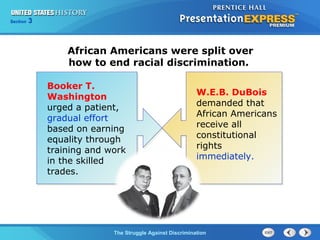
African Americans were split over
how to end racial discrimination.
Booker T.
Washington
urged a patient,
gradual effort
based on earning
equality through
training and work
in the skilled
trades.

W.E.B. DuBois
demanded that
African Americans
receive all
constitutional
rights
immediately.

The Struggle Against Discrimination
Section

3

In 1905, DuBois and William Monroe Trotter
were concerned that all across the South,
black men could not vote.

• Their Niagara Movement rejected the
gradualist approach stating that trade skills
“create workers, but cannot make men.”
• They also believed African Americans should
learn how to think for themselves through the
study of history, literature, and philosophy.

The Struggle Against Discrimination
Section

3

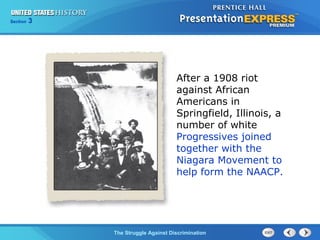
After a 1908 riot
against African
Americans in
Springfield, Illinois, a
number of white
Progressives joined
together with the
Niagara Movement to
help form the NAACP.

The Struggle Against Discrimination
Section

3

4. The NAACP or
National Association
for the Advancement
of Colored People
was founded to
demand voting and
civil rights for African
Americans.

The NAACP aimed to
help African Americans
become “physically free
from peonage, mentally
free from ignorance,
politically free from
disfranchisement, and
socially free from
insult.”

The Struggle Against Discrimination
Section

3

The NAACP attracted prominent
Progressives to their cause.
Supporters:

• used their newspapers to
publicize the horrors of race
riots and lynchings.

Jane Addams
Ray Stannard Baker
Florence Kelley
Ida B. Wells

Their tactics:

• used the courts to challenge
unfair housing laws.
• promoted professional careers
for African Americans.

The Struggle Against Discrimination
Section

3

In 1911, the Urban League was formed
to create a network of local clubs and
churches to assist African Americans
migrating to northern cities.
While the NAACP focused
on political justice, the
Urban League helped the
poor find jobs, housing,
clothing, and schools for
their children.

The Struggle Against Discrimination
Section

3

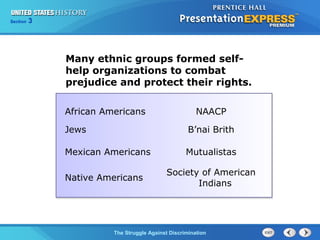
Many ethnic groups formed selfhelp organizations to combat
prejudice and protect their rights.
African Americans

NAACP

Jews

B’nai Brith

Mexican Americans

Mutualistas

Native Americans

Society of American
Indians

The Struggle Against Discrimination
Section

3

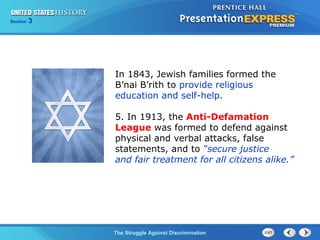
In 1843, Jewish families formed the
B’nai B’rith to provide religious
education and self-help.
5. In 1913, the Anti-Defamation
League was formed to defend against
physical and verbal attacks, false
statements, and to “secure justice
and fair treatment for all citizens alike.”

The Struggle Against Discrimination
Section

3

Mexican Americans formed mutualistas,
groups that provided legal assistance
and disability insurance.
The Partido Liberal
Mexicano in Arizona
served a role similar to
the Urban League for
Mexican Americans.
Many Latinos were
subject to unfair labor
contracts, which the
mutualistas helped to
defeat.
The Struggle Against Discrimination
Section

3

Despite organized protests, Native Americans
and Japanese lost their ownership of land.

In 1911, Carlos
Montezuma helped form
the Society of American
Indians to protest
federal policy.
Nevertheless, by 1932,
two-thirds of all tribal
lands had been sold off.

In 1913, California
restricted land
ownership to American
citizens only, which
excluded the Japanese,
who were not allowed
to become citizens.
In a 1922 decision, the
Supreme Court allowed
the limitation.

The Struggle Against Discrimination
Section

3

Section Review
QuickTake Quiz

Know It, Show It Quiz

The Struggle Against Discrimination

US History Ch. 8 Section 3 Notes

  • 1.
    Section 3 Objectives • Analyze Progressives’ attitudestoward minority rights. • Explain why African Americans organized. • Examine the strategies used by members of other minority groups to defend their rights. The Struggle Against Discrimination
  • 2.
    Section 3 Terms and People • Americanization– effort to replace immigrant customs with white, Protestant, middle-class practices and values • Booker T. Washington – favored a gradualist approach for blacks to earn rights through economic progress and employment in the skilled trades • W.E.B. Du Bois – demanded immediate and full rights for blacks as guaranteed by the Constitution The Struggle Against Discrimination
  • 3.
    Section 3 Terms and People (continued) • NiagaraMovement – opposed Washington’s approach; favored education in history, literature, and philosophy, not just in the trades • NAACP – National Association for the Advancement of Colored People, viewed full legal rights as the only solution to racial discrimination • Urban League – organization to assist working class African Americans with relief, jobs, clothing, and schools The Struggle Against Discrimination
  • 4.
    Section 3 Terms and People (continued) • Anti-DefamationLeague – organization to defend Jews and others from false statements, and verbal or physical attacks • mutualistas – Mexican American groups that provided loans, legal assistance, and disability insurance for members The Struggle Against Discrimination
  • 5.
    Section 3 What steps didminorities take to combat social problems and discrimination? 1. Prejudice and discrimination continued even during the Progressive era. Minorities, including African Americans, Latinos, Catholics, Jews, and Native Americans, worked to help themselves. Their efforts paved the way for the era of civil rights several decades later. The Struggle Against Discrimination
  • 6.
    Section 3 Most Progressives werewhite, middle-class Protestants who held the racial and ethnic prejudices common in that era. They envisioned a model America based on Protestant ethics and a white middleclass lifestyle. As a result, they were often hostile to minority or immigrant cultures. The Struggle Against Discrimination
  • 7.
    Section 3 2. Progressives believed assimilationwould turn immigrants into loyal and moral citizens. • The results were well-intentioned, but often insensitive or racist efforts to change the immigrants. • While teaching English they also advised immigrants to replace their customs with middle-class practices and Protestant values. • Settlement houses and other civic groups played a prominent role in Americanization efforts. The Struggle Against Discrimination
  • 8.
    Section 3 Progressives saw manyimmigrant customs as moral failures. Immigrant use of alcohol, such as the serving of wine with meals, alarmed some people. This prejudice against immigrant customs and culture gave strength to the temperance movement. The Struggle Against Discrimination
  • 9.
    Section 3 3. Racial theorieswere also used to justify laws that kept blacks from voting. Many Progressives supported racial prejudices. • The Plessy v. Ferguson decision furthered discrimination in the North as well as the South. • By 1910, segregation was the norm nationwide. • In 1914, even federal offices were segregated by Progressive President Woodrow Wilson. The Struggle Against Discrimination
  • 10.
    Section 3 African Americans weresplit over how to end racial discrimination. Booker T. Washington urged a patient, gradual effort based on earning equality through training and work in the skilled trades. W.E.B. DuBois demanded that African Americans receive all constitutional rights immediately. The Struggle Against Discrimination
  • 11.
    Section 3 In 1905, DuBoisand William Monroe Trotter were concerned that all across the South, black men could not vote. • Their Niagara Movement rejected the gradualist approach stating that trade skills “create workers, but cannot make men.” • They also believed African Americans should learn how to think for themselves through the study of history, literature, and philosophy. The Struggle Against Discrimination
  • 12.
    Section 3 After a 1908riot against African Americans in Springfield, Illinois, a number of white Progressives joined together with the Niagara Movement to help form the NAACP. The Struggle Against Discrimination
  • 13.
    Section 3 4. The NAACPor National Association for the Advancement of Colored People was founded to demand voting and civil rights for African Americans. The NAACP aimed to help African Americans become “physically free from peonage, mentally free from ignorance, politically free from disfranchisement, and socially free from insult.” The Struggle Against Discrimination
  • 14.
    Section 3 The NAACP attractedprominent Progressives to their cause. Supporters: • used their newspapers to publicize the horrors of race riots and lynchings. Jane Addams Ray Stannard Baker Florence Kelley Ida B. Wells Their tactics: • used the courts to challenge unfair housing laws. • promoted professional careers for African Americans. The Struggle Against Discrimination
  • 15.
    Section 3 In 1911, theUrban League was formed to create a network of local clubs and churches to assist African Americans migrating to northern cities. While the NAACP focused on political justice, the Urban League helped the poor find jobs, housing, clothing, and schools for their children. The Struggle Against Discrimination
  • 16.
    Section 3 Many ethnic groupsformed selfhelp organizations to combat prejudice and protect their rights. African Americans NAACP Jews B’nai Brith Mexican Americans Mutualistas Native Americans Society of American Indians The Struggle Against Discrimination
  • 17.
    Section 3 In 1843, Jewishfamilies formed the B’nai B’rith to provide religious education and self-help. 5. In 1913, the Anti-Defamation League was formed to defend against physical and verbal attacks, false statements, and to “secure justice and fair treatment for all citizens alike.” The Struggle Against Discrimination
  • 18.
    Section 3 Mexican Americans formedmutualistas, groups that provided legal assistance and disability insurance. The Partido Liberal Mexicano in Arizona served a role similar to the Urban League for Mexican Americans. Many Latinos were subject to unfair labor contracts, which the mutualistas helped to defeat. The Struggle Against Discrimination
  • 19.
    Section 3 Despite organized protests,Native Americans and Japanese lost their ownership of land. In 1911, Carlos Montezuma helped form the Society of American Indians to protest federal policy. Nevertheless, by 1932, two-thirds of all tribal lands had been sold off. In 1913, California restricted land ownership to American citizens only, which excluded the Japanese, who were not allowed to become citizens. In a 1922 decision, the Supreme Court allowed the limitation. The Struggle Against Discrimination
  • 20.
    Section 3 Section Review QuickTake Quiz KnowIt, Show It Quiz The Struggle Against Discrimination