Chapter 20
Floods of New Immigrants The Journey to America The Immigrant Experience Nativist Movement
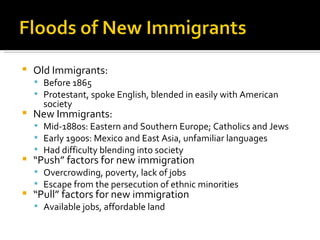
Old Immigrants: Before 1865 Protestant, spoke English, blended in easily with American society New Immigrants: Mid-1880s: Eastern and Southern Europe; Catholics and Jews Early 1900s: Mexico and East Asia, unfamiliar languages Had difficulty blending into society “ Push” factors for new immigration Overcrowding, poverty, lack of jobs Escape from the persecution of ethnic minorities “ Pull” factors for new immigration Available jobs, affordable land
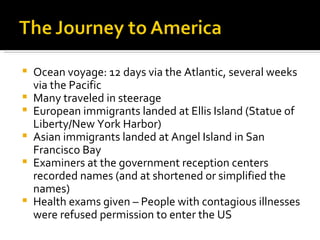
Ocean voyage: 12 days via the Atlantic, several weeks via the Pacific Many traveled in steerage European immigrants landed at Ellis Island (Statue of Liberty/New York Harbor) Asian immigrants landed at Angel Island in San Francisco Bay Examiners at the government reception centers recorded names (and at shortened or simplified the names) Health exams given – People with contagious illnesses were refused permission to enter the US
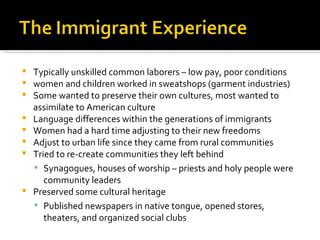
Typically unskilled common laborers – low pay, poor conditions women and children worked in sweatshops (garment industries) Some wanted to preserve their own cultures, most wanted to assimilate to American culture Language differences within the generations of immigrants Women had a hard time adjusting to their new freedoms Adjust to urban life since they came from rural communities Tried to re-create communities they left behind Synagogues, houses of worship – priests and holy people were community leaders Preserved some cultural heritage Published newspapers in native tongue, opened stores, theaters, and organized social clubs
Resented immigrants since they would work for lower wages Ethnic, religious and racial tensions heighten Blamed for crime, unemployment, and other problems Nativist movement: anti-immigration movement – strengthens in the late 1800s: 1882 – Chinese Exclusion Act – prohibited Chinese workers to enter the US for 10 years 1907 – “Gentleman’s Agreement” – Japan limits the number of Japanese immigrants going to the US Immigration Act of 1917 – required immigrant to be literate Grace Abbott and Julia Clifford Lathrop – Immigrants’ Protective League Growing industries provided with necessary workers Contributed their customs and cultures to American way of life
Growth of Cities Cities in Crisis The Changing City
US changing from a rural towards an urban nation Immigrants make up 80% of city population – Jobs located in the cities African Americans and women also move to the city for jobs Kansas City – meatpacking Pittsburg – iron and steel New York and San Francisco – international trade More city-dwellers = more housing needed:  Poorest residents lived in  tenements  in the city slums Middle-class (professionals, doctors, lawyers, ministers) lived in the suburbs = much better conditions than the urban slums Wealthy lived lavish lifestyles, but were only a tiny fraction of the population This age was known as the  Gilded Age : A time of extravagant wealth on the outside, but terrible poverty underneath
Overcrowding in tenements = health and sanitation problems Students begin to get screened for contagious diseases City establishes public health clinics Poverty led to increased crime: Gangs Religious groups and organizations (YMCA, YWCA) help as much as possible Settlement houses provided medical care, playgrounds, nurseries, libraries, and some education: Hull House – Jane Addams
Urban growth led to new developments Building upwards instead of outwards with the help of the safety elevator (Elisha Otis) William LeBaron Jenney – constructs the world’s 1 st  skyscraper Woolworth Building (1913) – 55 stories, known as Cathedral of Commerce Frederick Law Olmsted – designer of New York’s Central Park Streetcars and paved streets revolutionize methods of transportation within cities Steel Bridges allow divided portions of cities and towns to become connected
Expanding Education A Nation of Readers Art, Music, and Literature
Expansion in the number of public high schools Majority of students were girls - boys stayed home and worked  African Americans: not given equal opportunities to attend schools John Dewey - “progressive education” - relating learning to students interests, problems, and concerns Morrill Act gives states large amounts of federal land that they could sell to raise money for education Land-grant colleges:  Colleges started due funds taken from the sale of federal lands (Cornell, Stanford) Women’s colleges (Vassar, Smith, Wellesley, Bryn Mawr) Booker T. Washington - Tuskegee Institute - trained teachers to provide a practical education for African Americans Native Americans trained for jobs through Carlisle Indian Industrial School
Public libraries grow: Andrew Carnegie contributes millions of dollars to establish free public libraries Advances in print media: Joseph Pulitzer: New York World William Randolph Hearst: New You Morning Journal Yellow journalism  attracts readers Magazines become popular (Atlantic Monthly, Harper’s Magazine, Ladies’ Home Journal) Literature sees the new styles:  realism  and  regionalism
Americans begin to develop a distinct American style American artists pursue  realist  themes Jazz and ragtime become popular types of music Middle-class workers enjoy increased leisure time Spectator sports become popular (baseball) Football initiates as a college sport Basketball originates in US and spreads to other countries Bicycles made safer with rubber wheels Vaudeville shows (dancing, singing, comedy, and magic) become popular Thomas Edison’s moving pictures

Chapter 20 - Towards An Urban America

  • 1.
  • 2.
    Floods of NewImmigrants The Journey to America The Immigrant Experience Nativist Movement
  • 3.
    Old Immigrants: Before1865 Protestant, spoke English, blended in easily with American society New Immigrants: Mid-1880s: Eastern and Southern Europe; Catholics and Jews Early 1900s: Mexico and East Asia, unfamiliar languages Had difficulty blending into society “ Push” factors for new immigration Overcrowding, poverty, lack of jobs Escape from the persecution of ethnic minorities “ Pull” factors for new immigration Available jobs, affordable land
  • 4.
    Ocean voyage: 12days via the Atlantic, several weeks via the Pacific Many traveled in steerage European immigrants landed at Ellis Island (Statue of Liberty/New York Harbor) Asian immigrants landed at Angel Island in San Francisco Bay Examiners at the government reception centers recorded names (and at shortened or simplified the names) Health exams given – People with contagious illnesses were refused permission to enter the US
  • 5.
    Typically unskilled commonlaborers – low pay, poor conditions women and children worked in sweatshops (garment industries) Some wanted to preserve their own cultures, most wanted to assimilate to American culture Language differences within the generations of immigrants Women had a hard time adjusting to their new freedoms Adjust to urban life since they came from rural communities Tried to re-create communities they left behind Synagogues, houses of worship – priests and holy people were community leaders Preserved some cultural heritage Published newspapers in native tongue, opened stores, theaters, and organized social clubs
  • 6.
    Resented immigrants sincethey would work for lower wages Ethnic, religious and racial tensions heighten Blamed for crime, unemployment, and other problems Nativist movement: anti-immigration movement – strengthens in the late 1800s: 1882 – Chinese Exclusion Act – prohibited Chinese workers to enter the US for 10 years 1907 – “Gentleman’s Agreement” – Japan limits the number of Japanese immigrants going to the US Immigration Act of 1917 – required immigrant to be literate Grace Abbott and Julia Clifford Lathrop – Immigrants’ Protective League Growing industries provided with necessary workers Contributed their customs and cultures to American way of life
  • 7.
    Growth of CitiesCities in Crisis The Changing City
  • 8.
    US changing froma rural towards an urban nation Immigrants make up 80% of city population – Jobs located in the cities African Americans and women also move to the city for jobs Kansas City – meatpacking Pittsburg – iron and steel New York and San Francisco – international trade More city-dwellers = more housing needed: Poorest residents lived in tenements in the city slums Middle-class (professionals, doctors, lawyers, ministers) lived in the suburbs = much better conditions than the urban slums Wealthy lived lavish lifestyles, but were only a tiny fraction of the population This age was known as the Gilded Age : A time of extravagant wealth on the outside, but terrible poverty underneath
  • 9.
    Overcrowding in tenements= health and sanitation problems Students begin to get screened for contagious diseases City establishes public health clinics Poverty led to increased crime: Gangs Religious groups and organizations (YMCA, YWCA) help as much as possible Settlement houses provided medical care, playgrounds, nurseries, libraries, and some education: Hull House – Jane Addams
  • 10.
    Urban growth ledto new developments Building upwards instead of outwards with the help of the safety elevator (Elisha Otis) William LeBaron Jenney – constructs the world’s 1 st skyscraper Woolworth Building (1913) – 55 stories, known as Cathedral of Commerce Frederick Law Olmsted – designer of New York’s Central Park Streetcars and paved streets revolutionize methods of transportation within cities Steel Bridges allow divided portions of cities and towns to become connected
  • 11.
    Expanding Education ANation of Readers Art, Music, and Literature
  • 12.
    Expansion in thenumber of public high schools Majority of students were girls - boys stayed home and worked African Americans: not given equal opportunities to attend schools John Dewey - “progressive education” - relating learning to students interests, problems, and concerns Morrill Act gives states large amounts of federal land that they could sell to raise money for education Land-grant colleges: Colleges started due funds taken from the sale of federal lands (Cornell, Stanford) Women’s colleges (Vassar, Smith, Wellesley, Bryn Mawr) Booker T. Washington - Tuskegee Institute - trained teachers to provide a practical education for African Americans Native Americans trained for jobs through Carlisle Indian Industrial School
  • 13.
    Public libraries grow:Andrew Carnegie contributes millions of dollars to establish free public libraries Advances in print media: Joseph Pulitzer: New York World William Randolph Hearst: New You Morning Journal Yellow journalism attracts readers Magazines become popular (Atlantic Monthly, Harper’s Magazine, Ladies’ Home Journal) Literature sees the new styles: realism and regionalism
  • 14.
    Americans begin todevelop a distinct American style American artists pursue realist themes Jazz and ragtime become popular types of music Middle-class workers enjoy increased leisure time Spectator sports become popular (baseball) Football initiates as a college sport Basketball originates in US and spreads to other countries Bicycles made safer with rubber wheels Vaudeville shows (dancing, singing, comedy, and magic) become popular Thomas Edison’s moving pictures