325

Section
Chapter

Section

1

Objectives
•

Compare economic and cultural life in rural
America to that in urban America.

•

Discuss changes in U.S. immigration policy in
the 1920s.

•

Analyze the goals and motives of the Ku Klux
Klan in the 1920s.

•

Discuss the successes and failures of the
Eighteenth Amendment.

Social and Cultural Tensions
The Cold War Begins
325

Section
Chapter

Section

1

Terms and People
•

modernism – trend that emphasized science and
secular values over traditional religious ideas

•

fundamentalism – belief that emphasizes the
Bible as literal truth

•

Scopes Trial – 1925 “Monkey Trial,” which
challenged a law against teaching Darwin’s theory
of evolution in Tennessee public schools

•

Clarence Darrow – defense attorney in the Scopes
Trial

Social and Cultural Tensions
The Cold War Begins
325

Section
Chapter

Section

1

Terms and People (continued)
•

quota system – a formula to determine how many
immigrants could enter the U.S. annually from a
given country

•

Ku Klux Klan – a group violently opposed to
immigrants, Catholics, Jews, and African Americans

•

Prohibition – a ban on alcohol

•

Eighteenth Amendment – a 1919 Constitutional
amendment that established Prohibition

Social and Cultural Tensions
The Cold War Begins
325

Section
Chapter

Section

1

Terms and People (continued)
•

Volstead Act – a law that gave the government
power to enforce the Eighteenth Amendment

•

bootlegger – someone who illegally sold alcohol
during Prohibition

Social and Cultural Tensions
The Cold War Begins
325

Section
Chapter

Section

1

How did Americans differ on major
social and cultural issues?
1. In the 1920s, many city dwellers
enjoyed a rising standard of living, while
most farmers suffered through hard
times.
Conflicting visions for the nation’s future
heightened tensions between cities and
rural areas.
Social and Cultural Tensions
The Cold War Begins
325

Section
Chapter

Section

1

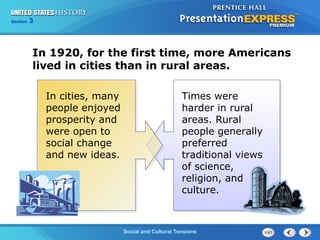
In 1920, for the first time, more Americans
lived in cities than in rural areas.
In cities, many
people enjoyed
prosperity and
were open to
social change
and new ideas.

Times were
harder in rural
areas. Rural
people generally
preferred
traditional views
of science,
religion, and
culture.

Social and Cultural Tensions
The Cold War Begins
325

Section
Chapter

Section

1

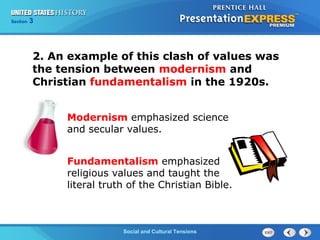
2. An example of this clash of values was
the tension between modernism and
Christian fundamentalism in the 1920s.
Modernism emphasized science
and secular values.
Fundamentalism emphasized
religious values and taught the
literal truth of the Christian Bible.

Social and Cultural Tensions
The Cold War Begins
325

Section
Chapter

Section

1

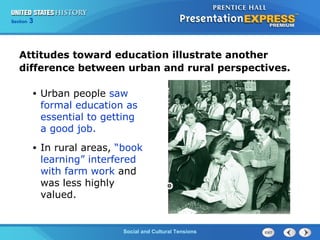
Attitudes toward education illustrate another
difference between urban and rural perspectives.
•

Urban people saw
formal education as
essential to getting
a good job.

•

In rural areas, “book
learning” interfered
with farm work and
was less highly
valued.

Social and Cultural Tensions
The Cold War Begins
325

Section
Chapter

Section

1

3. Education became a battleground for
fundamentalist and modernist values
in the 1925 Scopes Trial.

•

Tennessee made it illegal to teach evolution in
public schools.

•

Biology teacher John Scopes challenged the law.

•

Defense attorney Clarence Darrow tried to use
science to cast doubt on religious beliefs.
Social and Cultural Tensions
The Cold War Begins
325

Section
Chapter

Section

1

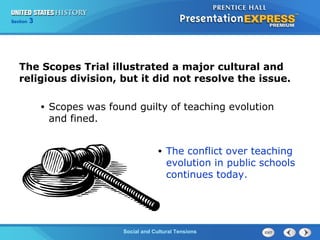
The Scopes Trial illustrated a major cultural and
religious division, but it did not resolve the issue.
•

Scopes was found guilty of teaching evolution
and fined.
•

The conflict over teaching
evolution in public schools
continues today.

Social and Cultural Tensions
The Cold War Begins
325

Section
Chapter

Section

1

Immigrants were at the center of another
cultural clash.
Many Americans
recognized the
importance of
immigration to
U.S. history.
Many Mexicans
settled in the
sparsely populated
areas of the
southwest.

Nativists feared that
immigrants took
jobs away from
native-born workers
and threatened
American traditions.
After World War I,
the Red Scare
increased distrust
of immigrants.

Social and Cultural Tensions
The Cold War Begins
325

Section
Chapter

Section

1

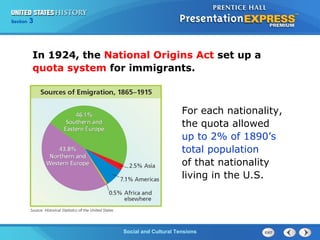
In 1924, the National Origins Act set up a
quota system for immigrants.

For each nationality,
the quota allowed
up to 2% of 1890’s
total population
of that nationality
living in the U.S.

Social and Cultural Tensions
The Cold War Begins
325

Section
Chapter

Section

1

4. Trends such as urbanization, modernism, and
increasing diversity made some people lash out
against change.
•

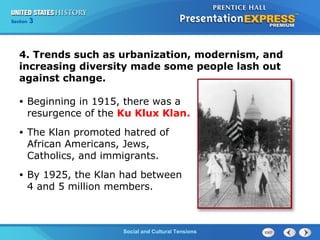
Beginning in 1915, there was a
resurgence of the Ku Klux Klan.

•

The Klan promoted hatred of
African Americans, Jews,
Catholics, and immigrants.

•

By 1925, the Klan had between
4 and 5 million members.

Social and Cultural Tensions
The Cold War Begins
325

Section
Chapter

Section

1

Others embraced the idea of racial, ethnic,
and religious diversity.

•

Many valued the idea of the United States as
a “melting pot.”

•

Groups such as the NAACP and the Jewish
Anti-Defamation League worked to counter
the Klan and its values.

By the late 1920s, many Klan leaders had been
exposed as corrupt.
Social and Cultural Tensions
The Cold War Begins
325

Section
Chapter

Section

1

Alcoholic beverages were another divisive issue.
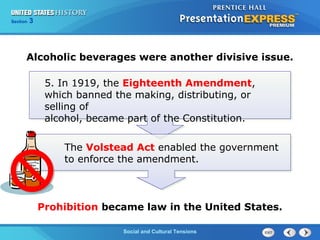
5. In 1919, the Eighteenth Amendment,
which banned the making, distributing, or
selling of
alcohol, became part of the Constitution.
The Volstead Act enabled the government
to enforce the amendment.

Prohibition became law in the United States.
Social and Cultural Tensions
The Cold War Begins
325

Section
Chapter

Section

1

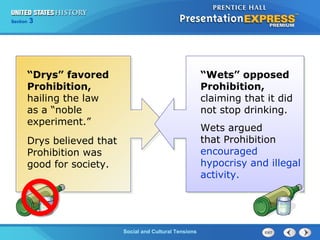
“Drys” favored
Prohibition,
hailing the law
as a “noble
experiment.”
Drys believed that
Prohibition was
good for society.

Social and Cultural Tensions
The Cold War Begins

“Wets” opposed
Prohibition,
claiming that it did
not stop drinking.
Wets argued
that Prohibition
encouraged
hypocrisy and illegal
activity.
325

Section
Chapter

Section

1

Prohibition
did not stop
people from
drinking
alcoholic
beverages.

•

A large illegal network created,
smuggled, distributed, and sold
alcohol, benefiting gangsters
such as Al Capone.

•

People bought alcohol illegally
from bootleggers and at
speakeasies.

Prohibition contributed to
the rise of organized crime.

Social and Cultural Tensions
The Cold War Begins
325

Section
Chapter

Section

1

Section Review

QuickTake Quiz

Know It, Show It Quiz

Social and Cultural Tensions
The Cold War Begins

United States History Ch. 11 Section 3 Notes

  • 1.
    325 Section Chapter Section 1 Objectives • Compare economic andcultural life in rural America to that in urban America. • Discuss changes in U.S. immigration policy in the 1920s. • Analyze the goals and motives of the Ku Klux Klan in the 1920s. • Discuss the successes and failures of the Eighteenth Amendment. Social and Cultural Tensions The Cold War Begins
  • 2.
    325 Section Chapter Section 1 Terms and People • modernism– trend that emphasized science and secular values over traditional religious ideas • fundamentalism – belief that emphasizes the Bible as literal truth • Scopes Trial – 1925 “Monkey Trial,” which challenged a law against teaching Darwin’s theory of evolution in Tennessee public schools • Clarence Darrow – defense attorney in the Scopes Trial Social and Cultural Tensions The Cold War Begins
  • 3.
    325 Section Chapter Section 1 Terms and People(continued) • quota system – a formula to determine how many immigrants could enter the U.S. annually from a given country • Ku Klux Klan – a group violently opposed to immigrants, Catholics, Jews, and African Americans • Prohibition – a ban on alcohol • Eighteenth Amendment – a 1919 Constitutional amendment that established Prohibition Social and Cultural Tensions The Cold War Begins
  • 4.
    325 Section Chapter Section 1 Terms and People(continued) • Volstead Act – a law that gave the government power to enforce the Eighteenth Amendment • bootlegger – someone who illegally sold alcohol during Prohibition Social and Cultural Tensions The Cold War Begins
  • 5.
    325 Section Chapter Section 1 How did Americansdiffer on major social and cultural issues? 1. In the 1920s, many city dwellers enjoyed a rising standard of living, while most farmers suffered through hard times. Conflicting visions for the nation’s future heightened tensions between cities and rural areas. Social and Cultural Tensions The Cold War Begins
  • 6.
    325 Section Chapter Section 1 In 1920, forthe first time, more Americans lived in cities than in rural areas. In cities, many people enjoyed prosperity and were open to social change and new ideas. Times were harder in rural areas. Rural people generally preferred traditional views of science, religion, and culture. Social and Cultural Tensions The Cold War Begins
  • 7.
    325 Section Chapter Section 1 2. An exampleof this clash of values was the tension between modernism and Christian fundamentalism in the 1920s. Modernism emphasized science and secular values. Fundamentalism emphasized religious values and taught the literal truth of the Christian Bible. Social and Cultural Tensions The Cold War Begins
  • 8.
    325 Section Chapter Section 1 Attitudes toward educationillustrate another difference between urban and rural perspectives. • Urban people saw formal education as essential to getting a good job. • In rural areas, “book learning” interfered with farm work and was less highly valued. Social and Cultural Tensions The Cold War Begins
  • 9.
    325 Section Chapter Section 1 3. Education becamea battleground for fundamentalist and modernist values in the 1925 Scopes Trial. • Tennessee made it illegal to teach evolution in public schools. • Biology teacher John Scopes challenged the law. • Defense attorney Clarence Darrow tried to use science to cast doubt on religious beliefs. Social and Cultural Tensions The Cold War Begins
  • 10.
    325 Section Chapter Section 1 The Scopes Trialillustrated a major cultural and religious division, but it did not resolve the issue. • Scopes was found guilty of teaching evolution and fined. • The conflict over teaching evolution in public schools continues today. Social and Cultural Tensions The Cold War Begins
  • 11.
    325 Section Chapter Section 1 Immigrants were atthe center of another cultural clash. Many Americans recognized the importance of immigration to U.S. history. Many Mexicans settled in the sparsely populated areas of the southwest. Nativists feared that immigrants took jobs away from native-born workers and threatened American traditions. After World War I, the Red Scare increased distrust of immigrants. Social and Cultural Tensions The Cold War Begins
  • 12.
    325 Section Chapter Section 1 In 1924, theNational Origins Act set up a quota system for immigrants. For each nationality, the quota allowed up to 2% of 1890’s total population of that nationality living in the U.S. Social and Cultural Tensions The Cold War Begins
  • 13.
    325 Section Chapter Section 1 4. Trends suchas urbanization, modernism, and increasing diversity made some people lash out against change. • Beginning in 1915, there was a resurgence of the Ku Klux Klan. • The Klan promoted hatred of African Americans, Jews, Catholics, and immigrants. • By 1925, the Klan had between 4 and 5 million members. Social and Cultural Tensions The Cold War Begins
  • 14.
    325 Section Chapter Section 1 Others embraced theidea of racial, ethnic, and religious diversity. • Many valued the idea of the United States as a “melting pot.” • Groups such as the NAACP and the Jewish Anti-Defamation League worked to counter the Klan and its values. By the late 1920s, many Klan leaders had been exposed as corrupt. Social and Cultural Tensions The Cold War Begins
  • 15.
    325 Section Chapter Section 1 Alcoholic beverages wereanother divisive issue. 5. In 1919, the Eighteenth Amendment, which banned the making, distributing, or selling of alcohol, became part of the Constitution. The Volstead Act enabled the government to enforce the amendment. Prohibition became law in the United States. Social and Cultural Tensions The Cold War Begins
  • 16.
    325 Section Chapter Section 1 “Drys” favored Prohibition, hailing thelaw as a “noble experiment.” Drys believed that Prohibition was good for society. Social and Cultural Tensions The Cold War Begins “Wets” opposed Prohibition, claiming that it did not stop drinking. Wets argued that Prohibition encouraged hypocrisy and illegal activity.
  • 17.
    325 Section Chapter Section 1 Prohibition did not stop peoplefrom drinking alcoholic beverages. • A large illegal network created, smuggled, distributed, and sold alcohol, benefiting gangsters such as Al Capone. • People bought alcohol illegally from bootleggers and at speakeasies. Prohibition contributed to the rise of organized crime. Social and Cultural Tensions The Cold War Begins
  • 18.
    325 Section Chapter Section 1 Section Review QuickTake Quiz KnowIt, Show It Quiz Social and Cultural Tensions The Cold War Begins